Published:Zorapid.Ltd
Let’s be real. If you’re a medical device startup, you’ve got enough problems without manufacturing adding to the list.
You’re burning cash every month. You need to iterate fast. You’ve got FDA deadlines breathing down your neck. And then you call a contract manufacturer, and they hit you with:
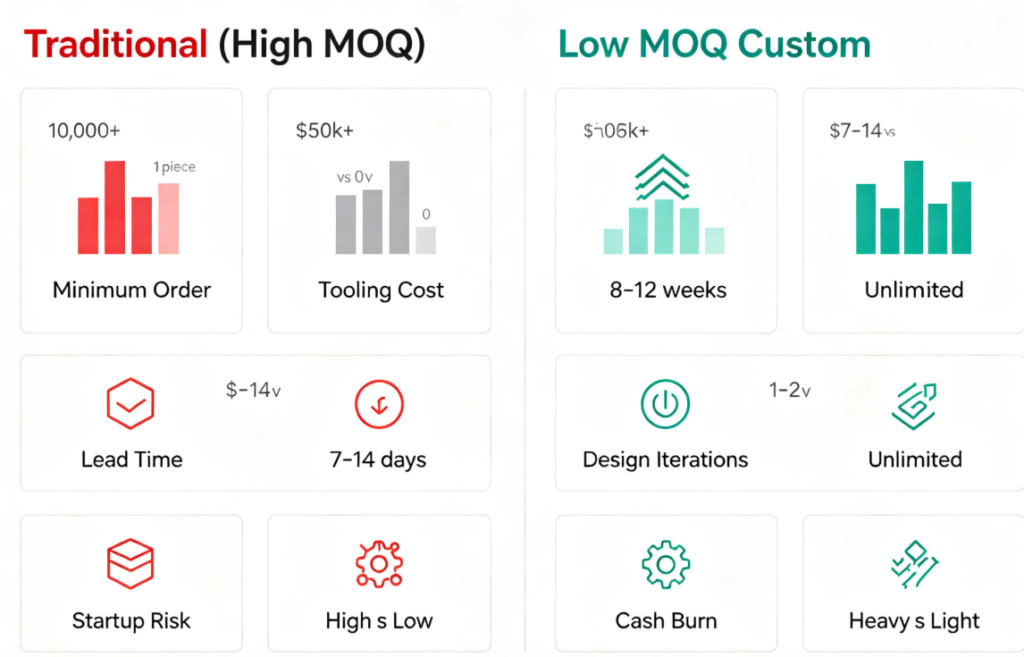
Minimum order? 10,000 pieces. Tooling? $65,000. Lead time? 12 weeks.
It’s like they don’t understand how startups work. You don’t need 10,000 parts. You need 50. Or 100. Or maybe just 1 for your first benchtop test.
The good news? You don’t have to play that game anymore. Low MOQ custom manufacturing is changing how medtech startups bring products to market. And it’s not just for prototypes anymore.
Why Traditional Manufacturing Kills Medical Innovation
Here’s the dirty secret of medical device manufacturing: the system is built for big companies, not startups.
Big OEMs order 100,000 parts at a time. They have teams of quality engineers. Can wait 3 months for tooling. They can absorb $100k setup costs without blinking.
Startups? We’re different.
The Startup Reality
- You’re burning $50k-$150k a month — every week of delay costs real money
- You need to iterate — design changes are normal, not failures
- You don’t know demand yet — ordering 10,000 parts before you’ve sold 100 is insane
- Regulatory timelines are tight — FDA doesn’t care about your manufacturing lead times
- Cash is oxygen — tying up half your runway in inventory is a death sentence
Traditional manufacturing treats all of this like it’s your problem. “That’s just how it works,” they say.
But here’s the truth: it doesn’t have to work that way.
Low MOQ Manufacturing: The Startup Superpower
Low MOQ — minimum order quantity — manufacturing is exactly what it sounds like. You can order 1 piece. Or 10. Or 500.
Here’s what changes when you don’t have to order thousands of parts:
1. You Iterate Faster (Way Faster)
In medtech, your first design is never your final design. You test, you learn, you tweak, you repeat.
With low MOQ manufacturing:
- Build 5 prototypes, test, revise, build 5 more — all in the same month
- Try 3 different design variations at once to see what works best
- Get real feedback from clinicians early, when changes are still cheap
- Shorten your development cycle by 6-12 months — easily
Traditional manufacturing? You get one shot. Order 1,000 parts, find a problem, and you’re throwing them all away and starting over. That’s expensive and slow.
2. You Preserve Cash (Your Most Important Resource)
Let’s do the math.
Traditional approach:
- Tooling: $65,000
- 10,000 parts at $8 each: $80,000
- Total upfront: $145,000
- Lead time: 12 weeks
Low MOQ approach:
- Tooling: $0
- 100 parts at $25 each: $2,500
- Total upfront: $2,500
- Lead time: 10 days
That’s $142,500 you keep in the bank. Money you can spend on engineers, clinical trials, FDA consultants, sales — things that actually move your business forward.
3. You De-Risk Everything
What if your design doesn’t work? What if the market isn’t as big as you thought?
With low MOQ manufacturing, none of these are existential threats. You build small batches, test the market, and scale when you’re ready.
No more betting the company on a single production run.
Is This Real Medical-Grade Manufacturing?
Great question. Because cheap and fast doesn’t matter if the parts don’t pass FDA inspection.
Here’s the thing about low MOQ manufacturing: it’s not just CNC machining and 3D printing (though those are part of it). It’s about doing medical-grade quality at any volume.
What Medical-Grade Actually Means
For medical devices, “good enough” isn’t good enough. You need:
- ISO 13485 certification — the medical device quality standard
- Full material traceability — every part back to the exact melt lot
- Validated processes — consistent results, every time
- Cleanroom manufacturing — for parts that touch patients
- Inspection documentation — CMM reports, material certs, the whole package
- Biocompatibility — materials that meet ISO 10993
A lot of low MOQ shops skip all this. They’ll machine you a part fast, but good luck getting it through FDA.
That’s where we’re different. We do all of the above — for 1 piece or 10,000.
How We Pull It Off
It’s not magic. It’s just investing in the right systems:
1. Digital Process Control
- Every job has a digital work instruction packet
- Tool paths are validated and stored digitally
- Operators check off every step in our QMS system
- No paper, no mistakes, full traceability
2. Flexible Production Cells
- CNC machines set up for quick changeovers (under 30 minutes)
- 3D printers for prototypes and low-volume complex parts
- Swiss-type lathes for small, precision components
- Dedicated medical cell with separate tooling
3. Quality Built In, Not Inspected In
- In-process gauging on critical dimensions
- SPC charting on key features
- 100% inspection for Class II/III devices
- CMM reports with every shipment
The result? Medical-grade quality, startup-friendly quantities.
Materials We Work With
Medical devices use specific materials for a reason. Here are the most common ones, and when to use them.
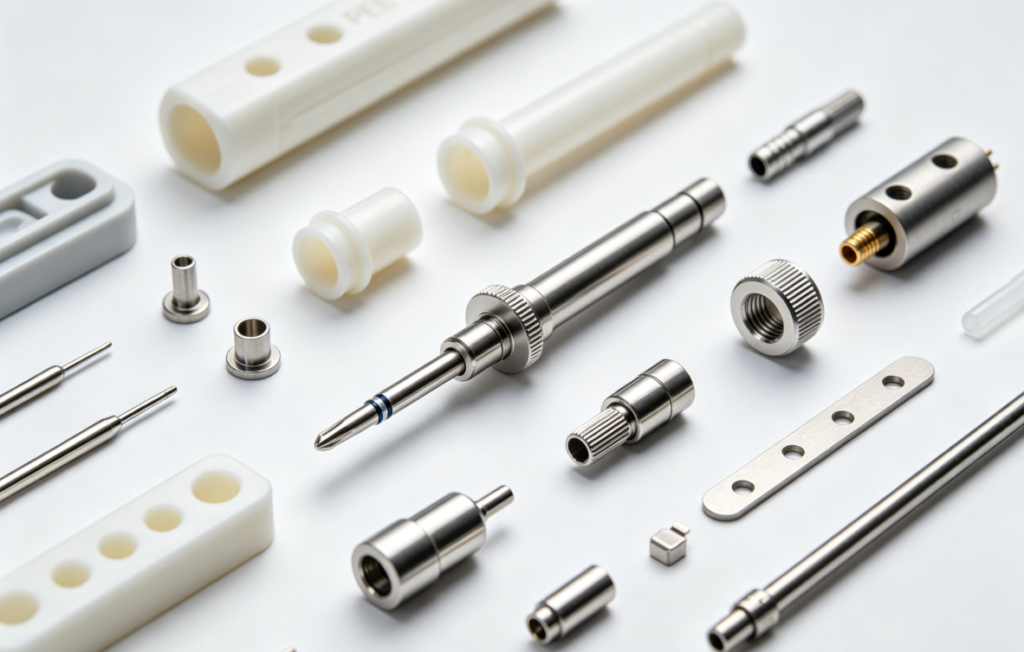
PEEK (Polyether Ether Ketone)
- Biocompatible — ISO 10993 certified
- Strong and light — better strength-to-weight than many metals
- Radiolucent — doesn’t show up on X-rays (great for surgical instruments)
- Chemical resistant — stands up to sterilization
- Great for: surgical instruments, implantable devices, dental components
Titanium (Ti-6Al-4V ELI)
- The gold standard for implants — osseointegrates with bone
- Excellent biocompatibility
- High strength-to-weight ratio
- Corrosion resistant in body fluids
- Great for: orthopedic implants, dental implants, surgical tools
Stainless Steel (316L, 17-4PH)
- Proven track record in medical devices
- Good strength and corrosion resistance
- Cost-effective compared to titanium
- Magnetic options (17-4) or non-magnetic (316L)
- Great for: surgical instruments, device housings, fasteners
Medical-Grade Polymers
- PEEK, POM, PTFE, HDPE, UHMWPE
- Each has specific properties for different applications
- Great for: housing components, insulators, bearing surfaces, disposable parts
Not sure which material is right for your device? We’ll help you figure it out. Free DFM review with every quote.
Real-World Case Study: From Prototype to 510(k) in 9 Months
A surgical device startup came to us with a problem. They had a great idea for a minimally invasive surgical tool, but their previous manufacturer was killing them.
Their situation:
- Series A funded, 8-person team
- Previous supplier: 8-week lead times, $50k tooling, 5,000 piece MOQ
- FDA 510(k) deadline in 9 months
- Needed to build 3 design iterations + 200 units for clinical validation
Here’s how we helped:
1: Design Iteration
- Reviewed their design, suggested 7 DFM improvements
- Built 5 units of Revision A — 10 days
- Tested, revised, built 5 units of Revision B — another 10 days
- Tested, revised, locked Revision C — final design
2-3: Validation Build
- Built 50 units for design verification testing
- Full inspection documentation
- Material certs and process validation packages
- All passed on first try
4-6: Clinical Units
- Built 200 units for clinical trials
- Cleanroom assembly and packaging
- Sterilization-ready
- Full DHF (Device History File) documentation
Month 7-9: 510(k) Submission
- Provided all manufacturing documentation for FDA submission
- Supported quality system audits
- Zero FDA questions about manufacturing
The results?
- 9 months from first prototype to 510(k) submission (industry average is 18-24 months)
- $12,000 total manufacturing cost (vs. $150k+ with traditional)
- 3 design iterations before locking the design
- Zero manufacturing-related FDA questions during review
They got their 510(k) clearance 4 months ahead of schedule. And they still had 70% of their Series A funding in the bank.
That’s the power of low MOQ medical manufacturing.
The Startup Roadmap: Manufacturing at Every Stage
Every startup is different, but here’s a rough guide for what you need at each stage.
1: Proof of Concept (0-3 months)
- Quantity: 1-5 pieces
- Goal: Does it even work?
- Process: CNC machining, 3D printing
- Quality focus: Fit, form, basic function
- Documentation: Basic material certs
2: Design Verification (3-9 months)
- Quantity: 10-50 pieces
- Goal: Test performance, iterate design
- Process: CNC, Swiss turning, EDM, 3D printing
- Quality focus: Dimensional accuracy, material properties
- Documentation: Full inspection reports, material traceability
3: Clinical Trials (6-18 months)
- Quantity: 50-500 pieces
- Goal: Clinical validation, regulatory submission
- Process: Production-intent processes
- Quality focus: Full medical-grade quality, process validation
- Documentation: DHF, DMR, full traceability, ISO 13485
4: Commercial Launch (12-24 months)
- Quantity: 500-5,000 pieces/month
- Goal: Scale with demand
- Process: Optimized production, some tooling where it makes sense
- Quality focus: Consistent production, Cpk > 1.33
- Documentation: Full QMS, ongoing validation
The best part? You can move through these stages without switching manufacturers. We grow with you.
The Zorapid Medical Manufacturing Difference
Lots of shops say they do medical. Few actually have the systems and certifications to back it up.
Here’s what you get with us:
ISO 13485:2016 Certified
We’re audited annually. Our quality system is built for medical devices, not just “we try to be careful.”
Full Material Traceability
Every part comes with a complete chain of custody — from raw material melt lot to final inspection. FDA loves this.
Class 100,000 Cleanroom
For parts that need it, we have a dedicated cleanroom for assembly and packaging.
DFM Expertise
We don’t just make what you send us. We help you design for manufacturability — saving you time and money before you cut a single part.
Startup-Friendly
We get it. You’re small. You’re fast. You need flexibility. We don’t treat you like a second-class customer because you’re not ordering 100k parts.
Regulatory Support
Need documentation for FDA? We know what they want. We provide complete DHF/DMR packages that pass inspection every time.
FAQ
What’s your minimum order quantity?
One. Seriously. We do everything from single prototypes to production runs of 10,000+ pieces. No order is too small. Pricing gets better at volume, but we’re happy to quote 1 piece if that’s what you need for testing.
Are you ISO 13485 certified?
Yes, ISO 13485:2016 certified. We’re audited annually by a third-party registrar. We can provide our certificate and scope with your quote. We also maintain ISO 9001 and IATF 16949 for other industries.
Do you provide material traceability?
Absolutely. Every medical-grade order comes with full material traceability — mill test reports, heat/melt lot numbers, and complete chain of custody. We keep records for the life of the device, per FDA requirements.
What’s the typical lead time?
Prototypes: 5-10 business days. Small production runs (10-100 pieces): 10-15 days. Larger runs: 2-3 weeks. We also offer expedite options for urgent projects — we’ve turned around simple parts in 48 hours before.
Can you help with design for manufacturability (DFM)?
That’s one of our favorite things to do. Every quote includes a free DFM review. Our engineers will look at your design and suggest changes that reduce cost, improve quality, and speed up production. We want you to succeed — good designs make both of us look good.
What materials do you work with?
All the common medical materials. Metals: Ti-6Al-4V ELI, 316L stainless, 17-4PH, cobalt chrome. Polymers: PEEK (medical grade), POM, PTFE, UHMWPE, HDPE. Ceramics: alumina, zirconia. Need something specific? Just ask.
Do you have cleanroom capabilities?
Yes, we have a Class 100,000 (ISO 8) cleanroom for assembly, packaging, and critical operations. For higher classes, we work with certified partner cleanrooms. All cleanroom work follows documented procedures and environmental monitoring.
Can you support FDA 510(k) submissions?
Yes, we provide all the manufacturing documentation you need for FDA submissions — process validation, material certs, inspection methods, quality system documentation, etc. We’ve supported dozens of 510(k) submissions with zero manufacturing-related questions from FDA.
Do you do assembly, or just parts?
Both. We can make individual components, or we can assemble complete sub-assemblies or even full devices. We do mechanical assembly, adhesive bonding, laser marking, cleanroom packaging — whatever you need.
How do you handle design changes?
Easily — that’s the whole point of low MOQ manufacturing. Send us the new CAD file, and we’ll update the quote and timeline. No expensive tooling changes, no minimum change fees. We’re set up for iteration.
What about biocompatibility testing?
We work with certified testing labs and can coordinate biocompatibility testing (ISO 10993) for your parts. We’ll provide the test articles, handle the logistics, and deliver the test report. One less thing for you to manage.
How do I get started?
Send us your CAD files and specs. Tell us what stage you’re at (prototype, clinical, production) and any regulatory requirements. We’ll get back to you with a quote, DFM feedback, and lead time within 48 hours. No obligation, no sales pitch — just engineering.
Ready to Stop Wasting Time and Money?
If you’re a medical device startup who’s tired of:
- Manufacturers who treat you like you’re too small
- Paying $50k for tooling before you’ve even validated your design
- Waiting 12 weeks for parts you need next week
- Getting “that’s just how it works” as an answer
Then let’s talk.
Low MOQ medical manufacturing isn’t some distant future. It’s what the smartest startups are using right now to get to market faster, cheaper, and with better products.
Send us your drawings today. We’ll review them, give you honest DFM feedback, and send a real quote with a real timeline.
No fluff. No runaround. Just medical-grade parts, delivered fast, at quantities that make sense for startups.
Zorapid — Medical Device Manufacturing for Startups
ISO 13485:2016 | ISO 9001:2015 | Full Material Traceability | Cleanroom Capable
3000㎡ Smart Manufacturing Center | Zhongshan, Guangdong