Published:Zorapid.Ltd
Let’s keep it real. Every mechanical engineer, product designer, and manufacturing lead has made this mistake at least once.
You lock in a manufacturing method too early. You sink budget into expensive molds, or waste weeks printing high-volume parts, or machine thousands of units when molding would’ve cut your per-unit cost in half. The result? Delayed launches, blown budgets, weak part performance, or scrapped prototypes.
The three workhorses of modern manufacturing — CNC machining, injection molding, and additive 3D printing — each have clear sweet spots. Seasoned engineers don’t guess. They run through a simple checklist every single time before quoting or kicking off production.
This no-jargon guide breaks down exactly how they decide. We’ll skip textbook fluff, focus on real shop-floor logic, and give you a reusable decision framework you can drop straight into your next part design project.
Quick 1-Minute Overview Of Each Manufacturing Method
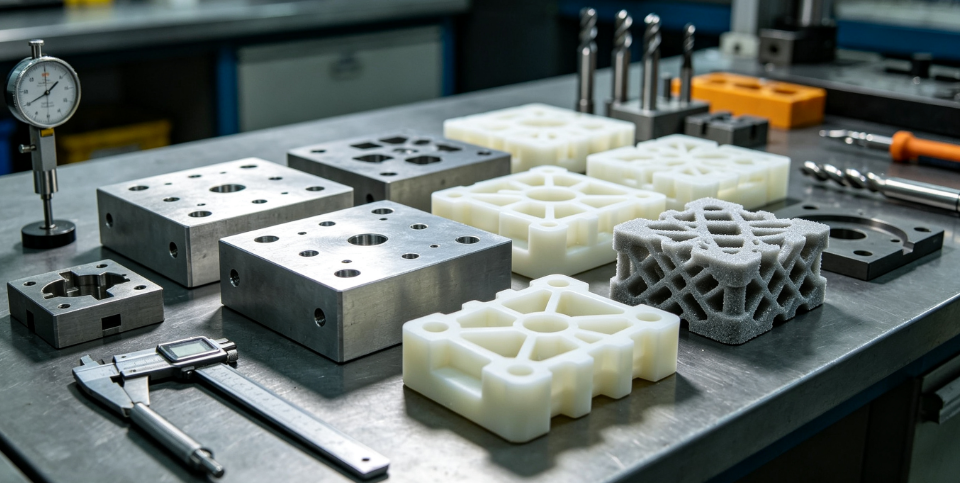
Before we dive into decision rules, let’s recap each process in plain engineer talk. No fancy academic lingo.
1. CNC Machining (Subtractive Manufacturing)
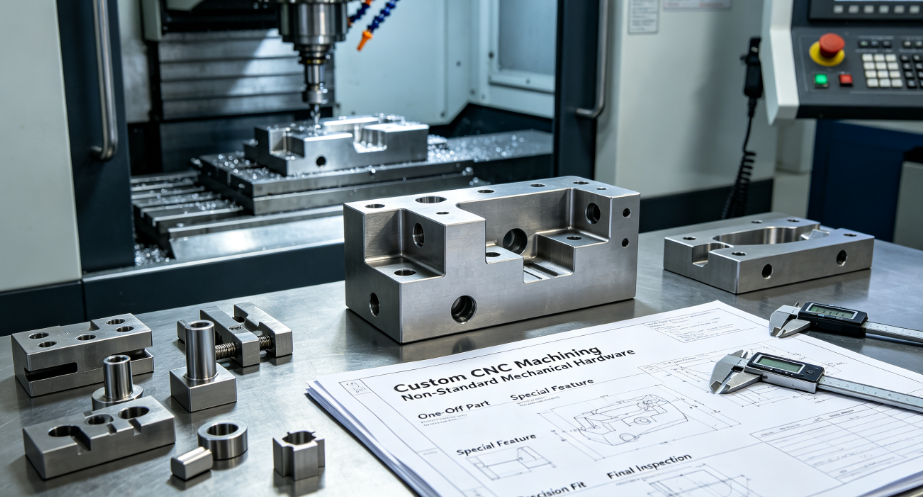
We start with a solid block of raw material (aluminum, steel, PEEK, ABS, brass). CNC cutters carve away material to match your CAD file.
- No tooling/molds needed upfront
- Works with nearly every metal & engineering plastic
- Ultra tight tolerances, mirror-smooth surface finishes
- Best for low to medium runs, high-precision functional parts
2. Injection Molding (Formative Manufacturing)
Molten plastic gets forced under high pressure into a custom machined steel mold. Once the mold is built, thousands of identical parts pop out fast.
- Huge upfront mold cost, tiny per-unit cost at scale
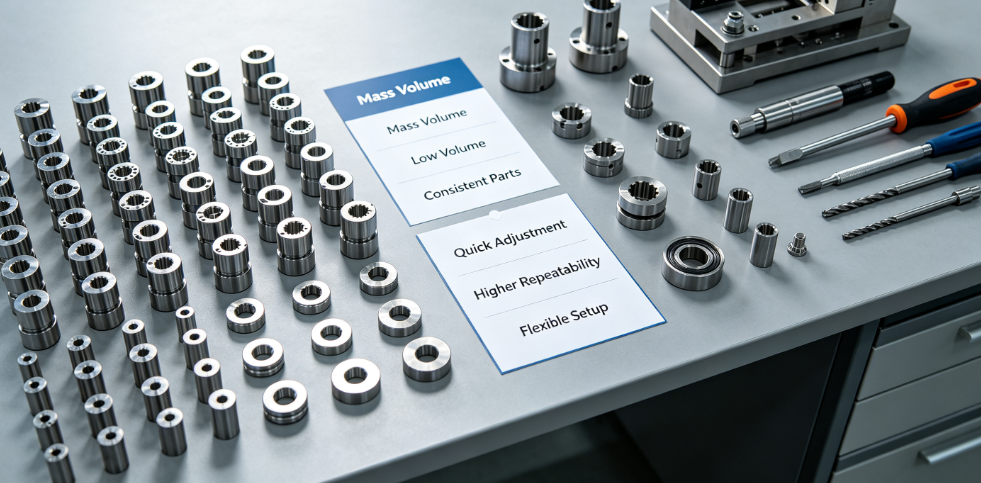
- Consistent, repeatable identical parts for mass market
- Design rules apply (draft angles, uniform wall thickness)
- Only worth it for hundreds to millions of units
3. Additive 3D Printing (Additive Manufacturing)
The printer builds your part layer by layer from powder or resin, no cutting, no molds.
- Zero tooling cost, print 1 custom part overnight
- Supports impossible geometries: lattices, internal cooling channels, hollow integrated structures
- Limited material options vs machining
- Higher per-unit price for large batches
Core Decision Rules Engineers Follow (5 Key Factors)
Engineers rank these 5 criteria in order of priority when choosing a process. Start with volume — it eliminates 1–2 options instantly.
Factor 1: Production Volume (The #1 Decider)
Volume is the biggest cost driver, full stop. Industry standard break-even thresholds every manufacturing team memorizes:
- 1–20 parts: Additive 3D Printing wins No mold fees, no CNC setup rework for one-off prototypes, custom fixtures, test samples. Turnaround in 1–3 days.
- 20–1,000 parts: CNC Machining takes the lead Avoids expensive mold fabrication. Delivers stronger, higher-tolerance functional prototypes and small production batches without long lead times for tooling.
- 1,000+ parts: Injection Molding becomes cost-effective The steep upfront mold investment amortizes across thousands of units. Per-part cost drops drastically at scale. For runs over 10,000, molding is almost always non-negotiable.
Quick engineer hack: If your demand forecast might jump later, prototype with CNC or additive first. Validate your design before sinking money into steel molds. Reworking molds costs 2–10x more than tweaking a CAD file for machining/printing.
Factor 2: Part Complexity & Internal Geometry
Look at your CAD’s hidden features: internal channels, organic lattices, undercuts, integrated assemblies, hollow lightweight structures.
- Ultra-complex internal features: Additive printing only. CNC tools can’t reach trapped internal cavities, and molds require expensive side actions for deep undercuts.
- Simple solid blocks, flat surfaces, straight holes: CNC machining fastest & cheapest.
- Uniform thin-wall plastic enclosures, consistent clip features: Injection molding optimized for repetitive simple-to-medium plastic geometries.
Factor 3: Precision, Tolerances & Surface Finish
When your spec sheet calls for tight dimensional control, this rule separates the three processes clearly:
- CNC Machining = Best precision overall Tolerances down to ±0.005 mm, polished, anodized, bead-blasted finishes available for metals and plastics. Critical for aerospace, medical, sensor hardware.
- Injection Molding = Excellent repeatable precision for plastics Consistent tolerances across millions of identical plastic parts, smooth as-molded surfaces without secondary polishing. Limited metal options.
- Additive Printing = Lowest baseline precision Layer lines require post-processing for smooth finishes. Standard tolerances looser than CNC/molding unless you invest in high-end metal SLM printing with secondary machining finishing.
Factor 4: Material Selection & Mechanical Strength
Every project has load, heat, chemical resistance requirements that eliminate manufacturing options right away:
- Wide metal alloy range (titanium, stainless, copper, aluminum) + high-performance plastics (PEEK, ULTEM): CNC machining is your only flexible pick.
- Mass plastic consumer goods (PP, ABS, PC, TPU): Injection molding dominates. Standardized plastic pellets optimized for molding cycles.
- Custom lightweight alloys, specialty resins, one-off biocompatible materials: Additive printing carries niche material options, but far fewer than CNC.
Strength note: CNC and molded parts deliver full bulk material density. Standard 3D printed parts have minor layer weakness unless heat-treated post-print. For load-bearing structural components, engineers default to CNC or molding first.
Factor 5: Lead Time & Upfront Budget
Time-to-market and cash flow often override theoretical cost savings:
- Fastest turnaround (1–4 days): Additive printing (no tooling)
- Medium lead time (3–10 days): CNC machining (simple setup, no mold build)
- Slowest initial lead time (4–8 weeks): Injection molding (mold CNC machining, testing, revisions)
Budget split:
- Low upfront cost: Additive, CNC
- High upfront capital cost: Injection molding (mold fabrication)
CNC Machining: When Engineers Reach For Subtractive Manufacturing
Core Use Cases Engineers Pick CNC
- Functional prototypes that need production-grade material strength
- Low/medium batch custom metal hardware (fixtures, jigs, robotics components)
- Medical, aerospace, semiconductor parts requiring ultra-tight tolerances
- Mixed metal/plastic assemblies with complex machined cutouts, threads, bores
- Post-processing finish for rough 3D printed blanks (precision secondary machining)
CNC Pros Engineers Love
- Unlimited material library (all metals, engineering plastics, composites)
- Superior dimensional accuracy & surface quality
- No minimum order quantity, flexible design edits mid-run
- Fully dense, uniform mechanical performance
CNC Cons To Plan For
- Higher per-unit cost vs molding for volumes over 1,000
- Material waste from subtractive cutting
- Very complex internal geometries are impractical or costly to machine
Injection Molding: The Go-To For Mass Production
Core Use Cases Engineers Pick Molding
- Consumer electronics housings, appliance plastic components
- Disposable medical plastic parts, automotive interior trim
- Any product with forecasted runs of 1,000+ identical units
- Parts requiring consistent cosmetic finishes for retail sales
Molding Pros Engineers Love
- Near-zero per-unit cost at high volume
- Perfect repeatability across millions of parts
- Automated fast cycle times for mass throughput
- Built-in options for textures, color matching, overmolding
Molding Cons To Plan For
- Massive upfront mold tooling expense
- Long lead time for mold design, machining, validation
- Strict design limitations (draft angles, wall thickness, undercut costs)
- Costly design changes after mold fabrication
Additive 3D Printing: Perfect For Wild, Custom, Low-Run Parts
Core Use Cases Engineers Pick Additive Printing
- Early-stage concept prototypes, proof-of-concept models
- One-off custom fixtures, jigs, replacement spare parts
- Topology-optimized lightweight aerospace parts with lattices
- Components with trapped internal cooling channels impossible to machine/mold
- Low-volume custom medical implants, custom lab equipment
Additive Pros Engineers Love
- Zero tooling cost, instant production from CAD files
- Zero design restrictions for complex organic geometries
- Fast same-week turnaround for single samples
- Minimal material waste compared to CNC subtractive methods
Additive Cons To Plan For
- Highest per-unit price for medium/large batches
- Narrower material portfolio vs CNC
- Layer lines require post-processing for smooth surfaces
- Lower raw tensile strength without heat treatment
Side-by-Side Comparison Cheat Sheet (Engineer Quick Scan)
| Evaluation Metric | CNC Machining | Injection Molding | Additive 3D Printing |
|---|---|---|---|
| Best Volume Range | 10–1,000 units | 1,000+ mass runs | 1–20 prototypes |
| Upfront Tool Cost | None | Very high | None |
| Per-Part Cost (High Volume) | Medium | Very low | Very high |
| Tolerance Accuracy | Best (±0.005mm) | Excellent plastic | Standard loose tolerance |
| Complex Internal Geometry | Limited | Restricted by mold design | Unlimited |
| Material Options | All metals + high-end plastics | Thermoplastics only | Limited specialty resins/metals |
| Standard Lead Time | 3–10 days | 4–8 weeks (mold build) | 1–4 days |
| Surface Finish Baseline | Smooth, polishable | Clean as-molded | Layer lines (post-finish required) |
Real-World Project Examples To Copy
Example 1: Robotics Sensor Bracket (50 Units, Aluminum, Tight Thread Tolerances)
Engineer’s pick: CNC Machining
Why? Medium volume, metal material, critical threaded bores demand tight tolerances. Molding would require expensive aluminum molds, additive can’t hit thread spec without secondary machining.
Example 2: Consumer Bluetooth Speaker Shell (50,000 Units, ABS Plastic)
Engineer’s pick: Injection Molding
Why? Mass volume, simple plastic enclosure geometry. Upfront mold cost amortizes over 50k units, per-piece cost drops to pennies. Prototypes first printed via additive for fit testing.
Example 3: Custom Aerospace Heat Exchanger (3 Units, Internal Lattice Cooling Channels)
Engineer’s pick: Metal SLM Additive Printing
Why? Internal flow channels cannot be milled or molded. Only additive manufacturing delivers the integrated lightweight lattice design the thermal team requires.
FAQ
What’s the break-even quantity where molding beats CNC?
Typically 500–1,000 identical plastic parts. Below that, CNC avoids mold tooling fees and faster lead times win out. Metal molding die costs push break-even far higher, so metal mass parts almost always use CNC for medium runs.
Can I mix processes for one project?
Absolutely — engineers do this daily. Common workflow:
- Additive print rapid prototypes for fit/function testing
- CNC machine small pre-production batches for lab validation
- Lock design, build injection molds for full mass launch Zorapid offers all three processes under one roof to streamline this hybrid workflow.
Is 3D printing going to replace CNC or molding long-term?
No. Each process fills a unique manufacturing niche. Additive excels at custom complex low-runs, CNC dominates precision metal hardware, molding remains the cheapest scalable mass-production solution for consumer goods. Most industrial teams maintain all three in their supply chain.
If I need tight tolerances but complex geometry, what’s the workaround?
Hybrid manufacturing: 3D print near-net shape blanks, then CNC machine critical surfaces and holes to hit tight tolerance specs. Zorapid regularly delivers this combined service for aerospace and medical clients.
How do I cut down lead time when switching between processes?
Standardize CAD design rules compatible across all three manufacturing methods upfront. Avoid extreme undercuts, uneven wall thickness, and impossible internal features unless you plan to print the part. Our engineering team at Zorapid reviews CAD files free for manufacturability feedback.
Wrap-Up
Choosing between machining, molding, and additive doesn’t need to be a guessing game. The core rule set we covered today eliminates nearly all uncertainty before you request a quote.
But every project has edge cases: tight budgets, compressed launch timelines, mixed material requirements, or hybrid part designs that blur process lines. That’s where Zorapid’s end-to-end manufacturing support steps in.
As a full-service rapid manufacturing supplier, Zorapid delivers CNC machining, injection molding, and industrial additive printing under one facility. Our in-house mechanical engineers review your CAD, run volume-cost projections, and recommend the most cost-efficient, fastest production process tailored exactly to your specs — no biased push for one service over another.
Next Step For Your Engineering Team
Send over your 3D CAD files and project requirements (volume, material, tolerance, deadline) for a free DFM analysis and multi-process quote comparison. We’ll map out machining, molding, and additive pricing side-by-side so you can make data-backed manufacturing decisions without wasting time or budget.