Published:Zorapid.Ltd
If you design medical implants, surgical tool components, wafer chucks, or semiconductor probe fixtures, you’ve almost certainly hit a wall with standard 3-axis CNC machines.
3-axis mills only move along X, Y, Z linear axes. To machine angled surfaces, curved contours, or hidden undercut features, operators have to stop production, re-clamp the part, re-indicate zero points, and restart cutting. Every new setup adds tiny alignment errors that stack up.
For generic mechanical brackets, minor tolerance drift is acceptable. But for medical and semiconductor hardware? Even a 0.002 mm deviation can ruin patient safety or trigger massive wafer yield loss in cleanroom fabs.
That’s why every serious medical device OEM and semiconductor equipment manufacturer relies on 5-axis machining. This plain-language guide breaks down exactly why 5-axis is no longer a nice-to-have upgrade — it’s an essential manufacturing requirement for regulated, ultra-precise components.
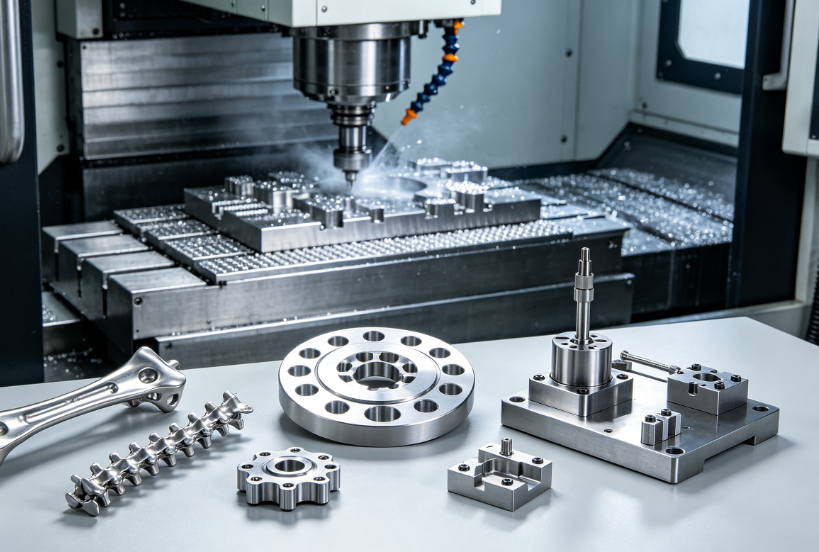
What Makes Medical & Semiconductor Components Unique?
Before diving into 5-axis benefits, let’s recap the strict shared demands of these two industries that rule out basic 3-axis machining:
Medical Part Standards
- Biocompatible materials: Titanium, PEEK, stainless steel, cobalt chrome
- Complex organic contours for implants, bone plates, surgical instrument handles
- Thin fragile walls, deep angled cavities, multi-angle threaded holes
- Ultra-smooth burr-free surfaces to avoid tissue irritation
- Strict FDA traceability and tight repeatable dimensional tolerances
- No secondary clamping marks that compromise sterility
Semiconductor Part Standards
- Ultra-flat wafer stages with micro vacuum channels and angled alignment pockets
- Non-magnetic, low-particle cleanroom-grade surfaces
- Tight positional tolerances down to ±0.001 mm
- Curved cooling manifolds and hidden fluid distribution channels
- Large flat plates with multi-sided angled features impossible to reach from one plane
- Zero surface scratches or micro burrs that contaminate silicon wafers
3-axis machining cannot reliably hit all these specs without risky, error-prone multiple re-fixturing. 5-axis solves all these pain points in one unified operation.
5 Core Reasons 5-Axis Machining Is Non-Negotiable
Single Setup Eliminates Stacked Tolerance Drift
This is the biggest advantage for regulated medical and semiconductor manufacturing.
3-axis machining requires multiple re-clamps to machine all sides of a component. Each time you unload, reposition, and re-zero a workpiece, you introduce small alignment offsets called stacked tolerances. Over 3–5 setups, those errors compound and blow your print specs.
5-axis machines rotate both the cutting spindle and the workpiece table around two additional rotational axes (A and C). Engineers clamp the blank once, and the machine tilts/rotates the part to reach every surface, angle, cavity, and hole without re-fixturing.
- No repeated zero-point calibration errors
- Tolerance accuracy stays consistent across the entire part
- Critical mating features align perfectly without manual adjustment Ideal for: Spinal implants, 300mm wafer chucks, surgical probe holders
Access Deep, Complex Undercuts & Micro Internal Geometry
Medical and semiconductor parts are packed with hard-to-reach features:
- Curved implant cavities for bone integration
- Angled micro vacuum grooves inside wafer carrier plates
- Recessed cooling channels for thermal processing stages
- Slanted threaded bores on surgical tool handles
On a 3-axis mill, reaching these deep angled features demands extra-long, fragile extended cutting tools. Long tools vibrate, bend, and leave rough uneven surfaces — catastrophic for biocompatible and cleanroom parts.
5-axis tilts the workpiece so short, rigid standard cutting tools stay perpendicular to every cutting surface. Shorter tools deliver stiffer, more stable cuts with zero chatter, even inside deep narrow cavities.
Superior Surface Finish for Cleanroom & Biocompatible Parts
Surface quality isn’t just cosmetic here — it’s functional safety.
- Medical implants need mirror-smooth finishes to prevent inflammation and bacterial growth
- Wafer contact surfaces require ultra-low Ra roughness to avoid scratching delicate silicon substrates
With 3-axis, long tool overhang creates vibration lines and uneven tool marks that require hours of manual polishing and deburring. Extra handwork risks micro scratches and inconsistent texture across batches.
5-axis shortens tool projection and lets the cutter maintain constant light contact with every contour. As-machined surface roughness is drastically smoother, cutting post-processing time by 40% or more. For medical and semiconductor parts, this minimizes contamination risks and reduces manual handling steps.
Faster Cycles & Lower Risk of Thin-Wall Deformation
Many critical components feature ultra-thin walls: PEEK medical implants, lightweight titanium bone plates, thin wafer chuck carrier frames.
3-axis machining uses heavy, deep vertical cuts that push hard against thin material walls, causing bending, warpage, or dimensional shift mid-process.
5-axis enables optimized trochoidal milling and angled light-depth cuts. The cutting force distributes evenly across the part instead of straight vertical pressure. Thin walls hold their geometry perfectly with zero deflection.
Bonus productivity win: Single-setup cutting slashes total machining time compared to repeated 3-axis re-clamping cycles, speeding up prototype and production lead times.
Consistent Repeatability for Regulated Batch Production
Medical devices and semiconductor equipment fall under strict compliance rules: FDA, ISO 13485, SEMI cleanroom standards. Auditors demand fully repeatable, traceable part dimensions across every batch.
3-axis multi-setup workflows rely heavily on operator skill. Human error during re-clamping creates dimensional variation between parts in the same run — a compliance failure risk.
5-axis programming locks all rotational angles and cutting paths into a single digital toolpath. Once the program is validated, every part from the first prototype to the 1,000th production unit matches exactly. Zorapid stores all certified 5-axis programs for reorders, guaranteeing identical parts year after year.
Real-World 5-Axis Use Cases (Medical + Semiconductor)
Medical Example: Custom Titanium Spinal Fusion Cage
Design requirements: Complex porous outer contour, angled bone graft cavities, cross-threaded fixation holes, biocompatible smooth finish, ±0.003 mm tolerance.
3-axis limitation: 4 separate clamping setups would stack alignment errors and risk wall deformation during deep cavity cutting.
5-axis solution: Single clamp completes all curved contours, angled bores and internal channels in one run. No manual repositioning, uniform surface finish, passes full biocompatibility inspection on first batch.
Semiconductor Example: 200mm Wafer Probe Station Chuck
Design requirements: Full-plate flatness ≤0.002 mm, multi-angle micro alignment pockets, recessed cooling channels, particle-free electropolished surface.
3-axis limitation: Repeated flipping of the large aluminum plate warps flatness and creates visible clamping marks on the wafer contact zone.
5-axis solution: One-time blank mounting machines top, bottom, and all angled side features without unclamping. Full flatness is preserved, zero surface indentations, ready for cleanroom finishing immediately after machining.
3-Axis vs 5-Axis Side-by-Side Comparison Chart
| Evaluation Metric | Standard 3-Axis CNC | 5-Axis CNC Machining |
|---|---|---|
| Number of Part Setups | 3–6 re-clamps for multi-angle features | 1 single setup |
| Tolerance Risk | High stacked alignment drift | Minimal, consistent micron accuracy |
| Tool Length Required | Long overhang tools (vibration risk) | Short rigid cutters only |
| Thin Wall Stability | High risk of bending/warpage | Low deformation, even ultra-thin geometry |
| Surface Roughness Baseline | Visible chatter lines, heavy post-polish needed | Smooth as-machined, less secondary finishing |
| Complex Undercuts & Angled Channels | Very limited, costly to machine | Fully accessible without compromise |
| Batch Repeatability | Operator-dependent dimensional variation | Digitally locked, identical parts every run |
| Ideal Application | Simple flat brackets, low-tolerance general hardware | Medical implants, surgical parts, wafer fixtures, semiconductor stages |
Zorapid’s 5-Axis Workflow for Medical & Semiconductor Hardware
We built our dedicated 5-axis machining cell exclusively for regulated precision critical parts, with a full end-to-end process tailored to medical and semiconductor standards:
- Specialized DFM Analysis Our engineers flag thin-wall risk, angled feature accessibility, and tolerance stacking issues before cutting. We adjust designs to maximize 5-axis efficiency while meeting biocompatible / cleanroom specs.
- Temperature-Stabilized 5-Axis Machining Granite-base 5-axis centers with constant temperature control eliminate thermal expansion drift for micron-level accuracy. Single-setup cutting for all complex contours.
- Burr-Free Precision Deburring Ultrasonic and micro abrasive flow finishing removes micro slivers without damaging delicate medical surfaces or wafer contact planes.
- Regulated Industry Finishing Biocompatible passivation, electropolishing, medical-grade anodizing, cleanroom low-particle coatings — all calibrated to preserve 5-axis machined tolerances.
- Full Compliance QA Inspection CMM full-part scanning, surface roughness testing, coating thickness verification, and certified inspection reports for FDA / SEMI audit trails.
FAQ
Is 5-axis only for complex curved parts?
No. Even flat wafer plates with angled side pockets or simple implants with cross-drilled holes benefit from single-setup 5-axis cutting to avoid tolerance stacking. Many clients switch to 5-axis purely for repeatability, not just complex geometry.
Does 5-axis machining cost significantly more than 3-axis?
For multi-feature medical and semiconductor parts, total project cost often drops with 5-axis. Fewer setups, less post-processing, zero scrap from tolerance failure offset the machine hourly rate difference. We provide transparent side-by-side 3-axis vs 5-axis quotes for every project.
Can Zorapid’s 5-axis handle both medical-grade titanium and semiconductor aluminum?
Yes. Our 5-axis lines run all biocompatible metals (titanium, cobalt chrome, 316L stainless), engineering plastics (PEEK, ULTEM), and cleanroom aluminum alloys used for wafer processing hardware.
Are 5-axis lead times longer than standard CNC?
For complex multi-sided parts, 5-axis lead times are shorter. Single-setup cutting eliminates hours of manual re-clamping work that slows down 3-axis production. Standard prototype turnaround: 5–9 business days including DFM, machining, finishing and full inspection.
Do you offer traceability documentation for medical device compliance?
Absolutely. We provide full material certifications, CMM inspection reports, batch process logs, and finishing compliance records required for ISO 13485 and FDA device audits.
Final Wrap-Up
Medical and semiconductor components carry zero room for manufacturing error. Patient safety, fab yield, and regulatory compliance all hinge on consistent, ultra-tight dimensional accuracy — something standard 3-axis machining cannot reliably deliver.
5-axis machining solves the core pain points of multi-setup alignment drift, unstable long cutting tools, thin-wall deformation, and inconsistent surface quality. It’s not an optional upgrade; it’s the baseline standard for high-performance critical hardware.
At Zorapid, our dedicated 5-axis manufacturing cell combines semiconductor and medical industry process expertise, in-house finishing, and full compliance QA under one roof. We eliminate scrap, shorten lead times, and deliver fully validated parts ready for cleanroom assembly or clinical testing.
Request Your Free DFM Review & 5-Axis Quote
Share your CAD files, tolerance prints, and industry compliance requirements. Our precision engineering team will run a full manufacturability analysis, compare 3-axis vs 5-axis cost and lead time projections, and deliver a transparent all-in quote.