Published:Zorapid.Ltd
If you design surgical probes, orthopedic micro pins, catheter guidewires, endoscopic shafts or implant fastener cores, you know the core manufacturing headache: tiny, long-slender shafts warp, chatter, and drift out of tolerance on every standard CNC lathe.
Conventional lathes grip bar stock in a fixed chuck, leaving long unsupported cantilevered material. Even light cutting force bends micro shafts under 3mm diameter, creating tapered diameters, poor roundness, and uneven surface roughness. For medical hardware, those microscopic flaws trigger critical risks:
- Sharp micro burrs scratch delicate patient tissue during minimally invasive procedures
- Concentricity drift causes surgical tool binding inside catheters
- Rough surface texture accelerates inflammation and implant rejection
- Dimensional inconsistency invalidates clinical test batch data
Swiss turning was originally invented for tiny watch gears, and today it’s the only proven process for medical micro shafts with extreme length-to-diameter ratios. This plain-language, jargon-free guide breaks down how Zorapid’s medical-grade Swiss machining eliminates all these failure points, with a fully compliant workflow built for FDA and ISO 13485 device audits.
What Makes Medical Micro Shafts Impossible For Conventional Turning
Medical micro shafts carry design constraints no standard mechanical part faces, and these rules rule out regular lathe production entirely:
- Ultra-small base diameters (0.3mm – 4mm) paired with long lengths, L/D ratios up to 20:1 A 1mm diameter, 20mm long surgical probe shaft flexes instantly without rigid cutting-zone support.
- Strict concentricity requirements down to ±0.002mm Even minor shaft wobble ruins endoscopic camera alignment and orthopedic screw insertion accuracy.
- Biocompatible cosmetic surface standards Ra ≤ 0.2μm Any visible tool chatter lines or rough surface peaks increase bacterial adhesion inside the human body.
- Mixed complex micro features on one slender blank Cross-drilled fluid channels, micro threads, flat torque drive cutouts, tapered tips and micro grooves all need precision placement without re-clamping.
- Zero residual micro burrs allowed Tiny metal slivers trapped on shaft surfaces contaminate sterile operating environments and damage vascular tissue.
- Full batch repeatability for clinical validation Every prototype and production shaft must match exactly to avoid inconsistent surgical performance across patient trials.
Unique Guide Bushing System Solves Slender Part Deflection
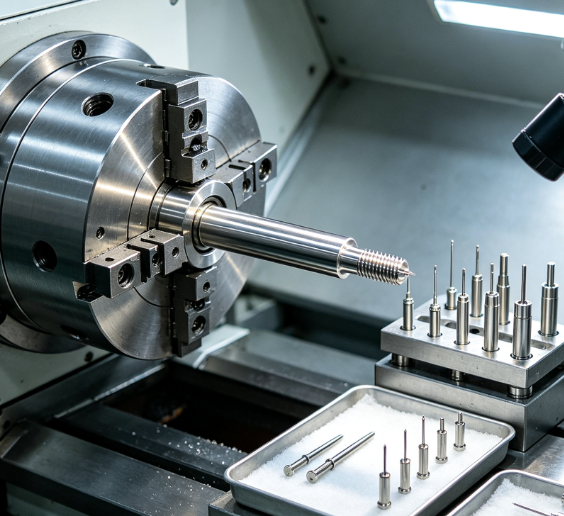
The single game-changing difference between Swiss turning and standard lathes is the sliding headstock + carbide guide bushing setup.
- Conventional lathe: Chuck holds the bar far from the cutting tool; long unsupported cantilever flexes under load.
- Swiss lathe: Bar stock feeds through a precision guide bushing that supports the material millimeters away from the cutting edge. The headstock slides along the Z-axis to push material forward, so only a tiny segment of thin shaft is exposed during every cut.
This rigid, near-tool support eliminates bending, vibration and chatter entirely — even for ultra-slender 0.5mm micro shafts. Multi-axis live tooling and a secondary sub-spindle machine front and back geometry in one continuous automated cycle, no manual re-fixturing required.
6 Non-Negotiable Swiss Turning Benefits For Medical Micro Shafts
Zero Deflection For High L/D Ratio Tiny Shafts
Swiss turning reliably machines micro shafts with length-to-diameter ratios up to 20:1 without taper or bending. Standard lathes struggle past a 3:1 L/D ratio before measurable deflection ruins OD tolerances.
Perfect for long endoscopic cores, catheter guidewires and thin orthopedic micro pins that cannot sacrifice straightness.
Micron-Tight Concentricity & Diameter Tolerances
Temperature-controlled Swiss cells hold consistent tolerances as tight as ±0.001mm on outer diameters, with concentricity down to ±0.0002 inches (0.005mm) across full shaft lengths.
For implantable hardware, this precision guarantees seamless assembly into surgical handles and implant housings without binding or play.
Single-Setup Complete Machining (Turn, Mill, Drill, Thread)
Modern multi-axis Swiss lathes integrate live tooling, cross-drilling, milling and sub-spindle backworking in one unattended cycle.
One blank delivers a fully finished micro shaft with tapered tips, micro threads, flat drive surfaces and radial fluid channels — no secondary lathe or mill operations that stack alignment errors or introduce contamination risks.
Mirror Smooth Biocompatible Surface Finishes
Short, rigid cutting tools eliminate chatter lines common on standard lathe workpieces. As-machined surface roughness hits Ra 0.4μm, and medical electropolishing post-processing easily drops roughness to Ra ≤ 0.2μm — the gold standard for implantable and invasive surgical hardware to reduce tissue irritation and bacterial colonization.
Minimal Micro Burrs To Avoid Tissue Irritation
The tight guide bushing support creates clean, crisp edge breaks during cutting. Combined with Zorapid’s medical ultrasonic micro deburring, we eliminate invisible micro metal slivers that would otherwise scratch vascular and bone tissue during minimally invasive procedures.
Seamless Scale From NPI Prototypes To Mass Medical Batches
Swiss lathes run low-volume 1–50 prototype micro shafts for clinical trials and scale directly to 100,000+ mass production runs on identical machine platforms. No process re-qualification, no tolerance shift between validation and commercial manufacturing, critical for FDA medical device compliance.
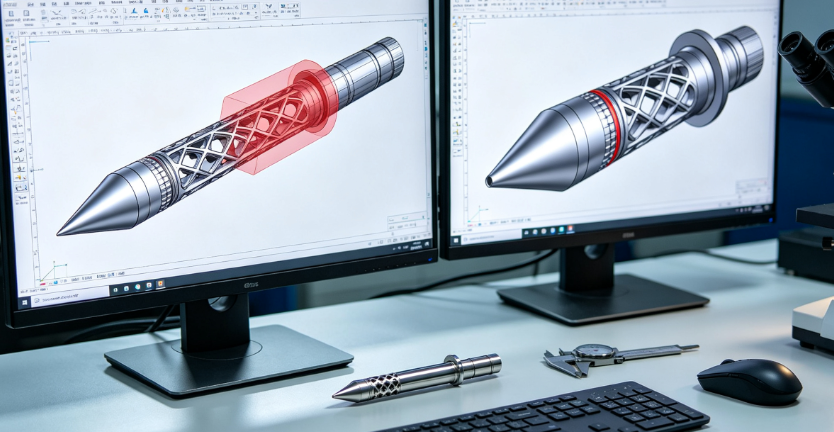
Top Biocompatible Materials For Swiss-Turned Micro Medical Shafts
We stock medical-grade bar stock optimized for Swiss micro turning, each alloy matched to specific invasive/implant applications:
- 316L Medical Stainless Steel (Most Common)
- Corrosion resistant, biocompatible, excellent machinability for micro shafts
- Use cases: Surgical probe cores, biopsy needle shafts, temporary fixation micro pins
- Finishing: Electropolishing + passivation for sterile operating room compatibility
- Ti-6Al-4V ELI Medical Grade Titanium
- Ultra-lightweight, low modulus matching human bone, MRI-safe, non-magnetic
- Use cases: Orthopedic implant micro pins, spinal instrumentation shafts, permanent implant fastener cores
- Machining note: Low-load Swiss cutting parameters to prevent tool wear and surface micro cracks
- 17-4 PH Stainless Steel
- High tensile strength after heat treatment, ideal for load-bearing surgical drive shafts
- Use cases: Orthopedic torque tool cores, bone fixation micro screws
- PEEK Medical Grade Plastic Bar Stock
- Non-conductive, radiolucent, no metal imaging artifacts
- Use cases: Disposable endoscopic micro shafts, non-metallic probe guides
- Machining note: Reduced spindle speed to avoid thermal melting of thin micro walls
Zorapid’s Full Swiss Turning Workflow For Micro Shafts
Our dedicated medical Swiss machining cell follows ISO 13485 quality standards end-to-end, all processes in-house with zero outsourced secondary operations that risk contamination or tolerance drift.
Medical-Focused Micro DFM Analysis
Before any bar stock is loaded onto Swiss lathes, our medical device engineers run a free micro DFM review targeting shaft-specific risks:
- L/D ratio validation to confirm Swiss turning is the optimal process
- Micro feature clearance checks for tiny cross-drills and internal micro threads
- Edge radius optimization to eliminate hard-to-deburr sharp corners
- Tolerance rationalization: Tighten only functional OD/concentricity specs to cut cycle time
- Surface finish compensation for electropolish coating thickness We deliver annotated CAD revisions and compliance lead time breakdowns within 24 hours for all medical NPI projects.
Temperature-Stabilized Multi-Axis Swiss Lathe Machining
Our Swiss turning workshop maintains a constant 20°C controlled environment to block thermal expansion dimensional drift:
- Sliding headstock + carbide guide bushing for deflection-free micro shaft cutting
- Multi-station live tooling for simultaneous turning, milling and cross-drilling
- Secondary sub-spindle to machine tapered tips and backside features in one cycle
- Solid carbide micro cutting tools (0.1mm minimum diameter) for ultra-fine features
- Full digital toolpath simulation to eliminate collision scrap before cutting begins
Medical-Grade Micro Deburring & Electropolishing
Raw Swiss-machined micro shafts receive sterile-grade finishing critical for patient safety:
- Ultrasonic micro media deburring removes all edge micro burrs without altering micron tolerances
- Medical electropolishing for titanium/316L stainless to create smooth, non-thrombogenic surfaces
- Passivation treatment to boost corrosion resistance and eliminate free iron contamination
- Full solvent ultrasonic cleaning to remove all cutting fluid residue (zero outgassing risk for sterile packaging)
100% Optical & CMM Metrology Inspection For Audit Trails
Every single micro medical shaft undergoes full inspection, no batch sampling shortcuts for medical compliance:
- High-magnification optical vision measuring machine: Verify OD, concentricity, micro hole positioning
- Surface roughness testing to validate Ra biocompatibility specs
- CMM full geometry scanning for critical implant shaft batches
- Material COA, full inspection log and batch traceability documentation packaged with every shipment for FDA audit requirements
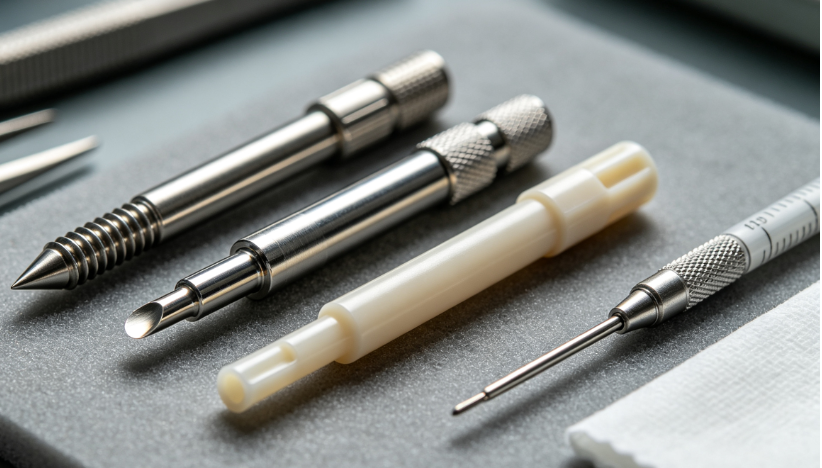
Common Swiss-Turned Tiny Medical Micro Shaft Applications
These are the highest-volume micro shaft parts our medical OEM and contract manufacturing clients produce on Zorapid Swiss lathes:
- Minimally Invasive Surgical Hardware
- Endoscopic camera core shafts
- Biopsy needle inner micro mandrels
- Laparoscopic tool drive shafts
- Catheter guidewire tapered micro cores
- Orthopedic Implant & Fixation Components
- 0.8–3mm micro bone pin shafts
- Spinal implant fixation screw blanks
- Bone graft delivery probe shafts
- Dental & Diagnostic Equipment
- Dental implant micro abutment posts
- Lab test probe micro shafts
- Optical medical sensor slender pin cores
- Disposable Single-Use Medical Devices
- PEEK disposable surgical guide shafts
- Sterile micro needle mandrel blanks
Swiss Turning vs Conventional CNC Lathe Side-by-Side Comparison Chart
| Evaluation Metric | Conventional Fixed-Head CNC Lathe | Medical-Grade Swiss Turning |
|---|---|---|
| Maximum Stable L/D Shaft Ratio | ≤3:1 (deflection beyond this) | Up to 20:1 ultra-slender micro shafts |
| Standard Diameter Tolerance | ±0.01 ~ ±0.03mm | ±0.001 ~ ±0.005mm micron precision |
| Concentricity Consistency | Poor for long thin shafts | ±0.002mm consistent across full length |
| Required Part Setups For Multi-Feature Shafts | 2–4 re-clamping cycles | 1 single unattended cycle |
| Baseline Surface Roughness | Ra 1.6–3.2μm with visible chatter lines | Ra ≤0.4μm as-machined, ready for electropolish |
| Micro Burr Risk | High (cantilever cutting creates sharp edge slivers) | Minimal clean cutting edges, easy medical deburr |
| Batch Repeatability For Clinical Trials | Operator-dependent dimensional variation | Digitally locked toolpaths, identical shafts every run |
| Ideal Medical Fit | Short thick fasteners, low-tolerance large pins | Tiny slender micro shafts, guidewires, implant micro pins |
Real Client Case: 1.2mm Titanium Orthopedic Micro Pin Shafts
A US orthopedic device OEM required Ti-6Al-4V ELI micro pin shafts (1.2mm OD, 18mm length, L/D=15:1) for spinal fixation clinical trials, 300 prototype units followed by 50,000 production parts.
Original Supplier Pain Points
- Conventional lathe production created severe shaft taper and 0.02mm concentricity drift, failing implant assembly fit tests
- Multiple re-clamping steps generated hidden micro burrs that scratched bone tissue during lab testing
- Outsourced electropolishing added 3 extra days of lead time and inconsistent surface roughness
- No full optical inspection documentation for FDA clinical audit submissions
Zorapid Swiss Turning Solution
- Medical DFM optimized shaft radii and tip taper geometry for deflection-free Swiss cutting
- Single-setup multi-axis Swiss machining completed OD, tapered tip and micro drive flat without re-fixturing
- In-house ultrasonic micro deburring + medical electropolishing eliminated third-party finishing delays
- 100% optical vision inspection with full batch traceability reports included with shipment
Final Outcome
All prototype micro pins passed clinical lab validation on the first submission. Zero taper or concentricity deviation, Ra 0.18μm electropolished surface, no tissue-scratching micro burrs. The OEM now sources all titanium micro implant shafts exclusively from Zorapid’s Swiss machining line.
Quick DFM Rules To Optimize Micro Shafts For Swiss Turning
Apply these design rules upfront to cut machining cost, reduce scrap and speed up medical NPI lead times:
- Keep minimum shaft diameter ≥0.3mm for stable Swiss bar feeding
- Add minimum 0.05mm internal radii on all micro cross-hole edges to avoid stress cracks
- Limit extreme L/D ratios above 20:1 where functionally possible; split multi-stage shafts if allowed
- Group all micro threads, flats and cross-drills on one side of the shaft for single-cycle machining
- Avoid blind ultra-deep micro holes without exit clearance for chip evacuation
- Pre-compensate OD dimensions to account for 2–5μm electropolish material removal
- Specify tight concentricity tolerances only on mating assembly zones; relax non-critical mid-shaft surfaces
FAQ
What’s the smallest micro shaft diameter Zorapid can Swiss turn for medical use?
We reliably machine biocompatible micro shafts starting at 0.3mm outer diameter, with stable production for 0.5–4mm diameter surgical and implant hardware.
Can Swiss turning eliminate secondary grinding for micro shaft precision?
Yes. Our temperature-controlled Swiss lathes hold tight enough OD and roundness tolerances to skip cylindrical grinding for most medical micro shafts, cutting lead time and production cost significantly.
Are Swiss-turned micro shafts cleanroom compatible for sterile medical packaging?
Fully compliant. All machining, deburring, electropolishing and cleaning processes run in low-particle controlled workshops; finished shafts are solvent cleaned and vacuum sealed to eliminate contamination risk for operating room use.
Can you switch seamlessly from prototype micro shafts to mass production on Swiss equipment?
Absolutely. We retain validated medical Swiss toolpaths for all customer designs, so clinical trial prototypes and commercial production shafts share identical dimensional specs without re-qualification.
Do you provide full ISO 13485 compliant documentation for FDA audits?
Every shipment includes complete material certificates of analysis (COA), full optical/CMM inspection logs, surface roughness test records and batch traceability reports required for medical device regulatory submissions.
Wrap-Up
Tiny medical micro shafts demand a level of slender-part precision conventional lathes simply cannot deliver. Deflection, chatter, stacked tolerance error and micro burrs aren’t just manufacturing defects — they create direct patient safety risks and costly clinical trial scrap.
Swiss turning’s sliding headstock and guide bushing design is purpose-built for ultra-slender micro medical components, delivering micron-level consistency, burr-free biocompatible surfaces and single-setup complete machining under one roof.
As an ISO 13485 certified full-service medical precision manufacturer, Zorapid combines medical-focused micro DFM analysis, temperature-stabilized multi-axis Swiss lathes, in-house medical electropolishing and 100% traceable metrology inspection for every micro shaft batch. We eliminate cross-vendor delays and contamination risks for your surgical, orthopedic and diagnostic device NPI and mass production.