Published:Zorapid.Ltd
If you design machine tools, automation equipment, press frames, or semiconductor fab equipment, you know machine bases are the backbone of every production system.
A cheap, poorly machined base triggers endless factory headaches: vibration chatter ruining part precision, uneven flatness causing assembly misalignment, slow thermal drift, and gradual warpage that makes your whole machine drift out of spec after months of operation.
Most small CNC shops only handle small to medium workpieces under 500kg. They lack three non-negotiable assets for heavy base production:
- Oversized gantry CNC machines with high load capacity to hold multi-ton blanks
- In-house stress relief furnaces to eliminate casting/welding residual stress
- Large-format CMM equipment to scan full-surface flatness across meters of casting
When you send a cast iron or welded steel machine base to a standard mill, you risk massive scrap, multi-week delays, and unstable long-term machine performance.
Zorapid’s dedicated large gantry CNC workshop specializes exclusively in heavy industrial frame and base machining. This plain-language guide breaks down our proven workflow, solves the biggest large-part manufacturing pain points, and explains exactly why large-format CNC milling is mandatory for stable industrial machine bases.
What Makes Industrial Machine Bases Unique & Hard to Machine
Machine bases are nothing like standard mechanical parts. Their design and material properties create manufacturing hurdles you won’t encounter with small components:
- Extreme mass & oversized dimensions Most industrial bases range from 1m up to 6–8m long, weighing 500kg to 5+ tons. Standard VMC tables cannot support the weight or travel range.
- Locked-in residual stress Cast iron castings and thick welded steel frames build massive internal stress during cooling or welding. Removing material during milling unbalances stress and causes slow, permanent warpage post.
- Strict full-surface flatness requirements Even 0.03mm/m flatness deviation ruins linear guide, spindle, and workpiece positioning accuracy for years of machine runtime.
- Mixed heavy material removal Rough milling removes hundreds of kilos of excess casting stock, generating extreme cutting forces that induce vibration and part deflection.
- Multi-meter GD&T tolerance control Mounting bores, T-slot rails, linear guide datum planes, and anchor foot pads must hold consistent positional tolerances across the entire large frame.
- Long continuous machining cycles Large base finish passes can run 12–48 hours nonstop; thermal drift across machine and workpiece becomes a major accuracy threat.
Top 4 Critical Challenges of Large Heavy Base Milling
We’ve listed the four most common failure points when machining heavy machine bases, plus how large gantry CNC eliminates each risk:
1. Residual Stress-Induced Warpage
Casting and welding trap massive internal stress. If you skip stress relief before milling, the base will slowly bend days or weeks after machining, destroying flatness and mounting hole alignment.
Large CNC solution: Mandatory thermal aging + vibration stress relief pre-machining to stabilize blank geometry before any cutting begins.
2. Vibration & Chatter During Heavy Stock Removal
Deep roughing cuts on thick cast iron generate powerful cutting forces. Light-duty vertical mills flex under load, leaving wavy chatter marks on guide mounting surfaces and shortening tool life drastically.
Large CNC solution: Extra-rigid heavy gantry frames, box guideways, high-torque spindles, and full base clamping fixtures lock down multi-ton blanks to eliminate vibration.
3. Thermal Drift Over Long Machining Cycles
12+ hour continuous milling heats the workpiece, machine rails, and spindle. Uneven thermal expansion creates linear deviation across meters of the base surface.
Large CNC solution: Enclosed temperature-controlled workshop, real-time thermal compensation software, and staged machining cycles with cooling breaks to stabilize dimensional accuracy.
4. Full-Surface Flatness Verification Limits
Small inspection tools only measure tiny local zones. You cannot validate global flatness across a 4m long base with handheld calipers.
Large CNC solution: Oversized bridge CMMs that scan the entire base surface in one setup to generate full flatness heat map reports for industrial equipment OEM audits.
Best Materials for Heavy Industrial Machine Bases (Cast Iron vs Welded Steel vs Polymer Concrete)
Every machine application demands a specific base material, each with unique large CNC milling characteristics:
1. Gray Cast Iron HT250 / HT300 (Most Popular for Precision Machine Tools)
- Key advantages: Unmatched vibration damping, low thermal expansion, excellent long-term dimensional stability
- Ideal use cases: CNC machine tool beds, grinding machine bases, semiconductor test equipment frames
- Machining notes: Requires full thermal stress relief aging pre-milling; rigid gantry setup prevents chatter during heavy stock removal
2. Thick Welded Carbon Steel Plates
- Key advantages: Lower upfront blank cost, customizable modular frames, fast lead time for custom large structures
- Ideal use cases: Heavy automation gantry frames, hydraulic press bases, industrial robot support stands
- Machining notes: Double vibration stress relief after welding; extra rigid clamping to counteract weld stress warpage
3. Polymer Concrete (Mineral Cast)
- Key advantages: Superior vibration absorption, low thermal conductivity, corrosion resistance
- Ideal use cases: High-precision measuring machines, optical inspection equipment
- Machining notes: Light cutting parameters only; avoid deep heavy roughing to prevent chipping composite surfaces
Zorapid’s Complete Large CNC Milling Workflow for Machine Bases
Our dedicated large-part workshop handles every stage in-house, no outsourcing of stress relief, heavy milling, or large-scale inspection for multi-ton machine bases.
Pre-Machining Stress Relief & Blanking Prep
This step eliminates 90% of post-machining warpage risk before a single chip is cut:
- Thermal aging furnace treatment: Heat cast iron blanks to 500–600°C, slow cool over 24–48 hours to release casting residual stress.
- Vibration stress relief for welded steel frames to break down weld lock-in stress
- Heavy load transport cranes to safely position multi-ton blanks onto gantry machine tables
- Full surface cleaning to remove casting sand, welding slag, and surface oxidation
Large-Part DFM Tuned for Massive Cast/Welded Frames
Our industrial DFM engineers optimize base designs specifically for large gantry milling limitations:
- Optimize internal rib layout to balance material removal and minimize stress redistribution
- Rationalize tolerances: Only hold tight ±0.01–0.03mm flatness on linear guide mounting datums; relax non-critical outer surfaces to cut cycle time
- Design wide, stable clamping foot pads to distribute multi-ton workpiece weight evenly on the gantry table
- Add generous internal radii on all casting pockets to eliminate long overhang tool chatter
- Pre-compensate CAD geometry for material thermal expansion during long machining cycles
We deliver annotated DFM revisions and full lead time breakdowns within 24 hours for all large base projects.
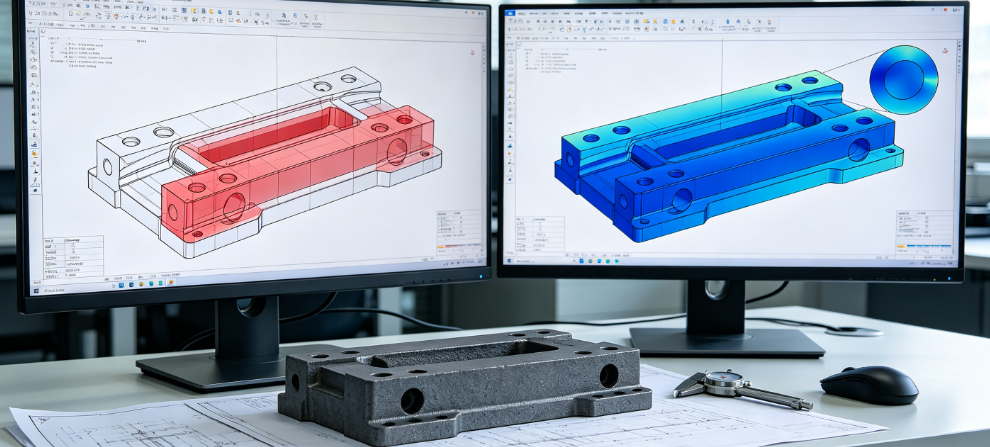
Heavy-Duty Gantry CNC Rough & Finish Milling
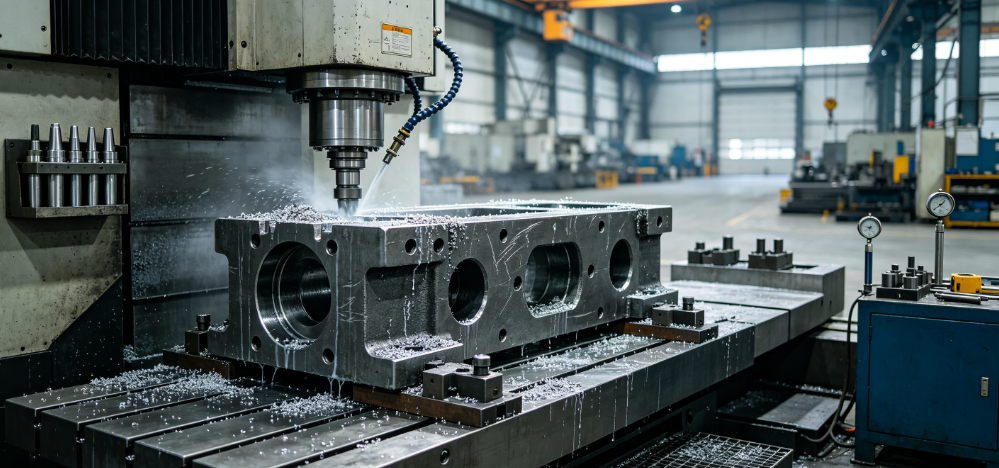
Our large-format gantry CNC centers support workpieces up to 8m long, 3m wide, maximum load capacity 12 tons, built for heavy industrial base production:
- Rough Milling Stage High-torque heavy-duty indexable mills remove bulk casting stock in deep passes, balanced symmetrical cutting to evenly release residual stress without unbalancing the blank.
- Semi-Finish Stabilization Cycle Light stock removal pass, followed by full workpiece cool-down to normalize temperature before final precision cuts.
- Precision Finish Milling Low-feed, shallow light passes on all critical datum planes, T-slot rails, mounting bores, and linear guide pads to lock in global flatness and positional tolerances.
- Multi-sided single-setup machining Large gantry travel range machines top, side mounting flanges, and anchor foot pads without re-clamping, eliminating stacked alignment errors across multi-meter surfaces.
Precision Deburring, Thread Tapping & Mount Pocket Machining
Raw milled heavy bases have sharp casting edges and rough bore surfaces that risk assembly injury and fit issues:
- Large-scale automated vibratory deburring for all external edges
- Precision thread tapping for anchor bolt holes, motor mounting flanges, and equipment assembly bores
- Custom pocket machining for spindle housings, hydraulic tank cutouts, cable routing channels, and leveling foot recesses
Industrial-Grade Surface Finishing & Anti-Corrosion Treatment
Machine bases operate in oily, dusty factory environments; our in-house finishing line protects cast iron and steel long-term:
- Cast iron: Anti-rust phosphate priming + industrial matte black epoxy paint for factory floor durability
- Welded steel: Shot blasting + heavy-duty powder coating for hydraulic press and outdoor automation frames
- Precision guide mounting surfaces: Precision grinding / fine milling to mirror flatness, no coating on datum contact zones
Full Large-Scale CMM Flatness & GD&T Inspection
Every heavy machine base undergoes 100% full-surface inspection on our oversized bridge CMM:
- Global flatness scanning across the entire base surface to generate color-coded deviation heat maps
- GD&T positional tolerance verification for all mounting holes, linear guide datums, and spindle mounting planes
- Surface roughness testing on all critical contact surfaces
- Full certified inspection report, flatness data logs, and material COA for OEM equipment audit compliance
Key Performance Standards for Industrial Machine Bases
These are the non-negotiable specs our industrial clients require for production-ready heavy bases:
- Global flatness: ≤0.02–0.05 mm per meter across full guide mounting plane
- Positional tolerance for linear guide mounting holes: ±0.02 mm
- Surface roughness (datum surfaces): Ra ≤ 1.6 μm post finish milling
- Post-machining stability: Less than 0.01mm warpage after 30-day stress stabilization test
- Uniform coating thickness ≥60μm for anti-rust factory protection
Real Client Case: 3-Ton Cast Iron CNC Lathe Base Machining
A machine tool OEM partnered with Zorapid for 3-meter long HT300 cast iron lathe bed bases, 4 production units per batch.
Original Supplier Pain Points
- Previous shop skipped full thermal stress relief; bases warped 0.12mm/m after machining, failing flatness specs
- Small vertical CNC required 4 separate re-clamping setups, stacking alignment errors on spindle mounting bores
- No large-format CMM; only local spot checks, no full-surface flatness validation reports
- Long lead times due to outsourced stress relief and painting vendors
Zorapid Large Gantry CNC Solution
- Full 48-hour thermal aging stress relief on all cast iron blanks before milling
- Single-setup large gantry machining completed all top, side, and end features without re-fixturing
- Symmetrical staged roughing cuts to evenly release internal casting stress
- Oversized bridge CMM full-surface flatness scanning for every base unit
- In-house painting line eliminated third-party finishing queue delays
Final Outcome
All four lathe bases passed OEM flatness and GD&T audits on first production run. Zero post-delivery warpage reported after 60 days of storage testing, total project lead time cut by 40% vs the client’s prior supplier. The OEM now sources all heavy machine tool beds exclusively from Zorapid’s large CNC division.
Large Gantry CNC vs Standard Vertical CNC Side-by-Side Comparison
| Evaluation Metric | Large Heavy-Duty Gantry CNC Milling | Standard Vertical CNC Mill |
|---|---|---|
| Max Workpiece Size | Up to 8m × 3m multi-ton blanks | Typically under 1.5m, <500kg load limit |
| Table Load Capacity | 12-ton maximum weight support | 0.5–2 ton lightweight limit |
| Vibration Control | Extra-rigid box guideways, heavy machine frame | Light cast frame, prone to chatter on deep roughing |
| Multi-Side Machining | Single setup full-surface machining | 3–6 re-clamping setups for long frames |
| Thermal Compensation | Real-time multi-sensor thermal correction | Limited basic temperature compensation only |
| Flatness Inspection Support | Oversized bridge CMM full-surface scanning | Handheld measuring tools, local spot checks only |
| Ideal Application | Cast iron machine beds, press frames, heavy automation bases | Small brackets, low-mass general mechanical parts |
| Risk of Post-Machining Warpage | Minimal with pre-machining stress relief | High risk for large cast/welded blanks |
Engineer’s Quick DFM Checklist to Avoid Base Warpage & Scrap
Run through these rules before finalizing your machine base CAD to cut machining cost and eliminate scrap:
- Specify thermal stress relief aging for all cast iron blanks before any CNC cutting
- Design symmetrical rib layout to balance stress release during material removal
- Add minimum 5mm internal radii to all deep casting pockets to reduce tool overhang
- Limit ultra-tight flatness tolerances only to linear guide and spindle mounting datums
- Build wide, thick clamping foot pads to evenly distribute multi-ton blank weight on the gantry table
- Avoid uneven wall thickness on cast frames to prevent differential cooling stress
- Reserve all anti-rust coating for non-contact surfaces; leave datum mounting planes uncoated
FAQ
What maximum size and weight machine bases can Zorapid machine?
Our large gantry CNC centers handle workpieces up to 8 meters long, 3 meters wide, with maximum table load capacity of 12 tons for cast iron and welded steel machine bases.
Is stress relief always required for cast iron machine bases?
Mandatory for precision machine tool frames. Skipping thermal aging guarantees slow, permanent warpage after machining, ruining flatness and assembly accuracy long-term.
Can large gantry CNC machine both prototype single bases and mass production batches?
Yes. We support 1-off custom prototype frames all the way through monthly production batches, holding identical flatness and tolerance standards across all volumes.
How long is standard lead time for a full cast iron machine base (stress relief + CNC + finishing + inspection)?
Standard turnaround: 10–15 business days for single large cast iron bases. Rush expedited production cuts lead time to 6–8 days for critical equipment launch deadlines.
Do you supply full flatness scan reports and material certification for OEM equipment compliance?
Every shipment includes full CMM flatness heat map reports, GD&T inspection logs, casting material COAs, and coating thickness validation documents for industrial factory audit trails.
Wrap-Up
Heavy industrial machine bases are the foundation of your entire production equipment. Cutting corners on large-format CNC machining, stress relief, or full-surface flatness inspection creates years of costly factory downtime, vibration-related precision loss, and rework.
Standard small CNC shops lack the equipment, workshop infrastructure, and process expertise to handle multi-ton cast iron and welded steel frames reliably. Zorapid’s dedicated large gantry CNC workshop delivers a fully in-house workflow: pre-machining stress relief, industrial DFM optimization, heavy-duty precision milling, anti-corrosion finishing, and full large-scale CMM inspection under one roof.
Whether you’re designing CNC machine tool beds, hydraulic press frames, automation gantry supports, or semiconductor test equipment bases, our large-part manufacturing team eliminates warpage, vibration, and tolerance drift to deliver stable, audit-ready heavy industrial frames.
Request Your Free Large Base DFM Review & Transparent CNC Quote
Send your machine base CAD files, material specs, flatness tolerance requirements, and batch volume forecast. Our industrial heavy-part engineering team will complete a full stress & manufacturability analysis, outline full-stage lead times, and share an all-inclusive quote for stress relief, large gantry milling, finishing and certified inspection.