Published:Zorapid.Ltd
Aerospace assemblies suffer unique cascading risks from high part counts: stacked tolerance drift across dozens of fastener joints, dozens of potential leak paths, heavy assembly labor, long QA traceability cycles, elevated weight and higher in-flight failure probability. Unlike general manufacturing, every extra bolt, shim, spacer or sub-component adds verified safety liability under AS9100D and FAA/EASA airworthiness standards.
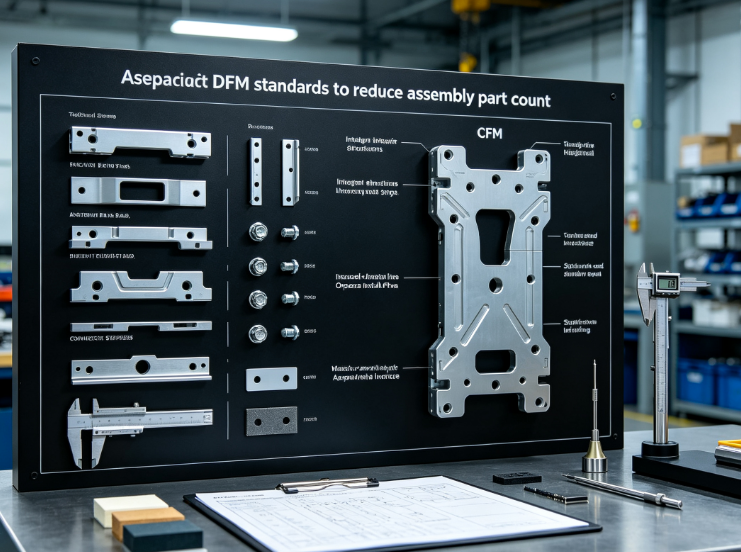
Aerospace DFM/DFMA standards push part consolidation as a key design fix: combine separate static mating parts into one solid or bonded integrated piece, with no loss of structural, thermal or pressure performance.
Consolidation is not simply simplifying geometry — it is a regulated, auditable design process aligned with NADCAP machining, heat treatment and NDT requirements, validated via DFMA analysis before drawing release.
Core Aerospace Regulatory & Quality Baselines
All part consolidation DFM work must adhere to these mandatory aerospace frameworks:
- AS9100D aerospace quality rule: All flight-critical assemblies need documented DFMA risk reviews. Consolidated single-piece parts cut process checkpoints, streamline traceability and shrink tolerance stack-up Cpk fluctuations.
- DFMA industry standard: Must-have concurrent engineering tool for aerospace OEMs. It uses formal scoring to measure part cutbacks, assembly labor savings and FMEA risk reduction.
- NADCAP accreditation note: Single consolidated parts cut riveting, welding and bonding—all needing separate NADCAP audits. Fewer steps slash third-party compliance costs.
- FAA/EASA airworthiness rules: Fewer mechanical joints mean fewer crack risks around fastener holes. Integrated single-piece structures deliver better fatigue performance for flight certification.
- AS9102 First Article Inspection (FAIR) Fewer unique parts shorten FAIR dimensional validation, reduce CMM inspection hours and simplify batch traceability records.
Measurable Business & Flight Safety Benefits of Fewer Assembly Parts
- Flight Safety Improvement Every discrete joint, fastener and seal creates a potential failure point; consolidated single-piece hardware eliminates leak paths, fastener loosening and inter-part fatigue crack origins.
- Weight Reduction (Core Aerospace Priority) Remove redundant mating flanges, bolt bosses, shims and spacer stock; typical 15–40% mass cut on structural brackets and engine components, lowering fuel burn or increasing payload capacity.
- Assembly Labor Cut 30–65% Eliminate bolt installation, torque verification, shim fitting, alignment checking and sealant application steps; DFMA case studies on helicopter crew stations recorded 40% assembly time reduction after consolidation.
- Lower Supply Chain & Tooling Cost Fewer unique part numbers reduce custom mold, fixture and CNC blank tooling investment; shrink BOM procurement, receiving and inventory overhead.
- Reduced Tolerance Stack-Up Scrap Single monolithic geometry removes cumulative alignment error across multiple mating parts; CMM dimensional pass rate improves significantly for tight GD&T flight-critical features.
- Shorter Program Lead Time Consolidated parts cut manufacturing, inspection and subassembly sequencing time; additive consolidated engine hardware reduced iteration cycles from months to days.
8 Foundational Aerospace DFM Standards for Part Consolidation
Single-Setup Monolithic 5-Axis CNC Consolidation (Primary Machining DFM Standard)
DFM Mandate: Merge all static co-planar/co-contour mating components into one single-forged/blank monolithic block machined via simultaneous 5-axis in one fixture.
Key Aerospace Rules:
- Design all integrated lugs, mounting bosses, rib stiffeners and fluid port bosses into one blank; eliminate separate spacer brackets, gussets and adapter plates
- Utilize full 5-axis single-clamp access to avoid multi-setup refixturing tolerance drift; all undercuts, angled holes and compound contours machined in one coordinate zero point
- Uniform wall thickness control to prevent post-machining warpage after large-volume stock removal Compliance Note: Monolithic titanium/aluminum airframe brackets replace 3–8 separate welded bolted components, eliminating weld joint NDT inspection steps.
DfAM Additive Function Integration (SLM Metal 3D Printing Standard)
DFM Mandate: Consolidate multi-part hydraulic, fuel and thermal assemblies into one single SLM printed metal component where CNC monolithic machining cannot achieve complex internal geometry.
Industry Benchmark Standard: GE LEAP fuel nozzle — 20 discrete machined parts consolidated into one Ti6Al4V SLM unit, 25% lighter, 5x longer service life, zero internal seal leak paths.
DFM Rules for Aerospace DfAM Consolidation:
- Integrate conformal cooling/fluid channels, mounting lugs and flow manifolds into one part; eliminate separate tube fittings, split manifold halves and gaskets
- Maintain minimum wall thickness ≥0.4mm for Ti SLM; avoid ultra-thin unsupported overhangs without self-supporting 45° geometry
- Design lattice lightweighting to offset any minor raw material cost increase vs multi-part CNC
- Mandatory post-print vacuum stress relief and full UT/PT NDT per NADCAP standards
- Only consolidate parts of identical alloy grade (Ti6Al4V, Inconel 718, AlSi10Mg) to avoid dissimilar metal joint risks
Fastener Elimination & Integral Feature Design
DFM Mandate: Remove all non-critical bolts, rivets, screws and sealing gaskets by integrating interlocking self-locating geometry into a single consolidated part.
Standard Aerospace Implementation Rules:
- Integrate snap-fit, self-keyed alignment tabs and interlocking tongue-and-groove datums built into monolithic geometry; eliminate separate locating pins
- Mold/machine integral threaded bosses directly into the main part instead of installing pressed-in threaded inserts
- Eliminate flat flange mating surfaces requiring gaskets by merging fluid flow cavities into one single manifold block
- Replace multi-piece clamp bands with integral one-piece retaining rings machined into the housing blank
- Limit fasteners only to separable serviceable subassemblies required for FAA maintenance access
Composite Thermoplastic Integrated Co-Bond Structures
DFM Mandate: Consolidate CFRP composite airframe panels, ribs and stringers via thermoplastic co-consolidation welding to eliminate thousands of rivet fasteners.
DFM Standards:
- Co-bond rib stiffeners, skin panels and edge fittings into a single thermoplastic unit during autoclave forming; no secondary mechanical fastening
- Design continuous fiber layup across integrated geometry to maintain uniform structural strength
- Avoid dissimilar metal insert bonding where monolithic composite geometry can replace metal sub-brackets
- Thermoplastic welding (induction welding) replaces rivet rows; cuts part count by 60–80% on fuselage panel assemblies
Multi-Functional Unitization Rule
DFMA Qualification Checklist Before Consolidation:
- Structural load bearing + fluid manifold routing
- Mounting bracket + EMI shielding housing
- Heat sink thermal barrier + equipment mounting frame
- Aerodynamic fairing + internal cable routing tray
- Hydraulic valve block + pressure sensor mounting boss If a component only performs one single function without overlapping features, consolidation yields minimal benefit and is not prioritized under aerospace DFM standards.
Tolerance Stack-Up Minimization DFM Rules
DFM Mandate: Consolidate all mating dimension chain features onto one single datum coordinate system to eliminate cumulative tolerance drift across multi-part assemblies.
Critical Aerospace DFM Controls:
- Define all critical GD&T flight datums on the monolithic base blank; remove secondary datums on separate mating brackets
- Run Monte Carlo tolerance stack simulation pre-design to quantify error reduction from consolidation
- Eliminate stacked shim adjustment features by integrating dimensional offset geometry directly into the consolidated part
- Avoid segmented feature splits across multiple components (e.g., split flow channels, split mounting lugs)
Standardization & Common Part Rationalization
DFM Mandate: Merge unique but functionally identical subassemblies across aircraft variants into one universal consolidated part to cut total program-wide BOM count.
Implementation Standards:
- Replace multiple size-variant brackets with one adjustable integrated monolithic unit with modular mounting slots
- Standardize all fluid port, fastener boss and alignment feature dimensions to eliminate custom unique sub-components
- Phase out one-off custom adapter plates by integrating adapter geometry into primary consolidated housing blanks
Mistake-Proof (Poka-Yoke) Integrated Assembly Geometry
DFM Mandate: Build orientation keying, anti-reverse tabs and self-locating features directly into consolidated monolithic parts to eliminate secondary alignment fixtures and error-prone small locating components.
Aerospace Safety Rule: Eliminate loose alignment pins, spacer washers and separate anti-rotation tabs by machining integral keyed geometry into the single consolidated assembly unit.
Process-Specific DFM Design Guidelines for Consolidated Parts
Machined Titanium/Aluminum Monolithic Components (5-Axis CNC)
- Max wall height-to-thickness ratio ≤6:1 for Ti6Al4V to prevent thin-wall deflection during heavy stock removal
- Integrate sacrificial support tabs for large free-standing ribs, trimmed in final finish pass
- Mandatory intermediate vacuum stress relief after roughing to eliminate post-machining warpage of large consolidated blanks
- Avoid deep blind narrow pockets requiring long overhang tools; tilt 5-axis spindle for short rigid cutting tools to suppress chatter
- All fillet radii standardized ≥0.8mm to reduce fatigue crack initiation risk for flight-critical monolithic structures
SLM Additive Consolidated Engine & Hydraulic Hardware
- Self-supporting overhang angle ≥45° to eliminate heavy solid metal support structures that add post-machining labor
- Conformal fluid channels designed with smooth continuous radii to avoid flow turbulence and pressure loss
- Lattice lightweighting integrated in non-load-bearing core zones to offset increased raw powder material cost
- All critical mating datums left with 0.1–0.15mm stock allowance for secondary 5-axis CNC finish machining post-print
- Material homogenization heat treatment mandatory post-print per NADCAP metallurgy standards
Aerospace Composite Integrated Panels
- Continuous fiber layup across all integrated rib-skin interfaces to prevent interlaminar shear failure
- Eliminate sharp internal corners that create resin-rich stress hotspots during autoclave cure
- Thermoplastic co-weld joint overlap designed to match parent composite tensile strength, removing rivet rows entirely
- Integrate edge hard points directly into composite layup instead of bonding separate metal fittings post-cure
Step-by-Step DFMA Part Consolidation Audit Workflow
This formal documented workflow is required for all flight-critical aerospace design releases:
- BOM Baseline Extraction Pull full subassembly part list, flag all static mating components of identical material with no separable service requirement.
- DFMA Functional Scoring Score each candidate assembly on: weight reduction potential, assembly labor hours saved, joint failure risk reduction, manufacturing cost delta.
- Consolidation Geometry Concept Design Draft monolithic/integrated CAD, merge all discrete features onto one single blank/build volume.
- FMEA Risk Assessment Document mitigation for consolidation risks: increased blank size, thicker raw material, additive anisotropy, machining cycle extension.
- Tolerance Stack & Structural Simulation Run FEA stress analysis + Monte Carlo tolerance stack simulation to validate consolidated geometry meets flight load and GD&T specs.
- Manufacturing DFM Review (Concurrent Engineering) CNC/Additive/Composite manufacturing engineers validate the consolidated design is producible under NADCAP/AS9100 processes.
- NDT & QA Validation Planning Update FAIR, NDT and inspection workflows to reflect reduced part count, remove redundant multi-part dimensional checks.
- Design Sign-Off & Drawing Release Archive full DFMA audit report as part of AS9100 design record package for airworthiness audit traceability.
Real Industry Case Studies of Aerospace Part Count Reduction
1: GE LEAP Fuel Nozzle (SLM DfAM Consolidation)
- Original: 20 separate CNC machined titanium sub-components, multiple braze joints, internal gaskets
- Consolidated DFM Design: Single SLM Ti6Al4V printed unit integrating all flow channels, mounting lugs and mixing vanes
- Results: Part count -95%, weight -25%, assembly labor eliminated, service life increased 5x, zero internal leak failures
2: Apache AH-64D Helicopter Crew Station Bracket (5-Axis Monolithic CNC)
- Original: 7-piece bolted aluminum subassembly with gussets, spacer plates and locating pins
- Consolidated DFM Design: Single monolithic 5-axis machined aluminum blank with integral ribs and mounting lugs
- Results: Part count -86%, assembly time -40%, tolerance stack scrap eliminated, overall subassembly weight -18%
3: Ariane 6 Rocket Engine Injection Head (Large-Format SLM)
- Original: 248 discrete machined components, hundreds of brazed tube joints
- Consolidated DFM Design: One single large metal additive printed integrated manifold
- Results: Part count -99.6%, manufacturing cost -50%, development iteration cycle shortened from months to days
4: Commercial Aircraft Thermoplastic Fuselage Panel
- Original: 14 CFRP skin + rib subassemblies, 1,200 rivet fasteners total
- Consolidated DFM Design: Co-bonded single thermoplastic integrated skin-rib panel
- Results: Part count -93%, rivet fasteners eliminated, panel assembly labor cut 78%
Common Pitfalls When Consolidating Aerospace Parts & Compliance Fixes
- Pitfall: Consolidated blank size becomes too large for existing 5-axis machine travel limits Fix: Early DFM machine envelope check; split only serviceable separable zones, keep static structural features monolithic
- Pitfall: Over-consolidation creates non-repairable single-piece hardware for required aircraft maintenance Fix: DFMA functional split rule: only merge permanently static components; separate replaceable service parts remain individual SKUs
- Pitfall: SLM consolidated parts exhibit Z-axis anisotropic strength below forged monolithic CNC Fix: Orient critical load planes perpendicular to print Z-axis, run full tensile metallurgy testing per NADCAP
- Pitfall: Consolidated thick blank creates excessive residual stress leading to post-machining warpage Fix: Mandatory intermediate vacuum stress relief between rough and finish machining passes
- Pitfall: Joining different alloy parts into a single assembly → galvanic corrosion risk Fix (DFM material rule): Only combine parts with matching base alloy grades; never fuse dissimilar metal subassemblies as one piece
Pre-Release DFM Checklist for Consolidated Aerospace Assemblies
- DFMA part consolidation audit report fully documented and archived per AS9100 traceability rules
- FEA structural fatigue simulation confirms monolithic integrated geometry meets flight load requirements
- Monte Carlo tolerance stack analysis verifies GD&T critical feature error reduction vs original multi-part design
- Manufacturing engineering review validates 5-axis CNC / SLM / composite process producibility
- All consolidated features avoid dissimilar metal integration risks
- Maintenance disassembly requirements preserved; only permanent static features merged
- Vacuum stress relief / heat treatment process defined for large monolithic titanium/aluminum blanks
- NDT (PT/UT/X-Ray) inspection plan updated for single-unit consolidated hardware
- BOM line item count reduction quantified with documented labor/weight/cost savings
- Poka-Yoke integral alignment geometry integrated to eliminate loose locating sub-components
FAQ
What is the primary aerospace standard governing part consolidation DFM?
DFMA (Design for Manufacture and Assembly) is the core methodology, executed within AS9100D quality system requirements, with process execution controlled by NADCAP machining/additive/composite standards.
Can every multi-part aerospace subassembly be consolidated into a single piece?
No. Separable serviceable replacement parts, dissimilar alloy components and hardware requiring independent thermal expansion must remain discrete; only permanently static same-material features qualify for consolidation.
Does monolithic 5-axis CNC consolidation or SLM additive consolidation deliver larger part count reduction?
SLM DfAM achieves far higher consolidation rates (80–99% part cut) for complex internal fluid/thermal manifolds; 5-axis monolithic CNC delivers 40–85% reduction for structural bracket subassemblies with simple external geometry.
How does part consolidation impact AS9102 FAIR and quality inspection workload?
Fewer unique part numbers drastically reduce CMM inspection hours, cut FAIR documentation volume and eliminate repeated dimensional stack validation across mating sub-components.
What weight savings are typical after aerospace DFM part consolidation?
Structural airframe brackets see 15–25% mass reduction; engine fluid manifolds consolidated via SLM achieve 20–40% weight cut by removing redundant flange and fastener stock.
Wrap-Up
Aerospace DFM standards for part consolidation are not optional design tweaks — they are regulated DFMA/AS9100 design controls that simultaneously improve flight safety, reduce program cost and shorten lead times. The highest-impact consolidation paths rely on two core manufacturing enablers: single-setup 5-axis monolithic CNC for structural airframe hardware, and SLM metal additive manufacturing for complex integrated engine/hydraulic manifolds.
All consolidation work must follow a formal concurrent engineering audit workflow, pairing design, manufacturing, QA and stress analysis teams to avoid over-consolidation, maintenance conflicts and metallurgy compliance risks. When executed correctly, consolidated single-piece assemblies eliminate hundreds of potential joint failure points, cut assembly labor by half and deliver measurable aircraft weight and fuel efficiency gains across commercial, defense and space programs.
Zorapid’s aerospace engineering team applies full AS9100-aligned DFMA DFM standards for titanium, aluminum and SLM metal components. We conduct pre-production consolidation audits, run FEA and tolerance stack simulation, and produce monolithic 5-axis or SLM consolidated flight-grade parts with full NADCAP heat treatment, NDT and AS9102 FAIR documentation.
Request Free Aerospace DFMA Part Consolidation DFM Audit
Submit your full subassembly BOM and 3D CAD files, material alloy grade and flight-critical GD&T requirements. Our aerospace design team will quantify achievable part count reduction, weight savings and assembly labor cuts, plus deliver a compliant consolidated geometry proposal aligned with AS9100 and NADCAP standards.