Published:Zorapid.Ltd
Industrial equipment prototypes regularly exceed 600mm in one axis: automation chassis, EV power equipment housings, agricultural machinery covers, wind tunnel test fixtures, robot base frames. Traditional manufacturing creates massive bottlenecks:
- CNC machining large solid blanks: Extremely high raw material cost, multi-week cycle times, heavy waste removal
- Sheet metal fabrication: Requires dozens of cut/bend/weld assemblies, alignment gaps, long design iteration delays
- Split small-format 3D printing + bonding: Weak glue joints, visible seam lines, dimensional mismatch, extra post-processing labor
- Vacuum casting large molds: High master pattern cost, minimum batch restrictions, slow mold turnaround
Large Format Additive Manufacturing (LFAM) prints oversized parts as single monolithic pieces in one continuous build, eliminating assembly seams and cutting prototype iteration lead times from 3–6 weeks down to 2–6 days. This guide focuses on industrial equipment NPI prototypes, balancing structural strength, dimensional stability, cosmetic quality and budget.
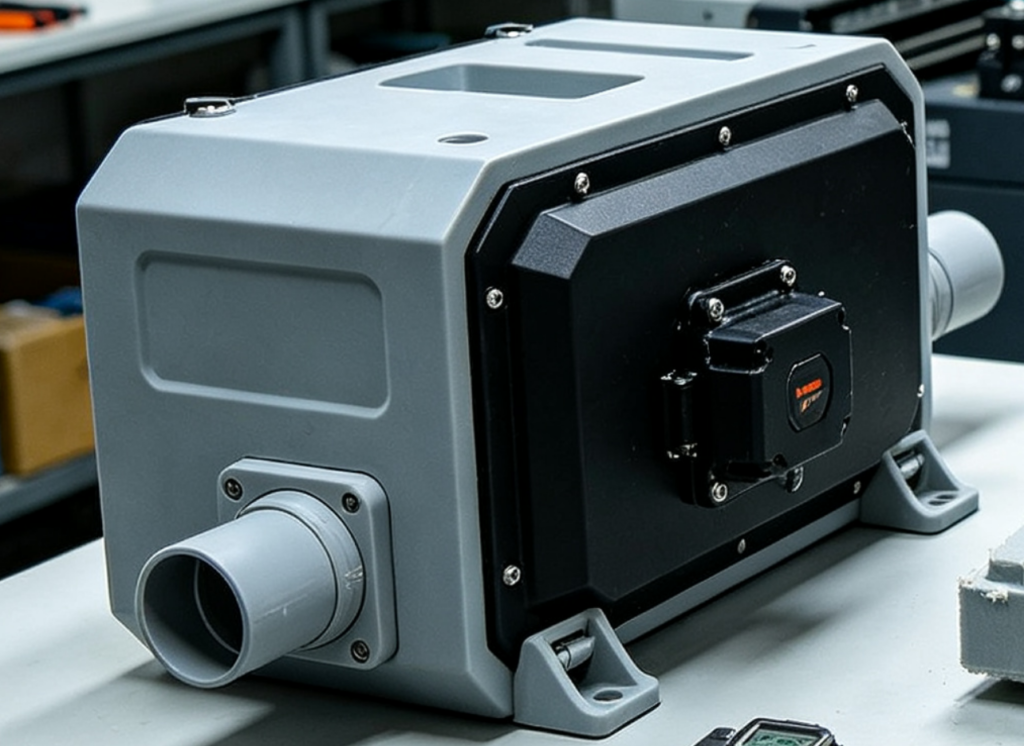
Four Main Large-Format Industrial 3D Printing Technologies
Large Format FDM (Stratasys F770/F900 style industrial heated chamber FDM)
- Max build volume: Up to 1000 × 610 × 610 mm (single-piece full equipment housing without splitting)
- Core principle: Thermoplastic filament extrusion inside fully temperature-controlled heated build chamber to suppress warpage
- Key trait: Wide engineering thermoplastic portfolio, soluble support for deep undercuts, functional load-bearing prototypes
Pellet Extrusion LFAM (Robotic Arm / Big Delta pellet printing)
- Max build volume: 2–4 meter custom build envelopes, unlimited modular size
- Core principle: Raw plastic pellet direct extrusion (no filament intermediate step) for ultra-low material cost on massive lightweight structures
- Key trait: Fast high-volume deposition rate, low-cost filler-reinforced plastics (glass fiber, mineral filled)
Large-Frame Industrial SLA
- Max build volume: Up to 700–800mm single vat
- Core principle: UV laser curing liquid photopolymer resin layer-by-layer
- Key trait: Ultra-smooth surface finish, fine cosmetic details, ideal for customer-facing equipment enclosures
Large-Bed SLS Powder Bed Fusion
- Max build volume: Up to 750mm standard industrial beds
- Core principle: Laser sinters nylon powder, loose powder acts as natural support
- Key trait: Zero support geometry, complex internal lattices, uniform isotropic strength for functional test frames
Side-by-Side Process Comparison Chart
| Evaluation Metric | Large Format Heated-Chamber FDM | Pellet Extrusion LFAM | Large Industrial SLA | Large-Bed SLS Nylon |
|---|---|---|---|---|
| Max Single-Piece Build Size | 1000 × 610 × 610 mm | 2–4m custom oversized | 700–800mm | 750mm max |
| Dimensional Tolerance | ±0.20–0.40 mm | ±0.40–0.80 mm (loose) | ±0.10–0.18 mm (tightest) | ±0.15–0.30 mm |
| As-Print Surface Quality | Visible layer lines, sandable | Coarse thick layers, heavy post-sanding required | Mirror-smooth, minimal finishing | Matte grainy powder texture |
| Support Requirement | Soluble support for overhangs | Minimal support ribs only | Wax/UV removable supports | No supports at all |
| Main Materials | ABS, ASA, PC, Carbon-ABS, FR PC/ABS | PP, GF-PP, filled ABS, low-cost thermoplastics | Clear, tough, low-outgassing UV resins | PA12, GF-PA12, flexible TPU powder |
| Structural Load Capacity | High (carbon fiber reinforced grades) | Medium (low modulus, prone to creep) | Low (resin brittle under heavy load) | Very high, uniform isotropic strength |
| Per-Volume Material Cost | Medium | Lowest | Highest | Medium-High |
| Standard Lead Time (1pc large housing) | 3–5 business days | 4–7 days | 3–6 days | 4–8 days |
| Best Equipment Prototype Fit | Single-piece functional machine chassis, EV enclosures | Oversized low-cost lightweight mockups, non-load-bearing covers | Customer-facing cosmetic display equipment housings | Complex lattice test frames, multi-underhand unassembled fixtures |
Deep Dive Into Each LFAM Process for Equipment Prototypes
Large Format Heated-Chamber FDM (Industry Standard for Equipment Prototypes)
Core Advantages
- Single-piece monolithic print up to 1m length, eliminate split bonding weak seams
- Fully enclosed heated chamber eliminates massive thermal warpage on large thin-wall housings
- Wide engineering thermoplastics portfolio including flame-retardant EV grades, UV-stable ASA for outdoor test equipment
- Soluble support enables deep undercuts, internal cable routing channels and complex integrated mounting bosses
- Balanced speed, cost and mechanical strength for functional fit-and-test prototypes
Limitations
- Visible horizontal layer lines require sanding/powder coating for high-cosmetic enclosures
- Anisotropic strength (lower inter-layer tensile strength vs SLS nylon)
- Build volume capped at ~1m; oversized parts still require split bonding
Best Equipment Use Cases
Automation machine chassis, EV power control unit large enclosures, robot base frames, agricultural equipment covers, lab test station housings.
Pellet Extrusion LFAM
Core Advantages
- Unlimited custom build envelopes up to 4m for full-size vehicle/equipment mockups
- Pellet raw material drastically cuts material cost vs filament (30–60% savings)
- High deposition speed for thick, lightweight hollow structural shells
- Glass/mineral filled low-cost plastics for one-time visual mockups
Limitations
- Very thick layer heights create coarse surface texture requiring extensive sanding
- Poor dimensional stability, significant shrinkage and creep under sustained load
- Limited high-performance engineering material options (mostly commodity PP/ABS)
Best Equipment Use Cases
Full-size equipment exterior visual mockups, trade show display frames, non-functional test housing shells, temporary fixture housings with no long-term load requirements.
Large-Frame Industrial SLA (Premium Cosmetic Equipment Housings)
Core Advantages
- Industry-leading smooth as-printed surface, minimal polishing before painting/anodizing
- Tight dimensional tolerance for cosmetic alignment gaps on customer-facing hardware
- Low-outgassing resin grades available for semiconductor and medical lab equipment prototypes
- Fine micro details (logo recesses, small mounting slots) preserved across large panels
Limitations
- High resin material cost scaling exponentially with part volume
- Low heat deflection temperature and brittle mechanical performance; not for load-bearing frames
- Maximum single-piece size limited to ~800mm, oversized panels must be bonded
Best Equipment Use Cases
Premium consumer automation display enclosures, medical lab equipment outer cosmetic panels, wind tunnel aerodynamic test surfaces, exhibition-grade equipment mockups.
Large-Bed SLS Nylon (Complex Functional Unassembled Frames)
Core Advantages
- Zero support structures; print integrated lattices, nested cable channels, deep undercuts in one piece without splitting
- Uniform isotropic mechanical strength (no weak layer planes like FDM)
- Tough, impact-resistant PA12 suitable for repeated functional lab testing
- Multiple medium-large parts can be nested in one powder bed batch to lower unit cost
Limitations
- Maximum single-piece size capped at ~750mm, cannot print full 1m equipment chassis monolithically
- Matte grainy powder surface requires blasting and polishing for cosmetic use
- Longer lead time and higher hourly machine cost vs large format FDM
Best Equipment Use Cases
Lightweight lattice test fixtures, multi-component integrated automation subframes, complex internal channel fluid test equipment housings.
Common Equipment Prototype Use Cases for Large Format 3D Printing
- EV High-Voltage Equipment Housings: Single-piece 800–1000mm FR PC/ABS FDM chassis for thermal cycle testing
- Automation Machine Base Frames: Integrated mounting bosses, cable trays and rib reinforcement printed in one build
- Agricultural Machinery Outer Covers: UV-stable ASA large format FDM for field trial fit testing
- Wind Tunnel Test Mockups: Large SLA smooth aerodynamic surface panels for airflow validation
- Robot & Cobot Outer Shells: Monolithic oversized cosmetic housings without bonded split seams
- Lab Semiconductor Test Station Enclosures: Low-outgassing large SLA or PC FDM prototypes
- Trade Show Full-Size Equipment Mockups: Low-cost pellet extrusion lightweight display shells
DFM Critical Design Rules to Prevent Warpage & Print Failure on Large Parts
Large format prints suffer severe thermal shrinkage and warpage without optimized CAD geometry; follow these mandatory rules:
- Uniform wall thickness 2.5–4mm minimum for FDM; avoid abrupt thick/thin transitions that create uneven cooling stress
- Add internal reinforcing lattice ribs every 100–150mm span to reduce large panel sagging and warpage
- Hollow oversized solid blocks to cut print time, material cost and thermal mass shrinkage (maintain minimum shell wall 2.5mm)
- Avoid full flat unsupported panels over 200mm wide; add cross ribs to stiffen thin large surfaces
- Minimum overhang angle ≥45° for FDM to reduce soluble support volume and post-processing labor
- For split bonded oversized parts: Design interlocking tongue-and-groove joint flanges to eliminate seam offset
- Locate critical mounting datums on thick reinforced boss zones, not thin large flat panels prone to shrinkage drift
- Add 0.2–0.4mm shrinkage allowance to all large linear dimensions for FDM thermoplastics
Material Selection Guide for Large Equipment Prototypes
Large Format FDM Primary Materials
- ASA: Outdoor UV-resistant, low warpage, ideal for field trial equipment covers
- ABS: Balanced impact strength, easy sanding/powder coating, general indoor equipment housings
- Carbon-Filled ABS/PC: High rigidity, low creep for load-bearing machine frames
- FR PC/ABS Halogen-Free: UL94 V-0 flame retardant for EV high-voltage equipment prototypes
- PC: High heat deflection up to 120°C for thermal cycling test housings
Pellet Extrusion Materials
- GF-PP, Mineral-Filled ABS: Low-cost lightweight mockups, non-load-bearing shells
Large SLA Resins
- Low-outgassing industrial resin: Semiconductor/medical lab equipment
- Tough impact resin: Cosmetic equipment enclosures for fit testing
- Clear transparent resin: Visible internal cable routing demonstration prototypes
Large SLS Materials
- PA12 Nylon: Standard functional test frames, impact resistant
- GF30 PA12: High rigidity lightweight structural fixtures
Full Cost & Lead Time Breakdown (Single-Piece vs Split Bonded Assembly)
Single Monolithic Large Format FDM (1000mm max one-piece)
- Material cost: Scales directly with part volume; large 1m chassis ~$1,200–$2,800
- Machine hourly rate: $50–$150/hour industrial heated chamber LFAM
- Lead time: 3–5 days print + 1 day post-processing (support removal, sanding)
- Total advantage: Zero bonding seam labor, no dimensional mismatch, stronger integrated structure
Split Multi-Piece Small Format Print + Bonding (Part >1000mm)
- Raw print material cost reduced ~30% vs single large LFAM
- Additional cost drivers: CNC tongue-and-groove joint machining, structural epoxy adhesive, seam sanding/filler, alignment fixture labor
- Total added labor overhead: +40–70% of raw printing cost
- Lead time extended 2–3 extra days for bonding and seam finishing
- Key risk: Bond lines act as structural weak points under vibration/load testing
Pellet Extrusion Oversized Mockups (2–4m)
- Lowest raw material cost (pellet vs filament savings 40–60%)
- Heavy post-sanding labor adds 30–50% total project cost
- Lead time: 4–7 days print + 2–3 days surface finishing
Real Client Case: Large Automation Equipment Chassis Prototype
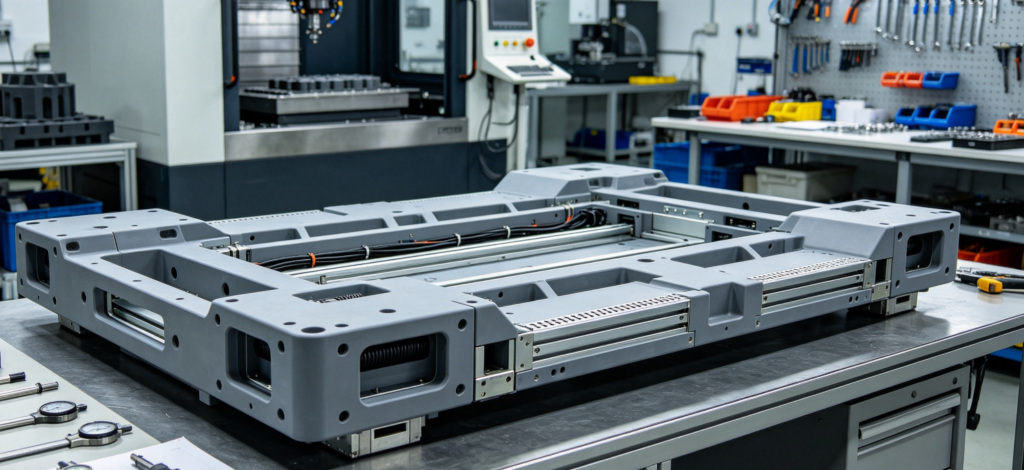
An industrial automation OEM required a 960mm single-piece equipment chassis prototype for customer on-site demo and fit testing, FR PC/ABS flame retardant spec, no visible split seams.
Original Alternative Options
- Sheet metal welded assembly: 28-day lead time, $4,600 total, multiple weld lines and alignment gaps
- Split small FDM 3-piece bonded design: 10-day lead time, $3,100, weak glue seams at vibration test
- Large format pellet extrusion mockup: 7-day lead time, $2,200, too coarse surface for customer demo cosmetic standards
Selected Solution: Large Heated-Chamber FDM Single-Piece Print
- DFM redesign added symmetrical internal rib lattice to suppress warpage, uniform 3mm shell wall
- Halogen-free FR PC/ABS filament printed monolithically in one 48-hour build cycle
- Soluble support removed, light sanding + matte black powder coat post-processing
Final Outcome
Total lead time 4 business days, total cost $2,750, seamless single-piece chassis passed vibration and flame safety fit testing, ready for customer field demo without assembly seams.
Frequent Large Format Printing Defects & Industrial-Grade Fixes
- Severe large-panel warpage / dimensional shrink drift Root cause: Unbalanced cooling, thin unsupported flat panels, inconsistent wall thickness Fix: Add cross rib reinforcement, uniform shell wall 2.5–4mm, full heated chamber FDM instead of pellet extrusion
- Layer delamination / chassis cracking under vibration testing Root cause: Low print temperature, insufficient inter-layer bonding, non-carbon filled filament Fix: Raise chamber/nozzle temp, switch carbon-reinforced thermoplastic, lower print speed for full layer fusion
- Bonded split part seam offset & visible crack lines Root cause: Simple butt joints without interlocking flanges, uneven epoxy application Fix: Integrate tongue-and-groove alignment flanges in CAD, precision fixture clamping during curing
- Coarse surface texture unable to reach cosmetic specs Root cause: Pellet extrusion thick layers or low-resolution FDM Fix: Upgrade to large industrial SLA for cosmetic panels or add heavy sanding/primer surface prep
- Internal rib sagging during long print cycles Root cause: Over-spanning unsupported rib geometry, thin wall shells Fix: Reduce rib span length, add secondary cross lattice bracing, increase shell wall thickness
Sourcing Checklist to Qualify Reliable Large Format 3D Printing Vendors
- Industrial heated-chamber large FDM equipment (≥1000mm build volume) for low-warpage functional prototypes
- Full material certification for FR, ASA, PC engineering thermoplastics with MTR traceability
- Proven portfolio of single-piece oversized equipment chassis prototypes (≥800mm)
- In-house post-processing: soluble support removal, sanding, priming, powder coating finishing
- DFM engineering team specialized in large-part warpage prevention and rib reinforcement design
- Clear single-piece vs split bonded cost breakdown with full seam labor disclosure
- Ability to provide dimensional inspection reports for critical mounting datums
- Enclosed factory climate control to stabilize large-part print environment
- No hidden rush surcharges for expedited large-format prototype batches
FAQ
What is the maximum single-piece size achievable with industrial large format FDM?
Standard Stratasys F770/F900 systems deliver monolithic prints up to 1000 × 610 × 610 mm; larger parts require split tongue-and-groove bonding or pellet extrusion robotic LFAM.
Is large format FDM strong enough for functional load-bearing equipment frames?
Yes, using carbon-filled PC/ABS filament with optimized internal rib lattice design; avoid pure ABS for sustained vibration/load testing.
When should I choose pellet extrusion LFAM instead of large FDM?
Only for non-load-bearing visual mockups over 1m size where raw material cost is the top priority and cosmetic precision is not required.
Can large format SLA print functional EV flame-retardant equipment housings?
SLA resins have low heat resistance and brittle mechanical properties; FR PC/ABS large FDM is the correct choice for high-voltage EV functional prototypes.
How much extra cost does splitting a large part into bonded sections add?
Bonding labor, joint machining and seam finishing typically add 40–70% to the raw printing cost, plus extended lead time and structural weakness risks.
Wrap-Up
For most functional industrial equipment prototypes under 1m requiring balanced strength, cosmetic flexibility and fast turnaround, heated-chamber large format FDM is the optimal all-around solution, enabling single-piece monolithic builds to eliminate bonded seam defects.
- Pick Pellet Extrusion LFAM: Oversized >1m non-functional visual mockups, lowest material budget
- Pick Large Industrial SLA: Customer-facing cosmetic panels requiring ultra-smooth surface finish, no structural load
- Pick Large-Bed SLS Nylon: Complex integrated lattices/internal channels where split assembly is impractical, size under 750mm
Zorapid operates industrial large-format heated-chamber FDM systems capable of single-piece prints up to 1000mm, stocked with ASA, ABS, carbon-filled PC and halogen-free FR PC/ABS materials for automation, EV and agricultural equipment prototypes. Our engineering team provides free DFM warpage optimization analysis and transparent single-piece vs split bonded cost comparison before printing.
Request Free Large Format Equipment Prototype DFM Review & Quote
Share your equipment chassis CAD, maximum part dimension, load/flame resistance requirements and cosmetic finish specs. We will deliver a full itemized cost breakdown, print cycle timeline and DFM rib reinforcement proposal to avoid warpage and bonding seams.