Published by: Zorapid.Ltd
316L austenitic stainless steel is the top material for medical implants, fluid fittings, and corrosion-resistant precision shafts.
But it’s also one of the gummiest metals you will ever turn.
Ramp up speed too high, and you get instant built-up edge (BUE). Drop feed too low, and the surface work-hardens into a rock-hard layer. You end up with chatter marks, torn grain, burr-filled edges, and insert failure after just a few parts.
At Zorapid, we run hundreds of precision turning jobs on 316L every month, both on standard CNC lathes and sliding-head Swiss machines. Our team has locked in repeatable feeds, speeds, tool geometry and coolant settings to hold ±0.005mm tolerance and consistently hit Ra 0.2–0.4μm without fighting tool wear all shift long.
This guide gives you shop-verified cutting parameters split for roughing and finishing. We break down tool selection, chip control, work-hardening fixes, and the exact Swiss lathe settings for slender bar stock. You can plug these numbers directly into your G-code for medical, aerospace and marine 316L components.
If you keep struggling with poor surface finish and short insert life on 316L, these calibrated settings will eliminate most of your daily headaches.
Why 316L Destroys Standard Turning Parameters
First, understand the material’s bad habits so you don’t fight the metal itself.
316L is low-carbon austenitic stainless steel with these three machining pain points:
- Severe work hardening Light cuts and low feed rates squeeze the surface and create a hardened skin. The next pass just rubs instead of cutting, wearing down the tool edge fast.
- Strong tendency to form BUE High friction sticks workpiece material to the insert rake face. BUE tears the part surface and ruins fine finishes.
- Poor chip breaking Long stringy chips wrap around the tool and bar, recutting finished surfaces and creating jagged burrs on cutoff edges.
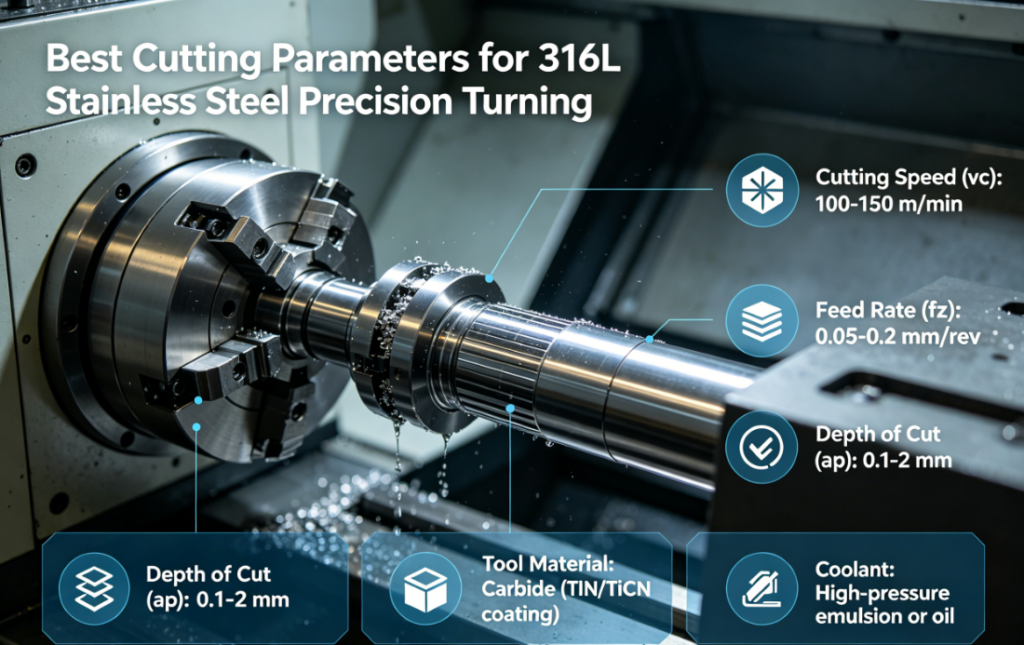
Mild steel parameters will never work here. You need positive-rake sharp inserts, controlled SFM, steady feed, and aggressive high-pressure coolant directed straight into the cutting zone.
Correct Tooling
1. Insert Grade & Coating (Non-Negotiable)
- Grade: Fine grain carbide M-grade for stainless steel (ISO M15–M25 substrate)
- Coating: AlCrN or multi-layer TiAlN PVD coating. TiN wears too fast against 316L heat.
- Never use uncoated carbide or steel turning inserts — they will load up with BUE in minutes.
2. Insert Geometry for Precision Turning
- Rake angle: Positive 8°–12° to lower cutting force and reduce sticking
- Relief angle: 6° primary relief to avoid rubbing the newly machined surface
- Edge prep: Light hone 0.03–0.05mm (0.001–0.002 inch). Too sharp edges chip easily; heavy hones create extra friction.
- Chipbreaker: Specialized U-shaped chip groove for gummy stainless steel, designed to curl long chips into small segments.
- Nose radius: • Roughing: R0.8mm • Precision finishing (Ra ≤0.4μm): R0.4mm smaller radius to reduce feed marks and chatter.
3. Tool Holding Rule
Minimize tool overhang. Keep the holder rigid to eliminate vibration. Even perfect parameters will produce chatter if the tool flexes.
Standard CNC Lathe Turning Parameters (316L Bar Stock)
All values tested on solid 316L bar, rigid fixture, high-pressure through-tool coolant.
We use SFM (surface feet per minute) as the base unit for global machine shops.
Roughing Operation (Material Removal, DOC Heavy Cut)
| Cutting Factor | Recommended Setting | Notes for 316L |
|---|---|---|
| Cutting Speed (SFM) | 100 – 140 | Start at 120 SFM; lower if BUE builds up fast |
| Feed Rate (IPR) | 0.007 – 0.012 | Never drop feed below 0.006 IPR — stops work hardening |
| Depth of Cut (DOC) | 0.030 – 0.070 inch (0.75–1.8mm) | Avoid light shallow roughing cuts |
| Coolant | 1000–1500 PSI flood coolant with stainless steel cutting fluid | Direct jet on the rake face to wash chips away |
Key roughing rule: Take deeper cuts with steady feed, not tiny skimming passes. Shallow cuts trigger surface hardening on 316L every time.
Precision Finishing Operation (Tight Tolerance + Ra 0.2–0.4μm Surface)
This is the exact setting we use for medical-grade 316L shafts with ±0.0002 inch dimensional control.
| Cutting Factor | Recommended Setting | |
|---|---|---|
| Cutting Speed (SFM) | 150 – 190 | Higher speed breaks BUE adhesion on the insert |
| Feed Rate (IPR) | 0.003 – 0.006 | Low feed reduces tool marks for ultra-smooth finish |
| Depth of Cut (Finishing Stock) | 0.008 – 0.015 inch (0.20–0.35mm) | Small consistent finishing allowance |
| Nose Radius | R0.4mm | Critical to hold fine surface roughness |
| Coolant | Through-tool high-pressure coolant, full coverage on cutting edge |
When tuned correctly, this finishing set eliminates tearing and produces a uniform matte finish ready for passivation without extra hand polishing.
Swiss Lathe (Sliding Headstock) 316L Micro Turning Data
Slender bar stock (length > 3× diameter) vibrates easily, so we dial back speed slightly while holding feed steady. This is our Zorapid production setup for small medical pins and cannulated parts:
- Main Turning External Diameter
- SFM: 90 – 125
- Feed: 0.004 – 0.007 IPR
- DOC: Max 0.025 inch per pass to prevent bar deflection
- Cutoff Operation (Eliminate Exit Burr)
- Positive-rake grooving insert
- SFM = 80–100
- Reduce feed by 20% as the tool reaches the bar center
- Keep high-pressure coolant aimed directly into the cutoff gap to stop material smearing
- Cross-Drilling & Internal Boring Boring 316L needs lower SFM (70–90) with steady feed. Interrupted cuts will instantly harden the bore surface.
Swiss bonus tip: Use a guide bushing to support the bar right next to the cut. Less deflection means tighter concentricity and no chatter lines on slender shafts.
Coolant Formula That Stops BUE & Work Hardening
Coolant is half the battle with 316L turning. Flood cooling alone is not enough for precision work.
- Fluid Selection Use sulfurized EP (extreme pressure) stainless steel turning oil. Sulfur additives lower friction and stop material from welding onto the insert edge. Do not use generic soluble cutting fluid — it cannot handle the high heat of 316L turning.
- Delivery Method
- Standard lathe: 800–1200 PSI external flood, two nozzles covering both rake face and flank face.
- Precision Swiss & fine finishing: Through-tool coolant (1500 PSI) so fluid penetrates right between chip and insert.
- Never let the cutting zone run dry. Even a short dry cut creates a hardened skin that ruins your next finishing pass.
The 4 Most Common Parameter Mistakes That Ruin 316L Turning
We see these four errors on nearly every customer’s initial 316L turning program:
1: Running too low feed to get a better finish
Feed below 0.003 IPR creates work-hardening. The insert rubs instead of shearing metal. The surface turns gray and the tool edge breaks down quickly.
Fix: Keep feed above 0.004 IPR for roughing; only lower feed slightly in finishing, never run skimming passes.
2: Mixing high SFM with poor chip control
Cranking SFM above 220 creates excessive heat. The 316L welds firmly to the insert rake face, forming thick BUE that tears the part surface.
Fix: Cap finishing SFM under 200 and add a chipbreaker insert to curl chips away fast.
3: Too small finishing stock left after roughing
Leaving less than 0.006 inch stock creates a light scraping cut. The cutter rubs the hardened layer left by roughing.
Fix: Always leave 0.008–0.015 inch consistent finishing allowance on all OD surfaces.
4: Stopping spindle mid-cut
Pausing the feed while the tool is engaged instantly work-hardens that small spot. You will get a visible groove and premature edge chipping.
Rule: Never stop spindle or feed during a continuous turning pass on 316L.
Real Zorapid Case – Tuning Parameters to Hit Ra 0.3μm on Medical 316L Shaft
Project Details
316LVM implant pin, 8mm diameter, length 45mm, required OD tolerance ±0.004mm, surface finish Ra ≤0.4μm.
Initial Program Problems
- SFM set too high (240), feed too low (0.002 IPR)
- Generic steel insert without chipbreaker Result: Heavy BUE, torn surface, inconsistent roughness, insert wear after 12 parts. Scrap rate hit 28%.
Our Parameter & Tooling Revision
- Switched to AlCrN positive-rake M-grade carbide insert with U-groove chipbreaker, R0.4 nose radius
- Reset finishing data: SFM=175, feed=0.0045 IPR, finishing DOC=0.012 inch
- Activated 1400 PSI through-tool EP coolant focused on the cutting edge
- Removed light skimming passes; kept roughing cuts deep to avoid surface hardening
Final Outcome
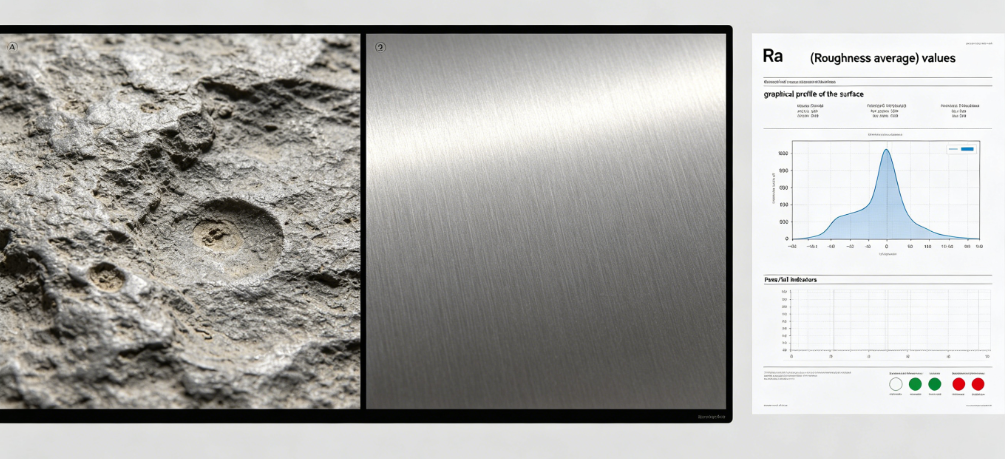
Surface roughness stabilized at Ra 0.28–0.35μm consistently. Insert life tripled, scrap rate dropped below 1%. Concentricity stayed within GD&T limits across the full 500-piece batch. No secondary polishing was needed before passivation.
Quick Parameter Checklist You Can Save for Every 316L Job
Positive rake (8°–12°) coated M-grade carbide insert with chipbreaker
Roughing: Deep DOC + steady feed, no light skimming cuts
Finishing SFM locked between 150–190; feed ≥0.003 IPR
0.008–0.015 inch consistent finishing stock
High-pressure EP sulfurized coolant aimed directly at the cutting zone
No spindle stops while the tool is engaged on the workpiece
Rigid tool setup with minimal overhang to eliminate chatter
Stick to this list, and you will eliminate BUE, work hardening and chatter on 95% of your 316L precision turning runs.
How Zorapid Optimizes 316L Turning for Precision Medical & Marine Parts
With 20+ years of precision turning on stainless steel alloys, we run both conventional CNC lathes and multi-axis Swiss turning centers for global customers.
Our process control for 316L components includes:
- Pre-job simulation to lock feeds, speeds and chip control before the first bar runs
- Edge honing and insert selection matched strictly to 316L’s low-carbon austenitic properties
- High-pressure through-tool coolant systems to suppress heat and built-up edge
- First-article surface roughness testing (Ra measurement) + dimensional CMM inspection
- Stable thermal environment to hold sub-micron repeatability on slender bar stock
We cut down trial-and-error setup time and keep surface finish consistent batch after batch.
Conclusion
Bad surface finish and short tool life on 316L are almost never machine issues. They come from wrong speeds, too-light feeds, poor insert geometry, and insufficient coolant.
Three core takeaways for precision turning:
- Use positive-rake coated stainless steel inserts with chipbreakers to fight BUE and stringy chips.
- Avoid tiny skimming passes — deep roughing cuts prevent work hardening on the surface layer.
- Run calibrated SFM and feed numbers, paired with high-pressure EP coolant to keep the cutting zone cool and clean.
Once your feeds, speeds and tooling are aligned with these shop-verified parameters, you will hold tight tolerances and reliably hit Ra 0.2–0.4μm finishes without endless tool changes and rework.
Send your 316L part drawings to Zorapid today. Our turning engineers will tune the cutting parameters and deliver consistent precision parts on schedule.
FAQ
What SFM should I start with on new 316L turning jobs?
Start roughing at 120 SFM and finishing at 170 SFM. Raise speed slightly if chips stick to the insert; lower speed if flank wear appears fast.
Why does low feed make 316L work-harden worse?
Minimal feed creates pure rubbing friction instead of clean shearing. This compresses the grain structure and forms a hard martensitic skin on the workpiece surface. Always keep feed above 0.003 IPR.
Can I achieve Ra 0.4μm without hand polishing on 316L?
Yes. Use R0.4 nose radius insert, low finishing feed, stable rigid setup and through-tool high-pressure coolant. Our standard finishing program consistently hits Ra 0.25–0.4μm straight off the lathe.
Is flood coolant enough for precision 316L turning?
Flood works for roughing. For ultra-fine finishing on medical components, through-tool high-pressure coolant is required to flush BUE material away before it welds onto the insert edge.
What is the best insert chipbreaker shape for 316L?
U-shaped closed chip grooves designed for gummy austenitic stainless steel. Open chipbreakers produce long stringy chips that wrap around the bar and create burrs.