Publisher: Zorapid.Ltd
If you build blanking dies, stamping molds or high-volume plastic tooling, you rely heavily on cold work steel mold bases.
Grades like D2 and Cr12MoV deliver incredible hardness and wear life up to HRC 64.
But they come with one major headache: extreme residual stress.
You mill all six faces perfectly on the CNC machine. The base looks flat right after cutting.
One or two days later, the plate bends upward. Dowel pin holes shift out of alignment. Guide surfaces lose perpendicularity.
Your assembled mold ends up with uneven shut-off and premature die wear.
Cold work steel’s poor thermal conductivity and heavy internal stress make precision milling far harder than ordinary mold steel.
At Zorapid, we machine hundreds of large cold work steel mold bases every year for European and North American stamping & injection mold projects.
We lock flatness below 0.008mm and stop post-machining warpage entirely with a strict multi-stage milling workflow.
Today we walk through the complete precision process, common defects, and proven shop-floor improvements. No theory — every step runs on our rigid gantry CNC machines.
Why Cold Work Steel Bends So Badly During Mold Base Machining
First, let’s break down the material’s tricky properties that ruin mold base accuracy:
- High carbon alloy creates massive locked stress during forging and vacuum hardening.
- Low heat conductivity traps cutting heat inside the plate instead of dissipating quickly. Local hot spots cause uneven expansion and contraction.
- Heavy material removal during rough milling releases internal stress, slowly bending thick mold frames over 24–72 hours.
- Cold work hardening builds edge tension if you run heavy deep cuts with dull tooling.
Most factory make the same fatal mistake:
Rough mill → skip stress relief → jump straight to finish milling.
The result is unavoidable dimensional drift long after the part leaves the machine.
Stage 1: Raw Steel Pre-Treatment — Lay The Foundation For Stable Milling
Precision starts before the first CNC cut. Poor blank preparation causes 60% of mold base warpage.
Zorapid Standard Material Rules
- Only select vacuum-annealed ESR refined D2 or Cr12MoV blanks. Low-quality rolled steel has uneven grain and unpredictable stress release.
- Run pre-rough stress relief annealing at 620–650°C, hold for 3 hours, then slow furnace cooling. This eliminates 70% of original mill-scale residual stress.
- Let the blank sit in a constant-temperature workshop (20±2°C) for 48 hours to stabilize temperature before clamping. Thermal expansion skews all datum surfaces.
- Keep uniform machining allowance on all six faces: 0.6~0.8mm stock left for semi-finish and hard milling. Never remove material unevenly on opposite sides.
Stage 2: Symmetrical Rough Milling
Roughing removes 90% of excess stock. This step generates huge mechanical stress inside thick mold bases.
Bad Old Workflow
Deep full-depth cuts, one-sided material removal, high radial engagement. The plate bends the second you release clamps.
Optimized Rough Milling SOP For Cold Work Steel
- Machine the mold base symmetrically. Alternate material removal on top & bottom, front & rear faces to balance stress release evenly.
- Use dynamic high-speed toolpaths instead of raster milling. Keep radial cut width under 15% to lower side force on the steel plate.
- Use coated carbide face mills with sharp cutting edges to reduce cold work hardening on the surface.
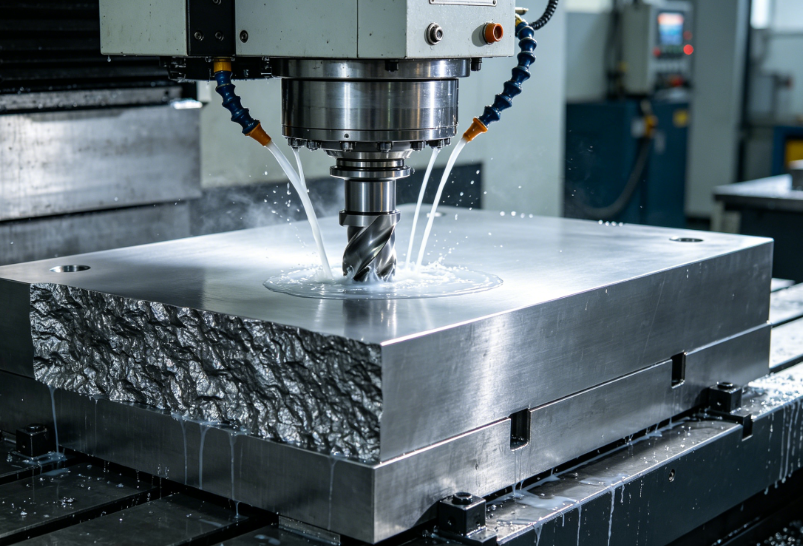
- Run high-pressure flood coolant to carry trapped heat away and avoid localized overheating.
- After rough milling completes, loosen all clamps slightly and let the plate free-relax for 4 hours before moving to heat treatment.
Stage 3: Intermediate Aging — The Most Critical Step To Stop Warpage
This is the difference between a stable mold base and a warped reject.
After rough milling cuts away most material, locked cutting stress is fully exposed.
If you skip this aging process, the mold frame will slowly deform for days after finishing.
Strict Heat Treatment Process
- Artificial stress relief tempering at 580–600°C, hold 2.5~3 hours, slow cooling inside the furnace.
- We never air-quench cold work steel after heating. Rapid cooling creates brand-new tension inside the plate.
- After aging, let the mold base cool naturally down to ambient workshop temperature before re-clamping for semi-finishing.
Measurable improvement:
Without aging: 0.03~0.05mm post-machining warpage
With one intermediate aging: Total deformation drops below 0.01mm
Stage 4: Semi-Finish Milling & Datum Preparation
Semi-finishing trims stock down to 0.15~0.25mm finishing allowance. This phase locks all reference planes for final precision work.
Key Process Controls
- Machine the primary datum surfaces first: bottom mounting face and two perpendicular side edges. These datums control all hole positions and perpendicularity.
- Keep climb milling consistent across the entire plate to avoid surface step lines and uneven residual tension.
- Reduce cutting depth further to prevent surface hardening on guide mating faces.
- Leave all dowel holes, ejector pin holes and cavity pockets for post-hardening finish machining. Drilling large holes early breaks the plate’s structural rigidity and triggers bending.
Stage 5: Vacuum Hardening + Triple Tempering
Cold work steel mold bases usually reach HRC 60–63 after quenching. Heat treatment brings new phase transformation stress.
Zorapid Hardening Standard For D2 & Cr12MoV
- Vacuum oil quenching at 1080°C to avoid uneven cooling and plate bending.
- Run triple low-temperature tempering instead of a single temper cycle. This eliminates retained austenite and stabilizes the steel microstructure long-term.
- Optional deep cryogenic treatment (-120°C for 12 hours) for ultra-stable long-running stamping die bases, to stop slow dimensional shift over millions of production cycles.
- After tempering, straighten minor distortion while the plate still holds mild heat. Cold straightening introduces new stress, so we avoid it completely.
Stage 6: Hard Milling For Final Precision
Once hardened, we carry out low-stress hard milling on all six faces and precision hole features.
This stage locks flatness, squareness and position tolerance.
Hard Milling Parameters For Cold Work Steel Mold Bases
- Tool: AlTiN coated micro-grain carbide end mills, short rigid shank to eliminate tool deflection.
- Cut strategy: Light, shallow finishing passes. Radial engagement limited to 5–8% to keep cutting force minimal.
- Keep the mold base fully clamped on a solid full-support plate. No overhanging sections during finishing.
- Pause the CNC cycle periodically to let the plate cool fully. Continuous long cutting cycles build thermal gradient and bend thick plates.
- Machine all pin holes and locating dowel holes in the final operation, so the rigid solid plate does not lose structural integrity early in the process.
Final Precision Target We Consistently Hit
- Surface flatness: ≤ 0.006mm over 500mm plate
- Perpendicularity of adjacent sides: ≤ 0.005mm
- Dowel hole position tolerance: ±0.004mm
- Surface Ra: 0.4~0.8μm without extra surface grinding
5 Common Cold Work Steel Mold Base Defects & Quick Fixes
We resolve these 5 issues daily on our production floor:
1. Plate Warps Upward After Finishing
Root cause: Unreleased rough-machining stress; skipped intermediate aging treatment.
Fix: Add stress relief annealing right after rough milling; machine both sides symmetrically.
2. Adjacent Faces Lose Squareness
Root cause: Repeated re-clamping and datum shift; uneven clamping force.
Fix: Machine all 6 faces in minimal setups; use zero-point fixture positioning to eliminate re-alignment error.
3. Hardened Surface Has Chatter Vibration & Tool Burns
Root cause: Long tool overhang, heavy side cuts, insufficient coolant penetration.
Fix: Use short rigid tool holders, split into light finishing passes, apply through-spindle high-pressure coolant.
4. Dowel Pin Holes Shift Position After Stabilization
Root cause: Drilling holes before finishing the main plate; the plate deforms after material removal.
Fix: Complete all face milling first, then drill and ream locating holes as the final operation.
5. Surface Hardening Creates Brittle Edge Cracks
Root cause: Conventional up-milling and excessive cutting pressure.
Fix: Stick strictly to climb milling with sharp coated carbide cutters.
Zorapid Full Standard Process Workflow
- ESR cold work steel blank → Pre-rough stress relief annealing
- Symmetrical 6-face rough milling → Leave 0.6~0.8mm stock
- First aging treatment to release cutting stress
- Semi-finish milling of all datum planes → Leave 0.2mm finishing allowance
- Vacuum quenching + triple tempering (HRC 60–63)
- Low-stress hard milling for all mating faces
- Precision reaming of locating dowel & guide holes
- Keep the mold base clamped and cool naturally for 24 hours
- Full 3D CMM inspection on flatness, squareness and hole position
Production Data:
Old 2-step process: 22% rejection rate from warpage
Our multi-stage stress-controlled process: First-pass yield >97%, no delayed dimensional drift
Real EU Client Case Study
A German automotive stamping OEM ordered a 600×450mm Cr12MoV cold work steel mold base.
Their previous supplier had two major problems:
- The large plate warped 0.04mm within 48 hours after CNC milling
- Adjacent guide surfaces lost squareness, causing die binding during high-speed stamping
We applied our full multi-stage process:
Pre-annealed steel → symmetrical roughing → intermediate aging → vacuum triple temper → low-load hard milling.
Final inspection result:
Flatness held within 0.007mm, perpendicularity error below 0.005mm, zero post-machining deformation after 7 days of stabilization.
The stamping die ran 800,000 blanking cycles without alignment issues.
Quick Troubleshooting Checklist For CNC Operators
| Defect | Root Cause | Fast Improvement |
|---|---|---|
| Mold base slowly warps after machining | Trapped roughing stress | Add intermediate aging after rough milling |
| Poor squareness on 6 faces | Multiple re-clamping | Minimize setups with zero-point fixtures |
| Burnt, work-hardened surface | Heavy deep cuts + poor cooling | Light shallow passes + high-pressure coolant |
| Hole positions drift over time | Early hole drilling | Finish plate first, machine holes last |
| Hard milling leaves wave chatter | Long tool overhang | Short rigid carbide tooling + low radial engagement |
Conclusion
Cold work steel mold base precision milling is not just about rigid CNC machines.
Stable accuracy depends entirely on controlling residual stress at every production stage.
You must split the process into roughing, stress relief, heat stabilization, and low-load hard milling.
Skipping even one aging step leads to costly warpage and assembly problems.
At Zorapid, we specialize in D2 and Cr12MoV cold work steel mold frame manufacturing for stamping dies and high-volume injection molds.
We hold micron-level flatness and eliminate delayed deformation for clients across Europe and North America.
If you keep fighting mold base bending and tolerance drift on cold work tool steel, send your STEP files. Our engineers will deliver a free optimized milling & heat treatment plan for your next project.
FAQ
Do I need triple tempering for small cold work steel mold bases?
Small inserts can use double tempering, but large mold frames always need triple low-temperature tempering. It removes retained austenite and prevents long-term slow shape shift after hardening.
Can I skip intermediate aging to shorten lead time?
You can shorten heating time, but never fully eliminate this step. Rough milling creates massive tension inside thick steel plates. Most warpage appears 2–3 days after machining without stress relief.
Is hard milling better than surface grinding for hardened mold bases?
High-precision hard milling delivers Ra 0.4~0.8μm directly on the CNC. It avoids the extra clamping and thermal stress generated during surface grinding, so the plate stays flatter long-term.
How to machine both sides without bending the thick plate?
Alternate top-bottom material removal, keep even stock on all faces, and never finish one full side completely before touching the opposite face. Balanced material removal keeps stress evenly distributed.