Publisher: Zorapid.Ltd
If you run a 5-axis CNC workshop for mold inserts, aerospace parts or medical components, you know the biggest production bottleneck.
Your spindle sits idle while operators spend hours re-aligning vices, touching off edges, and dialing fixtures back to zero.
Switching from one complex job to the next easily takes 2 to 3 hours.
Machine uptime drops, batch lead times stretch out, and your profit melts away during long setup cycles.
Repeated re-clamping also creates positioning errors, leading to out-of-tolerance parts and unnecessary scrap.
At Zorapid, we rebuilt our entire 5-axis production cell around zero point quick-change fixtures.
We cut job changeover time by more than 90%, and boosted spindle runtime by 28% across all high-mix orders.
Today we break down exactly how zero point systems cut 5-axis setup time, fix alignment errors, and unlock lights-out unmanned production. Every data point comes from our daily five-axis production runs.
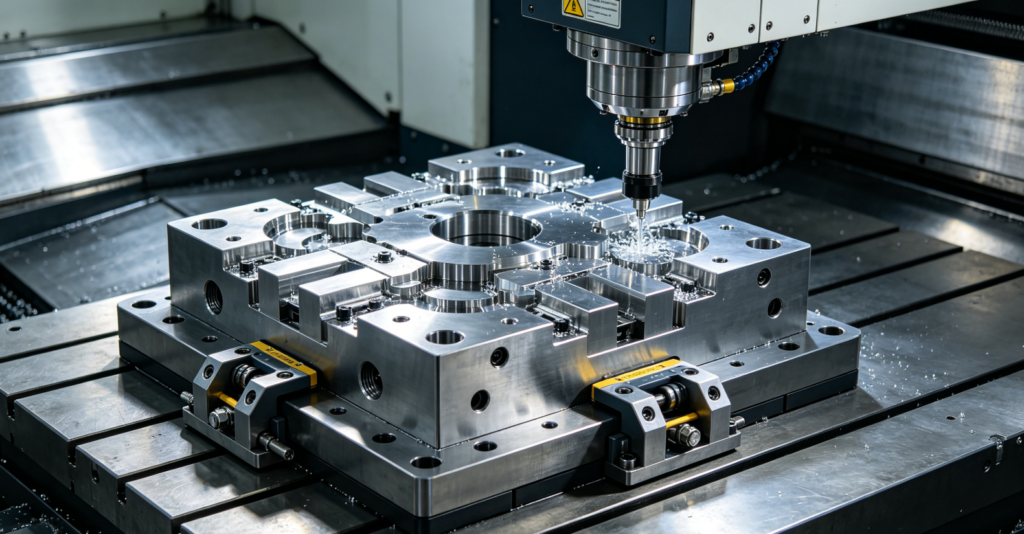
What Makes 5-Axis Setup So Slow Without Zero Point Fixtures?
Traditional workholding creates three huge time-wasting problems unique to five-axis machining.
1. Manual zero-setting eats machine runtime
Operators have to clamp the vise, edge-find every corner, touch off X/Y/Z zero, and adjust tilt for trunnion work.
All this work locks up your 5-axis machine while no chips are being cut.
2. Re-clamping causes cumulative positioning drift
Every time you unbolt and rebolt a fixture, datum shifts slightly.
For complex 5-sided parts, even 0.02mm offset creates mismatched features and parting line steps on mold cores.
3. No offline preparation
You cannot prep the next job while the machine is running.
One job ends, then you tear down the fixture and build the next one right on the machine table.
This creates nonstop downtime between batches.
Real Shop Data (Old Process)
Average 5-axis job changeover: 130–160 minutes
Position repeatability after re-clamping: ±0.020 ~ ±0.030mm
Spindle uptime: Only 52% of total machine shift
How Zero Point Fixture Works For 5-Axis Trunnion Tables
Zero point clamping uses two simple matched components:
- Base receiver plates hard-mounted permanently to your 5-axis machine table or trunnion plate. The datum origin is set once and locked forever.
- Quick-change pallets with built-in positioning studs. Your vise or custom fixture bolts firmly onto these pallets offline.
When you switch jobs:
You just drop the pre-fixtured pallet into the receiver plate.
Tapered locating pins lock the pallet into the exact same X/Y/Z position every single time.
No edge finding, no dial gauges, no repeated zero setting.
Positioning and clamping finish in 5 to 10 seconds per pallet.
Key advantage for 5-axis work:
Zero point pallets sit low profile, with minimal clamping protrusion.
You get full unobstructed tool access for 5-sided machining without fixture collision.
Core Benefit 1: Cut 5-Axis Setup Time By 90% Or More
This is the biggest payoff for small-batch, high-mix five-axis production.
Old Workflow
Machine stops → tear down fixture → clean table → mount new vise → align → edge find → set work zero → test cut → start production.
Total time: 2–2.7 hours per job swap.
Zero Point Optimized Workflow
- Prep the next fixture and workpiece on a free workbench offline while the machine is still cutting parts. No spindle downtime wasted.
- Once the first batch finishes, unlock the old pallet and lift it out.
- Drop the pre-loaded new pallet into the zero point base, lock the air or mechanical clamp.
- Call up the saved work offset and run the program immediately.
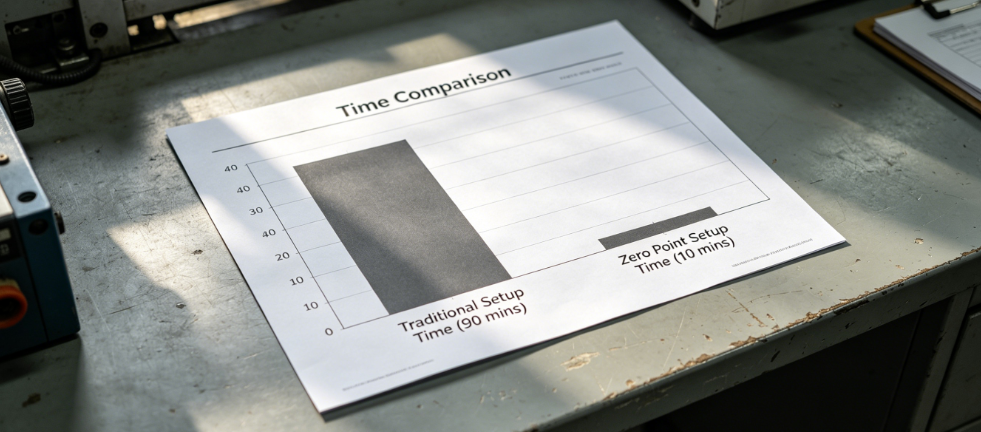
Measurable Time Result At Zorapid:
Job changeover dropped from 140 minutes down to just 7–10 minutes.
We eliminated more than 130 minutes of idle machine time between orders.
For shops running 6+ job switches per day, the saved hours add up to a full extra shift of production every week.
Core Benefit 2: Micron-Level Repeatability Eliminates 5-Axis Alignment Errors
5-axis multi-sided parts cannot tolerate inconsistent re-clamping.
Every time you reposition a fixture manually, you introduce small shift errors on complex curved surfaces and deep cavity features.
Zero point tapered cone positioning holds repeatability steady within ±0.002mm every single time you lock the pallet in place.
- No more offset drift after repeated job swaps
- No mismatched 5-axis multi-face features
- No more test cuts just to verify position For mold core & cavity, titanium aerospace blanks and thin medical inserts, this eliminates most rework caused by fixture positioning.
We used to scrap 7% of complex 5-axis parts due to re-clamp offset.
After switching to zero point fixtures, scrap from alignment errors fell below 0.8%.
Core Benefit 3: Offline Fixturing Maximizes 5-Axis Spindle Uptime
Machine time is your most expensive asset in a five-axis workshop.
Zero point splits production into two independent workflows:
- On-machine: Pure metal cutting, no fixture setup work
- Off-bench: Fixture assembly, part clamping and zero presetting on free auxiliary tables
Operators can load multiple pallets during runtime, so the machine never sits waiting for the next job.
This single change lifted our 5-axis spindle utilization from 53% up to 81%.
You do not need to buy a second expensive five-axis machine to boost throughput; just cut idle setup time with zero point workholding.
Core Benefit 4: Zero Point Pallets Enable Lights-Unmanned 5-Axis Machining
Unattended night runs only work if fixtures can be swapped reliably without human alignment.
Zero point standardized pallets let you stack multiple pre-loaded workpieces ready for sequential machining.
Robots can pick and place pallets automatically without manual zero correction.
At Zorapid, we built our unmanned 5-axis cell fully around zero point clamping.
We run 8-hour overnight lights-out batches without operator attendance, with zero positioning failure.
4 Critical Zero Point Setup Rules For 5-Axis Trunnion Machines
Poor installation ruins the whole system’s speed and precision. Follow our 4 shop-tested rules.
1: Lock base plates once, never re-zero again
Mount zero point receiver bases to your trunnion plate, set the global work offset one time, then seal and lock the datum.
Never re-indicate the base plate after initial installation. All pallets share this fixed origin.
2: Keep pallets low-profile to avoid 5-axis collision
Select thin zero point modules with minimal height.
Raised heavy blocks will block tool travel when the trunnion tilts steeply for deep cavity machining.
We use flat 26mm low-profile zero point bases for all five-axis mold work.
3: Standardize one grid across all your CNC machines
Use the same 52mm or 96mm grid pattern on every 5-axis and 3-axis machine in your shop.
Pallets can move freely between machining centers, CMM inspection stations and secondary EDM work without re-alignment.
One fixture fits every machine in your workshop.
4: Separate roughing and finishing pallets
Keep dedicated pallets for rough heavy cutting and fine finishing.
Heavy roughing creates clamping shock and tiny seat wear.
Isolate finish pallets to preserve micron-level positioning accuracy long-term.
Real Client Case Study
A German aerospace supplier sent us Ti-6Al-4V five-axis structural components.
Their old setup process had two major pain points:
- Job changeover took 2 hours and 20 minutes between different fixture layouts
- Repeated re-clamping caused 0.025mm feature offset on 5-sided surfaces, forcing repeated correction runs
We retrofitted their DMG 5-axis trunnion table with a full zero point pallet system.
All vise workholding moved onto offline quick-change pallets with unified datum.
Final measurable results:
Job swap time cut from 142 minutes down to 9 minutes
Position repeatability locked at ±0.003mm with zero feature offset
Spindle productivity increased by 27%
Total labor cost for fixture alignment dropped by 75%
The client recouped the cost of zero point hardware within just 3 months of production.
Zero Point Fixture ROI Breakdown For 5-Axis Shops
- Saved setup labor: Cut 120+ minutes of operator work per job change
- Higher spindle runtime: More finished parts without buying new 5-axis equipment
- Less scrap: Eliminate re-clamp positioning errors on precision components
- Enable overnight unmanned batches: Add extra production capacity without extra manpower For most high-mix five-axis workshops, zero point clamping delivers full payback in 2–4 months.
Quick Troubleshooting Checklist For Zero Point 5-Axis Workholding
| Problem | Root Cause | Fast Fix |
|---|---|---|
| Pallet sticks and cannot release | Chips stuck inside tapered seats | Add air-blow self-cleaning zero point modules |
| Minor repeatability drift | Dirty locating cones | Clean taper seats before every pallet lock |
| 5-axis tilt creates tool collision | Over-height pallets | Switch to low-profile flat zero point bases |
| Long changeover still exists | Fixture prep done on machine | Move all clamping work to offline workbenches |
| Pallet shifts under heavy rough milling | Insufficient pull-down clamping force | Select pneumatic pull-type zero point clamping |
Conclusion
The biggest bottleneck on most 5-axis CNC machines is not cutting speed or tooling — it is endless fixture setup and re-alignment.
Zero point quick-change fixtures erase nearly all idle setup time between jobs.
You move all fixture preparation offline, lock your datum permanently, and swap workpieces in minutes with consistent micron precision.
You get higher spindle uptime, fewer alignment errors, and open the door to fully unmanned five-axis production.
At Zorapid, we implement zero point workholding across our entire five-axis mold and aerospace machining cell.
If you are stuck with long changeover times and inconsistent part accuracy on your 5-axis machines, send us your machine layout. Our process engineers can build a customized zero point fixture layout to slash your setup time dramatically.
FAQ
Can zero point fixtures fit all 5-axis trunnion and table types?
Yes. Modular zero point base plates mount flat on vertical 5-axis tables, rotary trunnions and horizontal machining centers. We use 52mm and 96mm standard grid systems for all common five-axis machine brands.
How much repeatability can I expect from zero point clamping?
Good mechanical zero point systems hold repeatability within ±0.002~±0.005mm consistently. This is stable enough for SPI Class mold inserts and aerospace tight-tolerance components.
Do zero point pallets interfere with full 5-sided machining?
Low-profile flat zero point modules sit almost flush with the machine table. They create far less obstruction than standard bolt-on fixture plates, so you get full tilt rotation without tool collision.
Can small prototype shops afford zero point workholding?
You can start with just 2–3 pallets first, no full-shop overhaul required. Even a small zero point setup cuts changeover time drastically for small-batch prototype orders.