Published:Zorapid.Ltd
If you design plastic molded parts for EV, medical diagnostic, semiconductor, or racing equipment, you’ve seen the same budget shock:
Custom injection mold tooling runs tens of thousands in upfront fees, and complicated multi-piece assemblies stack up endless labor hours during production. Most of this extra cost doesn’t come from material or machine time—it stems from unoptimized CAD design that forces complex mold mechanics and slow manual assembly workflows.
Design for Manufacturability (DFM) is the single most effective way to trim both one-time mold tool investment and recurring assembly overhead. Small CAD adjustments made before mold steel gets cut can cut tooling cost by 20–40% and slash assembly labor time in half.
This guide breaks down actionable, production-proven DFM tips split into two core focus areas: lowering injection mold tooling charges, and simplifying assembly to cut per-unit labor cost. We cover wall geometry, undercut elimination, part consolidation, snap-fit design, standardization, material matching, plus a full FAQ answering OEMs’ most common plastic tooling & assembly cost questions.
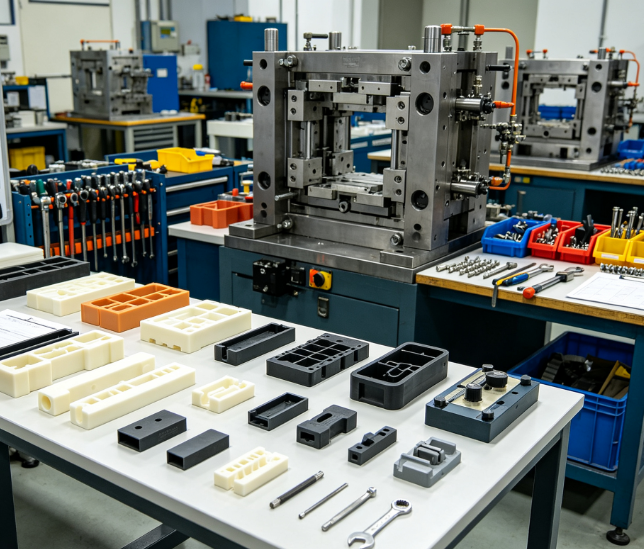
Core DFM Rules to Cut Injection Mold Tooling Expense
These design changes directly reduce mold complexity, required mold components, CNC mold machining hours, and mold lead time:
Rule 1: Eliminate internal/external undercuts wherever possible
Undercuts require costly slides, lifters, side cores, and custom mold inserts—each adds thousands to tool price and raises mold maintenance cost long-term.
- Redesign angled features to follow straight mold opening draw direction
- Replace hidden snap hooks with outward-facing simple tabs
- Reposition threaded bosses to avoid side pull mechanisms Cost win: Removing one slide/lifter assembly can cut mold tool cost by 15–25%.
Rule 2: Standardize all radii, draft angles, hole sizes
Custom unique dimensions force custom mold tool inserts and extra mold CNC programming.
- Universal minimum internal radius R0.8 / external R0.5
- Standard draft angle 1.5° for all vertical surfaces (avoid custom 0.5° special draft)
- Use industry standard hole diameters for fasteners, mounting pins This eliminates custom EDM and mold milling work, speeding mold build and lowering tool price.
Rule 3: Simplify parting line geometry
Complex stepped, jagged parting lines require precision hand-polishing and complex mold cavity matching. Smooth straight or gently curved parting lines reduce mold handwork hours drastically.
Avoid multiple stepped offsets that require tight mold plate fitting.
Rule 4: Design for multi-cavity mold layouts
Uniform part footprint, balanced mass distribution, and symmetric geometry enable 2/4/8 cavity molds. Multi-cavity molds drop per-piece molding cost without raising tool price proportionally vs single cavity tools.
Odd, asymmetrical part shapes limit cavity count and waste mold plate space.
Rule 5: Minimize deep narrow ribs & tiny micro-features
Extremely thin, deep ribs require slow EDM sinking for mold steel, adding mold build time. Widen rib thickness and shorten depth where performance allows to cut mold machining hours.
Rule 6: Avoid sharp internal corners in mold cavities
Sharp corners demand time-consuming wire EDM work. Consistent radii let mold makers use standard milling cutters instead of costly sinker EDM operations.
DFM Design Tweaks That Slash Manual Assembly Labor
Assembly labor is a permanent recurring cost for every production batch. These DFM changes cut assembly steps, fastener count, and human handling time:
Tip 1: Integrate snap-fit joints to eliminate screws, nuts, gaskets
Replace bolted connections with living hinges, cantilever snaps, annular full-circle snaps. Each removed fastener cuts picking, threading, torque checking, and inventory storage costs.
Well-designed snap fits can eliminate 30–80% of fasteners on a typical housing assembly.
Tip 2: Add built-in alignment locating tabs & guide posts
Separate alignment fixtures, shims, and positioning jigs add assembly time. Mold integrated self-locating tabs, male/female guide pins to let parts self-seat with zero manual adjustment.
Tip 3: Consolidate multiple small separate components into one single molded part
Every individual piece adds: separate mold tooling, separate inventory tracking, separate picking, separate assembly insertion steps. Merge brackets, covers, internal supports, and mounting bosses into one unified housing where molding geometry allows.
Tip 4: Design foolproof asymmetric assembly geometry
Add unique offset tabs, asymmetric cutouts, or polarized mounting holes to prevent backwards misassembly. This eliminates slow visual inspection rework and assembly mistakes that waste production time.
Tip 5: Integrate cable routing channels, clip bosses, and label recesses
Skip secondary plastic or metal cable brackets by molding routing grooves and clip posts directly into the main housing. Fewer loose small hardware items cut assembly part count dramatically.
Tip 6: Unify fastener sizes across full assembly
Mixing M2, M2.5, M3 screws forces operators to swap screwdriver bits constantly. Standardize to one single fastener size for all assembly points to speed up line throughput.
Material Selection DFM Strategies for Lower Tool & Build Cost
Material grade directly impacts mold steel requirements, cycle time, and assembly compatibility:
- Avoid high-performance filled resins (glass-filled, carbon-filled, flame-retardant) unless required Abrasive filled plastics wear mold steel faster, requiring hardened P20/H13 mold steel which raises tool cost by 20–35%. Use unfilled PP/ABS/PC for non-critical housings where thermal/structural loads are low.
- Match shrink rates for multi-mold assembly sets If your assembly uses two different molded parts with mismatched shrinkage, you’ll face fit issues requiring post-mold trimming and rework. Standardize base resin families across all mating components.
- Skip specialty medical high-temperature resins for non-contact cosmetic shells PEEK, PSU, PEI demand high-temperature mold bases, special heating circuits, and longer cycle times—both tooling and per-unit cost jump significantly. Reserve only for fluid-contact high-heat zones.
Wall Thickness & Rib Design: Eliminate Warpage & Mold Rework
Uneven wall thickness is the top cause of mold rework, dimensional warpage, and post-mold assembly fit failures:
- Maintain uniform wall thickness ±0.3mm across the entire part
- Rib thickness capped at 60% of main wall thickness to avoid sink marks on cosmetic surfaces
- Thick heavy bosses must be cored out to equalize wall mass—solid thick bosses create deep sink marks that require costly mold rework and surface polishing
- Avoid extreme thick-to-thin transitions that cause uneven shrinkage and assembly misalignment DFM payoff: Balanced wall geometry eliminates expensive mold steel rework and reduces manual post-mold sanding/trimming during assembly.
Undercuts, Slides & Lifters – The Biggest Tool Cost Drivers
If you can’t fully eliminate undercuts, use these DFM tricks to minimize mold complexity:
- Rotate part geometry to shift undercuts to the parting line Undercuts right at split lines only need simple parting line inserts, no expensive full side slides.
- Use flexible living hinge snaps instead of deep internal undercut hooks Living hinges form in the primary mold draw direction with zero side action required.
- Split large deep undercuts into multiple small shallow tabs Single massive undercuts require oversized heavy lifter assemblies; multiple small tabs use compact low-cost mold inserts.
- Avoid threaded internal bores that require unscrewing mold cores Replace molded internal threads with press-in metal thread inserts or external screw bosses to eliminate complex rotating unscrew mold mechanisms.
Multi-Part Consolidation: Cut Mold Count & Assembly Steps
Two major cost gains from part merging:
- One mold instead of two or three separate mold tools, eliminating tens of thousands in upfront tool investment
- Remove multiple assembly steps: picking, positioning, fastening, aligning separate pieces
DFM consolidation rules to avoid molding defects after merging:
- Keep mass balanced to prevent uneven shrinkage and warpage
- Avoid extreme geometry differences that create inconsistent cooling cycles
- Ensure all integrated features sit within the main mold draw direction to avoid new undercuts
Common Costly DFM Mistakes Engineers Repeatedly Make
- Over-specifying tight cosmetic tolerances across full part surface → extra mold hand polishing & inspection labor
- Random mixed radii, draft angles, hole sizes → custom mold inserts and longer mold CNC hours
- Solid thick un-cored mounting bosses → sink marks requiring mold rework
- Multiple deep internal undercuts requiring slides/lifters → massive tool cost increase
- Splitting a single logical housing into dozens of tiny molded sub-parts → extra molds + dozens of assembly steps
- Mixed fastener sizes with no unified standard → slow assembly line throughput
- Unbalanced wall thickness leading to warpage → fit failures and rework during assembly
- Specifying glass-filled resin for non-structural cosmetic shells → hardened expensive mold steel requirement
- Complex jagged stepped parting lines → hours of manual mold fitting labor
- No self-locating alignment features → slow manual positioning during assembly
Real-World Cost Reduction Case: Medical Diagnostic Plastic Housing
Project Background
OEM building lab diagnostic test equipment, original design split into 4 separate molded plastic housings with multiple internal undercuts, mixed screw sizes, solid un-cored bosses, no snap-fit joints.
Original Cost Breakdown
- Mold tooling: 4 separate injection molds + 6 slide/lifter assemblies → $42,800 total tool cost
- Assembly labor: 12 screw fasteners + separate alignment jigs → 3.2 minutes labor per unit
Applied DFM Cost-Saving Adjustments
- Consolidate 4 separate housings into one single integrated molded main shell
- Redesign all internal undercut hooks to outward snap tabs, remove all 6 mold slides/lifters
- Core out all thick mounting bosses to equalize wall thickness and eliminate sink marks
- Integrate cantilever snap joints to remove all 12 fasteners
- Mold integrated self-locating guide tabs to eliminate alignment jigs
- Standardize all radii and draft angles to universal mold shop specs
Measurable Final Results
- Total mold tooling cost reduced to $18,600 (56% tool cost cut)
- Assembly labor time dropped from 3.2 mins to 0.7 mins per unit (78% labor reduction)
- Zero mold rework required during tool build; no post-mold trimming rework on production lines
FAQ
Which single DFM change delivers the largest total cost savings?
Consolidating multiple separate molded parts into one single component. It cuts multiple mold tool purchases upfront and eliminates all associated assembly labor for those separate pieces, hitting both capital tool expense and recurring production labor costs at once.
How much do mold slides/lifters add to total tool price?
Each slide or lifter mechanism typically adds $3,000–$8,000 to mold tooling cost, plus longer mold build lead time and higher long-term mold maintenance fees. Redesigning to eliminate undercuts is one of the fastest ways to slash tool budget.
Can snap-fit designs fully replace screws without sacrificing part reliability?
Yes, when sized per DFM cantilever snap guidelines with proper wall thickness and radii. For non-high-vibration diagnostic, EV consumer and lab equipment, well-engineered snaps eliminate all fasteners with zero assembly failure risk. Heavy vibration racing hardware may require a small number of retention screws as backup.
Why does uneven wall thickness increase both mold and assembly cost?
Uneven mass creates uneven plastic shrinkage, sink marks, and warpage. This often requires mold rework (extra tool cost) and causes mating misalignment during assembly, forcing slow manual trimming and fitting labor that raises per-unit production expense.
Does part consolidation create molding defects that add hidden cost?
Only if executed without DFM checks. When balanced wall thickness, uniform shrinkage, and straight draw direction are maintained, consolidated single parts have fewer defects than multi-piece assemblies. Merging geometry with extreme mass differences will introduce warpage, so DFM review is mandatory before mold release.
How does material choice impact injection mold tool cost?
Abrasive glass/carbon filled resins wear mold cavities quickly, requiring expensive hardened H13 mold steel instead of standard P20, raising tool cost by 20–35%. High-temperature specialty polymers also add costly mold heating circuits and longer cycle times. Stick to unfilled commodity resins where functional specs allow.
What DFM steps cut assembly labor without changing core part functionality?
Add self-locating alignment tabs, unify all fastener sizes, integrate cable clip/routing features, implement snap fits instead of bolted joints, and design asymmetric polarized geometry to prevent backwards misassembly and rework.
Are multi-cavity molds always cheaper long-term?
Yes for volumes over 500 units, provided the part geometry is symmetric and balanced for multi-cavity layout. Asymmetrical, irregular shapes limit cavity count and waste mold plate space, so DFM tweaks to balance part footprint unlock higher cavity numbers and lower per-piece molding cost.
Can DFM reduce mold lead time alongside tool price?
Definitely. Standardized radii, draft angles, smooth simple parting lines, and zero undercut slide requirements cut mold CNC machining and hand-polishing hours, shortening total tool build timeline by 2–4 weeks on average.
Should I complete a DFM review before ordering mold steel?
Mandatory. Making design changes after mold steel is cut means costly rework, EDM modifications, or full mold rebuilds—costs that can exceed 30% of the original tool price. A pre-mold DFM review catches nearly all expensive geometry flaws at zero extra cost.
Quick DFM Cost Saving Checklist (Design & Procurement Use)
Mold Tooling Cost Reduction Checklist
All internal undercuts eliminated or repositioned to parting line to remove slides/lifters
Uniform 1.5° draft angle and standardized radii applied across all features
Wall thickness balanced; all thick bosses fully cored out to prevent sink marks
Smooth, simple straight parting lines with minimal stepped offsets
Geometry balanced and symmetric to support multi-cavity mold layout
Sharp internal corners replaced with consistent radii to avoid costly EDM work
Abrasive filled/high-temp resins only specified where functionally required
Assembly Labor Cost Reduction Checklist
Multiple small molded components consolidated into single integrated parts
Cantilever snap-fit joints integrated to cut screw/fastener count
Molded self-locating guide tabs to eliminate manual alignment jigs
All fastener sizes unified to one standard dimension
Asymmetric polarized geometry added to prevent backwards misassembly
Cable clips, routing channels molded in to remove secondary brackets
Closing Wrap-Up
DFM optimization delivers dual cost wins: lower one-time injection mold tool capital expenditure, and permanent recurring savings on assembly labor across every production batch. Most expensive mold complexity and slow assembly workflows stem from avoidable CAD design choices, not unavoidable functional requirements.
By eliminating undercuts, standardizing features, balancing wall geometry, consolidating parts, and integrating snap-fit self-locating features, engineering teams can slash tooling investment by 20–55% while cutting assembly time drastically. Always run a full DFM review before finalizing drawings and launching mold fabrication to lock in these cost savings.
If you need a full DFM cost-down review for your plastic molded part CAD files, send your STEP drawings for a free analysis. Our mold manufacturing engineers will flag undercuts, uneven wall geometry, redundant separate parts, and assembly bottlenecks with clear cost reduction estimates for each design tweak.