Published:Zorapid.Ltd
If you run 5-axis CNC workshops making aerospace Ti6Al4V, Inconel, 316L stainless steel, semiconductor aluminum chamber hardware or mold steel like H13, you know cutting tools eat up a big chunk of recurring costs. Carbide end mills, drills and inserts crack, wear down, chip prematurely, forcing frequent tool swaps, production downtime and higher per-part expenses.
Most shops rely on standard low-pressure flood coolant and wonder why tool life stays short on tough alloys. The fix is simpler than many teams realize: high-pressure coolant delivery (typically 70 bar / 1,000 PSI up to 700 bar / 10,000 PSI).
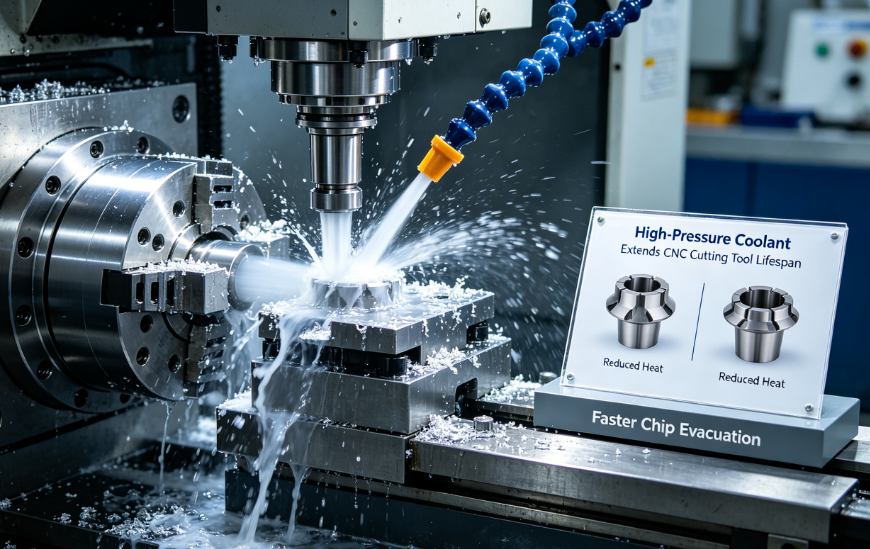
How Standard Low-Pressure Coolant Fails Heavy CNC Cutting
Regular flood coolant runs at 7–15 bar (100–200 PSI). It works fine for soft aluminum roughing with shallow cuts, yet falls apart on hard, heat-resistant metals:
- Heat piles up at the tool-chip interface Machining superalloys generates extreme friction heat. Low-pressure liquid cannot penetrate the tight gap between cutting edge and metal chip. Most coolant bounces off the hot chip surface instead of touching the actual cutting zone. High heat softens carbide substrates, wears coating, triggers crater wear.
- Chips re-cut and scratch tool flanks Long, stringy chips (titanium, stainless steel) bend back into the cut. Low-pressure flow lacks enough force to blast chips clear. Chips grind against tool sides, causing flank abrasion and chipping.
- Built-up edge (BUE) sticks to cutting edges Hot ductile metals (aluminum, copper, Inconel) weld tiny workpiece material onto tool tips. BUE rips away tool coating layer by layer during cutting cycles. Standard coolant cannot break this adhesion.
- Thermal cycling weakens carbide The tool tip swings from blazing hot to mildly cool with every rotation. Uneven temperature expansion creates micro-cracks inside carbide. These cracks spread fast and cause sudden catastrophic tool failure.
All these issues combine to cut tool life in half or worse on hard-to-machine alloys.
The Core Mechanisms: Why High-Pressure Coolant Lengthens Tool Life
High-pressure coolant shoots focused, high-velocity coolant straight into the tiny tool-chip contact line, fixing every weakness of low-pressure cooling. Four key protective effects extend tool service life:
1. Direct targeted heat removal stops thermal wear
High velocity coolant punches through the chip boundary layer to reach the cutting edge itself. Rapid heat transfer keeps tool temperature stable, preventing carbide annealing and thermal softening. Less heat = slower crater wear on rake faces and less flank wear.
For Inconel machining, cutting zone temperatures drop by 30%–45% with 1,000 PSI coolant. Cooler edges hold coating integrity far longer.
2. High force blasts chips out of the cut to eliminate re-cut damage
Titanium, aluminum and stainless produce long, flexible chips. Pressurized coolant physically breaks chips into small segments and flushes them away from the tool path entirely. No re-cut chips mean zero abrasive scratching on tool sides. This alone improves tool life by 20%~60% for deep pocket 5-axis semiconductor chamber milling.
3. High-pressure lubrication prevents built-up edge (BUE)
Coolant additives reach the metal-to-carbide contact area under pressure. The lubricant film stops ductile workpiece material from cold-welding onto tool tips. Aluminum shops struggle constantly with BUE; high-pressure coolant nearly eliminates this failure mode, protecting tool coatings from peeling.
4. Reduced thermal fatigue cuts micro-cracking
Consistent edge cooling minimizes rapid hot-cold cycling. Carbide tools develop fewer heat-induced micro-fractures. Tools resist breakage under interrupted cuts, angular 5-axis passes and heavy depth-of-cut roughing. Tools run predictably instead of snapping randomly mid-batch.
Quantified Tool Life Improvements by Material
Data collected from 5-axis aerospace manufacturers, semiconductor CNC workshops and mold shops; all results compare high-pressure coolant (1,000–3,000 PSI) against conventional flood cooling:
| Work Material | Typical Application | Tool Life Increase | Primary Wear Reduced |
|---|---|---|---|
| Ti6Al4V Titanium | Aerospace brackets, medical implants | 70%–120% | Flank wear, thermal cracking, chip re-cutting |
| Inconel 718 | High-temp turbine parts, semiconductor high-heat fixtures | 80%–150% | Crater wear, BUE, thermal fatigue |
| 6061/7075 Aluminum | Semiconductor vacuum chambers, manifold blocks | 40%–75% | Built-up edge, coating abrasion |
| 316L Stainless Steel | UHV chamber components, vacuum flanges | 50%–90% | Abrasive wear, edge chipping |
| H13 Tool Steel | Injection mold cores, conformal cooling molds | 35%–65% | Thermal softening, flank wear |
| Copper Alloys | Semiconductor cooling bases, thermal components | 30%–60% | Material adhesion, fine chip abrasion |
Key note: Gains jump higher for deep cavities, internal radii and long-reach tooling. These hard-to-reach features get almost no coolant with low-pressure setups, while high-pressure nozzles route fluid directly to edges regardless of part geometry.
Best High-Pressure Coolant Setup Rules for CNC Shops
Tool life gains only happen with proper configuration. Random high-pressure retrofits often waste money without benefits. Follow these proven guidelines:
- Match pressure to material and cut depth
- Aluminum general milling: 70–140 bar (1,000–2,000 PSI)
- Stainless steel / copper: 140–210 bar (2,000–3,000 PSI)
- Titanium / Inconel heavy roughing: 210–350 bar (3,000–5,000 PSI)
- Deep hole drilling >5xD: Boost pressure an extra 30% to push chips up drill flutes
- Use through-tool coolant delivery first Through-spindle, through-tool coolant channels are far more effective than external spray nozzles. Liquid exits right at the cutting edges, guaranteed coverage even on angled 5-axis moves, deep pockets and undercuts. External nozzles easily deflect away on complex geometry.
- Nozzle targeting for external high-pressure systems If retrofitting external jets: use multiple directional nozzles locked to follow tool tilt. Align jets parallel to chip flow direction, never straight onto the workpiece surface.
- Maintain clean coolant filtration High-pressure lines and tiny tool coolant ports clog fast with metal fines. Install 5–20 micron full-flow filtration + magnetic separators. Clogged channels cut coolant flow and erase tool life gains entirely. Semiconductor machining requires even finer filtration (1–5 μm) to avoid particle contamination on finished parts.
- Select compatible coolant chemistry
- Aluminum machining: Use low-pH synthetic coolant to limit corrosion and BUE
- Titanium/Inconel: Extreme-pressure (EP) additives for boundary lubrication
- Cleanroom semiconductor parts: Low-particle, low-outgassing coolant formulas with zero sulfur or chlorine additives
- Regulate coolant temperature Hold coolant steady at 20–22°C. Hot coolant reduces heat dissipation efficiency; cold coolant causes thermal contraction stress on carbide. Temperature stability also keeps workpiece dimensions consistent for tight GD&T tolerances.
Extra Side Benefits Beyond Longer Tool Life
While tool lifespan is the top payoff, high-pressure coolant unlocks cascading production savings that boost overall ROI:
- Higher allowable cutting speeds and feeds Cooler tools let you safely ramp up RPM and feed rates by 15%–40%. Cycle times shrink alongside tool cost per part. Semiconductor chamber batch lead times drop noticeably.
- Less machine downtime for tool changes Fewer tool swaps cut unproductive downtime. Shops running continuous lights-out 5-axis production see major uptime improvements.
- Better surface finish Reduced BUE and chatter create smoother machined surfaces. Many aluminum and stainless parts hit Ra 0.2 μm specs with less hand polishing, cutting secondary finishing labor.
- Lower total carbide spend Longer tool runs lower monthly carbide ordering volume. For high-alloy jobs with expensive specialty coated inserts, monthly tooling bills fall dramatically.
- Cleaner machined surfaces Aggressive chip flushing prevents embedded metal chips on part walls. Critical semiconductor vacuum surfaces have fewer trapped micro-particles, improving cleanroom yield.
Common Mistakes That Kill High-Pressure Coolant ROI
- Running high pressure with clogged coolant ports Dirty filters plug through-tool holes. Coolant cannot reach edges, pressure turns meaningless, tool wear stays rapid. Schedule weekly port cleaning.
- Overpressuring soft metals Excess pressure blasts aluminum chips into tiny abrasive dust, which can scratch finished surfaces and create cleanroom particle risks. Do not run 5,000 PSI on aluminum chamber components.
- Ignoring 5-axis tool angle adjustment Fixed external nozzles miss cutting edges when spindles tilt. Always use multi-jointed follow nozzles or switch fully to through-spindle delivery for 5-axis work.
- Using cheap coolant with insufficient lubrication Pressure cannot replace lubricant quality. Budget coolants lack EP additives; edges still wear fast despite high flow velocity.
- Skipping regular coolant concentration checks Diluted coolant loses thermal and lubricating performance. Test concentration daily to maintain manufacturer mixing ratios.
FAQ
Is high-pressure coolant worth upgrading only for aluminum semiconductor parts?
Yes, but you do not need extreme pressure. 1,000–2,000 PSI greatly reduces aluminum built-up edge, cutting tool coating wear and chip re-cutting. Tool life rises 40%–75%. Avoid ultra-high pressure over 3,000 PSI on aluminum; excessive pressure creates fine aluminum dust that raises particle contamination risk for vacuum hardware.
Can high-pressure coolant extend life for solid carbide drills and taps?
Absolutely critical for deep-hole drilling. Through-tool high pressure pushes chips upward along flutes, stopping chips from jamming. Drills break far less often, tap chipping drops sharply. Deep holes in Inconel and stainless see tool life double in many cases.
Do I need a brand-new CNC machine to run high-pressure coolant?
Most modern machining centers support high-pressure spindle upgrades as a retrofit. Older mills can add external high-pressure pump systems with articulated nozzles. Retrofit costs are almost always justified on high-volume hard alloy runs. Only low-run simple soft part jobs may not pay for upgrades.
How much longer tool life should I expect on Inconel?
With properly filtered through-tool high pressure (3,000–5,000 PSI), Inconel tool life typically increases 80% to 150%. Thermal crater wear and heat-related edge failure drop drastically. Shops running Inconel routinely cut carbide consumption nearly in half.
Does high-pressure coolant cause more workpiece corrosion on stainless or aluminum?
No, as long as coolant chemistry and concentration are correct. Use rust-inhibited coolant matched to your alloy, and blow parts fully dry with filtered air post-machining. Improper coolant dilution causes corrosion, not high pressure itself. Semiconductor parts add DI water rinsing after machining for extra protection.
Are there any cutting scenarios where high-pressure coolant does not help tool life?
Two narrow cases see minimal benefit:
- Ultra-shallow light finishing passes on flat soft plastic or brass; heat and chip volume are too low to need high pressure.
- Very short stub tools with rigid setup, minimal heat generation. For all heavy roughing, deep cavities, long-reach tools, hard metals and 5-axis complex parts, high pressure consistently improves tool life.
How do I calculate ROI for a high-pressure pump upgrade?
Total annual savings = (monthly tool cost reduction + downtime savings from fewer tool swaps + cycle time reduction savings) × 12 Compare against pump, filtration and installation cost. Most aerospace and semiconductor CNC workshops hit full payback within 8–20 months. Shops machining expensive superalloys often pay off in under a year.
Can high-pressure coolant reduce particle defects on semiconductor chamber surfaces?
Yes. Efficient chip evacuation prevents micro-chips from embedding into machined surfaces. Fewer embedded particles lower cleaning workload and fab contamination risk. Combined with fine filtration, high-pressure cooling supports Ra 0.2 μm low-particle requirements for UHV components.
Closing Thoughts
High-pressure coolant is one of the most cost-effective, low-risk upgrades to cut CNC tooling expenses. It does not require redesigning CAM tool paths or switching expensive cutting tools; it optimizes existing cutting conditions by fixing heat, chip and BUE failures at the source.
For workshops specializing in hard alloys (titanium, Inconel, stainless steel) and complex 5-axis semiconductor/mold/aerospace geometry, longer tool life translates directly to lower part cost, faster throughput and fewer quality rejects. The biggest missed opportunity comes from running tough materials on outdated low-pressure cooling systems.
Start with through-tool delivery, match pressure to your workpiece material, maintain strict filtration and coolant maintenance. These small setup steps maximize tool lifespan, stabilize production consistency and improve profitability batch after batch.