Published:Zorapid.Ltd
If you design molded plastic parts for semiconductor vacuum chambers, wafer handling gear, medical devices, aerospace hardware, or high-temperature industrial fixtures, picking between thermoplastics and thermosets is make-or-break. Choose wrong, and you face melting under heat, heavy outgassing, constant particle shedding, chemical erosion, or impossible rework.
Many mechanical engineers only judge plastics by heat resistance alone. But for precision industrial applications, machinability, cleanroom compatibility, particle risk, vacuum performance, chemical resistance and manufacturability all weigh equally.
This guide breaks down clear differences between thermoplastics and thermosets, compares top-grade materials side by side, maps each family to semiconductor, medical and aerospace use cases, lists key selection criteria, calls out common mistakes, and answers all recurring client questions in an organized FAQ. All descriptions stay plainspoken, no dense textbook jargon.
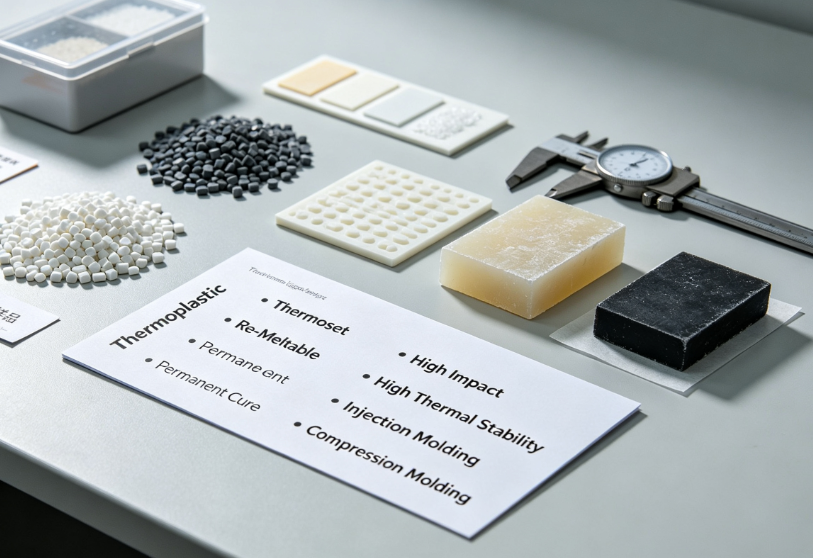
Basic Core Definition: How the Two Plastics Behave Chemically
Thermoplastics
Long polymer chains connect loosely, with no permanent cross-link bonds. When heated, thermoplastics soften and melt fully. Cool them down, and they harden again. This melt-freeze cycle can repeat dozens of times without breaking down core polymer structure.
Key trait: re-meltable, recyclable, machinable, injection moldable repeatedly.
Common high-performance grades: PEEK, PVDF, PFA, FEP, LCP, high-purity PC, PPS, ESD ABS, UHMWPE
Thermosets
Raw resin softens once during initial curing. Heat triggers irreversible chemical cross-linking across all molecular chains. Once fully cured and hardened, thermosets cannot melt again. Extra heat only burns, chars or cracks the material.
Key trait: permanently rigid after cure; cannot be remelted; excellent heat stability, zero re-molding possible.
Common industrial grades: Epoxy, phenolic resin, polyimide thermosets, melamine, FR4 fiberglass, bulk molding compound (BMC), silicone thermoset
Side-by-Side Full Comparison Table
| Comparison Category | Thermoplastics | Thermosets |
|---|---|---|
| Heat Response | Melts at defined glass transition/melting point; softens gradually with rising heat | Never melts post-cure; withstand sustained high heat until thermal degradation/charring |
| Recyclability | Recyclable, regrind allowed (restricted in semiconductor clean molding) | Non-recyclable; cured scrap cannot be remelted, only disposed |
| Machining & Post-Processing | Easy to CNC mill, drill, tap, turn; smooth polished surfaces down to Ra 0.2 μm; tolerances tight | Brittle post-cure. Machinable but prone to chipping, micro-cracking; higher risk of particle generation |
| Injection Molding | Standard high-speed injection friendly; complex geometry, thin walls, undercuts easy to mold | Requires compression molding, transfer molding; longer cure cycles; complex shapes cost more to produce |
| Outgassing (UHV Semiconductor) | High-purity fluoropolymers (PVDF, PFA) low outgassing; general grades release VOCs under vacuum | Ultra-low outgassing fully cured polyimide/epoxy; stable long-term bakeout performance for high-vacuum |
| Chemical Resistance | Fluoropolymer thermoplastics resist nearly all acids, solvents, plasma; some grades swell with strong organics | Phenolic, epoxy thermosets resist aggressive chemicals; less vulnerable to solvent swelling than many thermoplastics |
| Particle Generation Risk | Low if virgin resin only (no regrind); smooth machined surfaces shed minimal debris; improper regrind causes fines | Risk of tiny brittle chips when machined; cured thermosets fracture into hard micro-particles during cutting |
| Elasticity & Flexibility | Flexible options available (FEP, silicone thermoplastics); absorbs mild impact without cracking | Rigid, stiff overall; most thermosets brittle, prone to crack under sharp impact |
| Repair Feasibility | Damaged sections can be reheated, welded, bonded for rework | Cannot weld; repairs rely on adhesives only; permanent damage hard to fix |
| Cost Profile | High-performance thermoplastics (PEEK) expensive raw stock; fast molding cuts per-unit labor cost | Raw resin cheaper, but long cure times raise cycle cost for mass production |
| Cleanroom Compatibility | Great for wafer-contact parts; easy ultrasonic cleaning with DI water/IPA | Excellent for static structural vacuum components; machining must use ultra-sharp tooling to limit particles |
Key Selection Criteria Broken Down by Industry
We split recommendations into three highest-demand fields: semiconductor vacuum hardware, medical components, aerospace high-heat parts.
1. Semiconductor & Wafer Fab Components (Low particle + UHV + plasma resistance top priorities)
Choose Thermoplastic If:
- Parts touch bare silicon wafers (wafer trays, end effector grippers, handling fingers)
- You need smooth Ra ≤0.2μm machined surfaces with minimal particle shedding
- Multiple prototype iterations are needed; design changes require re-machining or remolding
- Regular wet clean (DI water, IPA, mild solvents) is standard maintenance Top picks: PVDF, PFA, LCP, high-purity PEEK
Choose Thermoset If:
- Components live inside high-temperature plasma chambers with continuous bakeout (150°C+ sustained heat)
- Static structural brackets, insulating spacers, chamber insulation panels with no wafer contact
- Extreme long-term vacuum stability required; minimal volatile release over years Top picks: Fully cured high-purity polyimide, low-outgassing epoxy, glass-filled phenolic
Hard Rule: Never use machined general thermosets for wafer-contact surfaces. Brittle chipping during machining creates submicron contamination that ruins wafer yield.
2. Medical Implants & Single-Use Medical Hardware
Thermoplastic Best Fits
- Reusable surgical instruments, implantable bone hardware (PEEK medical grade)
- Sterilization via autoclave, ethylene oxide (EtO), repeated sterilization cycles
- Thin flexible tubes, catheter components, soft grip housings
- Complex molded geometry requiring consistent mass production
Thermoset Best Fits
- Disposable rigid sterile casings, dental composites
- High-temperature sterilized insulating fixtures, surgical tool handles
- Adhesive-bonded medical assemblies with zero creep under body heat
3. Aerospace High-Temp & Flame-Resistant Parts
Thermoplastic
- Complex thin-wall aerospace ducting, wiring conduits
- Parts needing field repair via hot-air welding
- Repeated thermal cycling with risk of impact damage PEEK, PPS dominate high-performance aerospace thermoplastics
Thermoset
- Fire-resistant interior panels, structural composite skins (FR4, BMC)
- Engine-side brackets with constant 200°C+ operating heat
- Non-load-bearing insulating parts where creep must be eliminated
Most Common Application Match List
Thermoplastic Typical Parts
- Semiconductor: Wafer carriers, transfer arm tips, chamber gaskets, liquid chemical flow fittings
- Medical: PEEK spinal implants, PVDF fluid tubing, disposable syringe housings
- Mold Tooling: Conformal cooling plastic inserts, high-temperature jigs
- General Industrial: Chemical pump bodies, corrosion-resistant valve components
Thermoset Typical Parts
- Semiconductor: Vacuum insulating plates, plasma chamber mounting insulators, wiring terminal blocks
- Aerospace: Flame-retardant cabin panels, composite structural laminates
- Electronics: PCB substrates (FR4), circuit potting epoxy, high-voltage insulation
- Industrial: Heat-resistant oven handles, chemical-resistant pump housings
Critical Limitations to Avoid Design Errors
Thermoplastic Weak Points
- Creep risk under sustained high heat and constant clamping force: PEEK creeps slightly above 180°C; regular nylon creeps at moderate temperatures
- Some thermoplastics swell or degrade in strong polar solvents
- Thermoplastics will fully melt if operating temperature exceeds melting point, causing catastrophic chamber failure
- Low-cost thermoplastics (regular ABS, PVC) have terrible outgassing, forbidden inside semiconductor UHV zones
Thermoset Weak Points
- Zero rework ability: Once molded/cured, geometry changes need brand-new tooling
- Brittle nature leads to chipping during CNC machining; elevated particle risk for cleanroom use
- Long compression molding cycles slow down fast prototyping
- Cannot be thermally welded; assembly only via mechanical fasteners or adhesives
Step-by-Step Material Decision Checklist
Run through these questions in order to lock your material family:
- Max continuous operating temperature? Over 200°C with no cooling → lean thermoset; below 200°C with thermal cycling → thermoplastic
- Does the part touch wafers, sensitive optics or sealing surfaces needing ultra-smooth Ra finish? Choose thermoplastic
- Do you expect design revisions, prototype tweaks or field repair? Thermoplastic only
- Must the material survive constant plasma exposure and UHV bakeout long-term? Compare low-outgassing thermoset polyimide vs fluoropolymer thermoplastic
- Will the part be machined heavily after molding? Thermoplastics deliver cleaner cuts and fewer particles
- Is brittleness a failure risk under vibration/impact? Pick thermoplastic
- Budget for high volume mass production? Thermoplastic injection molding lowers cycle cost; thermosets win on cheap raw resin for low-volume static parts
FAQ
Which family has better low-outgassing performance for semiconductor vacuum chambers?
Both have qualified low-outgassing options. Fully post-cured polyimide thermosets hold steady during long high-temperature bakeouts with extremely low total mass loss (TML). Meanwhile, high-purity PVDF, PFA and PEEK thermoplastics meet NASA ASTM E595 outgassing standards at moderate temperatures. If your chamber runs continuous 160°C+ heat, thermoset polyimide performs more reliably. For cool vacuum zones and wafer-contact surfaces, fluoropolymer thermoplastics are safer.
Can thermosets be injection molded like regular thermoplastics?
Standard injection molding does not work for thermosets. Thermosets use compression molding or transfer molding, which involve heating to trigger cross-link curing inside the mold cavity. Cycle times run 2–10x longer than thermoplastic injection molding. Thermosets cannot run on all-electric high-speed injection presses built for thermoplastics.
Which material sheds fewer particles in cleanroom production?
Virgin thermoplastics produce far fewer particles. Thermosets chip easily during CNC machining, generating hard micro-debris that contaminates semiconductor processes. If you must machine thermosets for cleanroom use, use diamond cutting tools and limit material removal volume as much as possible. Never machine thermosets for direct wafer contact.
Are thermoplastics recyclable for production scrap? Can we use regrind?
Thermoplastics can technically be reground and remelted. But semiconductor cleanroom rules ban regrind for all wetted/plasma/wafer components. Regrind creates micro-fines and increases particle counts. Thermoset scrap is permanently non-recyclable and must be fully discarded.
Which option handles repeated autoclave sterilization better for medical parts?
High-grade thermoplastics (medical PEEK, PVDF) withstand hundreds of autoclave cycles without degradation. Most thermosets crack or discolor after dozens of repeated high-pressure steam cycles, as trapped moisture causes internal stress fractures. Thermoplastics are the standard choice for reusable medical hardware.
What if a component needs both high heat resistance AND complex machined smooth surfaces?
Use high-temperature thermoplastics such as PEEK or PPS. These grades tolerate sustained 220°C heat while allowing precision machining to Ra 0.2 μm. If temperatures exceed 250°C constantly, switch to thermoset polyimide and limit CNC machining to minimal finishing only.
Do thermosets creep less than thermoplastics under constant load?
Yes. Cross-linked thermoset molecules have zero hot creep. Thermoplastics gradually deform under steady pressure at elevated temperatures. This makes thermosets ideal for permanently clamped insulating spacers inside hot process chambers.
Which material costs less for large-batch manufacturing?
Thermoplastics win high-volume pricing. Fast injection molding cycle times slash hourly machine labor. Thermosets have cheaper raw pellets, but long curing cycles drive total production cost up for mass runs. For low-quantity custom static parts, thermosets often cost less overall.
Final Closing Summary
There is no universal “better” material between thermoplastics and thermosets. The decision hinges on operating temperature, surface roughness needs, particle control rules, rework requirements, sterilization or vacuum conditions, and production batch size.
- Pick high-performance thermoplastics (PVDF, PEEK, PFA, LCP) for wafer handling, precision machined sealing surfaces, cleanroom parts needing rework or repeated wet cleaning.
- Select fully cured thermosets (polyimide, low-outgassing epoxy, phenolic) for high-heat static insulation, long-term UHV bakeout hardware, fire-resistant aerospace panels where brittleness and machining particle risk are acceptable.
When designing semiconductor plastic components, avoid choosing purely based on maximum heat rating. Always cross-check particle risk, machinability and outgassing to match fab process rules.