Published by: Zorapid.Ltd
Traditional processing for hybrid rotational parts always hits the same wall.
You turn cylindrical OD on a lathe, move the part to a 5-axis mill, re-fixture repeatedly to machine eccentric pockets, angled holes and freeform curved profiles.
Every machine transfer creates datum shift. Concentricity drifts, positional GD&T fails inspection, and lead times stretch out for days.
Standard turn-mill only handles simple flats and cross holes. Standard 5-axis mills waste bar stock and run slow circular turning cycles.
Our hybrid turn-mill 5-axis workflow merges the best of both worlds: high-precision spindle turning plus full B-axis 5-axis simultaneous milling — all in a single clamping cycle.
At Zorapid, we build these complex hybrid shafts without a single part transfer. Today we break down the process, tolerance gains, cost reduction and real-world production results.
What Is Hybrid Turn-Mill 5 Axis
Ordinary Turn-Mill (C/Y Axis Live Tool Only)
Great for turned shafts with simple milled flats, radial drill holes and keyways.
Hard limit: No swinging B-axis spindle. It cannot machine 3D freeform contours, eccentric curved surfaces or compound-angle undercuts. Complex curved geometry still needs a separate 5-axis VMC.
Ordinary 5-Axis VMC
Can mill any freeform shape with full B/C axis tilt.
Hard limit: No lathe spindle. Turning round OD via circular interpolation delivers poor concentricity, wastes bar stock by cutting billets, and takes 2–3x longer for cylindrical material removal.
Hybrid Turn-Mill 5 Axis (Our One-Stop Solution)
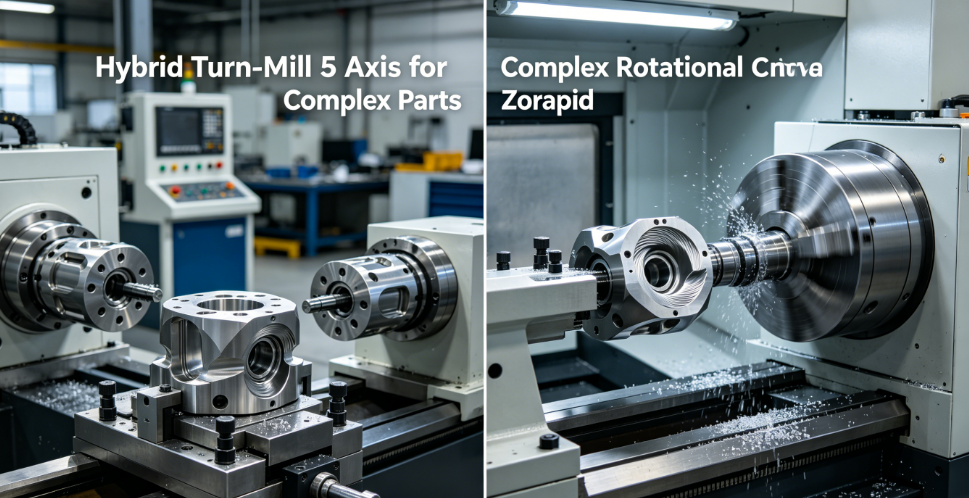
This multitasking machine combines:
- Main lathe spindle for high-speed OD/ID turning to hold ultra-tight concentricity
- Powered Y-axis off-center milling for eccentric features
- Swinging B-axis milling head for full 5-axis simultaneous contouring
- Twin sub-spindle to finish the backside without flipping the workpiece
One single setup handles three types of geometry together:
Pure rotational turning → eccentric off-center features → freeform 3D curved profiles.
No unclamping, no re-zeroing, no moving parts between lathe and mill.
Core workshop rule:
If your part mixes turned cylinders + eccentric bores + organic curved surfaces, hybrid turn-mill 5-axis is the only stable, cost-effective process.
Side-by-Side Process Comparison
Test piece: Ti-6Al-4V aerospace eccentric shaft, turned main OD, 4 angled eccentric holes + one freeform spiral contour, bar stock material, batch 25 pcs, concentricity ≤0.004mm.
| Production Item | Lathe + Separate 5-Axis VMC (Multi-Operation) | Hybrid Turn-Mill 5 Axis (Single Setup) |
|---|---|---|
| Number of Clamping Cycles | 3 separate re-fixtures | 1 single chuck setup |
| Total Manual Handling Time | 145 minutes (loading, indicating, proving) | 25 minutes total |
| Material Form | Cut billet (22% material waste) | Continuous bar feed (less than 5% scrap) |
| Net Machining Cycle Time | 62 minutes per piece | 36 minutes continuous cycle |
| Concentricity & Runout Deviation | ±0.012mm (clamp stack-up error) | ≤0.004mm zero datum shift |
| Rework & Scrap Rate | 16% from misalignment | Below 2% |
| Total Production Lead Time | 7 working days | 3 working days |
| Final Per-Piece Total Cost | $286 | $198 |
Clear result:
Even with 5-axis capability, splitting turning and milling between two machines creates massive hidden waste. Hybrid turn-mill 5-axis cuts total cost by 31% and eliminates tolerance stack-up entirely.
Four Key Advantages of Hybrid Turn-Mill 5 Axis For Rotational Hybrid Parts
Zero Tolerance Stack-Up (The Biggest Quality Win)
Every time you unload and re-clamp a shaft, you introduce positional error between turned OD and milled 3D profiles.
With one fixed spindle datum, concentricity, runout and profile GD&T stay consistent across turned and milled features.
We regularly hold total cumulative deviation below 0.005mm for medical and aerospace rotational components.
Bar Feeding Eliminates Billet Material Waste
Standard 5-axis machining requires cutting bar into short vise-held blanks.
Our hybrid turn-mill runs full-length bar stock automatically. You only pay for the finished part plus cutoff scrap, slashing raw material cost by nearly 20% on bar-fed shaft jobs.
One Program Combines Turning + 5-Axis Contouring
No separate lathe NC file and 5-axis milling program.
CAM software seamlessly switches between spindle turning, Y-axis eccentric cutting and B-axis simultaneous 5-axis milling without stopping the machine.
Cycle time shrinks dramatically because there is no waiting between separate operations.
No Secondary Backside Operation
Twin sub-spindle grabs the workpiece after front-side work. The machine finishes the rear face, threaded bores and reverse-side contours without flipping the part manually.
This eliminates the third clamping cycle that ruins runout on long shafts.
Our Standard Hybrid Turn-Mill 5 Axis Workflow (Zorapid In-House Process)
We lock this sequence for all complex rotational hybrid components:
- Bar stock loading: Feed long round bar into the main spindle; no billet cutting required
- Primary turning: Machine OD, ID, shoulders and threads with the main lathe spindle to lock concentricity
- Y-axis eccentric milling: Cut off-center slots and non-concentric bores without repositioning
- B-axis 5-axis simultaneous milling: Swing the milling head to machine freeform curved surfaces, spiral profiles and compound-angle holes
- Sub-spindle handoff: Transfer the shaft to the sub-spindle and machine the backside features in the same program
- Single final CMM inspection: Measure turned roundness, hole position and 3D profile all on one datum
No intermediate inspection, no re-indicating, no part transport between workstations.
Which Parts Belong On Hybrid Turn-Mill 5 Axis?
Perfect fit if your rotational component includes all or most of these features:
- Main cylindrical turned OD with strict runout & concentricity specs
- Eccentric shafts, off-center pockets and non-concentric holes
- Spiral grooves, turbine shaft freeform contours and curved blade roots
- Compound-angle drilled bores and undercut milled profiles
- Front + back side features requiring twin-spindle backworking
Common parts we run daily on this hybrid machine:
- Aerospace eccentric turbine shafts
- Medical titanium threaded implant blanks with curved contours
- EV motor hybrid shaft with angled cooling holes
- High-precision sensor mandrels with spiral grooves
- Oil & gas valve rotational core components
Do not use this process for simple fully round shafts with only cross holes: basic C-axis turn-mill will be cheaper.
Do not use for large rectangular prismatic blocks: stick to standalone 5-axis VMC instead.
Real Zorapid Customer Case Study
Project Background
In718 superalloy rotational shaft, main turned journal + 6 eccentric angled holes + continuous spiral curved profile, batch 22 pieces, runout tolerance ≤0.004mm.
Traditional Process (Lathe + 5-Axis Mill, 3 Clamps)
- Multiple re-fixtures created 15% scrap from positional drift
- Billet cutting caused 23% material waste
- Total lead time: 8 days
- Unit cost: $312
Optimized Hybrid Turn-Mill 5 Axis Solution
- Bar feed direct into main spindle, zero blank cutting waste
- Turning + Y-axis eccentric work + B-axis 5-axis spiral milling completed in one clamping
- Twin sub-spindle finished rear-side features without flipping
- Zero clamping-related deviation, all CMM GD&T passed on first article
Final Outcome
Scrap dropped below 1%, lead time shortened to 3 days, and unit cost reduced by 35%. The shaft passed high-speed spin test without concentricity failure.
Programming & Simulation Control To Avoid Collision
Complex 5-axis B-axis movement plus lathe turning creates high collision risk.
We follow two strict rules:
- All NC code runs full VERICUT machine simulation before hitting the machine. We verify spindle travel, tool swing and sub-spindle handoff without physical trial cuts.
- We split the program into turning cycles and 5-axis milling segments, with soft travel limits on the B-axis swing to prevent tool holder clashing with the chuck.
This offline verification keeps our first-run success rate above 98% on complex rotational parts.
Quick RFQ Decision Checklist
Choose Hybrid Turn-Mill 5 Axis
- Bar stock raw material, rotational main body
- Mix of turning + eccentric features + 3D freeform contours
- Strict concentricity, runout and cross-feature GD&T
- Multiple front & backside features needing sub-spindle backworking
- Low-to-medium NPI batches with tight delivery schedules
C/Y Turn-Mill
- Turned shaft with only flats and radial holes, no 3D curved milling
- No eccentric or compound-angle features
Choose Standalone 5-Axis VMC
- Rectangular billet parts with almost no rotational turning work
Why Zorapid Delivers Stable Hybrid Turn-Mill 5 Axis Results
- We operate B-axis multitasking turn-mill centers with twin spindles, combining lathe precision and full 5-axis milling in-house
- We calculate full landed cost including material yield, setup labor and scrap risk instead of only comparing hourly machine rates
- VERICUT offline simulation eliminates collision errors for combined turning and simultaneous 5-axis code
- We hold concentricity below 0.004mm by locking the workpiece inside one single datum
- First-pass inspection yield stays above 97% for titanium, In718 and hardened alloy rotational components
- We offer two-tier quoting: basic turn-mill for simple shafts, and hybrid 5-axis turn-mill for complex eccentric contoured parts
Conclusion
For complex rotational hybrid parts with turned journals, eccentric bores and freeform 3D profiles, splitting work between a lathe and standalone 5-axis mill is a costly compromise.
Repeated clamping creates tolerance drift, material waste and extended lead times.
Hybrid turn-mill 5-axis merges high-precision spindle turning with B-axis simultaneous milling. One bar-fed clamping completes the full part, eliminates datum shift, cuts material waste and slashes total piece cost by nearly one-third.
When you send your shaft STEP file to Zorapid, we will generate two side-by-side quotes: multi-operation lathe + 5-axis routing and single-setup hybrid turn-mill 5-axis machining, with full breakdowns of tolerance risk, cycle time and turnaround.
Submit your complex rotational component drawing for a free process review today.
FAQ
Can hybrid turn-mill 5-axis hold better concentricity than separate lathe and 5-axis mill?
Yes. The part never leaves the main spindle chuck. Zero re-clamping means no cumulative positional error. Runout can easily stay below 0.004mm, which is impossible with multiple machine transfers.
What geometry requires B-axis 5-axis on a turn-mill machine?
Spiral contours, compound-angle angled holes, eccentric curved profiles and undercut milling features that standard C/Y live-tool turn-mill cannot reach.
Does bar feeding reduce material cost on rotational shaft parts?
Dramatically. Hybrid turn-mill uses full bar stock with only small cutoff scrap. Billet cutting for standalone 5-axis machining usually wastes 20~25% of raw bar material.
Do I need separate CAM programs for turning and 5-axis milling on hybrid turn-mill equipment?
No. One integrated program seamlessly switches between X/Z turning, Y eccentric cutting and B-axis 5-axis simultaneous milling. No program splitting or machine re-setting.
Is VERICUT simulation required for hybrid turn-mill 5-axis code?
Absolutely. Combined lathe spindle rotation plus swinging B-axis milling head creates high collision risk. Offline simulation eliminates costly machine crashes before the first cut.