Published:Zorapid.Ltd
If you’re working on automotive New Product Introduction (NPI), speed and validation accuracy are everything. Every project stage has strict gate deadlines: design sign-off, bench testing, crash simulation, thermal validation, and pre-production pilot runs.
Most manufacturers rely on standard 3-axis CNC for prototypes, and it creates predictable NPI bottlenecks:
- Multiple re-clamping setups stack alignment errors that fail OEM tolerance audits
- Long overhang cutting tools create chatter, ruining A-class cosmetic surfaces
- Thin lightweight EV aluminum or magnesium parts warp during repeated fixturing
- Extra days lost reworking flawed prototypes before test lab submission
For automotive NPI, you don’t just need a physical part — you need a prototype that matches production geometry, holds tight tolerances, and lands in your testing lab days faster.
5-axis prototyping solves nearly every pain point holding up automotive NPI gates. This plain-language guide breaks down exactly how multi-axis machining accelerates EV, interior, powertrain and chassis validation, with Zorapid’s automotive-specific production process built for fast NPI turnaround.
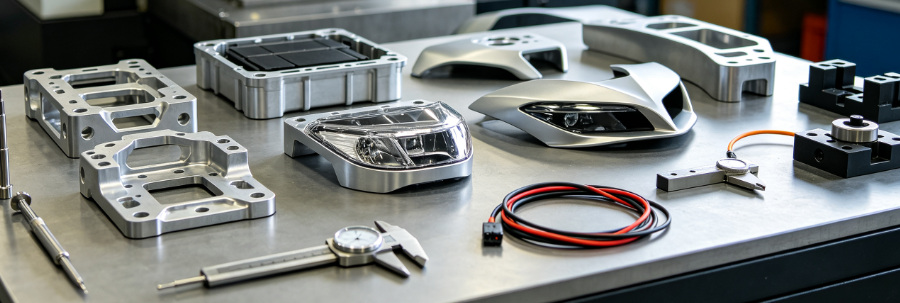
Unique Automotive NPI Part Demands That Need 5-Axis Prototyping
Automotive prototypes carry far stricter requirements than general mechanical parts, and these rules make 3-axis machining inefficient or unreliable:
- Mixed complex curved geometry EV battery housings, sculpted interior trim, aerodynamic cooling manifolds, and suspension brackets feature multi-angle contours, deep undercuts and angled mounting holes impossible to machine in one 3-axis setup.
- A-class cosmetic surface standards Interior decorative trim, display bezels and sensor covers demand scratch-free, uniform as-machined finishes for design review and customer clinic testing.
- Lightweight thin-wall lightweight alloys EV aluminum, magnesium and high-strength plastic components have ultra-thin sections prone to bending under heavy vertical 3-axis cutting loads.
- Tight repeatable dimensional tolerances Bench testing, vibration cycling and crash validation require identical prototype batches; small setup drift from 3-axis multi-fixturing ruins test data consistency.
- Diverse high-performance materials Aluminum 6061/7075, cast aluminum blanks, magnesium alloys, PEEK, glass-filled PC, stainless steel for fuel and thermal systems.
- Fast gate-driven lead time targets NPI schedules rarely allow extra weeks for repeated prototype rework or multi-vendor secondary finishing.
6 Key Advantages of 5-Axis for Automotive New Product Prototypes
Single Setup Eliminates Stacked Tolerance Errors
3-axis mills require re-clamping, flipping and re-indicating parts to machine all sides. Every new fixture introduces tiny alignment offsets that stack up across 3–6 setups. For automotive powertrain and suspension prototypes, even 0.003 mm drift leads to misalignment during assembly testing.
5-axis machines tilt and rotate the workpiece or spindle to access every surface, hole and contour in one single clamp. No repeated zero-point calibration errors, all critical mating features maintain perfect positional accuracy required for OEM NPI documentation.
Machine Complex Contours & Deep Undercuts For EV & Styling Parts
Modern automotive NPI designs lean heavily on organic, aerodynamic shapes: curved battery cooling channels, sculpted dashboard trim, hidden mounting undercuts for sensor housings.
With 3-axis machining, reaching deep angled cavities requires long, thin extended cutting tools that vibrate and leave uneven surface marks. 5-axis tilts the blank so short, rigid standard cutters stay perpendicular to every cutting surface. Less tool chatter, clean internal geometry, no compromise on complex EV lightweight structures.
Better Surface Finish Ready For Automotive A-Class Cosmetic Checks
Design clinics and OEM styling reviews judge prototypes on mirror-smooth A-class surfaces. Long 3-axis tool overhang creates visible vibration lines that demand hours of manual sanding and polishing.
5-axis uses short, stiff cutting tools with constant light contact across curved profiles. As-machined surface roughness is drastically smoother, cutting secondary finishing labor by 40% or more. Prototypes arrive ready for paint, grain matching or showroom design evaluation without extra manual rework.
Reduce Thin-Wall Warpage On Lightweight EV Components
EV NPI prioritizes weight reduction, leading to ultra-thin aluminum and magnesium walls. Vertical heavy cuts on 3-axis machines push hard against delicate thin sections, causing permanent bending and dimensional shift mid-process.
5-axis optimized trochoidal milling distributes cutting force evenly across angled surfaces, minimizing stress-induced deformation. Thin battery tray ribs, lightweight motor housings and dashboard frames hold their designed geometry perfectly through full machining cycles.
Shorter Lead Times To Hit Aggressive NPI Gate Deadlines
Multi-setup 3-axis machining wastes hours of operator time repositioning parts between cuts. Single-setup 5-axis workflows eliminate all downtime for re-fixturing, slashing total production days for complex automotive prototypes.
For tight NPI gate deadlines, Zorapid’s dedicated 5-axis cell runs extended shifts to cut turnaround by 2–4 business days compared to traditional 3-axis shops. Faster prototype delivery lets engineering teams start testing earlier and avoid project schedule delays.
Consistent Repeatability For Bench, Crash & Thermal Testing Batches
Automotive validation requires multiple identical prototypes for parallel testing: vibration cycling, thermal soak, crash impact and durability trials.
3-axis multi-fixture workflows rely heavily on operator skill, creating dimensional variation between parts in the same batch. 5-axis toolpaths are fully digital and locked into one program. Once validated, every prototype from the first sample to the 50-piece test batch matches exactly. Zorapid archives all automotive 5-axis programs for repeat NPI pilot orders with zero dimensional drift.
Common Automotive NPI Components Built With 5-Axis Prototyping
These are the highest-volume NPI parts our automotive OEM and Tier 1 clients run on 5-axis equipment:
- EV Hardware
- Lightweight aluminum battery tray prototypes
- Motor housing cooling manifolds & end caps
- Inverter enclosures, power distribution contact brackets
- Thermal heat sink plates with complex internal flow channels
- Interior Styling & HMI Parts
- Curved dashboard trim bezels
- Touchscreen display housings & sensor covers
- Decorative A-class trim samples for design clinics
- Powertrain & Chassis Test Components
- Suspension control arm prototypes
- Transmission valve body test blanks
- Engine cooling component fixtures
- Brake caliper validation samples
- Test & Assembly Fixtures
- Dedicated NPI bench jigs for vibration testing
- Crash test mounting fixtures
- Robotic assembly tooling prototypes
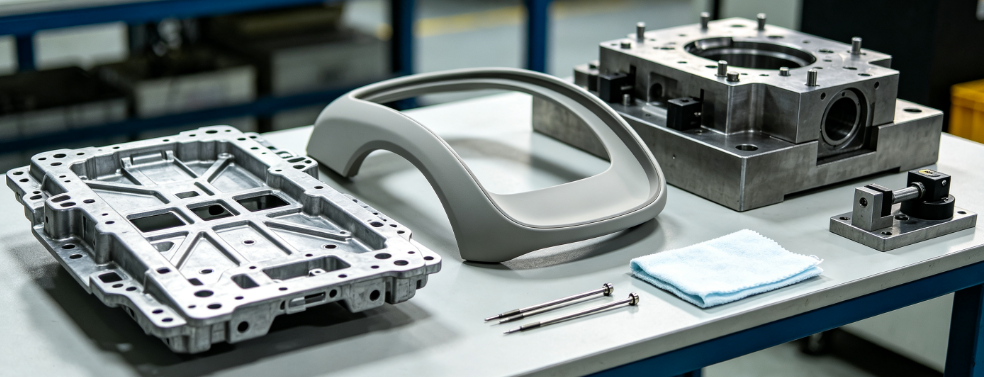
Zorapid’s Complete 5-Axis Workflow Tailored For Automotive NPI
We built our 5-axis precision cell exclusively to meet automotive OEM NPI standards, with every stage optimized for fast validation and audit-ready documentation:
Automotive-Focused DFM Analysis
Before any material is cut, our automotive engineers run a dedicated DFM check targeting common NPI risks:
- Thin-wall deflection prediction for lightweight EV alloys
- Undercut and angled feature accessibility review to avoid multi-setup delays
- Tolerance rationalization to cut machining time without losing test accuracy
- Thermal expansion compensation for aluminum/magnesium high-temperature test parts
- Pre-planning for paint, anodizing or bead blasting finishing layers
We deliver annotated CAD feedback and a clear lead time breakdown within 24 hours for all automotive NPI orders.
Temperature-Stabilized 5-Axis Precision Machining
Granite-base 5-axis machining centers with constant workshop temperature control eliminate thermal expansion drift that ruins automotive tolerance specs.
- Single-setup full-part cutting for all multi-angle contours and holes
- Material-specific light-cutting parameters for soft magnesium and high-strength aluminum
- Full digital toolpath simulation to eliminate collision scrap before cutting begins
Deburring & Automotive-Grade Surface Finishing
All automotive prototypes receive standardized post-processing aligned with OEM cosmetic and durability requirements:
- Precision micro deburring to remove sharp edges for safe lab handling
- A-class polishing, bead blasting, hard anodizing, powder coating or clear sealing
- Laser engraving of part numbers, test batch IDs and OEM specification marks All finishing is completed in-house to avoid third-party vendor lead time delays.
Full Dimensional & Material QA For OEM Validation Reports
Every NPI prototype batch undergoes full inspection to generate audit-ready documentation required for automotive gate reviews:
- CMM full-part scanning to verify all critical assembly tolerances
- Surface roughness testing for A-class cosmetic surfaces
- Material certification COAs for aluminum, magnesium and engineering plastics
- Coating thickness validation for corrosion-resistant finished parts We attach full inspection reports with every shipment to speed up your internal NPI approval process.
3-Axis vs 5-Axis Prototyping Automotive NPI Side-by-Side Chart
| Evaluation Metric | Standard 3-Axis CNC Prototyping | 5-Axis CNC NPI Prototyping |
|---|---|---|
| Required Part Setups | 3–6 re-clamps for multi-angle automotive geometry | 1 single setup |
| Tolerance Consistency | High stacked alignment drift risk | Minimal, OEM-grade consistent micron accuracy |
| Thin-Wall EV Alloy Stability | High risk of bending/warpage | Low deformation with angled light cutting passes |
| A-Class Surface Finish | Visible chatter lines, heavy manual polishing required | Smooth as-machined finish, less secondary work |
| Complex Undercut & Cooling Channels | Limited, costly and slow to machine | Fully accessible without compromise |
| Batch Repeatability For Testing | Operator-dependent dimensional variation | Digitally locked identical prototypes every batch |
| NPI Lead Time Performance | Slow for complex multi-contour parts | 2–4 days faster for typical EV/styling prototypes |
| Best Automotive Fit | Simple flat brackets, low-tolerance fixture blanks | EV housings, interior trim, powertrain test parts |
Real Client Case: EV Battery Tray Prototype NPI Acceleration
A Tier 1 EV supplier needed aluminum lightweight battery tray prototypes for thermal and vibration NPI testing, with a hard gate deadline 7 business days out.
Original Project Bottlenecks
- Complex curved cooling ribs and angled mounting lugs required 5 separate 3-axis setups
- Thin aluminum ribs would warp under heavy vertical 3-axis cutting loads
- Multi-vendor outsourcing for polishing would add 2 extra days of lead time
- Previous 3-axis prototypes had inconsistent flatness that invalidated thermal test data
Zorapid 5-Axis NPI Solution
- Automotive DFM optimized rib geometry to minimize cutting stress
- Single-setup 5-axis machining completed all curved contours and angled holes in one run
- Light trochoidal cutting eliminated thin-wall warpage across all prototype trays
- In-house bead blasting and precision deburring removed third-party finishing delays
- Full CMM batch inspection delivered OEM-compliant test reports alongside prototypes
Final Outcome
All prototypes shipped 3 days ahead of the NPI gate deadline. Zero dimensional variation between test samples, thermal and vibration lab data passed first OEM review. The Tier 1 supplier now uses Zorapid’s 5-axis prototyping for all their EV NPI validation batches.
Quick NPI Engineer Hacks To Maximize 5-Axis Prototyping Efficiency
- Lock your CAD design fully before submitting for quoting Mid-order geometry changes force full program rework and push back your NPI timeline.
- Follow automotive DFM thin-wall guidelines upfront Minimize extreme uneven wall thickness to cut machining cycle time and eliminate warpage risk.
- Prioritize raw or brushed finishes for early bench testing Reserve anodizing/powder coating for final design clinic prototypes to shave days off lead time.
- Group multiple related NPI parts into one single order Our 5-axis nesting process runs multiple prototype blanks in one production cycle without extra lead time.
- Request expedited weekend 5-axis production shifts for critical gate deadlines Zorapid offers after-hours manufacturing to avoid missing your NPI approval milestones.
- Archive validated 5-axis programs for follow-up pilot batches We store all automotive part toolpaths so reorders match your original prototype geometry perfectly.
FAQ
Can 5-axis prototyping handle lightweight magnesium EV components?
Yes. Our 5-axis cells use low-load, slow-feed cutting parameters calibrated for soft magnesium alloys to prevent chipping and thin-wall deformation, fully compliant with EV lightweight NPI testing standards.
Does 5-axis prototyping cost significantly more than 3-axis for automotive NPI?
For complex multi-contour EV and interior parts, total project cost is often lower. Fewer setups, reduced manual finishing labor and zero scrap from tolerance failure offset higher machine hourly rates. We provide side-by-side 3-axis / 5-axis quotes for every automotive NPI project.
What file formats do you accept for automotive NPI DFM review?
We support STEP, IGES, SolidWorks, CATIA, UG and AutoCAD DWG/DXF — all standard formats used by OEM automotive design teams.
Can you produce small test batches and larger pilot runs on the same 5-axis workflow?
Absolutely. Our 5-axis line supports 1-off design samples all the way up to 50+ piece test batches, holding identical automotive tolerance standards across all volumes.
Do you supply material certificates and inspection reports required for automotive NPI gates?
Full compliance documentation is standard for every automotive order, including material COAs, CMM dimensional scans, surface roughness logs and coating thickness test records for OEM audit trails.
Final Wrap-Up
Automotive NPI success hinges on fast, accurate prototypes that pass OEM testing and design reviews on the first submission. Traditional 3-axis machining creates avoidable delays, dimensional drift and cosmetic flaws that push critical project gates off schedule.
5-axis prototyping eliminates multi-setup errors, stabilizes thin lightweight EV alloy geometry, delivers showroom-ready A-class surfaces and cuts overall turnaround time for complex automotive parts.
As a full-service precision manufacturer focused on automotive and EV NPI, Zorapid combines automotive-specific DFM, temperature-controlled 5-axis machining, in-house finishing and audit-ready QA documentation under one roof. We remove cross-vendor bottlenecks and deliver consistent, test-ready prototypes aligned with your strict NPI timeline targets.
Request Your Free Automotive DFM Review & 5-Axis Quote
Share your automotive CAD files, material specs, finishing requirements and NPI gate deadline. Our automotive engineering team will complete a full manufacturability analysis, compare 3-axis vs 5-axis lead time and cost projections, and deliver a transparent all-in quote for your prototype batch.