Published:Zorapid.Ltd
If you make plastic inserts, chamber gaskets, wafer trays, plasma shields, sensor housings or flow fittings for semiconductor fabs, you already know particles equal lost wafers.
Even one tiny 0.3μm speck shed from molded plastic can short microcircuits, ruin plasma stability, scratch silicon wafers, or contaminate ALD/PVD process chambers. Ordinary injection molding kicks up tons of dust, fiber debris, oil mist and polymer flaking—all deadly for advanced-node chip production.
Semiconductor cleanroom molding isn’t just “a cleaner factory.” It’s a complete rulebook built to stop particles from three sources: incoming dirt, human activity, machine wear, and plastic material breakdown. This guide breaks down all mandatory low-particle rules sorted by environment, staff, machines, materials, molds, post-processing and quality checks. We stick strictly to ISO 14644 standards, tailor every rule to semiconductor fab requirements, and wrap up with actionable FAQs for OEM design and procurement teams.
Core Goal of All Rules
Block particle introduction, limit particle generation inside the room, trap airborne contaminants fast, and guarantee molded plastic parts arrive particle-free for vacuum, plasma and wafer-handling workflows. Semiconductor molding prioritizes both airborne particles and surface particles, plus strict ESD control (static sparks attract particles and damage chips).
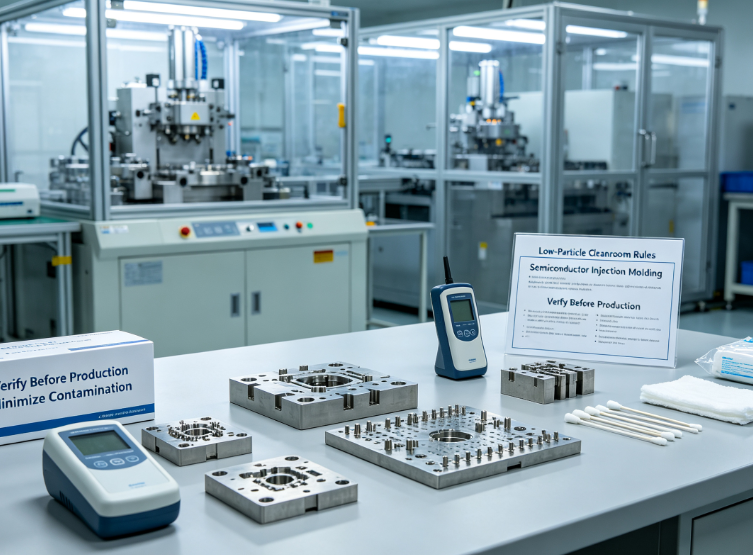
Mandatory Cleanroom Air & Environmental Rules (ISO 14644-1 Base Standard)
Semiconductor injection molding splits zones by risk; no one-size-fits-all cleanliness class. All classifications reference particles ≥0.5μm per cubic meter, the industry standard metric.
Cleanroom Zone Classification for Semiconductor Molding
| Production Zone | Required ISO Class | Max ≥0.5μm Particles/m³ | Air Changes Per Hour (ACH) | Primary Semiconductor Use |
|---|---|---|---|---|
| Critical molding + part ejection (wetted vacuum parts, wafer contact trays) | ISO 6 | ≤35,200 | 60–90 | Wafer carriers, chamber sealing plastic, plasma exposed components |
| General injection molding area | ISO 7 | ≤352,000 | 30–60 | Standard sensor housings, cable glands, non-wetted chamber fixtures |
| Entry gowning, material prep, final packaging | ISO 8 | ≤3,520,000 | 15–25 | Receiving raw resin, finished part bagging, QC sampling |
All semiconductor cleanrooms follow these non-negotiable environmental rules:
- Constant positive pressure zoning Maintain 10 Pa higher pressure inside the cleanroom versus hallways, storage and non-clean areas. Doors must never be propped open. Positive pressure stops dirty outside air drifting in with dust and fibers. Airlocks connect clean/non-clean zones for all personnel and material transfer.
- Full HEPA/ULPA air filtration All supply air passes 3-stage filtration: pre-filter → medium filter → terminal HEPA H14 or ULPA. Return air filters catch plastic fine dust and mold wear debris. Critical ISO 6 molding stations add local laminar flow hoods right above mold opening and part pickup to sweep particles away instantly.
- Strict temperature & humidity lock (ESD + particle prevention) Hold stable 20–22°C (68–72°F), relative humidity 45%–55%.
- Too dry (<40% RH): Static electricity builds up; static pulls airborne particles onto plastic surfaces
- Too humid (>65% RH): Resin absorbs moisture, causes molding splay and polymer flash that sheds micro-particles Daily temperature/humidity logging required for compliance audits.
- Smooth, non-shed construction materials Walls, floors, ceilings, worktables must use seamless epoxy, vinyl or powder-coated metal. No drywall, wood, porous paint, carpet or fabric curtains. All joints sealed silicone-free. Porous surfaces trap dust and release particles every time air flows or surfaces are wiped.
- Controlled air turbulence Minimize swirling eddies near molding machines. Turbulence stirs settled dust back into air. Laminar unidirectional airflow for high-risk wafer-contact component production.
Personnel Low-Particle Dress Code & Behavior Rules
Skin flakes, hair, lint from street clothes, cosmetics and lotion create 70% of cleanroom particles. Every staff member, visitor, inspector follows these zero-exception protocols.
Full Cleanroom Attire Rules
- Disposable or reusable non-linting cleanroom suit (nylon/polyester, no cotton). All zippers fully covered. No regular jeans, hoodies, knit fabrics allowed inside any ISO 6/7 zone.
- Double hairnet + full beard cover for facial hair. No stray hair exposed.
- Nitrile powder-free gloves only. Latex banned (latex sheds proteins and fine rubber particles). Gloves changed hourly or after touching any non-clean object.
- Shoe covers plus dedicated cleanroom boots for ISO 6/7. Street shoes never enter clean zones.
- No makeup, eyeliner, lipstick, facial lotion, nail polish or artificial nails. Cosmetics flake heavily onto parts.
- Disposable sleeve cuffs; no personal jewelry, watches, bracelets, rings. Metal scratches molds and skin debris collects on jewelry.
Strict On-Site Behavior Rules
- Hands stay below shoulder height in laminar flow zones; reaching overhead disturbs settled dust
- No running, fast arm movements, excessive talking; heavy breathing expels saliva particles
- All tools passed through disinfected pass-through chambers; no carrying items through main gowning doors
- Eating, drinking, chewing gum, smoking strictly forbidden anywhere inside cleanroom boundaries
- Visitors limited; all guests complete full gowning and sign contamination acknowledgment forms
- Operators cannot touch molded part surfaces with bare gloves; use ESD tweezers or robotic pickup
Injection Molding Machine Hardware Rules for Minimal Particle Output
Hydraulic machines are banned from semiconductor clean molding. Oil mist leaks spray micro-droplets and fine carbon particles onto plastic parts. All equipment must meet these specs:
- All-electric injection presses mandatory Zero hydraulic oil lines, zero risk of oil contamination. Servo motors sealed to stop brush carbon dust escaping. All motor vents fitted with small inline particle filters.
- Machine surface build requirements All machine frames coated with hard, scratch-resistant non-shed paint. Exposed metal stainless steel 304/316L. No unpainted raw steel that rusts and flaks rust particles. All crevices rounded for easy wiping and dust removal.
- No exposed belts, loose wiring insulation Open rubber belts shed rubber dust; wiring sleeves are smooth closed tubing. All moving mechanical joints enclosed to catch wear particles from gears and bearings.
- Machine cleaning frequency Exterior machine surfaces wiped with lint-free IPA wipers every shift. Weekly full tear-down cleaning of injection barrels, hopper connections, ejector plates. All cleaning tools are cleanroom-certified; regular shop rags prohibited.
- Vibration control Machines bolted to vibration-dampening pads. Heavy vibration shakes loose accumulated dust from equipment frames into the air.
Resin & Material Handling Rules (Prevent Incoming Particle Contamination)
Semiconductor plastics include PEEK, PPS, PVDF, high-purity PC, PFA, LCP, ESD-safe ABS. Resin handling errors introduce dust, pellets fines, fibers. These rules apply from receiving to feeding the press:
- All resin shipped double vacuum-sealed cleanroom packaging. Never accept bags with pinholes, tears or damaged seals.
- Material unpacking only inside ISO 8 material airlocks under laminar flow. Outer packaging discarded before resin enters main molding zones.
- Hopper dryers fully sealed with HEPA filtered intake/exhaust air. Dryer air recirculation filters replaced monthly to trap resin dust.
- All feed hoses, adapters, hoppers are stainless steel or virgin PTFE. Recycled metal tubing can shed rust and machining grit. All hose connections clamped airtight to stop fine resin powder leaking out.
- Resin regrind heavily restricted. For semiconductor wetted/vacuum parts, no regrind allowed whatsoever. Non-critical components permit max 10% regrind, and regrind must be double-filtered to remove plastic dust before blending. Regrind micro-fines are a major particle source.
- Colorants limited to high-purity masterbatch only. No powdered pigments (powders disperse airborne particles easily).
Mold Tooling Low-Particle Maintenance Rules
Mold wear, poor surface finish, dirty cooling lines, flash generation all create loose plastic particles. Standard cleanroom mold rules:
- Mold surface finish minimum Ra ≤0.8μm; critical wafer-contact molds polished to Ra ≤0.2μm. Rough mold surfaces tear plastic during ejection, generating tiny plastic shavings.
- All mold release agents banned for semiconductor parts. Release sprays aerosolize silicone particles that outgas and contaminate process chambers. Use draft angles and polished steel instead for easy part release.
- Molds pass full ultrasonic IPA cleaning before entering cleanroom. All mold assembly done inside laminar flow benches. No grinding, sanding or hand polishing molds inside clean zones.
- Mold cooling channels fully cleaned quarterly to remove mineral scale; scale breaks loose during thermal cycling and transfers particles to molded surfaces.
- Mold vents sized correctly to reduce burning, charring and flash. Charred plastic breaks into hard micro-particles. Excess flash is trimmed only post-molding in a separate clean station, not inside molding cells.
- When molds sit idle, they are fully wrapped in anti-static PE film inside clean storage cabinets to collect zero dust.
In-Molding & Post-Molding Particle Control Workflows
Every production step documented to avoid shedding debris:
- Robotic part ejection required for ISO 6 critical parts. Human hand removal increases contact contamination risk. Robots use smooth ESD grippers with no porous rubber padding.
- Parts drop into closed, lined cleanroom collection bins with HEPA-filtered lids. Open bins catch floating room particles constantly.
- Trimming, degating and deflashing completed in isolated ISO 7 trimming booths with local exhaust filtration. Trimming dust pulled out immediately so it does not drift onto other finished parts.
- All post-mold cleaning mandatory for chamber/wafers parts: ultrasonic DI water wash → IPA rinse → dry with HEPA filtered nitrogen blow-off. Air guns without filters blast ambient dust onto surfaces.
- Final packaging takes place under ISO 6 laminar flow. Parts sealed inside two layers of anti-static virgin PE bags. All packaging bags are certified low-particle, non-outgassing, no talc coating.
Cleaning Supplies & Sanitization Rules (Cleaning tools cannot add particles)
Most regular cleaners introduce lint and particles. Approved supply list only:
Allowed: Lint-free polyester wipers, non-woven cleanroom wipes, IPA 99.9% pure, DI water, static-free mop heads, sterile cleanroom detergent
Banned: Cotton rags, paper towels, regular sponges, scouring pads, household cleaners, aerosol sprays, silicone cleaners
Cleaning schedule rules:
- Daily shift end: Wipe all machine surfaces, tables, door frames with wet IPA wipes
- Weekly: Mopping entire cleanroom floor with dedicated cleanroom mop; HEPA vacuum all ceilings, air vents, light fixtures
- Monthly: Disassemble and wipe all machine crevices, mold frames, conveyor surfaces
- No dry dusting ever. Dry wiping kicks settled particles into air; all cleaning uses damp methods.
ESD Cross Rules (Static Attracts Particles + Damages Semiconductor Hardware)
Static charge pulls floating particles to plastic surfaces. Semiconductor molding ties particle control directly to ESD compliance:
- Full room ESD grounding: Floors, worktables, machine frames, metal carts bonded to single earth ground.
- All totes, packaging, grippers are conductive or dissipative anti-static plastic. Regular insulating plastic builds static.
- Operators wear grounded wrist straps while handling finished critical parts inside ISO 6 zones.
- Humidity held steady to cut static buildup; low humidity forces extra ionization bars near mold openings and packaging stations to neutralize charge.
Validation & Routine Particle Testing Rules (Proof of Compliance)
Rules mean nothing without regular monitoring, aligned with ISO 14644-2 testing cadence:
- Air particle counting
- ISO 6: airborne particle testing every 6 months
- ISO7/ISO8: airborne testing once per year
- Dynamic testing required (machines running, staff working) — static empty-room counts do not reflect real production particle levels
- Surface particle testing Wipe sampling of molded parts, mold surfaces, machine tabletops monthly. Count particles ≥0.3μm on surfaces to catch hidden contamination.
- Filter maintenance log HEPA/ULPA filters integrity leak-tested every 12 months. Pre-filters replaced monthly; terminal HEPA replaced every 12–24 months based on pressure differential readings.
- Outgassing verification All production plastic batches send test coupons for outgassing analysis. High outgassing often pairs with loose surface particles dangerous for UHV chambers.
- Deviation protocol If particle counts exceed ISO limits, production pauses immediately. Root-cause investigation (filter failure, staff gown error, resin leak, mold flash) completed before restarting runs. All affected parts quarantined and re-inspected.
FAQ
Can I use ISO 8 cleanrooms for semiconductor wafer tray molding?
Not recommended. Wafer-contact components touch bare silicon; ISO 6 is required to keep airborne particles low enough to prevent wafer scratching. ISO 8 is acceptable only for fully external non-process plastic housings that never enter vacuum or plasma environments.
Why ban hydraulic molding presses for semiconductor cleanrooms?
Hydraulic oil leaks form tiny oil aerosols that stick permanently to plastic. Oil residue releases volatile organics inside process chambers and traps solid dust particles. All-electric machines eliminate oil entirely and produce far less wear-related particulate debris.
Is regrind plastic allowed for semiconductor chamber molded parts?
Zero regrind permitted for all wetted, vacuum-exposed or plasma-facing plastics. Regrind generates abundant micro plastic dust during melting and injection. Minor regrind (≤10%) may pass for external non-casings only after full particle filtration validation.
Can I use spray mold release inside the semiconductor cleanroom?
Strictly prohibited. Aerosol release sprays spread silicone mist and solid additives throughout the air. These contaminants cause plasma arcing, heavy outgassing, and permanent particle adhesion on molded surfaces. Proper mold polish and draft angles replace release agents.
How do I confirm molded parts are low-particle, not just the cleanroom air?
Combine three checks: airborne ISO particle logs, surface wipe particle counts on finished parts, and nitrogen blow-down particle testing. Air quality only reflects room conditions; surface testing confirms no mold wear, resin fines or handling particles stick to components. Visual inspection is unreliable—human eyes cannot detect sub-micron particles.
What’s the biggest overlooked particle source in clean molding?
Improper cleaning supplies. Cotton mops, regular paper towels, cheap generic wipes shed millions of lint fibers every wipe. Even if air filters work perfectly, wrong cleaning tools continuously add particles all shift long. All consumables must carry cleanroom certification.
Do temperature swings create more particles?
Yes. Large temperature fluctuations make molds expand/contract repeatedly, rubbing plastic and steel together to create micro-shavings. Stable temperature reduces mechanical abrasion and cuts particle generation from ejection and mold movement.
Can staff wear regular safety glasses inside the cleanroom?
Only if glasses are fully sealed with no fabric foam padding. Foam padding sheds fibers. All eyewear must be hard smooth plastic or safety glass with rubberless frames.
Final Wrap-Up
Low-particle semiconductor injection molding relies on layered rules: filtered clean air, controlled human activity, sealed electric machinery, clean resin workflows, smooth non-shed molds, zero-contamination cleaning, and regular validation. No single rule fixes particle risk; every protocol connects to stop debris at its source.
For semiconductor OEMs partnering with mold suppliers, always demand documented ISO 14644 dynamic particle reports, all-electric equipment logs, full material traceability, and surface particle test records. Small shortcuts in gowning, resin handling or mold cleaning add up to fab defects, expensive wafer scrap and unstable chamber performance. Consistent rule enforcement turns cleanroom molding from a nice upgrade into non-negotiable process protection for chip manufacturing.