Published:Zorapid.Ltd
Automotive OEMs are racing to cut vehicle curb weight to boost EV range and meet emissions rules. Magnesium alloys are one of the lightest structural engineering metals—~33% lighter than aluminum, ~75% lighter than steel—perfect for instrument panel frames, suspension brackets, steering components, gearbox housings, battery system supports, and chassis cross members.
But magnesium CNC milling is nothing like aluminum machining: it’s highly flammable, prone to chatter, thin-wall deflection, burr formation, and rapid corrosion. Without correct tooling, parameters, dust control, and surface protection, you risk fire hazards, dimensional scrap, premature field corrosion, and IATF 16949 audit non-conformances.
This guide covers shop-ready magnesium CNC milling best practices for automotive structural applications, including alloy selection, milling parameters, thin-wall DFM rules, fire safety, corrosion finishing, and automotive quality compliance workflows.
Core Material Properties & Common Automotive Magnesium Alloys
Key Properties
- Density: ~1.74 g/cm³ (far lower than Al 2.7 g/cm³, steel 7.85 g/cm³) → massive vehicle weight reduction
- High specific stiffness, excellent vibration damping (great for noise / NVH control)
- Good machinability (low cutting forces) but high thermal sensitivity, prone to creep, galvanic corrosion, and fine combustible dust
- Lower absolute yield strength vs aluminum; best for semi-structural / secondary chassis components (not primary crash load structures without proper design validation)
Primary Automotive Magnesium Alloys
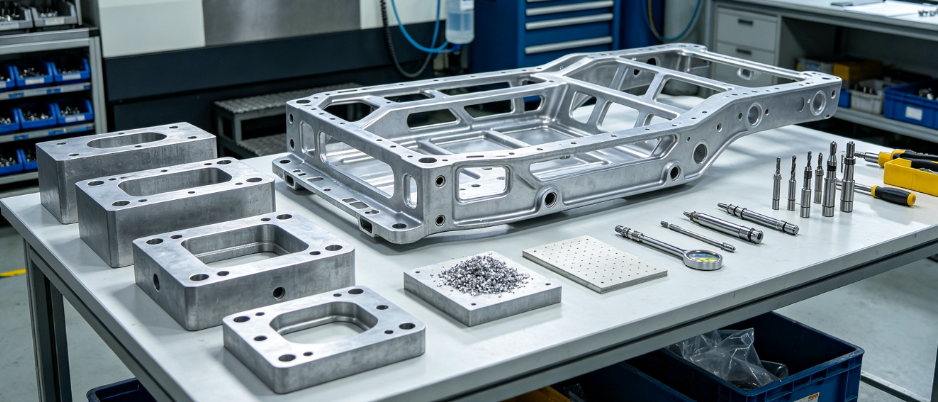
- AZ31B / AZ31B-H24: General structural sheet & plate, moderate strength, common for brackets, frames, instrument panel structures
- AZ91D: Die-cast magnesium alloy, high strength, used for gearbox housings, steering column housings (most common auto magnesium alloy)
- AM60B / AM50: High ductility die-cast magnesium, crash-energy absorbing components, EV auxiliary frames
- WE43 / ZE41: Rare-earth enhanced magnesium, higher heat resistance, for high-temperature powertrain adjacent structural parts (higher cost, specialized milling parameters)
Raw Blanks
Most automotive magnesium structural parts start as die-cast blanks or extruded billets (not solid full billet), with near-net shape geometry to reduce total CNC material removal.
Key Magnesium CNC Milling Challenges
- Combustion risk: Fine magnesium chips + dry heat can ignite; ultra-fine magnesium dust accumulates in machine enclosures, creating explosive dust clouds
- Thin-wall chatter & springback: Low stiffness creates vibration, dimensional drift, excessive burrs, inconsistent surface finish
- High corrosion susceptibility: Bare magnesium corrodes rapidly in moisture/salt environments (road spray, winter de-icing fluid)
- Excessive built-up edge (BUE): Soft magnesium easily welds to tool flutes, causing poor finish, dimensional error, chip jamming
- Thermal distortion: Low melting point (~650°C); excess cutting heat causes localized softening, warpage, and residual stress
- Galvanic corrosion risk: Direct contact with steel fasteners/aluminum creates galvanic cells, accelerating degradation
- IATF 16949 traceability & PPAP compliance requirements for serialized automotive production
Machine, Fixturing & Workholding Setup Rules
Machine Requirements
- Dedicated or fully cleaned CNC machines (remove residual steel/aluminum dust/debris to avoid galvanic contamination + fire risk)
- Equip full enclosed machine cabinet + dedicated industrial magnesium dust extraction / mist collection system (critical safety requirement)
- Thermal compensated 3/5-axis CNC for tight GD&T mating features; avoid light frame machines for large thin-wall magnesium assemblies
- Prevent hot chips from accumulating in machine sumps / cabinets; schedule regular machine deep cleaning cycles
Fixturing & Workholding Best Practices
- Rigid, non-ferrous fixturing (aluminum, composite, brass soft jaws): Minimize direct steel contact with magnesium to prevent galvanic corrosion risk and indentation damage
- Vacuum chucks / full-surface fixturing for large thin magnesium panels to reduce chatter and deflection
- Temporary sacrificial support ribs for ultra-thin wall structural sections during roughing; remove supports in final light finishing passes
- Single-setup 5-axis machining for complex 3D brackets to eliminate tolerance stack-up and repeated re-fixturing distortion
- Reduce clamping force: magnesium is soft, easy to dent/deform under heavy clamping pressure
- Use datum features only on thick, non-cosmetic, non-thin-wall regions for consistent CMM inspection validation
Tooling, Speed & Feed Parameters for Magnesium Milling
Tool Selection
- Tool Material: Solid carbide, high-polish mirror finish, large flute volume, high helix angle (35°–45°), few flutes (2-flute preferred for roughing, 2–3 flutes for finishing)
- Polished flutes drastically reduce BUE chip adhesion
- Avoid unpolished, coated tools with excessive surface roughness (causes chip sticking)
- Sharp, razor-like cutting edges to minimize burr formation and cutting forces
- Tool Overhang: Keep tool overhang as short as possible, use shrink-fit hydraulic holders to eliminate chatter
- Coolant / Lubrication Rules (Fire Prevention Core Rule):
- Use water-soluble synthetic coolant or low-viscosity mineral oil mist lubrication to control cutting temperature
- Never run full dry high-speed magnesium milling in production (extreme fire risk)
- Avoid excessive coolant pooling that traps fine dust; maintain clean sump filtration
- Separate magnesium coolant systems to prevent cross-contamination with ferrous metals
- Baseline Speed & Feed (AZ31B / AZ91D Magnesium):
- Rough Milling: High spindle speed (6,000–12,000 RPM), high feed rate, moderate depth of cut, trochoidal milling patterns to spread heat
- Finish Milling: Light depth of cut, high feed, sharp polished tools to minimize burrs and residual stress
- Reduce speed drastically for rare-earth magnesium alloys (WE43, ZE41) and deep pocketing to avoid excessive heat buildup
- Continuous chip evacuation is key: avoid chip packing inside pockets and flutes
- Chip Handling: Continuous chip removal, collect coarse chips separately from fine dust; store magnesium chips in dedicated conductive fire-safe metal bins, never plastic bins
DFM Design Rules for Magnesium Auto Structural Parts
Magnesium’s low stiffness and corrosion sensitivity require specific DFM rules to meet automotive durability specs:
- Minimum Wall Thickness Rule: ≥1.5mm for general structural panels; add formed ribs (not solid thickening) to boost rigidity and reduce chatter during milling
- Avoid large unsupported flat thin panels; add grid ribbing to reduce vibration and NVH resonance
- Uniform Wall Thickness: Eliminate extreme thick/thin transitions to reduce thermal distortion and residual stress
- Fillets & Radii: Consistent large internal radii (R ≥1mm), eliminate sharp corners that create stress risers and burrs
- Isolate Dissimilar Metals: Design non-conductive plastic/gasket isolators between magnesium and steel/aluminum fasteners to block galvanic corrosion
- Limit Overhang Features: Reduce deep cantilever geometry prone to chatter and springback
- Tolerance Zoning: Tight GD&T tolerances only on mating mounting holes; relax non-critical cosmetic/outer surfaces to reduce cycle time and scrap
- Pre-Net Shape Blanks: Specify near-net die-cast magnesium blanks to minimize deep heavy CNC roughing, reduce heat input and residual stress
- Account for Creep Risk: Avoid constant high-temperature load applications without alloy validation (rare-earth grades only)
Post-Machining Finishing, Corrosion Protection & Treatments
Bare magnesium cannot survive road salt, humidity, and automotive environmental cycles—mandatory post-processing steps:
- Deburring: Vibratory tumble, micro-brush deburring (light process only). Avoid aggressive grinding (generates fine dust + residual stress)
- Remove all sharp micro-burrs that accelerate corrosion initiation
- Pre-Treatment:
- Alkaline cleaning, DI water rinse, chromate-free conversion coating (automotive RoHS compliant, e.g., phosphate, permanganate, or magnesium-specific conversion coatings)
- Anodizing (MAO / Micro-Arc Oxidation) for high-performance structural magnesium parts: creates a hard ceramic barrier layer for corrosion + wear resistance (ideal for EV chassis brackets)
- Passivation per automotive OEM specs
- Topcoat: Automotive powder coating, polyurethane paint, or sealant systems applied after conversion coating
- Verify coating thickness and adhesion (ASTM D3359 cross-hatch test)
- Mask critical GD&T mating surfaces before coating to preserve dimensional tolerances
- Assembly Fastener Specs: Use coated fasteners + isolating washers to eliminate galvanic corrosion pathways
- Surface Roughness Target: Ra 1.6–3.2μm general structural surfaces; tighter Ra only on precision mating boss features
Safety Protocols (Magnesium Fire Risk + Dust Control)
Magnesium fires cannot be extinguished with standard water or CO₂ fire extinguishers—this is a non-negotiable workshop rule
- Dust Mitigation:
- Dedicated continuous magnesium dust extraction system, regular enclosure deep cleaning
- No accumulation of fine magnesium dust on machine walls, floors, filters, or under conveyors
- Conduct regular dust explosion risk assessments
- Fire Safety Setup:
- Store dedicated Class D dry powder magnesium fire extinguishers + dry sand / graphite powder at all magnesium CNC workstations
- Post clear magnesium fire emergency procedures
- Separate magnesium chip waste storage: conductive grounded metal bins, daily removal, away from heat sources, welding areas, oxidizers
- No smoking, hot work near magnesium machining zones
- Install thermal / spark detection sensors on enclosed magnesium CNC machines
- Emergency Rule: Never spray water directly onto a magnesium chip fire (water reacts with burning magnesium and worsens combustion)
- Operator Training: Formal magnesium machining safety training, documented in IATF 16949 records
Traceability & Automotive Compliance
- Material Traceability:
- Track magnesium alloy heat / cast lot numbers, mill CoA, die-cast batch records through the full CNC production workflow
- Use permanent laser marking (non-ferrous compatible) on non-critical surfaces for part traceability (AIAG / VDA compliant)
- Maintain traveler records: machine ID, operator ID, batch ID, process parameters, coating batch logs
- IATF 16949 & PPAP / APQP:
- Complete FMEA (DFMEA / PFMEA) for magnesium structural parts (corrosion risk, fire risk, dimensional risk)
- SPC statistical process control for critical GD&T features, CMM inspection reports, dimensional validation
- Full PPAP submission for mass automotive production, including corrosion durability test data
- Retain production records per OEM automotive retention rules
- Material Validation: XRF alloy verification on incoming magnesium blanks to prevent wrong alloy substitution
- NVH / Durability Validation: Fatigue / vibration cycle testing for structural chassis magnesium assemblies
Common Magnesium Milling Defects & Fixes
- Excessive Burr Formation
- Cause: Dull tools, low helix angle tools, too slow feed rates, excessive depth of cut
- Fix: High-polish 2-flute carbide tools, increase feed rate, reduce depth of cut, finish light passes
- Thin-Wall Chatter & Dimensional Springback
- Cause: Long tool overhang, poor fixturing, insufficient rib support, high residual stress
- Fix: Rigid fixturing + temporary supports, reduce roughing depth, add DFM stiffening ribs, light finishing passes
- Rapid Surface Corrosion Post-Machining
- Cause: Bare magnesium surface, residual coolant salts, no conversion coating / MAO treatment, dissimilar metal contact
- Fix: Immediate post-machining cleaning + conversion coating, RoHS compliant barrier coatings, isolate dissimilar metals
- Built-Up Edge (BUE) Chip Welding
- Cause: Unpolished tools, incorrect coolant/lubrication, too low feed speed
- Fix: Mirror polished 2-flute carbide, mist lubrication, consistent high feed parameters
- Thermal Distortion / Residual Stress Warpage
- Cause: Excessive cutting heat, uneven roughing passes, no stress relief
- Fix: Trochoidal roughing, controlled coolant, low-heat finishing, optional low-temperature stress relief annealing per alloy spec
- Fine Dust Accumulation Risk
- Cause: Inadequate dust extraction, infrequent machine cleaning
- Fix: Automated dust extraction schedule, daily enclosure cleaning, regular filter maintenance
Real-World Case: EV Magnesium Instrument Panel Structural Frame
Project Background
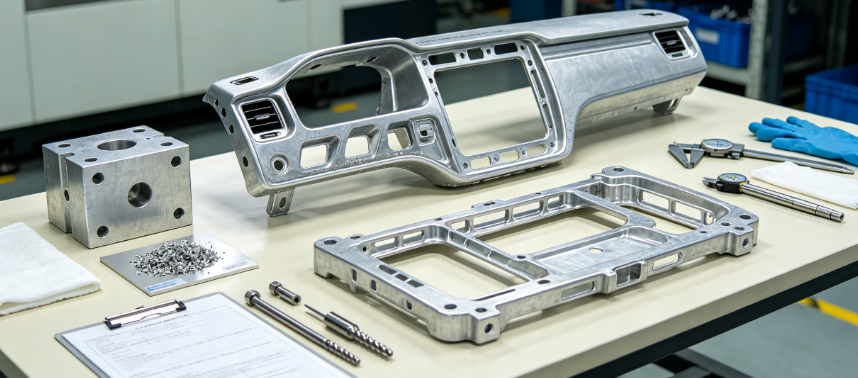
Tier 1 automotive EV magnesium AZ31B instrument panel crossbeam, large thin-wall structural frame, weight reduction target 35% vs aluminum baseline, IATF 16949 mass production
Original Issues
- Severe thin-wall chatter, excessive burrs, slow cycle time, ongoing surface corrosion risk
- Uncontrolled fine magnesium dust buildup (fire risk)
- No formal conversion coating workflow, failed automotive salt spray testing
Implemented Magnesium CNC Milling Fixes
- Dedicated 5-axis vacuum fixturing + DFM grid ribbing for thin-wall panels
- High-polish 2-flute carbide tools, optimized trochoidal high-feed milling parameters, continuous mist coolant
- Automated magnesium dust extraction + daily machine enclosure cleaning + Class D fire safety station
- MAO micro-arc oxidation conversion coating + automotive polyurethane topcoat, validated salt spray testing
- IATF 16949 SPC CMM monitoring + full batch magnesium cast lot traceability
Measurable Results
- 37% weight reduction vs aluminum equivalent frame
- 40% reduction in burr rework time, consistent Ra surface finish
- Passed 1000hr automotive salt spray corrosion testing
- Zero magnesium fire incidents, compliant mass production workflow
- Full PPAP approval for 100k/year EV production volume
FAQ
Is magnesium suitable for primary crash-critical automotive chassis structures?
Standard magnesium alloys (AZ31B, AZ91D) are best for secondary semi-structural frames, instrument crossbeams, steering housings, and auxiliary EV battery supports. Primary crash safety structures require advanced rare-earth magnesium alloys + full crash simulation validation, and are not standard mass-production applications today.
What is the biggest safety risk when CNC milling magnesium?
Fine combustible magnesium dust and hot chips can ignite, creating flash fires and dust explosions. Use continuous dedicated dust extraction, Class D fire suppression, avoid dry high-speed milling, and follow formal magnesium machining safety protocols. Never use water for magnesium chip fires.
How do I prevent magnesium automotive parts from corroding in road salt environments?
3 key steps: 1) Apply RoHS compliant conversion coating / MAO micro-arc oxidation barrier treatment, 2) add automotive polyurethane/powder topcoat, 3) isolate magnesium from steel/aluminum fasteners using non-conductive gaskets/coatings to block galvanic corrosion pathways.
Which magnesium alloy is best for mass production automotive structural CNC parts?
AZ91D die-cast magnesium for gearbox, steering housings; AZ31B sheet/plate for instrument panel frames; AM60B for crash-absorbing auxiliary frames. Rare-earth WE43/Z41 are for high-temperature powertrain adjacent components (higher cost).
Can magnesium parts use standard aluminum CNC tooling and parameters?
No. Magnesium requires high-polish large-flute 2-flute carbide tools, modified high-feed trochoidal cycles, and strict dust/coolant rules to avoid BUE, chatter, and fire risk. Generic aluminum tooling creates burrs and chip adhesion issues.
Does magnesium require stress relief annealing after CNC roughing?
Yes for large thin-wall structural frames. Low-temperature stress relief cycles reduce residual stress and delayed dimensional warpage, validated per alloy spec and IATF 16949 SPC control.
What automotive quality standard governs magnesium structural part production?
IATF 16949 automotive QMS, plus AIAG PPAP/APQP/ FMEA requirements, OEM corrosion specs, RoHS compliance, and full material cast lot traceability.
Can magnesium be used directly with standard steel bolts?
No—direct contact creates galvanic corrosion, leading to premature bolt joint failure. Use coated fasteners + non-conductive isolator washers per OEM drawing specs.
What is the ideal surface finish for automotive magnesium structural brackets?
General structural surfaces: Ra 1.6–3.2μm, validated after conversion coating/MAO treatment. Precision mounting boss features may require tighter Ra for assembly tolerance control.
What is the typical weight saving vs aluminum for magnesium auto structural parts?
Approximately 30–35% lighter for equivalent geometry, delivering meaningful EV range improvement while meeting semi-structural stiffness/NVH specs.
Quick Magnesium CNC Milling Checklist
Magnesium Material & Traceability
Verified magnesium alloy batch / cast lot COA + XRF validation
IATF 16949 batch traveler, SPC records, permanent traceability marking
Dedicated magnesium fixturing (non-ferrous soft jaws, vacuum chucks)
DFM ribbing added for large thin-wall panels; minimum wall ≥1.5mm
CNC Machining & Tooling
High-polish 2-flute carbide tools, short tool overhang, shrink-fit holders
Trochoidal high-feed roughing with controlled mist/water-soluble coolant
Continuous dedicated magnesium dust extraction system active during runs
Light finishing passes to reduce burrs, chatter, residual stress
Daily machine enclosure dust cleaning schedule
Safety & Fire Compliance
Class D magnesium fire extinguisher + dry sand / graphite on site
No dry high-speed magnesium milling in mass production
Conductive grounded metal magnesium chip bins, daily chip removal
Formal magnesium machining safety training documented
Corrosion & Finishing
RoHS magnesium conversion coating / MAO micro-arc oxidation treatment
Automotive validated topcoat/powder coating (mask GD&T mating surfaces)
Non-conductive isolators between magnesium and dissimilar metals
Salt spray corrosion validation per automotive OEM specs
Dimensional Validation
CMM GD&T inspection for critical mounting features, SPC monitoring
Post-finish dimensional check for residual stress warpage
Full PPAP / FMEA documentation for mass automotive production
Closing Wrap-Up
Magnesium CNC milling is a powerful lightweighting solution for automotive semi-structural EV and chassis components, delivering massive weight savings vs aluminum and steel. Success hinges on balancing 3 core priorities:
- Controlling magnesium’s unique fire risk, chatter, burr formation, and residual stress distortion
- Following DFM rules for thin-wall magnesium geometry and applying proper corrosion barrier coatings
- Maintaining full IATF 16949 automotive traceability, FMEA, and PPAP compliance
When done correctly, magnesium structural components cut curb weight, improve NVH, and boost EV range—while meeting automotive durability and safety standards. The biggest risk is cutting corners on dust safety and corrosion protection, not basic milling parameters.
If you need a magnesium AZ31B/AZ91D 5-axis CAM template or IATF 16949 traveler template, share your part geometry and OEM specs for a free review.