Published:Zorapid.Ltd
Medical product development moves through strict stages: early form study, human factors testing, bench functional validation, pre-clinical trials, and regulatory documentation.
One critical decision repeats on every project:
Which manufacturing method should I use to build prototypes and low-volume pre-production parts?
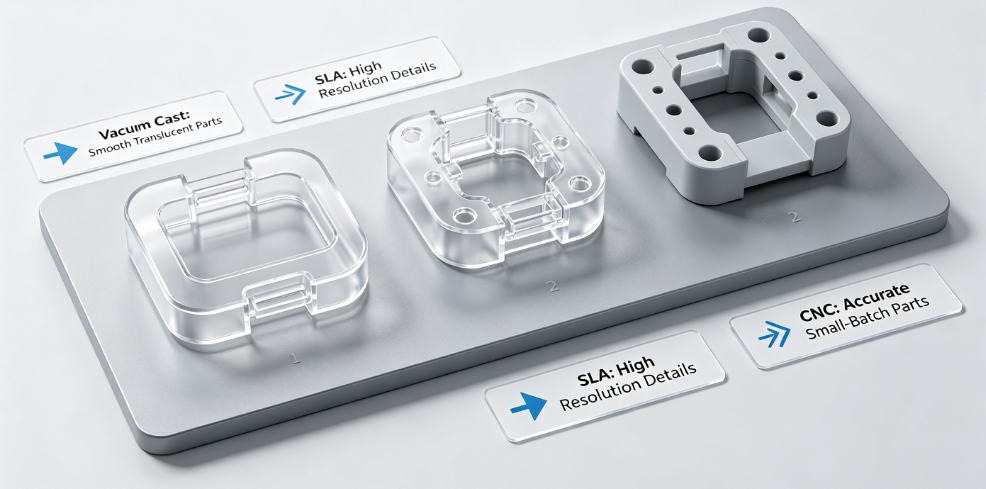
SLA resin printing, vacuum casting (urethane casting), and small-batch CNC machining are the three most widely used options for medical prototyping. Each carries unique limits on material selection, surface quality, tolerances, biocompatibility, batch size, cost and available geometries.
Pick the wrong process, and you risk:
- Parts that cannot withstand functional testing
- Material not suitable for biocompatibility screening
- Poor dimensional consistency across multiple samples
- Wasted budget when you scale up batches
- Surfaces or materials that fail cleaning and sterilization trials
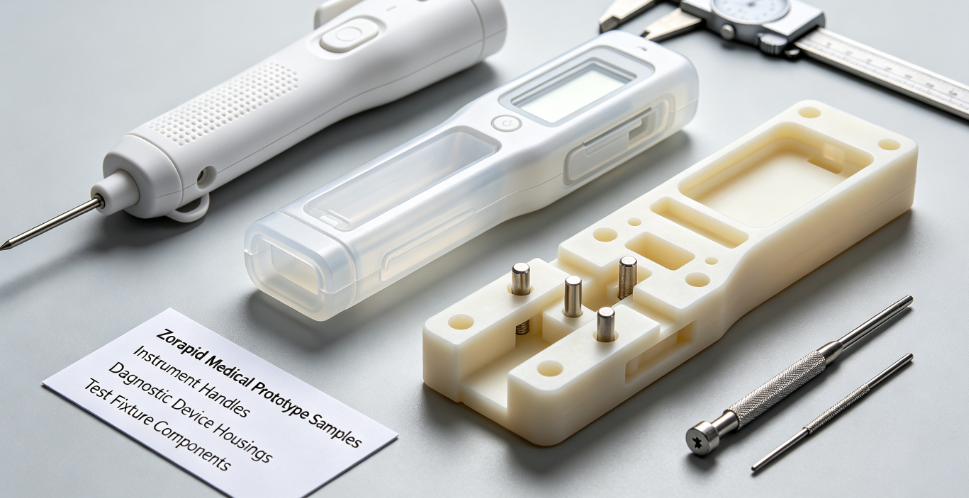
In this guide, we break down vacuum casting, SLA and small-batch CNC specifically for medical applications. We cover strengths, limitations, realistic medical use cases, and how Zorapid supports you to select the optimal workflow from concept prototype to pre-production runs.
Unique Requirements for Medical-Grade Prototypes
Medical prototypes face stricter demands than general consumer product models. Before evaluating any process, confirm you need to satisfy one or more of these criteria:
- Biocompatibility & sterilization capability Autoclave, ETO, gamma sterilization resistance; ISO 10993 compliant material options.
- Dimensional stability Parts must not warp during testing, storage or repeated sterilization cycles.
- Surface cleanliness Low particle generation, minimal trapped casting residues, suitable for ultrasonic cleaning.
- Consistency across multiple units Human factors and clinical mockups often require 5–50 identical samples.
- Functional mechanical performance Elastic properties, impact resistance, chemical resistance to disinfectants.
- Traceability for test documentation Material certificates, batch records for lab and pre-clinical reporting.
Not every process can check all these boxes. This is why direct head-to-head comparison matters.
Technology Overview
1. SLA – Stereolithography Resin 3D Printing
SLA uses UV light to cure liquid resin layer by layer. It delivers extremely high resolution, fine feature detail and smooth surface finish directly out of the machine.
Strengths
- Outstanding fine detail, thin walls, intricate internal geometry
- Fast single-part turnaround for early form fit models
- Excellent surface quality; minimal post-processing
- Supports transparent, rigid, flexible and medical-grade photopolymer resins
Limitations
- Limited batch scalability; cost rises quickly above ~20 units
- Many standard resins are NOT biocompatible or sterilizable
- Layer orientation creates anisotropic mechanical behaviour
- Lower heat and chemical resistance compared to engineering plastics
- Large flat surfaces risk warpage
Best for: Early form & fit prototypes, ergonomic mockups, transparent fluid channel test models, visual presentation samples, single-unit proof-of-concept hardware.
2. Vacuum Casting (Urethane Casting / PU Casting)
Vacuum casting builds silicone molds from a master pattern, then pours two-part polyurethane resin under vacuum to eliminate bubbles.
Strengths
- Low cost for batches of 5 up to ~50 identical parts
- Wide material range: rigid, rubber-like, transparent, flame-retardant PU
- Can simulate ABS, PP, PC, and soft-touch TPU feel
- Parts are isotropic; no 3D printing layer anisotropy
- Complex geometry with undercuts possible with split silicone molds
Limitations
- Mold lifespan limited (typically 15–30 shots per silicone tool)
- Longer lead time than SLA; requires master pattern + mold making
- Very few biocompatible, autoclavable PU grades
- Tolerances looser than CNC; shrinkage must be compensated in mold design
- Not suitable for high-temperature continuous operation
Best for: Human factors testing batches, marketing prototypes, low-volume functional mockups, assemblies requiring multiple identical housings, soft-grip surgical handles.
3. Small-Batch CNC Machining
CNC subtractive machining cuts parts from solid stock of engineering plastics or metal.
Strengths
- Widest selection of certified medical raw materials: PEEK, PEI, PC, PP, POM, 316L stainless, Ti6Al4V
- Precise, stable tolerances, excellent dimensional repeatability
- Materials support ISO 10993 testing, repeated sterilization
- Isotropic mechanical properties, identical to production material
- Can achieve Ra ≤0.4 μm precision surfaces for contact components
Limitations
- Higher unit price for very low quantities (1–3 pieces)
- Complex internal undercuts require multi-axis machining
- Lead time longer than SLA for one-off prototypes
- Cannot easily produce organic freeform lattices or ultra-thin unsupported structures
Best for: Functional prototypes requiring production-equivalent material, sterilization testing, fluid contact components, surgical tool bodies, implant fixture hardware, pre-production validation batches.
Process Core Characteristics
| Comparison Factor | SLA Resin Printing | Vacuum Casting | Small-Batch CNC Machining |
|---|---|---|---|
| Typical Batch Sweet Spot | 1–20 units | 5–50 units | 1–200+ units |
| Lead Time (CAD to finished parts) | Fast: 1–4 days | Medium: 5–12 days (master + mold + casting) | Medium: 4–14 days based on complexity |
| Minimum Feature Resolution | Excellent (0.05 mm fine details) | Good (0.2 mm minimum practical wall) | Dependent on tool size (0.3 mm typical limit) |
| Dimensional Tolerance | ±0.05 ~ ±0.15 mm | ±0.10 ~ ±0.20 mm | ±0.005 ~ ±0.05 mm critical features |
| Material Isotropy | Anisotropic (layer effect) | Isotropic | Isotropic |
| Surface Quality As-Built | Very smooth | Smooth, minor parting lines | Machined texture; can be polished |
| Biocompatible Material Availability | Limited medical resin grades | Very limited PU options | Extensive (PEEK, PC, PP, Ti6Al4V, 316L) |
| Repeated Sterilization Compatibility | Restricted to specialty medical resins | Rarely suitable | Excellent with correct stock selection |
Cost, Geometry & Medical Suitability
| Comparison Factor | SLA Resin Printing | Vacuum Casting | Small-Batch CNC Machining |
|---|---|---|---|
| Cost for 1–3 prototypes | Lowest | Higher | Highest |
| Cost for 20–40 unit batches | Expensive | Most economical | Moderate |
| Cost above 50 units | Not competitive | Cost plateaus | Scales steadily |
| Complex Freeform / Thin Walls | Excellent | Good | Limited by tool access |
| Internal Undercuts & Deep Cavities | Excellent | Good with split molds | Requires multi-axis setup |
| Simulate Production Plastic Feel | Limited resin selection | Great PU simulation | Exact production material |
| Traceability for Regulatory Tests | Limited resin documentation | Basic batch records | Full raw material certification |
| Risk of Trapped Porosity | Low | Possible without proper vacuum | Zero inherent porosity risk |
How to Choose the Right Process for Your Medical Project
Choose SLA when:
You need 1–20 units for form, fit, visual and ergonomic testing
Parts contain tiny fine features, thin walls or transparent fluid channels
Lead time is extremely tight
Not recommended if you require repeated autoclaving or long-term functional durability
Choose Vacuum Casting when:
You need 5–50 identical prototype assemblies
You want multiple colour variants or soft-touch overmock handles
Testing human factors with multiple user samples
Avoid if parts will undergo sterilization or chemical disinfection cycles
Choose Small-Batch CNC when:
Functional testing requires production-grade engineering plastic or metal
Parts need ISO 10993 biocompatibility screening and sterilization
Tight dimensional tolerances are critical for assembly
You plan to transition directly into low-volume production after prototyping
Common Costly Mistakes in Medical Prototyping
- Using visual prototype material for functional / sterilization testing SLA standard resin or general PU vacuum cast parts will fail autoclave trials. Many engineers waste test time discovering material limitations late.
- Selecting vacuum casting for high-precision assembly components Natural shrinkage and wider tolerances cause fit issues when mating multiple cast housings.
- Ignoring anisotropy in SLA parts Load-bearing SLA prototypes may break along layer lines even if simulation predicts sufficient strength.
- No material certification documentation For pre-clinical work, test labs require material data sheets. Many generic prototyping suppliers cannot provide formal traceability.
- Switching manufacturing method mid-stage testing Changing from SLA prototype to CNC production material can shift mechanical behaviour and invalidate historical test data.
Core Zorapid Advantages for Medical Device Prototyping
Few suppliers offer all three processes under one roof. Zorapid delivers unbiased process recommendations and full traceability for medical development teams:
Three-in-one prototyping capability: SLA, vacuum casting, small-batch CNC
We evaluate your batch size, functional requirements, sterilization goals and budget to recommend the optimal process, instead of pushing a single service.
Medical material library with formal documentation
Medical-grade SLA resins, biocompatible PU casting materials, and certified stock: PEEK, PEI, medical PC, PP, 316L stainless, Ti6Al4V. We provide material certificates to support lab testing and regulatory filings.
DFM review focused on medical risks
Our engineers flag geometry issues early: thin-wall stability, draft angles for casting, machinability, potential porosity risks, and surface requirements for cleaning & disinfection.
Controlled post-processing for medical cleanliness
Precision deburring, ultrasonic cleaning, dust-free finishing and sealed packaging. We avoid residual casting oil, loose particles that ruin biocompatibility testing.
Consistent quality across prototype batches
Whether you order 2 SLA samples or 40 vacuum cast housings, we lock process parameters to maintain repeatability for human factors and bench testing.
Smooth transition path from prototype to production
If your project moves beyond prototyping, we scale seamlessly into larger batch CNC, sheet metal or injection molding, removing the risk of switching vendors.
Hybrid assembly support
We combine multiple processes in one assembly: SLA internal inserts, vacuum cast outer grips, CNC-machined metal surgical components.
FAQ
Can vacuum casting parts be autoclaved for medical testing?
Only a small number of specialty polyurethane grades survive limited autoclave cycles. Most standard vacuum casting PU will deform, discolour or degrade. If repeated sterilization is required, CNC machined medical plastics (PP, PEEK, PC)
Are SLA medical resins truly ISO 10993 compliant?
Only professional medical SLA resins with complete certification. Standard consumer-grade SLA resins have no biocompatibility certification and contain toxic residual monomers. Zorapid exclusively uses formal medical-grade SLA resins with full ISO 10993 test reports for cell contact and short-term tissue contact prototypes.
Which process is best for early-stage human factor testing with 20–30 units?
Vacuum casting is the optimal choice. SLA 20–30 batches cost extremely high with inconsistent surface texture. CNC is overpriced for pure ergonomic testing. Vacuum casting delivers uniform color, texture and hand feel at the lowest batch cost, perfectly matching human factor evaluation demands.
Can I use CNC prototype data directly for regulatory submission?
Yes. CNC parts use industrial standardized medical stock materials with complete traceability certificates, mechanical test data and batch records. All test results based on CNC prototypes are recognized for pre-clinical verification and regulatory filing, while SLA and vacuum casting data are only for internal R&D reference.
Why do my SLA functional prototypes always break easily?
Mainly due to anisotropic layer structure. SLA parts have weak bonding between printing layers. When bearing tension, bending or impact loads, they fracture along layer lines easily. SLA is only for form/fit/visual testing, never for mechanical functional verification.
What is the maximum batch size for vacuum casting before cost increases?
50 units is the economic threshold. A single silicone mold can only stably produce 15–30 high-precision medical parts. Beyond 50 units, repeated mold replacement and manual calibration increase cost and reduce consistency. For batches over 50 pcs, we recommend switching to small-batch CNC or rapid injection molding.
Which process supports transparent medical fluid channel prototypes?
SLA is the only feasible option. Vacuum casting transparent parts have slight haze and bubble risks. CNC transparent plastic machining leaves tool marks and requires complex polishing. Medical-grade transparent SLA resin achieves ultra-clear light transmission, perfect for simulating liquid flow, pipeline structure and internal fluid dynamics.
Can vacuum casting simulate soft-touch TPU surgical handles?
Yes, perfectly. We support 30–90 Shore A hardness PU materials, simulating TPU soft rubber, anti-slip and shock-absorbing effects. It is the best low-cost solution for ergonomic surgical handle prototype verification.
What process should I choose for implant fixture prototypes?
Small-batch CNC exclusively. Implant fixtures require high dimensional stability, zero porosity, biocompatibility and repeated disinfection. SLA resin is not implant-safe, vacuum casting has shrinkage defects. CNC-machined medical PEEK and titanium are fully compliant with medical fixture standards.
Can medical prototypes from Zorapid support ultrasonic cleaning testing?
CNC & qualified vacuum casting parts support it; standard SLA does not. Ordinary SLA resin absorbs water and cracks during ultrasonic cleaning. Zorapid’s medical CNC parts and high-grade vacuum casting parts pass standard medical ultrasonic cleaning cycles without deformation or residue shedding.
What tolerance level can I expect for medical-grade prototypes?
SLA ±0.1mm, Vacuum Casting ±0.15mm, CNC ±0.01mm. For precision assembly medical devices requiring tight mating tolerance, only CNC can guarantee long-term dimensional stability. Casting and SLA are only suitable for non-critical assembly structures.
Is it possible to switch from SLA prototype to mass production directly?
Not recommended. SLA material and structure are completely different from production plastic/metal. Test data from SLA cannot represent formal product performance. Zorapid recommends: SLA for early iteration → Vacuum casting for batch verification → CNC for formal validation → Injection molding for mass production.
Are Zorapid’s medical materials RoHS and REACH compliant?
100% compliant for EU/US medical market sales. All resin, PU, plastic and metal materials pass RoHS, REACH and medical biocompatibility screening, fully meeting FDA and CE medical device accessory standards.