Published:Zorapid.Ltd
Here’s the question every product development team asks at some point:
Should we build a cheap prototype mold now and upgrade later? Or should we bite the bullet and build a full production mold from day one?
Get it right, and you save time, money, and headaches. Get it wrong, and you’re either wasting money on a mold you outgrow in months — or worse, you’re stuck with a production mold for a product that never sells.
Let’s Start With the Basics
Before we dive into costs, let’s make sure we’re talking about the same things.
What Is a Rapid Prototype Mold?
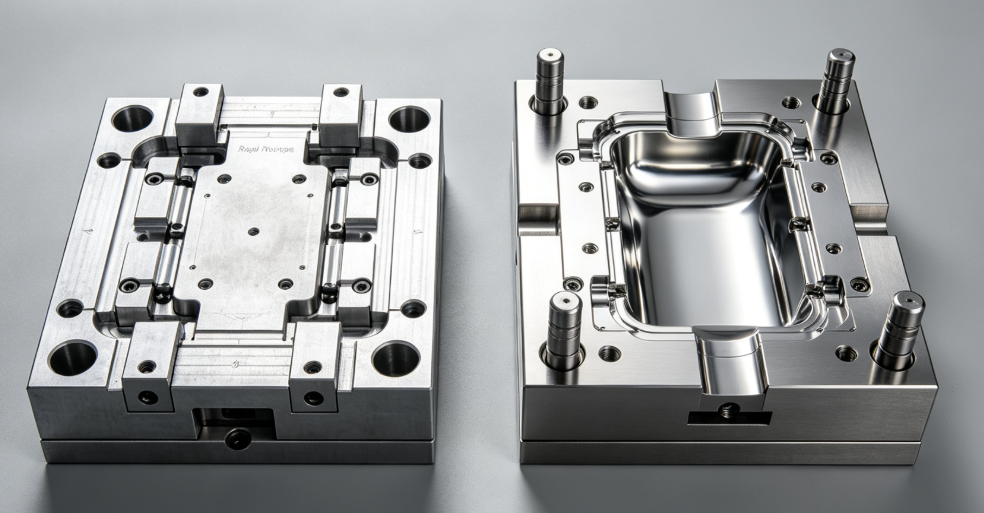
A rapid prototype mold (also called a prototype tool, bridge tool, or soft tool) is a simplified mold designed for low-volume production.
Key characteristics:
- Material: Usually aluminum (P20 sometimes, but aluminum is most common)
- Construction: Simplified design, fewer features, standard components
- Lead time: 1-3 weeks (much faster than production molds)
- Cost: $1,500 – $15,000 (depends on size and complexity)
- Lifespan: 1,000 – 50,000 shots (depends on material and design)
- Best for: Prototyping, market testing, low-volume production
Think of it like a rental car. It gets you where you need to go, it’s cheap upfront, but you wouldn’t want to drive it across the country every day.
What Is a Hardened Production Mold?
A hardened production mold (also called a production tool, hard tool, or Class A mold) is a full-featured mold designed for high-volume production.
Key characteristics:
- Material: Hardened tool steel (S136, H13, D2, P20 hardened)
- Construction: Full features — hot runners, cooling systems, ejector pins, lifters, slides
- Lead time: 4-12 weeks
- Cost: $10,000 – $100,000
- Lifespan: 500,000 – 2,000,000
- Best for: Mass production, long product lifecycles, high-quality requirements
Think of it like buying a new truck. It’s expensive upfront, but it’s built to last and can handle heavy use day after day.
The Head-to-Head Comparison
Alright, let’s see how these two stack up.
1. Upfront Cost
Winner: Rapid prototype mold — by a lot.
This is the big one. Prototype molds cost a fraction of what production molds cost.
Typical cost comparison (single-cavity, medium complexity):
- Rapid prototype mold (aluminum): $3,000 – $8,000
- Hardened production mold (S136): $15,000 – $40,000
That’s 5-10x difference. For multi-cavity molds, the gap gets even bigger.
2. Lead Time
Winner: Rapid prototype mold.
Need parts fast? Prototype molds win here too.
- Rapid prototype mold: 7-21 days
- Hardened production mold: 30-90 days
If you’re trying to get to market quickly or test a new product, 2-3 weeks vs 2-3 months is a huge difference.
3. Part Cost Per Unit
Winner: Hardened production mold.
Here’s where production molds start earning their keep.
Production molds have:
- Better cooling → faster cycle times → more parts per hour
- More cavities → more parts per shot
- Longer life → mold cost spread over more parts
Typical per-part cost comparison (medium part, ABS material):
- From prototype mold: $2.50 – $5.00 per part
- From production mold: $0.50 – $1.50 per part
That’s 3-5x difference per part. Multiply that by thousands of parts, and it adds up fast.
4. Mold Lifespan
Winner: Hardened production mold — no contest.
- Aluminum prototype mold: 5,000 – 50,000 shots (depends on plastic material and part design)
- Hardened steel production mold: 500,000 – 2,000,000+ shots
Production molds last 10-100x longer. If you’re making a lot of parts, this matters.
5. Part Quality & Surface Finish
Winner: Hardened production mold.
Production molds can achieve better surface finishes, tighter tolerances, and more consistent parts.
- Prototype mold: Good quality, but aluminum is softer and wears faster. Surface finish is decent but not mirror-grade.
- Production mold: Excellent quality. Hardened steel holds polish better, maintains tolerances longer, and produces more consistent parts over millions of shots.
For consumer products where appearance matters, production molds usually win. For functional parts, prototype molds are often good enough.
6. Design Flexibility
Winner: Rapid prototype mold.
Here’s an underrated advantage of prototype molds: they’re easier to modify.
If you need to change the design:
- Prototype mold: Aluminum is easier to machine and weld. Changes are faster and cheaper.
- Production mold: Hardened steel is much harder to modify. Changes take longer and cost more. Sometimes you can’t modify it at all — you have to make a new insert.
If you’re still iterating on the design, a prototype mold gives you more flexibility.
7. Material Compatibility
Winner: Hardened production mold.
Some plastics are hard on molds. Glass-filled materials, abrasive materials, high-temperature materials — they wear out aluminum molds fast.
- Prototype mold: Works fine with general-purpose plastics (ABS, PP, PE, PC). Not great for abrasive or high-temperature materials.
- Production mold: Handles everything — glass-filled nylon, PEEK, Ultem, you name it. Hardened steel stands up to abrasion and heat much better.
8. Total Cost of Ownership
Winner: It depends on volume.
This is the real question. Which one is cheaper overall?
And the answer is: it depends on how many parts you’re going to make.
Low volume → prototype mold is cheaper.
High volume → production mold is cheaper.
Somewhere in the middle, there’s a break-even point. Let’s talk about that.
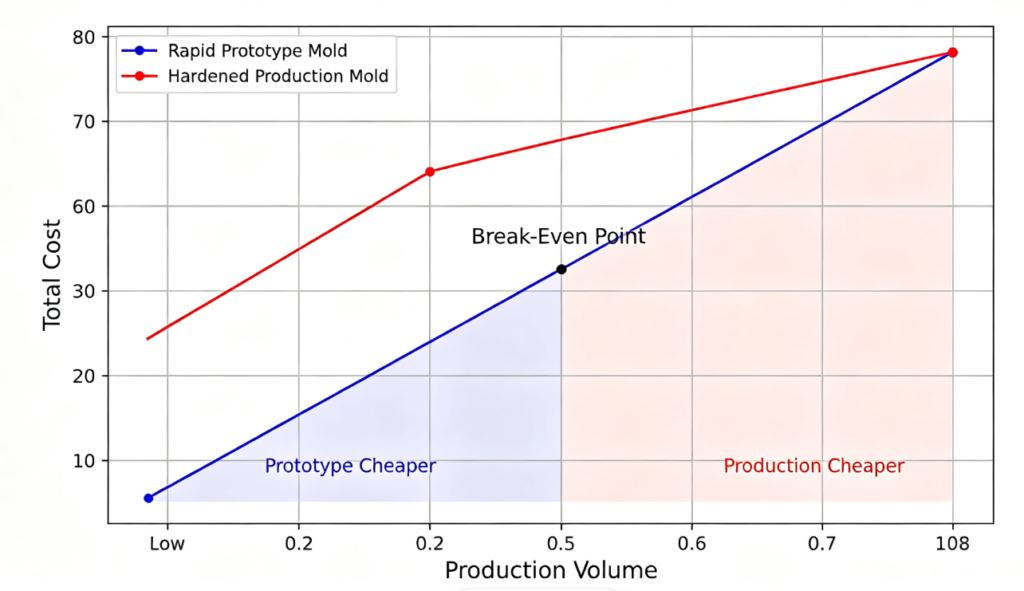
The Break-Even Point: How to Calculate It
Alright, let’s do some math. Don’t worry — it’s simple math.
The Formula
Total cost = Mold cost + (Number of parts × Cost per part)
At the break-even point, the total cost is the same for both options.
Real-World Example
Let’s use realistic numbers for a medium-sized plastic housing:
Rapid prototype mold:
- Mold cost: $5,000
- Cost per part: $3.00
Hardened production mold:
- Mold cost: $25,000
- Cost per part: $0.80
Let’s calculate the break-even point:
$5,000 + ($3.00 × N) = $25,000 + ($0.80 × N)
$2.20 × N = $20,000
N = 9,091 parts
So the break-even point is about 9,000 parts.
- Under 9,000 parts: Prototype mold is cheaper
- Over 9,000 parts: Production mold is cheaper
- At 9,000 parts: They cost about the same
What Affects the Break-Even Point?
The bigger the cost gap between the molds, the higher the break-even point.
- If production mold is 10x more expensive → higher break-even
- If production mold is only 3x more expensive → lower break-even
The bigger the per-part cost difference, the lower the break-even point.
- If per-part cost is 5x different → lower break-even
- If per-part cost is only 2x different → higher break-even
Rule of thumb: For most consumer products, the break-even is usually between 5,000 and 20,000 parts.
When to Choose a Rapid Prototype Mold
Pick a prototype mold when:
You’re testing the market — not sure if the product will sell
You need parts fast — 2-3 weeks vs 2-3 months
Low volume — under 5,000-10,000 parts total
Design might change — you want flexibility to iterate
Budget is tight — can’t afford $25k+ for a production mold
Functional testing only — appearance isn’t critical
Typical scenarios:
- Kickstarter / crowdfunding campaigns
- Market testing and validation
- Functional prototypes for testing
- Low-volume custom products
- Bridge production while production mold is being built
When to Choose a Hardened Production Mold
Pick a production mold when:
High volume — 10,000+ parts, or ongoing production
Long product lifecycle — product will sell for 2+ years
High appearance requirements — mirror finish, tight tolerances
Abrasive or engineering materials — glass-filled, high-temp, etc.
Consistent quality is critical — every part must be identical
You’ve validated the design — no more changes needed
Typical scenarios:
- Mass market consumer products
- Medical devices (ISO 13485)
- Automotive components (IATF 16949)
- Long-running products with stable demand
- High-volume production runs
The Middle Ground: Bridge Tools & Hybrid Approaches
You don’t have to pick one or the other. There are options in between.
Option 1: Prototype Mold First, Then Production Mold
This is the most common approach for new products.
How it works:
- Build a prototype mold (2-3 weeks, $5k)
- Make 1,000-5,000 parts for testing and initial sales
- Validate the design and market demand
- If it works, build a production mold (6-8 weeks, $25k)
- Transfer production to the production mold
Pros:
- Lower risk — you don’t spend big money until you know the product works
- Faster time to market
- Flexibility to make design changes
- You can use the prototype mold as a backup
Cons:
- You pay for two molds ($5k + $25k = $30k total)
- Gap between prototype mold wearing out and production mold being ready
- Some design changes might not transfer well
Option 2: Semi-Hardened Bridge Tool
This is like a middle option — not as cheap as aluminum, not as expensive as full hardened steel.
How it works:
- Use P20 or pre-hardened steel instead of fully hardened S136
- Still a full-featured mold, just with a softer steel
- Lifespan: 50,000 – 200,000 shots
- Cost: about 50-70% of a full hardened mold
Pros:
- Better quality and longer life than aluminum
- Cheaper and faster than full hardened mold
- Good for medium volumes (10k-100k parts)
Cons:
- Still more expensive than aluminum
- Not as durable as fully hardened steel
- Still takes longer than a prototype mold
Option 3: Modular Production Mold
Design the production mold with replaceable inserts.
How it works:
- Build a standard mold base (can be reused)
- Use inserts for the cavity/core (cheaper to replace)
- If the design changes, just make new inserts
Pros:
- Cheaper to modify or upgrade later
- Mold base can be reused for future products
- Good if you think the design might evolve
Cons:
- Slightly higher initial cost
- More complex design
Real-World Example: Consumer Electronics Housing
A startup came to us with a new consumer electronics product. They weren’t sure how well it would sell, but they wanted to get to market fast.
The situation:
- Product: Plastic housing for a smart home device
- Material: ABS + PC blend
- Expected first-year volume: 3,000 – 20,000 units (big range)
- Budget: Tight
- Time to market: Critical
Production mold only
- Mold cost: $28,000
- Lead time: 45 days
- Per-part cost: $0.75
- Mold life: 1,000,000+ shots
- Total at 10k units: $28,000 + $7,500 = $35,500
Option C: Prototype + Production (what we recommended)
- Phase 1: Prototype mold ($4,500, 14 days)
- Phase 2: Production mold ($28,000, 45 days, starts after design validation)
- Total mold cost: $32,500
- Per-part cost: $2.80 (phase 1), $0.75 (phase 2)
What they did:
They went with Option C.
Timeline:
- Week 2: Prototype mold ready, started producing parts
- Week 4: Launched Kickstarter, got real market feedback
- Week 6: Confirmed design, ordered production mold
- Week 12: Production mold ready, switched over
The results:
- Got to market 30 days faster than going straight to production mold
- Validated demand before spending $28k on a production mold
- Made 2,500 units on the prototype mold (covered initial orders)
- Total cost: $32,500 + $7,000 (phase 1 parts) + $13,125 (phase 2 parts for 17.5k units) = $52,625
- If they’d gone straight to production mold for 20k units: $28,000 + $15,000 = $43,000
Wait — that’s more expensive. But here’s the thing: they didn’t know they’d sell 20k units. If they’d sold only 3k units:
- Option C total: $32,500 + $8,400 = $40,900
- Option B total: $28,000 + $2,250 = $30,250 (but they would have wasted money on a mold for a product that didn’t sell)
The extra cost was insurance. It bought them speed, flexibility, and risk reduction. And for a startup, that’s usually worth it.
The Zorapid Mold Making Advantage
Whether you need a prototype mold or a production mold, we’ve got you covered.
Both Options, One Shop
We make both prototype molds and production molds. No need to work with multiple suppliers. We can help you pick the right approach, and we can handle the transition when you’re ready to scale.
Fast Turnaround
- Prototype molds: 7-21 days
- Production molds: 30-60 days
- Rush options available for urgent projects
Full-Service Capabilities
- Mold design and engineering
- DFM analysis (we’ll tell you if your design is moldable)
- Mold making (CNC, EDM, grinding, polishing)
- Injection molding (prototype to production volumes)
- Secondary operations (painting, printing, assembly)
- Quality inspection (CMM, dimensional reports)
FAQ
How much does a rapid prototype mold cost?
It depends on size and complexity, but generally $1,500 – $15,000. Small, simple parts might be $1,500 – $3,000. Medium complexity parts are usually $3,000 – $8,000. Large or complex parts can be $8,000 – $15,000. Aluminum is the most common material for prototype molds because it machines fast and is relatively cheap.
How many parts can I get from a prototype mold?
It depends on the mold material and the plastic you’re molding. For general-purpose plastics (ABS, PP, PE) in an aluminum mold: 5,000 – 50,000 shots is typical. For abrasive materials (glass-filled nylon, etc.), it could be as low as 1,000 – 5,000 shots. The part design matters too — sharp corners and thin walls wear faster.
How much does a production mold cost?
Production molds have a huge range. Simple single-cavity molds: $10,000 – $25,000. Medium complexity multi-cavity: $25,000 – $60,000. Large, complex molds with hot runners, slides, lifters: $60,000 – $150,000+. The number of cavities is the biggest cost driver — a 4-cavity mold is not 4x the price of 1-cavity, but it’s significantly more.
What’s the break-even point between prototype and production molds?
For most consumer products, the break-even is usually between 5,000 and 20,000 parts. Below that, a prototype mold is cheaper. Above that, a production mold is cheaper. The exact number depends on the cost difference between the molds and the per-part cost difference. We can calculate the exact break-even for your specific project during the quoting process.
Can I use a prototype mold for production?
Yes, for low-volume production. Prototype molds work great for 1,000 – 10,000 parts. Beyond that, you’ll start seeing wear on the mold, and part quality might degrade. Also, cycle times are slower with prototype molds, so per-part cost is higher. For ongoing production, you’ll want a production mold eventually.
How long does it take to make each type of mold?
- Rapid prototype mold (aluminum): 7-21 days, depending on complexity
- Semi-hardened bridge tool (P20): 20-35 days
- Hardened production mold (S136/H13): 30-60 days for single-cavity, 60-90 days for multi-cavity
These are typical lead times. Rush options are available for urgent projects — we can sometimes cut lead times by 30-50% for an additional cost.
What materials are used for each type of mold?
- Prototype molds: 6061 or 7075 aluminum (most common), sometimes P20 for semi-hardened tools
- Production molds: S136 (stainless, good for medical/clear parts), H13 (for high-volume/abrasive materials), D2 (for high wear), P20 (pre-hardened, good balance)
The right material depends on your volume, plastic material, and quality requirements. We’ll recommend the best material for your specific application.
Can I modify a prototype mold later if the design changes?
Yes, and that’s one of the big advantages. Aluminum is relatively easy to machine and weld, so design changes are faster and cheaper than on a hardened steel mold. Minor changes might cost $200 – $1,000 and take 1-3 days. Major changes might require new inserts. We’ll always tell you if a change is possible and what it will cost before we do anything.
What about multi-cavity molds? When should I consider that?
Multi-cavity molds (2-cavity, 4-cavity, 8-cavity, etc.) make multiple parts per shot. They’re more expensive upfront, but they reduce per-part cost and increase production capacity. Consider multi-cavity when: 1) You need high volume (100k+ parts per year), 2) The part is small enough that multiple fit in a standard press, 3) The design is stable (no more changes expected). The cost per cavity decreases as you add more cavities — a 4-cavity mold is about 2.5x the cost of 1-cavity, not 4x.
Do you offer DFM (Design for Manufacturing) analysis?
Yes, free with every quote. We’ll review your part design and tell you: if it’s moldable, what changes would make it cheaper/easier to mold, potential problem areas (thin walls, undercuts, sink marks), and recommendations for draft angles, gate locations, and ejection. Good DFM can save you 20-40% on mold cost and prevent expensive rework later.
Can you help me decide which mold type is right for my project?
Absolutely. That’s part of our service. Tell us about your product, expected volumes, timeline, and budget. We’ll explain the options, calculate the break-even point, and recommend the best approach for your specific situation. No sales pitch — just honest advice.
How do I get started with a mold project?
Send us your 3D files (STEP, IGES, or STL) and tell us: material, expected volume, surface finish requirements, and timeline. We’ll do a free DFM review, provide quotes for both prototype and production mold options (if applicable), and give you lead times. Usually within 24-48 hours.
Ready to Make the Right Mold Decision?
If you’re tired of:
- Guessing whether to build a prototype or production mold
- Wasting money on the wrong tool
- Waiting months for molds
- Getting parts that don’t meet your quality standards
Then let’s talk.
We don’t just make molds. We help you figure out the right strategy for your product — whether that’s a prototype mold, a production mold, or a phased approach. We’ll show you the numbers, explain the trade-offs, and help you make the best decision for your business.
Send us your files today. We’ll review them, give you options, and tell you exactly what to expect.
No fluff. No pressure. Just honest advice and quality molds.
Zorapid — Prototype & Production Molds, Done Right
ISO 9001:2015 | ISO 13485 | IATF 16949 | Full DFM Support
3000㎡ Smart Manufacturing Center | Zhongshan, Guangdong