Published:Zorapid.Ltd
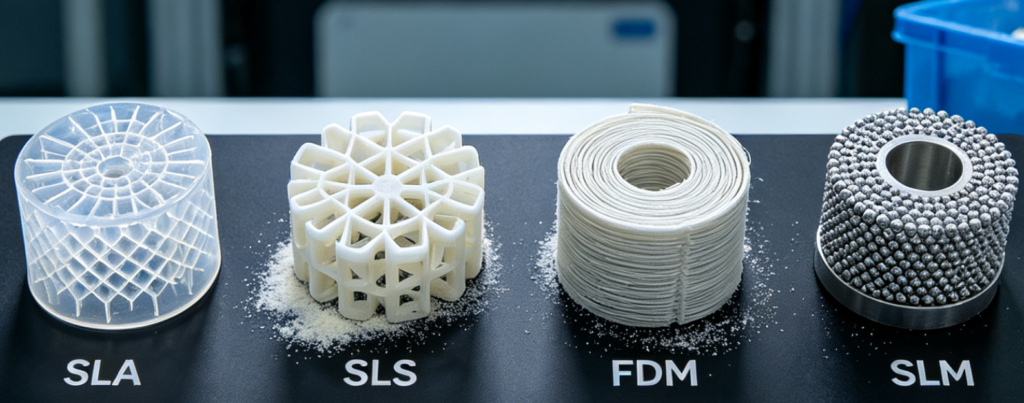
When sourcing prototype or low-volume custom parts, four additive processes dominate industrial R&D, medical, aerospace and semiconductor projects:
- SLA: UV resin photopolymer printing for ultra-fine micro features
- SLS: Laser sintered nylon powder for strong, unassembled complex plastic structures
- FDM: Filament extrusion for large, low-cost structural plastic frames
- SLM: Laser melting metal powder for flight-grade metal components (Ti, Inconel, aluminum)
Each technology has unique limits on precision, surface smoothness, heat resistance, material strength and unit price. This quick comparison cuts through technical jargon to help you select the right method without overpaying or failing functional testing.
Core Working Principle for Each Process
SLA
Liquid UV resin in a tank. A precision UV laser traces each layer cross-section, curing resin solid layer by layer. Parts are supported by thin removable support structures. Post-cured under UV light after printing.
SLS
Dry nylon powder bed. High-power laser sinters (fuses) nylon powder particles together at each layer. Un-sintered loose powder acts as natural support — no extra support geometry needed. Surplus powder can be recycled.
FDM
Solid thermoplastic filament fed through a heated nozzle. Nozzle moves along X/Y axes, depositing melted plastic strand by strand. Requires support material for overhangs, which is manually removed post-print.
SLM
Closed inert argon chamber filled with fine metal powder. High-energy fiber laser fully melts metal powder into fully dense solid metal. Supports are mandatory to resist thermal warpage, later cut off via CNC or grinding.
Full Side-by-Side Comparison Chart
| Evaluation Metric | SLA Resin Printing | SLS Nylon Sintering | FDM Filament Printing | SLM Metal Printing |
|---|---|---|---|---|
| Dimensional Tolerance | ±0.05–0.12 mm | ±0.10–0.20 mm | ±0.15–0.30 mm | ±0.03–0.10 mm (as-printed) |
| Minimum Feature Size | 0.15 mm micro channels | 0.4 mm thin walls | 0.8 mm minimum ribs | 0.2 mm fine metal structures |
| As-Print Surface Roughness | Very smooth (Ra 0.8–3 μm) | Matte grainy (Ra 6–12 μm) | Visible layer lines (Ra 12–30 μm) | Grainy metal surface (Ra 8–15 μm) |
| Support Requirement | Yes, thin supports mark surfaces | No free powder support | Yes, thick removable supports | Yes, heavy solid metal supports |
| Available Base Materials | UV-curable resins (clear, low-outgassing, tough, high-temp) | PA12, PA6, glass-filled nylon, TPU flexible powder | ABS, PLA, PC, PEEK, PETG thermoplastic filament | Ti6Al4V, Inconel 718, AlSi10Mg, stainless steel |
| Max Operating Temperature | 60–120°C (resin grade dependent) | Up to 140°C (glass-filled PA) | 50–240°C (PEEK highest) | Up to 650°C (Inconel) |
| Complex Internal Geometry | Excellent (no cost penalty) | Excellent (no support needed) | Limited, hard to clean internal channels | Excellent conformal cooling channels |
| Per-Part Cost (1–10 small prototypes) | Medium | Medium-High | Lowest | Highest |
| Standard Lead Time (1–10 pcs) | 1–3 days | 2–4 days | 1–2 days | 4–8 days (incl stress relief) |
| Batch Capacity Fit | Small micro fixture batches | Medium complex plastic assemblies | Large simple frame low-cost prototypes | Low-volume metal aerospace/medical hardware |
| Post-Processing Required | Wash + UV post-cure + polish supports | Powder blast cleaning only | Remove supports + sand layer lines | Support removal + heat treatment + CNC finish datums |
Breakdown of Each Process: Strengths, Limitations & Typical Applications
SLA High-Resolution Resin Printing
Key Strengths
- Industry-leading micro feature resolution for tiny channels, alignment pins and optical surfaces
- Smooth as-printed surface ideal for transparent, cosmetic and lab cleanroom fixtures
- Fast iteration speed for frequent design revisions; no tooling cost
- Special low-outgassing semicon/medical resin grades available
Limitations
- Limited heat resistance; cannot sustain long-term high-temperature cycling
- Brittle standard resins; prone to cracking under heavy impact load
- Supports leave visible marks on curved surfaces requiring polishing
- Only resin polymers, no metal or high-strength thermoplastics
Best Use Cases
Semiconductor microfluidic carriers, disposable medical test cassettes, optical alignment jigs, small cosmetic prototype housings, low-outgassing cleanroom lab fixtures.
SLS Selective Laser Sintering Nylon Powder
Key Strengths
- Zero support structures; fully free complex lattices, nested assemblies, deep undercuts
- Uniform isotropic mechanical strength (no layer-line weakness like FDM)
- Tough, flexible nylon with good impact resistance and chemical resistance
- Batch nesting efficiency for 10–50 identical complex plastic parts
Limitations
- Matte grainy surface requires media blasting, cannot reach optical smoothness
- Higher unit cost than FDM for simple large frames
- Minimum wall thickness limit of 0.4 mm rules out ultra-micro channels
Best Use Cases
Lightweight industrial structural brackets, snap-fit multi-part assemblies, drone frames, wearable equipment housings, low-volume functional nylon test parts.
FDM Fused Deposition Modeling Thermoplastic
Key Strengths
- Lowest raw material and per-unit cost for large simple geometry
- Wide thermoplastic range including high-performance PEEK
- Large build volume for big equipment chassis and enclosures
- Fast single-piece turnaround for rough fit-check prototypes
Limitations
- Visible horizontal layer lines; poor surface finish for cosmetic parts
- Weak inter-layer bonding, anisotropic strength (breaks easily along print layers)
- Thick minimum wall size restricts delicate micro features
- Supports leave deep marks on contact surfaces
Best Use Cases
Large equipment enclosure fit prototypes, low-cost proof-of-concept frames, PEEK medical non-critical jigs, low-budget internal test fixtures.
SLM Selective Laser Melting Metal Printing
Key Strengths
- Produces fully dense solid metal parts matching forged mechanical properties
- Creates impossible-to-machine conformal cooling channels, lightweight lattices
- High-temperature resistant Ti/Inconel alloys for aerospace engine hardware
- Fine precision for thin metal structural ribs after post-CNC finishing
Limitations
- Highest material and production cost by far
- Mandatory heat treatment to relieve massive residual stress
- Long lead time due to inert chamber printing + post-processing
- As-printed surface rough; critical datums require secondary 5-axis CNC machining
Best Use Cases
Aerospace lightweight titanium brackets, jet engine Inconel heat components, medical titanium implants, high-performance heat exchange manifolds, semiconductor metal shielding fixtures.
How to Pick the Right Process Based On Your Part Requirements
Choose SLA if all apply
- Part has micro channels, optical surfaces or thin walls <0.4 mm
- Requires transparent, low-outgassing or cosmetic smooth finish
- Operating temperature below 100°C, short-term lab testing only
- Batch size 1–30 small precision fixtures
Choose SLS if all apply
- Complex geometry with deep undercuts, lattices or nested assembled parts
- Needs tough, impact-resistant nylon functional strength
- No need for transparent mirror-smooth surfaces
- Batch size 10–50 functional plastic prototypes
FDM if all apply
- Large simple frame / enclosure geometry with no micro features
- Strict low-cost budget for proof-of-concept fit checks
- Requires PEEK or high-temperature thermoplastic, cosmetic quality unimportant
- One-off rough iteration prototypes
Choose SLM if any single condition applies
- Part must be metal (titanium, Inconel, aluminum, stainless steel)
- Needs conformal internal cooling channels un-machinable via CNC
- High-temperature continuous operation above 140°C
- Flight-critical aerospace or implant-grade medical hardware
Common Cost & Lead Time Breakdown by Batch Size (1–50 pcs)
Batch 1–10 Small Precision Parts
- FDM: $20–$80 / unit, 1–2 days
- SLA: $40–$100 / unit, 1–3 days
- SLS: $70–$150 / unit, 2–4 days
- SLM: $200–$600 / unit, 4–8 days
Batch 10–50 Medium Complex Parts
- FDM: $15–$55 / unit
- SLA: $30–$75 / unit (nest discount)
- SLS: $50–$110 / unit (powder batch amortization)
- SLM: $140–$420 / unit
Key cost note: SLM metal raw powder is the dominant cost driver; resin/nylon filament costs are far lower for plastic additive processes.
Frequently Seen Defects & Process-Specific Fixes
- SLA support marks on cosmetic surfaces Fix: Add extra polishing post-print, redesign support touch points to non-visible areas
- SLS uneven dimensional shrinkage Fix: Apply material shrinkage compensation in CAD slicing, avoid oversized thin ribs
- FDM layer splitting / low part strength Fix: Increase wall thickness, raise print temperature, avoid heavy load-bearing designs
- SLM warpage and micro cracking Fix: Mandatory vacuum stress relief heat treatment, add dense support structures on thin walls
FAQ
Which process delivers the tightest dimensional accuracy?
SLM metal has the best raw precision for metal parts; SLA resin achieves tighter tolerances for small plastic micro fixtures. FDM has the loosest tolerance range.
Can SLS nylon replace injection molded plastic for low-volume batches?
Yes for functional non-cosmetic parts. SLS nylon strength matches many molded PA grades, but surface finish cannot match polished mold plastic.
Is SLM metal cheaper than 5-axis CNC for small complex metal batches?
Only for parts with un-machinable internal lattices or conformal channels. Simple solid metal brackets are always cheaper via micro CNC.
Which process works best for low-outgassing semiconductor cleanroom fixtures?
Specialty low-outgassing SLA resin is the standard choice; SLS nylon releases slightly more residual powder fumes and is not recommended for wafer-contact hardware.
Can I get high-temperature resistant parts from 3D printing?
FDM PEEK and SLM Inconel handle extreme heat; standard SLA and SLS grades are limited to moderate temperature environments.
Wrap-Up
- Micro precision / transparent cosmetic prototypes → SLA
- Tough complex functional plastic assemblies → SLS
- Large low-cost rough fit frames / PEEK simple parts → FDM
- Titanium / Inconel metal high-performance hardware → SLM
Zorapid offers all four 3D printing technologies under one roof, enabling hybrid builds (e.g. SLA printed fluid channels + SLM metal mounting frames) and consistent batch quality without switching multiple suppliers. Our engineering team can cross-compare all four processes to balance cost, lead time and functional performance for your prototype batch.
Request Free 3D Printing Process Comparison Quote
Share your CAD file, operating temperature, surface requirements and batch quantity. We will provide side-by-side pricing and lead time for SLA, SLS, FDM and SLM to pick the most cost-effective process for your hardware.