Published:Zorapid.Ltd
Aerospace hardware faces two non-negotiable demands: extreme strength-to-weight ratio and reliable high-temperature performance. Traditional CNC machining and casting struggle with modern aero part designs. These designs feature complex internal channels, thin lattices, and consolidated multi-part structures.
Selective Laser Melting (SLM) solves these pain points perfectly. It melts fine metal powder layer by layer with precise fiber lasers. This creates fully dense, flight-ready metal components without custom molds or multi-axis fixturing.
Titanium and Inconel are the most common SLM materials for aerospace. Titanium delivers lightweight structural stability. Inconel resists extreme heat and corrosion for engine and exhaust systems. Together, they enable next-gen aircraft, turbine, and satellite components that traditional manufacturing cannot produce.
What Is SLM 3D Printing (Aerospace Simplified)
SLM is a high-precision metal additive manufacturing process. It builds parts from 20–60 micron metal powder layers inside an inert argon atmosphere. This oxygen-free environment eliminates oxidation and material contamination, which is critical for flight-grade parts.
A high-power fiber laser scans sliced CAD geometry. It fully melts powder particles into dense, solid metal. Each layer cools rapidly before the next layer deposits. The final part achieves 99.9% material density, matching or exceeding forged metal mechanical properties.
Unlike 3-axis or 5-axis CNC machining, SLM creates complex internal geometry with zero waste. It removes the strict design limits of traditional metal cutting.
Titanium vs Inconel: Aero-Grade SLM Material Comparison
Titanium and Inconel have distinct strengths. Each fits specific aerospace use cases and requires unique SLM process tuning.
Titanium Alloy (Ti6Al4V / Ti64 Aero Grade)
Titanium is the primary structural SLM material for airframe and satellite components.
- Core advantages: Ultra-light weight, high tensile strength, excellent fatigue resistance, low thermal expansion
- Best for: Aircraft brackets, structural lattices, landing gear sub-components, satellite fixtures, hydraulic manifolds
- SLM process traits: Fast print speed, stable melting behavior, low cracking risk with calibrated parameters
- Aero performance: Reduces part weight by 20–40% via lattice optimization while retaining full structural safety
Inconel Alloy (IN718 / IN625 Aero Grade)
Inconel is a nickel-based superalloy built for extreme thermal and chemical stress.
- Core advantages: Extreme heat resistance (up to 650°C), anti-corrosion, anti-oxidation, high-temperature creep resistance
- Best for: Jet turbine blades, combustion chambers, exhaust nozzles, hot-section engine components
- SLM process traits: Higher laser energy required, slower cooling, higher residual stress, strict support rules needed
- Aero performance: Maintains dimensional stability under continuous engine-cycle thermal shock
Zero Material Waste for High-Cost Alloys
Titanium and Inconel are extremely expensive. Traditional CNC machining removes 70–90% of raw material as waste. SLM only uses powder needed for the part. It cuts material costs drastically for low-volume aero qualification batches.
Superior Strength & Fatigue Performance
SLM’s rapid, controlled melting creates fine, uniform metal grain structures. Properly heat-treated SLM parts deliver fatigue strength equal to forged aerospace-grade metal. This meets strict flight qualification standards.
Fast Aero NPI & Iteration Cycles
No mold fabrication or long CNC setup is needed. Teams can revise lattice density, channel diameter, and structural geometry rapidly. They can test multiple design iterations in days instead of months.
Critical SLM Manufacturing Challenges for Aero Alloys
Titanium and Inconel SLM parts face unique failure risks that do not exist in standard aluminum printing.
- Residual stress & warpage: Inconel generates high internal stress during rapid cooling. Unrelieved stress causes bending or layer delamination post-print.
- Micro porosity: Improper laser power or scan speed creates tiny voids. These voids reduce fatigue life and fail aero non-destructive testing (NDT).
- Cracking risk: Inconel hot zones easily develop micro cracks without optimized support structures and temperature staging.
- Surface roughness limitations: As-printed surfaces cannot meet aero A-class or high-precision seal requirements. Post-machining is mandatory for functional surfaces.
Aero-Grade DFM Rules for Titanium & Inconel SLM
Follow these simple, actionable design rules to avoid scrap and pass aerospace qualification.
- Minimum wall thickness: 0.4mm for titanium; 0.6mm for Inconel to prevent layer breakage
- Overhang angle: Maintain 45°+ self-supporting angles. Add precision supports for lower angles to avoid drooping.
- Internal channel design: Add smooth radii and avoid sharp corners. Sharp corners trap powder and create residual stress hotspots.
- Lattice transition zones: Gradually shift solid and lattice structures. Abrupt transitions cause stress concentration and fatigue failure.
- Support density tuning: Use dense supports for Inconel high-stress zones. Use lightweight supports for titanium non-critical areas to reduce post-processing work.
- Flat datum protection: Reserve all mounting and sealing surfaces for post-print CNC finishing to guarantee precision tolerances.
Zorapid’s Full Aero SLM Workflow (Titanium & Inconel)
Our aerospace-certified SLM workflow is optimized for flight-grade mechanical consistency and audit-ready documentation.
Aerospace DFM & Process Simulation
We run residual stress simulation, support optimization, and powder flow analysis. Eliminate warpage, cracking, and trapped powder risks before printing starts. We deliver annotated DFM reports for engineering review.
Inert Atmosphere SLM Precision Printing
All prints run in closed argon environments with low oxygen levels. This prevents oxidation. We use alloy-specific laser power, scan speed, and layer thickness parameters to ensure full density and uniform grain structure.
Stress Relief & Heat Treatment (Aero Mandatory)
Titanium and Inconel parts undergo standardized vacuum heat treatment. This releases residual stress and unifies mechanical properties to meet aerospace fatigue and tensile specs.
Support Removal & Precision Post-Processing
We remove supports cleanly without damaging base material. Critical datum surfaces receive 5-axis finish milling. Flow channels get precision polishing to reduce turbulence and improve thermal performance.
NDT & Full Aero QA Inspection
Every batch undergoes ultrasonic testing (UT), dimensional CMM scanning, and surface defect inspection. We provide full material COAs, process logs, and mechanical test reports for aerospace qualification audits.
Common Aerospace SLM Components
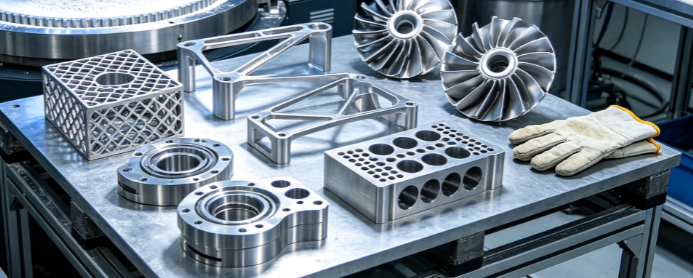
- Titanium SLM Parts: Aircraft structural brackets, lightweight lattices, satellite sensor mounts, hydraulic manifolds, drone airframe components
- Inconel SLM Parts: Turbine heat shields, engine combustion components, high-temperature nozzles, exhaust system fixtures, thermal barrier sub-assemblies
Real Client Case: Inconel 718 Aero Engine Hot-Component SLM Project
An aerospace Tier 1 supplier needed low-volume Inconel 718 high-temperature nozzle components for engine thermal validation.
Original Pain Points: Traditional CNC wasted massive expensive Inconel material. Long lead times delayed NPI gates. Early trial parts had micro cracks and thermal distortion.
Zorapid SLM Solution: Optimized support layout eliminated micro cracks. Vacuum heat treatment stabilized dimensional accuracy. In-house post-milling guaranteed seal surface tolerances. Full NDT reports supported official qualification.
Final Result: 35% lower material cost, 45% faster lead time, zero defects during thermal cycle testing. The client fully adopted our SLM process for all follow-up hot-section prototype batches.
SLM 3D Printing vs Traditional CNC for Aero Ti/Inconel Parts
| Evaluation Metric | SLM 3D Printing | Traditional CNC Machining |
|---|---|---|
| Complex Internal Geometry | Fully achievable (channels/lattices) | Limited or impossible |
| High-Alloy Material Waste | Minimal | Extremely high (70–90% scrap) |
| Lightweight Optimization | Excellent (lattice topology) | Limited to solid structures |
| Low-Volume Lead Time | Fast (days) | Slow (long setup/machining cycles) |
| Surface Roughness | As-printed rough (requires post-finish) | Smooth, ready for use |
| Best Aero Use Case | Complex, lightweight, high-temp custom parts | Simple solid structural components |
Common SLM Defects & Fast Fixes for Aero Parts
- Micro porosity: Fix by tuning laser energy density and optimizing layer overlap
- Layer delamination: Fix via pre-heat staging and strict stress relief heat treatment
- Inconel micro cracking: Fix with redesigned support geometry and slower cooling ramps
- Surface warpage: Fix by balancing part orientation and symmetric support distribution
FAQ
Are SLM titanium and Inconel parts qualified for aerospace testing?
Yes. With standardized heat treatment and NDT inspection, SLM Ti64 and Inconel 718 meet aerospace mechanical and fatigue specs for NPI, validation, and low-volume flight batches.
Do SLM aero parts require CNC post-processing?
Yes. All mating, sealing, and high-precision datum surfaces need finish milling to meet tight aero tolerances and smoothness requirements.
Which is better for engine hot sections: Ti or Inconel SLM?
Inconel is mandatory for continuous high-temperature operation above 400°C. Titanium works for ambient and moderately elevated temperature structural components only.
Can you scale from SLM prototypes to formal production batches?
Absolutely. We archive locked process parameters to ensure identical mechanical and dimensional performance from 1-off prototypes to volume production.
Do you provide full aerospace audit documentation?
Yes. Every shipment includes material COAs, heat treatment logs, NDT reports, CMM dimensional data, and full batch traceability records.
Final Wrap-Up
SLM metal 3D printing is the most flexible and cost-effective process for modern titanium and Inconel aerospace components. It solves the biggest limits of traditional CNC and casting: excessive waste, rigid design boundaries, and slow iteration speeds.
For aerospace NPI, lightweight structural optimization, and high-temperature engine hardware, SLM delivers faster validation, lower material cost, and better mechanical performance. The key to reliable flight-grade results lies in aero-focused DFM, alloy-specific parameter tuning, mandatory heat treatment, and full NDT quality control.
Zorapid delivers end-to-end aerospace SLM solutions: design optimization, high-density printing, stress relief, precision post-machining, and audit-ready QA documentation for titanium and Inconel aero parts.
Submit your CAD files, alloy selection, functional requirements, and batch volume. Our aerospace additive team will deliver a full manufacturability report, defect risk assessment, and transparent lead time & pricing breakdown.