Published by: Zorapid.Ltd
Most RFQ comparisons only look at machine hourly rates, and this is where you get tricked.
Conventional CNC turning looks cheap on paper, but you stack lathe work, then move parts to a mill for flats, cross holes and slots.
Every part transfer adds labor, extra fixtures, repeated clamping error, and weeks of lag time. Scrap rates jump, and tight GD&T tolerances fail inspection from datum shift.
At Zorapid, we run parallel quotes every single day: multi-operation turning with secondary milling, vs one-clamp turn-mill composite machining.
The hard shop-floor truth: For turned shafts with milled features, turn-mill often cuts total piece price by 25%–35%, even with a higher machine hourly cost.
Today we break down every hard cost, hidden waste, tolerance gap and lead time difference with real production data, no sales fluff.
Core Process Difference That Shapes All Your Costs
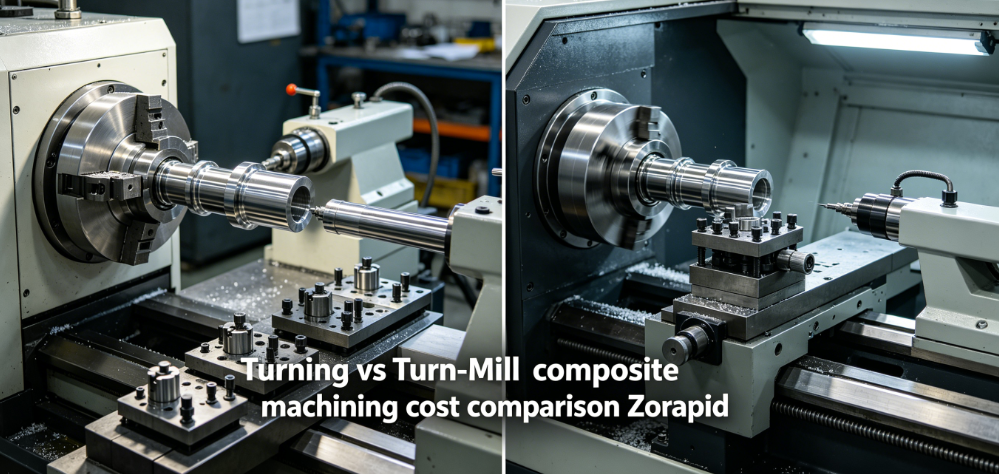
Conventional Turning + Secondary Milling
- First operation: Turn OD, ID and faces on a standard CNC lathe
- Unload the workpiece, re-fixture on a milling machine
- Re-zero datum, then machine keyways, cross drilled holes, hex flats and off-center slots
- Extra handling: deburr, re-inspect after every machine transfer
Every re-clamp creates positional drift. Multiple machines mean waiting for machine availability. Non-cutting downtime makes up nearly 60% of total production time on multi-feature shafts.
Turn-Mill Composite Machining
Equipped with C-axis, Y-axis and live powered tooling.
We clamp bar stock once only. The machine runs OD turning, then indexes the spindle to mill flats, drill cross holes and machine asymmetric pockets without opening the chuck.
Zero part transfer, zero repeated re-zeroing. All features finish in a single setup.
Key rule we follow for quoting: Every extra operation adds three cost layers: labor, fixturing and scrap risk.
Side-by-Side Full Cost & Lead Time Data
Test part: 7075 aluminum shaft with OD turning, two cross holes and a hex flat, batch of 35 pieces, position tolerance ±0.007mm.
| Cost & Production Item | Conventional Turning + Secondary Milling | Single-Setup Turn-Mill Composite |
|---|---|---|
| Machine Hourly Rate | $68 / hr (lathe) + $75 / hr (3-axis mill) | $125 / hr (turn-mill center) |
| Number of Separate Operations | 2 (lathe → mill transfer) | 1 single clamping cycle |
| Total Manual Setup & Handling Time | 135 minutes total (two machine setups + part loading/unloading) | 28 minutes total (one chuck setup only) |
| Custom Fixture Cost | 2 sets of soft jaws + locating stops for two machines | Only standard collet, zero custom workholding |
| Net Cutting Cycle Time | 6.8 hours total (split across two machines) | 4.1 hours continuous cutting |
| Tolerance Stack-Up Error | ±0.018mm from repeated re-clamping | ±0.006mm, no datum shift |
| Rework & Scrap Rate | 13% (positional deviation between turned and milled features) | Below 2% |
| Total Production Lead Time | 6–7 working days | 2–3 working days |
| Final Total Cost Per Finished Part | $192 | $134 |
Clear result: Even though turn-mill machine time costs more per hour, eliminated labor, fixtures, scrap and downtime cut total part cost by 30% on this multi-feature shaft.
Breakdown of Hidden Costs With Traditional Turning
Labor Cost: The Biggest Budget Leak
Two separate machines need two separate setups.
Operators spend time unloading, transporting, re-indicating workpieces and re-proving programs.
For small-batch NPI orders, non-cutting labor can exceed actual machining cost entirely.
Turn-mill cuts handling labor by 75% because parts never leave the machine chuck.
Custom Fixture Tooling Expense
When you split turning and milling into two processes, you need two different locating fixtures.
One-time fixture costs get spread across small batches and blow up unit pricing.
Turn-mill only uses one standard collet or jaw, eliminating nearly all custom workholding cost.
Scrap Caused By Clamping Tolerance Drift
Every time you re-clamp a shaft after turning, you lose datum alignment.
Cross holes and milled flats often fail positional GD&T relative to the turned OD.
We regularly see 1 out of every 8 multi-operation turned parts get rejected from cumulative clamping error.
Single-setup turn-mill completely removes this alignment risk.
Lost Machine Uptime & Extended Lead Time
With two separate machines, production waits if either the lathe or mill is busy.
Queues push lead times out multiple extra days, which kills prototype testing schedules for medical, aerospace and EV projects.
Turn-mill runs continuously without machine-to-machine waiting, compressing total turnaround drastically.
Lead Time Gap: Multi-Operation Turning vs Turn-Mill Timeline
Traditional Turning + Secondary Milling Timeline
- Program two separate NC files for lathe and mill (1 full day)
- Build two sets of locating fixtures (1–2 days)
- Run turning → unload → wait for mill availability → re-fixture → run milling
- Double inspection after each operation to catch alignment drift Total wall-clock lead time: 6~7 business days.
Turn-Mill Single-Setup Timeline
- One integrated program for turning + live tool milling
- Clamp bar once and run all features continuously
- One final CMM inspection after completion Total wall-clock lead time: 2~3 business days.
Net lead time reduction: 55%–60% for turned parts with milled secondary features.
When Stick With Pure Conventional Turning
Turn-mill is not always the cheaper choice. Stick with separate lathe work if all these conditions apply:
- Parts are fully rotational, no flats, cross holes or asymmetric milled features
- Batch runs 200+ identical simple shafts, fixture cost fully amortized over large volume
- Only basic linear tolerances (±0.05mm or looser), no cross-feature GD&T position requirements
- Pure OD/ID turning without any secondary milling or drilling work
For plain cylindrical pins and simple sleeves, standard CNC turning remains your lowest-cost option.
Zorapid Middle Solution: Entry-Level Turn-Mill Without High Hourly Cost
For cost-sensitive mid-volume orders, we offer two tiers:
- Full live-tool turn-mill: one-clamp complete machining for complex asymmetric shafts
- Semi-composite lathe with basic driven tools: cuts secondary milling work without jumping to full mill-turn machine rates
This hybrid option retains single-setup accuracy while knocking 15% off turn-mill hourly pricing, our most popular option for export automotive and sensor shaft orders.
Real Zorapid Customer Case Study
Project Info
Ti-6Al-4V aerospace pin shaft, turned OD + 3 radial cross holes + two milled flats, batch of 22 pieces, strict positional GD&T ±0.006mm.
Option A: Conventional Turning + Secondary Milling
- Two machine setups with custom locating fixtures
- 14% scrap from re-clamp position drift
- Total lead time: 7 days
- Final unit cost: $246
Option B: Turn-Mill Composite Single Setup
- One collet clamping, zero part transfer
- Zero alignment-related scrap
- Total lead time: 3 days
- Final unit cost: $171
Result: The customer switched to turn-mill processing, cut per-part cost by 30% and hit prototype testing milestones four days early with zero failed CMM inspections.
Quick Decision Checklist For Your Next Turned Part RFQ
Choose Conventional Turning Only
- Pure rotational geometry, no milling features
- High volume batches over 200 pcs
- Loose tolerances, no cross-feature positional GD&T
- Simple OD/ID turning with no secondary operations
Choose Turn-Mill Composite Machining
- Shafts with flats, cross holes, slots or off-center pockets
- Tight position tolerance between turned and milled features
- Low-to-medium NPI prototype batches (5–50 pcs)
- Need shorter lead time and lower scrap loss
- Want to eliminate two-machine transfer and custom fixture cost
Why Zorapid Delivers Accurate Turn-Mill vs Turning Cost Quoting
- We run both processes in-house, so we quote total landed cost (not just machine runtime) with no biased upselling
- Our engineers calculate setup labor, fixturing and scrap risk during DFM review before pricing
- VERICUT program verification eliminates collision errors on all live-tool turn-mill code
- We control tolerance stack-up strictly by keeping every part in one single clamping cycle
- First-pass inspection yield on turn-mill components runs above 97% for export medical and aerospace orders
- We split turn-mill into two price tiers to match your budget, no forced high-end machine pricing
Conclusion
The old myth turn-mill is always too expensive only holds true if you ignore secondary operation labor, fixture expense, scrap waste and multi-day production delays.
Conventional turning looks cheap on hourly lathe rates, but part transfers between lathe and mill pile up hidden cost and positional tolerance drift.
For turned shafts with milled features, single-setup turn-mill composite machining consistently cuts total piece cost and slashes lead time in half.
When you send your shaft STEP file to Zorapid, we prepare two side-by-side quotes: multi-operation turning with secondary milling, and one-clamp turn-mill composite. We list every labor, fixture and scrap line item so you pick the most economical process without guesswork.
Send your turned part drawings for a full cost & lead time comparison today.
FAQ
Does every machine-to-machine transfer create tolerance error?
Yes. Every time you unload and re-fixture a shaft, you introduce datum shift. Two-operation turning and milling typically creates ±0.015~0.02mm cumulative deviation between OD and milled features, impossible to fully eliminate.
Why is small-batch turning so much more expensive than quoted?
Custom fixture cost and repeated setup labor cannot be spread across low volumes. Prototypes bear 100% of fixturing expense, blowing up the original lathe-only quote. Turn-mill removes nearly all secondary fixturing cost.
Can turn-mill eliminate secondary deburring and re-inspection work?
Yes. The part stays fixed in the chuck through all turning and milling cycles. Sharp edges can be deburred in the same program, cutting extra finishing labor drastically.
Are turn-mill parts always more accurate than multi-operation turned parts?
Absolutely. With just one clamping operation, there is zero repositioning error. Cross-hole and flat positional GD&T hold far tighter than parts moved between lathe and mill.
When should I avoid turn-mill to save money?
Stick with standard CNC turning for fully round shafts without any milled flats or drilled cross holes, especially on production runs over 200 pieces with simple loose tolerances.