Published by: Zorapid.Ltd
Most buyers mix up these two single-setup processes, and pick the wrong machine based only on hourly rates.
Both 5-axis and turn-mill finish parts in one clamping with zero re-fixturing. But they are built for totally different geometry.
You throw a bar-fed shaft into a 5-axis mill, waste material and run slow cycle times. Or you try to machine a multi-sided prismatic block on a turn-mill and hit hard travel limits.
At Zorapid, we generate dual quotes every week: 5-axis vs turn-mill.
The biggest hidden cost gap comes from blank material type, spindle concentricity, bar feeding and programming labor.
Today we share real shop-floor data: full cost breakdown, lead time, tolerance limits and part fit cases with zero sales fluff.
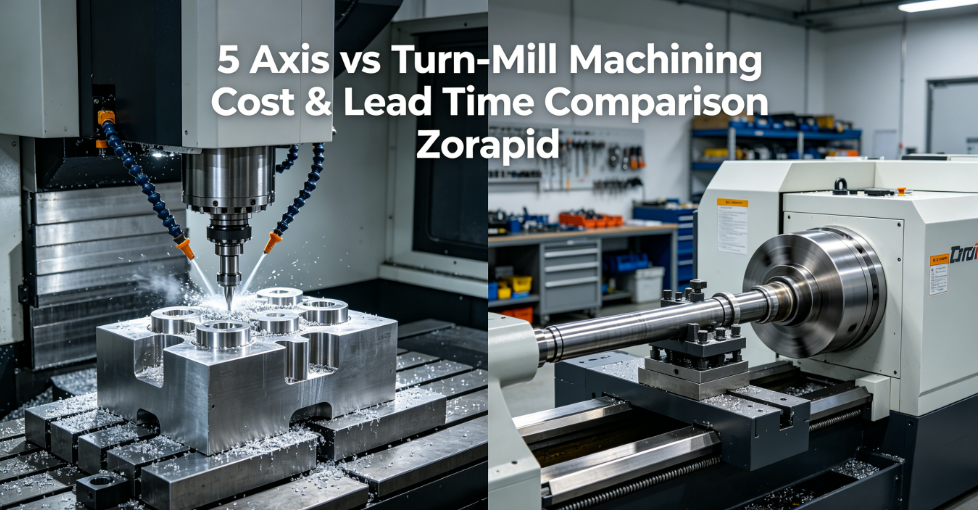
Core Mechanical Difference That Decides All Costs
5-Axis Machining (3+2 & Simultaneous)
Machine tilts the cutting head or the worktable.
It uses solid billet blanks, holds rectangular blocks or castings in a vise.
Strength: free reach for 5+ sides, complex freeform 3D contours, deep pockets and compound-angle holes.
Weakness: poor rotational concentricity, cannot feed long bar stock automatically.
All turning work has to be done with milling toolpaths, which is slow for cylindrical OD/ID features.
Turn-Mill Composite Machining (Live Tool + C/Y Axis)
Built around a main lathe spindle for rotational turning.
Powered live tools handle milling, cross drilling and flats without unclamping the bar.
Strength: perfect concentricity on turned OD surfaces, automatic bar feeder for long shaft runs, ultra-fast cylindrical material removal.
Weakness: limited work envelope for large prismatic blocks; complex freeform 3D surfaces become slow and expensive to program.
Simple rule:
Round + hybrid shaft parts = turn-mill wins on cost and speed.
Solid block multi-face non-cylindrical parts = 5-axis stays more economical.
Side-by-Side Production Data (Same Hybrid Test Part)
Test piece: 7075 aluminum shaft with turned OD, 2 cross holes, milled hex flats and a small off-center pocket, raw material 20mm bar stock, batch 35 pcs, GD&T position tolerance ±0.006mm.
| Evaluation Item | 5 Axis (3+2 VMC) | Turn-Mill Live Tool Composite |
|---|---|---|
| Standard Hourly Machine Rate | $140–170 / hr | $115–140 / hr |
| Raw Material Form | Cut billet (wasted excess stock) | Full bar feed (minimum material loss) |
| Total Setup Time | 35 minutes (vise clamping) | 22 minutes (collet bar feed setup) |
| Net Cutting Cycle Per Part | 48 minutes (slow milling for cylindrical OD) | 29 minutes (fast spindle turning + quick live-tool milling) |
| Concentricity of Turned OD | ±0.012mm (milling circular interpolation error) | ±0.003mm (main lathe spindle rotation) |
| Programming Labor Cost | High (3D milling toolpath generation) | Moderate (turning primary + simple milling cycles) |
| Scrap & Rework Rate | ~4% (concentricity deviation on round surfaces) | Below 1.5% |
| Total Production Lead Time | 4–5 working days | 2–3 working days |
| Final Total Cost Per Finished Part | $186 | $131 |
Key takeaway: Even with single-setup zero re-clamping, machining cylindrical features on a 5-axis mill drives up cycle time and material waste. Turn-mill beats 5-axis on bar-fed rotational hybrid parts by nearly 30% total unit cost.
Hidden Cost Gap Between 5-Axis and Turn-Mill
Raw Material Waste (The Biggest Price Difference)
5-axis requires cutting short billet chunks from bar stock. Every blank leaves extra stock on all sides for vise clamping. Material yield drops to 70–78%.
Turn-mill uses continuous bar feeding. The blank only leaves minimal cutoff scrap. Material utilization hits 92–96%.
For small bar diameter shafts, material cost alone makes 5-axis 15–20% more expensive.
Cycle Time for Cylindrical Surfaces
Milling a round OD via circular interpolation is always slower than lathe spindle turning.
A 20mm diameter cylinder takes 2–3x longer to machine on a 5-axis mill.
When most of your part is rotational geometry, 5-axis milling wastes hours of machine runtime.
Concentricity & Roundness Tolerance Gap
5-axis machines create roundness via milling arcs. Minor servo lag leads to out-of-round OD.
Turn-mill uses the main lathe spindle to spin the workpiece. Roundness and coaxiality hold far tighter with zero circular interpolation error.
If your part requires tight shaft runout for bearings, turn-mill eliminates roundness-related rework entirely.
Automation & Labor for Medium Batches
Turn-mill pairs with automatic bar feeders. It runs unattended long runs with minimal operator input.
5-axis needs manual billet loading piece by piece, so labor cost creeps up for batch production.
Lead Time Timeline Comparison
5-Axis Machining Schedule
- Cut bar into individual billets (extra prep work)
- Program full 3D milling toolpaths for OD turning + milled features
- Load one billet at a time into the vise
- Complete all features in one setup, then inspect concentricity Total wall-clock time: 4~5 business days.
Turn-Mill Schedule
- Load long bar stock into automatic feeder (one-time setup)
- Program primary turning cycles plus secondary live-tool milling
- Machine parts continuously one after another with no manual blank handling Total wall-clock time: 2~3 business days.
Net lead time reduction with turn-mill: 45~55% for bar-fed shaft hybrid components.
When 5-Axis Beats Turn-Mill (Do Not Use Turn-Mill Here)
Stick strictly to 5-axis VMC if all these apply:
- The blank is a rectangular solid billet, not round bar stock
- Part geometry is mostly prismatic blocks, manifolds, valve bodies with 5+ machined sides
- Features include complex freeform curved surfaces, impeller blades or deep irregular cavities
- No long cylindrical shaft sections; milling work makes up over 75% of total cutting time
- Part size exceeds the turn-mill spindle swing and travel limits
For block-type multi-sided components, turn-mill hits travel limits and requires heavy custom fixturing, while 5-axis tilts the head freely without extra workholding cost.
When Turn-Mill Is The Clear Winner
Choose live-tool turn-mill composite machining for these jobs:
- Raw material is round bar stock (automatic bar feeding available)
- Main geometry is turned OD/ID shafts with secondary flats, cross holes and keyways
- Strict concentricity, runout and roundness specs for bearing mating surfaces
- Low to medium batch runs that benefit from unattended bar-fed automation
- Mixed turning + light milling, no complex 3D contoured surfaces
This covers most sensor pins, aerospace studs, medical threaded shafts and EV motor shaft components.
Zorapid Hybrid Middle Solution
For complex shaft parts with small freeform pockets:
We split the process: turn-mill completes all rotational OD and cross-hole work, then one short secondary 5-axis operation finishes the complex 3D pocket.
This balances cost, concentricity and geometry reach without overpaying for full 5-axis bar milling.
Real Zorapid Customer Case Study
Project Info
Ti-6Al-4V aerospace shaft stud, main turned cylinder + radial drilled holes + milled square drive, bar stock raw material, batch 25 pcs, runout tolerance ≤0.005mm.
Option A: 5 Axis 3+2 Machining
- Required cutting bar into individual billets (22% material waste)
- OD milled via circular path, poor roundness, 5% scrap from runout deviation
- Cycle time 52 minutes per piece
- Lead time: 5 days
- Unit cost: $274
Option B: Turn-Mill Live Tool Machining
- Continuous bar feed with less than 5% material scrap
- Main spindle turning held runout within 0.003mm, zero roundness rework
- Cycle time dropped to 31 minutes
- Lead time: 2.5 days
- Unit cost: $196
Final result: The customer switched to turn-mill composite work, cut piece price by 28% and passed bearing runout inspection on the first article.
Quick Decision Checklist For Your Next RFQ
Choose 5-Axis Machining
- Rectangular billet raw stock
- Prismatic block, multi-sided manifold geometry
- Complex freeform 3D contours & deep pockets
- Minimal cylindrical turning work
- Part exceeds turn-mill swing travel limits
Choose Turn-Mill Live Tool Composite
- Round bar stock with auto bar feed
- Primary OD/ID turning + secondary milling & cross drilling
- Tight concentricity, runout and roundness requirements
- Medium batches for unattended automated runs
- No complex organic curved surfaces
Why Zorapid Delivers Accurate Dual Process Quoting
- We run both 5-axis VMC and turn-mill centers in-house, so we quote objectively without forcing unnecessary high-end processes
- Our DFM team accounts for material yield, cycle time and concentricity risk instead of only comparing hourly machine rates
- VERICUT offline simulation eliminates program errors for both milling and live-tool turning code
- We separate 3+2 positional 5-axis from full simultaneous 5-axis to control programming cost
- First-pass yield stays above 97% on bar-fed turn-mill shaft parts and billet 5-axis block components
- We offer hybrid two-process routing for complex hybrid parts to balance cost and precision
Conclusion
The core dividing line between 5-axis and turn-mill is not the hourly rate — it is your blank shape and main geometry.
5-axis dominates solid billet multi-sided blocks and complex freeform contours. It struggles with round bar stock and rotational turning, leading to material waste, slow cycles and poor concentricity.
Turn-mill excels on bar-fed hybrid shafts with turned OD plus milled secondary features. It delivers faster cycle time, better roundness and far less material scrap, slashing total unit cost by nearly 30% on shaft components.
When you send your STEP file to Zorapid, we build two independent quotes: 5-axis billet machining and turn-mill bar-fed composite work. We break down material waste, runtime, tolerance risk and lead time so you pick the most cost-effective path.
Submit your shaft or block drawing today for a side-by-side cost & timeline comparison.
FAQ
Can a 5-axis mill match the roundness of a turn-mill spindle?
No. Circular interpolation milling always creates minor out-of-round error. Turn-mill spins the workpiece on the main lathe spindle, holding OD concentricity 2–3 times tighter than 5-axis milling.
Why is 5-axis so expensive for bar stock shaft parts?
You must cut long bars into short billets for vise clamping, creating massive material waste. Plus, milling cylindrical surfaces takes far longer than spindle turning, pushing up machine runtime cost sharply.
Can turn-mill machine large multi-sided block workpieces?
No. Turn-mill has limited swing diameter and Y-axis travel. Big prismatic blocks quickly hit machine envelope limits, while 5-axis tilts the head to reach all faces freely.
Which process has shorter lead time for small-batch prototype shafts?
Turn-mill with bar feed wins every time. No blank cutting prep work, continuous unattended production cuts turnaround nearly in half vs piece-by-piece 5-axis billet loading.
Is turn-mill programming more expensive than 3+2 5-axis programming?
For standard turn + live-tool milling cycles, programming labor is lower. Only freeform 3D milling pushes turn-mill programming cost above 5-axis levels.