Published:Zorapid.Ltd
EVs carry high-voltage lithium battery packs, power inverters, on-board chargers and motor controllers. Internal short circuits, overcharging or thermal runaway can trigger rapid high-temperature ignition inside sealed housings.
Standard non-flame-retardant plastics burn quickly, release toxic fumes and produce flaming drips that spread fire to adjacent cells, creating catastrophic vehicle safety risks.
Flame-retardant (FR) engineered plastics slow ignition, cut flame spread, self-extinguish after heat source removal and suppress flammable dripping. They buy critical escape time for passengers and contain thermal runaway propagation between battery modules.
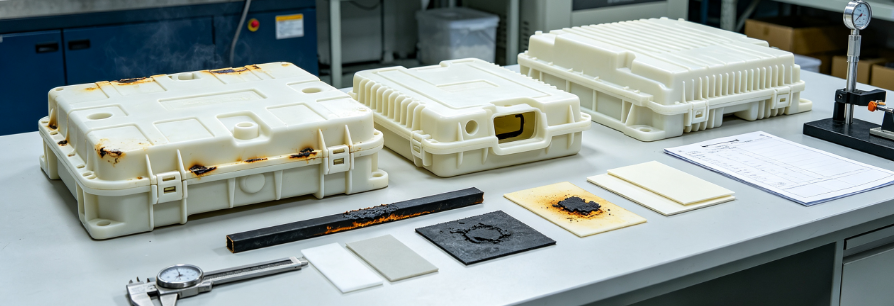
Mandatory Global Flame & Safety Standards for EV Plastic Housings
All EV structural and high-voltage plastic housings must pass multi-layer certification before OEM launch:
Core Flammability Benchmark: UL94 Vertical Burning
- UL94 V-0 (Minimum EV High-Voltage Standard): Self-extinguish within 10s after flame removal; no flaming drips that ignite cotton under the part. Most battery/PCU housings require V-0 at thin wall thickness (1.0–1.5 mm).
- UL94 5VA (Premium Thermal Runaway Grade): Highest plastic flame rating; resists hole formation under prolonged flame, used for cell separating frames and pack outer barriers.
- V-1 / V-2: Only permitted for low-voltage non-cosmetic interior trim; banned for battery adjacent hardware.
International Automotive & Electrical Standards
- IEC 60695 Glow Wire Test: GWIT ≥750°C for parts near live electrical contacts, prevents ignition from hot spots.
- UN R100: Global EV vehicle regulation mandating low flame propagation for battery system components.
- FMVSS 302 / ISO 3795: Horizontal burn rate limit for cabin and trunk interior plastic housings.
- GB 38031: China mandatory EV battery safety standard with strict plastic flame and low-smoke requirements.
- Environmental Compliance: RoHS, REACH, low halogen limits for toxic combustion gas control.
Additional EV-Specific Material Tests
- Low smoke density & low toxic gas emission for passenger compartment safety
- Long-term hydrolysis resistance (USCAR-2) for under-hood humid environments.
- High CTI comparative tracking index for high-voltage insulation
- Thermal cycling stability (-40°C ~ 125°C) without FR additive migration
Core Performance Requirements for EV Flame-Retardant Housing Resins
Beyond flame resistance, EV housings demand balanced multi-property performance:
- Stable FR rating at thin wall sections (many module ribs only 1.0–1.8 mm thick)
- High heat deflection temperature (HDT) to resist battery soak heat up to 120°C
- Excellent electrical insulation, high CTI for 400V/800V high-voltage platforms
- Low smoke, low halogen to avoid toxic fume release during thermal events
- Balanced impact & tensile strength; no severe brittleness after FR filler addition
- Resistance to electrolyte, coolant and automotive oil chemical corrosion
- Low warpage, consistent dimensional stability for tight module assembly tolerances
- Good flowability for complex thin rib, deep cavity injection molding
Mainstream Flame-Retardant Plastic Grades for EV Housings
FR PC / PC-ABS Alloy (Most Popular for Battery & PCU Housings)
- Flame rating: UL94 V-0 @1.5 mm, premium blends reach 5VA
- Core strengths: High impact toughness, low temperature ductility, easy color matching, excellent dimensional stability, low shrinkage, great thin-wall flow.
- FR system: Halogen-free phosphorus-based FR, no toxic bromine compounds
- Ideal parts: Battery module covers, power control unit housings, OBC enclosures, charging gun shells
- Limitations: Poor chemical resistance to strong alkaline electrolytes; higher cost than FR PP/PA
Glass-Filled FR PA66 / PBT (High-Voltage Connectors & Small Module Frames)
- Flame rating: Halogen-free FR PA66 GF30 V-0 @1.6 mm; FR PBT V-0 @1.2 mm.
- Core strengths: High rigidity, outstanding hydrolysis resistance, high CTI tracking resistance, low cost, excellent wear resistance
- Ideal parts: Connector housings, busbar insulators, small battery separating brackets, relay boxes
- Limitations: High moisture absorption causes slight dimensional shift; lower impact at cold temperatures
Long Glass Fiber FR PP (Large Battery Pack Structural Housings)
- Flame rating: FR LGF-PP UL94 V-0 @1.5 mm, cost-effective large-format molding.
- Core strengths: Ultra-low density (lightweight for pack weight reduction), lowest raw material cost, superior chemical resistance to electrolytes
- Ideal parts: Battery pack outer lower trays, large module carrier frames, cooling channel housings
- Limitations: Lower heat resistance (HDT ~110°C), easy to warp with uneven wall thickness, poor low-temperature impact
PPS / PPA High-Temp FR Super Engineering Plastics
- Flame rating: Inherently flame resistant, naturally V-0 without heavy FR filler
- Core strengths: Extreme heat resistance (>220°C), full electrolyte resistance, zero FR migration, ultra-low creep
- Ideal parts: Fast-charging high-temperature contact housings, thermal barrier separators near cells
- Limitations: Very high material cost, poor flow for ultra-thin ribs, difficult polishing
PEI / PEEK Premium FR Grades (High-End Thermal Barrier Components)
- Flame rating: Inherent V-0 / 5VA, ultra-low smoke generation
- Core strengths: Outstanding thermal runaway barrier performance, stable insulation at extreme heat
- Limitations: Highest material cost, limited mass production for large housings
Material Matching Guide: EV Housing Part Type vs Recommended FR Plastic
| EV Housing Component | Primary Recommended FR Plastic | Key Reasoning | Required Flame Grade |
|---|---|---|---|
| Battery module top covers / cell frames | FR PC/ABS Alloy | Balanced impact, thin-wall FR, cosmetic quality | UL94 V-0 @1.5 mm |
| Large battery pack lower tray | LGF Flame-Retardant PP | Lightweight, low cost, electrolyte resistant | UL94 V-0 @1.5 mm |
| Power inverter / OBC control box | FR PC+GF / FR PBT GF | High insulation, high CTI, heat stable | UL94 V-0 + GWIT 775°C |
| High-voltage connector housings | Halogen-free FR PA66 GF30 | Hydrolysis resistant, high tracking index | UL94 V-0 @1.6 mm |
| Charging port / gun outer shell | FR PC/ABS | Weather resistance, color stability, impact safe | UL94 V-0 |
| Thermal barrier separators between cells | FR PPS / PPA | Inherent FR, high temp electrolyte resistance | UL94 5VA preferred |
| Small relay & sensor E/E housings | FR PBT Unfilled | Fast cycle, low warpage, low smoke | UL94 V-0 @1.2 mm |
Halogen vs Halogen-Free Flame Retardant Systems for EVs
Halogen-Free FR (Industry Standard for New EV Platforms)
- FR chemistry: Phosphorus, melamine, metal hydroxide (aluminum/magnesium oxide)
- Advantages: Low toxic smoke, compliant with EU REACH/RoHS, no corrosive hydrogen halide gas during combustion, OEM preferred for passenger vehicles.
- Tradeoff: Adds 10–25% loss in impact toughness; requires optimized DFM thickening sharp corner radii
- Mandatory for: All passenger EV battery and cabin E/E housings
Halogenated FR (Bromine-Based, Restricted Use)
- Advantages: Higher flame efficiency, less impact strength loss, thinner wall V-0 performance at lower loading
- Disadvantages: Releases corrosive toxic halogen fumes in fire; many OEMs ban for passenger vehicles
- Only allowed: Off-highway industrial EVs, non-passenger commercial machinery with special approval
DFM Design Rules to Maximize FR Performance & Avoid Molding Defects
Flame rating heavily depends on wall thickness and geometry; follow these rules to maintain certified V-0 performance:
- Maintain minimum uniform wall thickness ≥1.2 mm for V-0 compliance; avoid local thin ribs below 1.0 mm
- Add minimum 0.5 mm radii to all internal sharp corners; sharp stress points reduce impact and accelerate flame spread
- Avoid thick heavy mass sections adjacent to thin ribs — uneven cooling causes FR additive separation and warpage
- Design wide balanced vents at mold parting lines to prevent trapped air bubbles (bubbles create flame propagation channels)
- Separate hot gate locations from thin critical FR ribs; high shear heat degrades FR agents locally
- Limit deep blind undercuts requiring long thin ejector pins; pin marks create weak ignition points
- For LGF-PP battery trays: Add symmetrical rib layout to balance shrinkage and prevent post-mold warpage
- Mask precision mating sealing surfaces to avoid over-thick FR-rich skin layers affecting fit tolerance
Injection Molding Best Practices for Flame-Retardant EV Plastics
FR additives are heat-sensitive; improper molding parameters degrade flame performance permanently:
- Dry material fully before molding: PC/ABS 4hr @80°C; PA66 6hr @85°C; residual moisture causes splay and FR breakdown
- Lower barrel temperature 10–15°C vs non-FR base resin to prevent phosphorus FR decomposition
- Reduce screw rotation speed to cut shear heat; high shear breaks glass fiber and deactivates flame retardants
- Maintain consistent mold temperature to ensure uniform FR distribution across thin and thick sections
- Purge machine thoroughly before switching FR grades; cross-contamination ruins UL94 certification
- Short hold pressure to avoid FR filler migration to surface (surface FR depletion reduces flame resistance)
- Archive material lot test records; run periodic in-house UL94 spot checks per production batch
Common FR Plastic Defects & Root-Cause Fixes for EV Housings
- Fails UL94 V-0 test after molding Root cause: Excessive barrel shear heat degraded FR additives; local thin wall <1.0 mm Fix: Lower screw speed, increase minimum wall thickness, optimize gate placement
- Surface splay, silver streaks on battery housing cosmetic faces Root cause: Undried FR pellets, moisture reacting with phosphorus FR Fix: Extend pre-drying cycle, seal raw material storage against humidity
- Severe brittleness, easy cracking during module assembly Root cause: Overloaded halogen-free FR filler, sharp unradiated corners Fix: Switch balanced low-loading FR grade, add 0.5mm minimum corner radii
- Post-mold warpage on large LGF-PP battery trays Root cause: Asymmetric rib layout, uneven mold cooling Fix: Symmetrical DFM rib design, uniform mold cooling channel layout
- Black bloom residue on contact surfaces Root cause: FR additive migration from improper hold pressure Fix: Reduce packing pressure, optimize mold temperature balance
Real Client Case: FR PC/ABS Battery Module Housing Mass Production
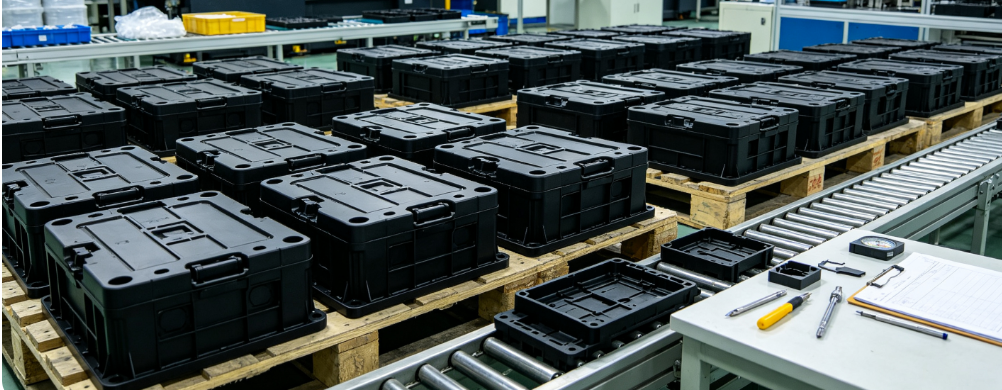
A European EV Tier 1 required 120,000 annual FR PC/ABS battery module covers, UL94 V-0 @1.5 mm halogen-free.
Initial Sourcing Pain Points
- Generic FR PC/ABS grade lost V-0 rating on 1.3 mm thin ribs due to high shear molding heat
- Sharp 0.2mm internal radii created frequent assembly cracking (halogen-free FR low impact)
- Poor drying process caused consistent silver splay on cosmetic outer surfaces, 8% scrap rate
- No batch UL94 spot testing; late-stage third-party lab testing discovered non-compliant lots
Optimized FR Material & Molding Solution
- Switched to EV-specific low-shear halogen-free FR PC/ABS blend formulated for thin-wall V-0 retention
- DFM redesign rounded all internal corners to 0.6mm minimum radius to boost impact resistance
- Implemented automated 4-hour pre-drying station with closed material conveying system
- Adjusted barrel temp and screw speed to cut shear heat, preserved FR chemical integrity
- Added in-house periodic vertical flame spot checks per production shift
Final Outcome
Scrap rate dropped to 0.9%, all batches consistently passed UL94 V-0 and GWIT 775°C testing, stable mass production launch without OEM qualification delays.
Sourcing Checklist for EV Flame-Retardant Plastic Mold Vendors
Screen mold suppliers against these EV FR plastic mandatory criteria:
- Uses EV-certified halogen-free FR resin with full UL94 test report at actual molded wall thickness
- Complete raw material drying station with temperature/time logging for FR engineering plastics
- Adjustable low-shear injection molding parameters optimized for FR additive stability
- In-house or third-party lab capable of UL94 vertical flame testing for batch spot checks
- Full material COA traceability linking pellet lots to finished EV housing batches
- DFM engineering team familiar with FR thin-wall thickness rules and flame performance tradeoffs
- Process control to prevent cross-contamination between FR and non-FR resin grades
- Can provide full OEM compliance documentation: RoHS, REACH, glow wire test records
FAQ
Is halogen-free FR plastic mandatory for passenger EV battery housings?
Most global OEMs enforce halogen-free FR systems for passenger vehicles to limit toxic corrosive smoke during thermal runaway. Halogenated FR is only permitted for industrial off-road EVs with formal design waiver approval.
Can a material rated V-0 at 3 mm automatically pass V-0 at 1.5 mm thin ribs?
No. Wall thickness directly reduces flame resistance. Always confirm datasheet UL94 rating at your actual molded minimum wall thickness; many standard FR grades drop to V-2 or HB below 1.5 mm.
Which FR plastic offers the lowest total cost for large-format battery pack trays?
Long glass fiber flame-retardant PP delivers the lowest raw material cost and lightweight advantage for large structural trays, as long as operating temperature stays below 110°C. For high-temperature compact modules, FR PC/ABS is preferred.
Do FR additives impact long-term EV aging durability?
Low-quality overloaded FR blends suffer FR migration and brittleness after thermal cycling. EV-specific balanced halogen-free FR grades maintain mechanical and flame performance over 10-year vehicle service life.
What flame rating is required for cell-to-cell thermal barrier separators?
Premium EV platforms specify UL94 5VA for cell separating barriers to resist hole penetration under prolonged flame exposure; standard module covers only require UL94 V-0.
Wrap-Up
Flame-retardant plastic selection for EV housings balances three core priorities: thermal runaway safety compliance, long-term vehicle durability, and mass production cost efficiency.
FR PC/ABS alloy remains the versatile mainstream choice for battery modules and power electronics enclosures, while FR LGF-PP minimizes weight and cost for large pack trays. Glass-filled FR PA/PBT suits high-voltage connector hardware, and high-end PPS/PPA handles extreme heat barrier applications.
Critical compliance risks arise from ignoring thin-wall flame rating limits, using unoptimized halogen-heavy FR blends, or poor molding parameters that degrade flame retardant chemicals. Early DFM review with a FR-specialized mold supplier eliminates scrap and OEM qualification delays.
Zorapid molds all mainstream EV flame-retardant plastic grades, with dedicated low-shear injection processes, in-house material drying and periodic flame testing for prototype and mass EV housing batches. Our engineering team provides material grade matching and FR-focused DFM optimization aligned with UN R100, UL94 and OEM automotive safety standards.
Request Your Free EV FR Plastic Material Recommendation & DFM Review
Share your housing CAD, minimum wall thickness, operating temperature range, target flame rating and batch volume. Our automotive mold team will recommend the optimal halogen-free FR resin grade, flag thin-wall flame risks and deliver a full injection molding process proposal.