Published:Zorapid.Ltd
If you make high-precision metal parts for aerospace, semiconductors, medical implants or injection molds, you’ve run into two classic manufacturing headaches:
- Pure CNC subtractive machining wastes tons of expensive metal and drags out lead times on complex internal geometries
- Standalone additive manufacturing (SLM/DED/Wire AM) delivers tricky internal structures but fails tight Ra surface specs, critical dimensional tolerances and often costs too much at mid-to-high batch sizes
Hybrid manufacturing blends additive near-net shaping + 5-axis CNC precision finishing in one workflow. It fixes both flaws. But most engineering teams only compare upfront part price, missing massive long-term returns on material waste, yield, downtime, supply chain and part performance.
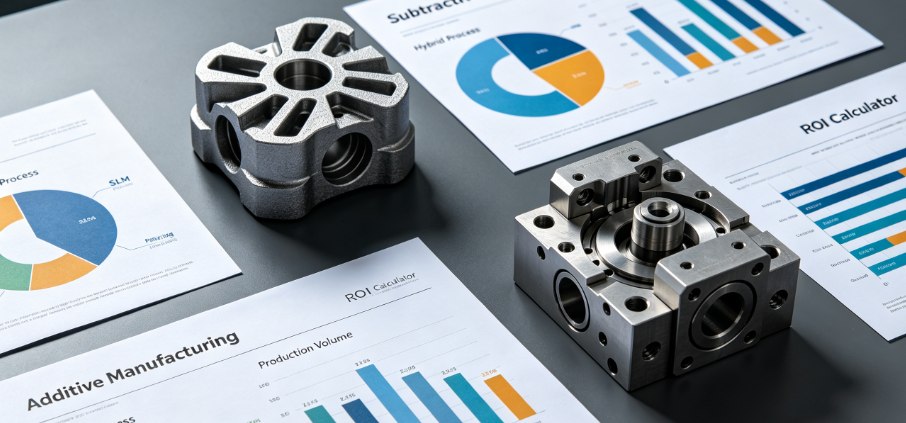
What Is Hybrid Additive + Subtractive Manufacturing? Quick Recap
Hybrid manufacturing follows two mainstream workflows:
- AM first, CNC finish (most common) Use SLM/DED/WAAM to print complex lattice, conformal cooling channels, undercuts, internal manifolds into near-net shape. Then run 5-axis milling, turning, grinding on critical sealing surfaces, mating faces and vacuum walls to lock GD&T tolerances and smooth roughness down to Ra 0.2 μm or betterResearchGa….
- CNC base + localized AM deposition Machine solid bulk metal blocks conventionally, then add high-performance alloys only on wear zones, repair damaged components, or add small complex features via additive. Perfect for mold repair, turbine overhaul, custom tool inserts.
The core value tradeoff: additive handles impossible internal geometry; subtractive guarantees repeatable precision and surface finish. ROI lives in the gap between pure CNC and pure AM costs.
Full ROI Cost Framework – Hard Costs vs Hidden Savings
Most companies miscalculate ROI by only tallying machine purchase and raw part cost. Complete hybrid ROI requires tracking hard capital expenses (CAPEX), recurring operating expenses (OPEX), and intangible business gains that often make up 40%+ of total annual savings.
CAPEX (One-Time Upfront Investment)
All capital costs feed into payback timeline calculation:
- Hybrid machine hardware (DED 5-axis integrated machine / separate SLM + standalone 5-axis cell)
- Tooling: special AM cutting tools, grinding wheels, probing fixtures
- Software: hybrid CAM simulation, build path programming, GD&T inspection software
- Facility upgrades: cleanroom ventilation, inert gas supply, temperature-controlled shop floor
- Staff training for hybrid programming, quality inspection, post-process control
Recurring OPEX: Line-item ongoing costs
| Cost Category | Pure Subtractive CNC | Pure Additive | Hybrid AM+CNC |
|---|---|---|---|
| Raw material | Highest; Titanium/Inconel removal rate up to 95% (20:1 buy-to-fly ratio) | Medium; expensive metal powder | Lowest; near-net shape cuts material consumption 60%–70% on complex parts |
| Labor programming | Long CAM setup for deep cavities/angles | Long AM build simulation + support programming | Shorter combined programming; one unified process plan |
| Machine hourly run time | Many long CNC passes, multiple re-fixturing | Slow AM layer-by-layer printing | Balanced; fast AM bulk forming + short CNC finishing cycles |
| Cutting fluids, tool wear | High heavy metal cutting wears end mills fast | Minimal cutting wear | Tool wear drops drastically; CNC only machines small critical surfaces |
| Post-processing polishing/buffing | Heavy hand polish needed for smooth Ra | Massive post-finish labor to remove AM layer lines | Targeted CNC machining eliminates hand polishing for controlled Ra specs |
| Scrap rate | High on complex geometry due to fixturing error | High warpage risk on thin walls | Low scrap; AM minimizes clamping steps, CNC corrects minor distortion |
Quantifiable Hard Savings
These drive tangible monthly ROI numbers with measurable dollar values:
Material Cost Reduction (Top ROI driver for high-cost alloys)
Titanium Ti6Al4V, Inconel 718, copper, stainless 316L cost hundreds per kilogram.
- Traditional CNC aerospace brackets: remove 90%+ stock; hybrid cuts material waste by 65%–75%
- Real industry metric: Steel spare parts cut raw steel usage by 70% with WAAM+CNC hybrid; operational material cost down 28% year-over-year For semiconductor aluminum chamber parts with deep internal ports, hybrid slashes aluminum feedstock spend while locking Ra 0.2 μm on vacuum surfaces.
Total Manufacturing Lead Time Compression
- Multi-piece CNC assemblies: hybrid prints as single monolithic component, eliminates assembly time, bolt holes, alignment fixtures
- Mold inserts with conformal cooling: hybrid production lead time down 30%–50% vs fully CNC machined moldsResearchGa… For low-volume custom parts, prototype turnaround shrinks from 2–4 weeks to 3–7 business days, accelerating customer revenue launches.
Tooling & consumable cost cuts
CNC only cuts critical finished surfaces (20%–40% of total part area). Less metal removal = far less carbide tool breakdown. Factories record 35%–50% lower monthly tool replacement bills with hybrid workflows.
Rework & scrap reduction
3-axis CNC repeated re-clamping causes alignment drift and dimensional scrap. Hybrid single-setup processing cuts reject rates by 22%–42% on curved, multi-angle components (semiconductor chambers, turbine hardware). Every rejected high-alloy part saved directly hits net profit.
Hidden Intangible ROI
These factors often push total ROI from acceptable to exceptional for advanced manufacturing clients:
- Higher end-product performance = premium pricing & larger customer orders Conformal cooling molds run injection cycles 30%–80% faster, lowering client per-unit molding cost. Hybrid lets you charge 10%–20% price premiums for high-performance tooling. Semiconductor hybrid chamber parts deliver lower outgassing and stable plasma, qualifying for advanced-node fab projects competitors cannot win.
- Supply chain risk reduction & inventory cost savings Hybrid enables on-demand production. OEMs cut safety stock inventory of low-volume complex spare parts by 60%–90%. Less warehouse capital tied up, less obsolete part write-offs.
- MRO repair cost ROI Instead of buying brand-new high-value turbine blades, chamber flanges, worn mold inserts, hybrid DED adds material only to worn zones then CNC re-finishes. Repair cost is 30%–60% cheaper than new component procurement; downtime shrinkage adds extra production uptime revenue.
- Lower energy & waste disposal fees Hybrid slashes machining chips, cutting fluid waste, industrial trash hauling fees. Studies show hybrid manufacturing cuts overall manufacturing energy consumption up to 97% for large forged aerospace-style parts. Sustainability compliance also helps win EU/US government aerospace contracts with green procurement rules.
Step-by-Step Hybrid ROI Calculation Formula (Factory Ready)
Simple universal formula all manufacturing teams can plug internal numbers into:
Basic Annual Net Gain =
(Total annual material savings + labor savings + tool/consumable savings + scrap rework savings + uptime revenue gains)
− Annual hybrid machine depreciation − yearly hybrid maintenance cost − annual training overhead
Simple Payback Period (Months) =
Total hybrid CAPEX ÷ Monthly average net cash gain
Annual ROI % =
(Annual Net Gain ÷ Total CAPEX) × 100
Sample Real-World Calculation Case: Injection Mold Conformal Cooling Insert
Baseline annual volume: 24 custom mold inserts per year
- Pure full CNC total annual cost: $148,000
- Pure SLM full-print annual cost: $172,000
- Hybrid (SLM conformal cooling core + 5-axis CNC sealing surface finish) annual cost: $96,200 **Annual hard savings: $51,800 vs CNC / $75,800 vs full AM**
Hybrid CAPEX investment for dedicated cell:
$192,000
Monthly net saving = $51,800 ÷12 = $4,317
Payback period = 192,000 ÷ 4,317 ≈ 44 months
Annual ROI after payback: ~27%
Add secondary gains (customer molding cycle speed-up, fewer mold defects for buyers), total annual savings jump to $72,000, payback drops to 32 months, annual ROI hits 37%.
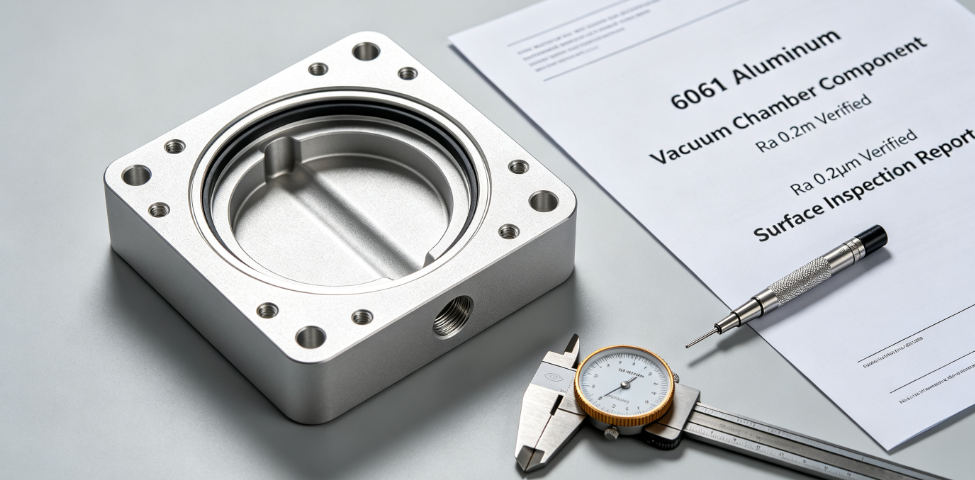
Second Verified Case: Semiconductor 6061 Aluminum Vacuum Chamber Component (Ra 0.2μm spec)
Batch size: 12 chamber bodies yearly
Traditional 5-axis CNC: massive aluminum block stock removal, heavy hand polishing to hit Ra 0.2 μm
Annual CNC total cost:
$117,600
Hybrid workflow: AM build internal complex gas channels + CNC machine all exterior/wetted vacuum surfaces to Ra ≤0.2 μm
Annual hybrid cost: $64,400
Annual material + polishing labor saving:
$53,200
CAPEX add-on for hybrid capability: $134,000
Payback timeline: ~30 months
Additional yield upside: hybrid chamber outgassing improves wafer yield by 1.2% for fab clients; manufacturer wins repeat long-term OEM contracts worth $90,000 incremental annual revenue.
Industry-by-Industry Hybrid ROI Benchmarks (Verified Field Data)
Data compiled from DMG MORI, ASME, aerospace tier 1 and semiconductor precision manufacturing reports
- Aerospace (Ti6Al4V, Inconel complex structural parts)
- Hybrid total production cost reduction vs pure CNC: 23%–47%
- Buy-to-fly ratio improves from ~20:1 down to 1.2:1
- Typical payback window: 28–48 months for dedicated hybrid equipment
- Biggest ROI triggers: high-cost superalloy material savings, part consolidation eliminating assembly labor
- Injection Molding / Die Cast Tooling (H13, P20)
- Hybrid vs full CNC cost reduction: 15%–20% on conformal cooling moldsResearchGa…
- Mold customer injection cycle time cuts 40%–70%, allowing mold shops to charge premium rates
- Fastest ROI (20–36 month payback) for shops running 30+ custom molds annually
- Semiconductor UHV Hardware (Aluminum, 316L SS chamber parts)
- Hybrid eliminates multi-piece chamber assembly, cuts leak risk and QA hours
- Ra 0.2μm consistency removes costly electropolishing rework
- Payback: 24–38 months for high-mix low-volume fab component suppliers
- Medical Implants (Titanium lattice orthopedics)
- AM builds bone-ingrowth lattice structures; CNC machines implant locking tapers, sealing faces to tight medical tolerances
- Hybrid cuts post-process surface finishing time by 60%; scrap rate down 38%
- Ideal ROI for 50–500 annual unit batch sizes
- MRO Industrial Repair (Turbines, Pump Parts, Worn Fixtures) No full machine CAPEX required if outsourcing hybrid processing
- Repair cost 40% lower than new part purchase; equipment downtime reduced 60%+
- Immediate positive ROI with zero long-term payback risk
When Hybrid Has Weak ROI – Clear Red Flags
Hybrid manufacturing is not universally profitable. Avoid investment if these conditions apply:
- Simple flat prismatic parts with zero internal channels/lattices/undercuts; regular 3-axis CNC remains cheapest
- Mass high-volume runs (5,000+ identical units annually); traditional forging + high-speed CNC beats hybrid unit pricing
- Part materials only low-cost mild steel with no expensive alloy premium; material savings cannot offset hybrid equipment overhead
- In-house order volume is tiny (under 10 complex parts per year); outsourcing hybrid machining is smarter than buying your own machine
FAQ
Do I need to buy an all-in-one hybrid machine, or can I pair separate SLM + standalone 5-axis CNC? Which has better ROI?
Two equipment paths deliver different payback timelines.
Integrated single hybrid machines (DED + 5-axis mill all-in-one) cut handling and alignment errors, lower labor programming time, best for high-volume complex parts with 24+ annual batches. CAPEX is higher, payback extends 6–10 months longer.
Separate SLM printer + existing 5-axis CNC cells lower upfront CAPEX drastically. Great for job shops already owning CNC capacity; payback shrinks by 8–14 months. The only downside: extra part transport between machines adds minor alignment risk.
Most small-to-medium precision manufacturers pick split equipment for faster ROI.
How does batch size change hybrid ROI? Is hybrid only profitable for low-volume prototypes?
Hybrid ROI peaks for low-to-medium batches (10–2,000 units).
- <10 units: Hybrid crushes CNC lead time, excellent ROI on custom one-offs
- 10–2,000 units: Sweet spot balancing material waste reduction and amortized programming cost
- Above 5,000 identical parts: Forging/stamped blank + high-volume CNC becomes cheaper; hybrid ROI declines For custom complex molds and aerospace spare parts with variable batch sizes, hybrid stays cost-effective year-round.
Does surface finish work like Ra 0.2μm hurt hybrid ROI with extra CNC time?
On net, tight roughness specs improve long-term ROI.
Pure AM cannot reliably hit Ra 0.2μm on vacuum and sealing surfaces, requiring expensive manual hand polishing or electropolishing. Hybrid uses automated 5-axis milling to lock Ra specs consistently. You eliminate costly manual finishing labor and rework rejects. The CNC time added is far cheaper than manual polishing overhead, especially for semiconductor chamber hardware.
What are hidden hybrid costs most teams forget in ROI math?
Top overlooked costs: inert gas consumption for SLM, HIP heat treatment fees for metal AM density, CMM inspection time for hybrid feature validation, specialized AM powder disposal fees.
These add 5%–9% to yearly OPEX. Always build these recurring fees into your spreadsheet model to avoid overestimating returns.
an outsourcing hybrid manufacturing deliver positive ROI without buying equipment?
Absolutely, and it’s the lowest-risk entry point.
Many precision factories outsource AM printing and keep in-house 5-axis finishing, or fully subcontract the whole hybrid workflow. CAPEX drops to zero; positive ROI starts with your first production order. Outsourcing is recommended if your annual complex part count is under 15 units, until order volume justifies in-house equipment investment.
How long is a typical acceptable payback timeline for hybrid manufacturing?
Western industrial manufacturing standard thresholds:
- Outstanding ROI: Payback under 24 months
- Strong viable ROI: 24–36 months (most aerospace/mold/semiconductor hybrid projects land here)
- Borderline acceptable: 36–48 months (only justified if major customer long-term contracts guarantee steady volume)
- Poor investment: Longer than 48 months without locked-in multi-year customer orders
Do multi-material hybrid parts boost ROI?
Yes for targeted use cases. For example, copper cooling features AM-deposited onto stainless steel chamber bodies, CNC-finished together. Hybrid eliminates bonding/brazing assembly steps, reduces thermal interface resistance, improves part performance and cuts assembly QA labor. Performance gains let you charge higher customer pricing and expand qualified project bids, lifting total annual ROI by 10%–18%.
How to calculate ROI if hybrid wins new customer business that traditional CNC cannot support?
Split ROI into two buckets:
- Cost savings ROI (material/labor/scrap reductions on existing orders)
- Revenue expansion ROI (new client revenue only possible via hybrid design freedom) Combine both numbers. Many precision shops see 50%+ of total hybrid ROI coming from new high-margin aerospace/semiconductor projects they previously could not manufacture at all.
Closing Takeaways
Hybrid additive-subtractive ROI is never one-size-fits-all. Simple parts stay cheapest on regular CNC; fully mass-produced parts favor forging and high-speed machining. For complex geometry parts using costly alloys (titanium, Inconel, aluminum vacuum hardware, mold steel), hybrid delivers reliable returns via less material waste, faster lead times, fewer rejects, higher customer part performance value and leaner supply chain overhead.
The biggest mistake businesses make is judging hybrid purely by per-piece manufacturing cost. Always build a full-year ROI model including hard OPEX savings plus revenue upside from better component functionality. For most precision manufacturers serving aerospace, semiconductor and medical markets, hybrid manufacturing delivers stable long-term ROI with predictable 2–4 year payback windows, while opening access to high-margin orders competitors cannot fulfill.