Published:Zorapid.Ltd
If you source custom industrial hardware, design mechanical components, or manage factory production in 2026, CNC machining is the most reliable subtractive manufacturing process you will encounter. Short for Computer Numerical Control, CNC uses pre-programmed computer commands to drive cutting tools and carve solid metal/plastic blanks into finished precision parts, replacing error-prone manual machine operation.
Today’s CNC landscape is far upgraded from old-school mills. AI control, lights-out automation, 5-axis mainstream adoption and hybrid additive-CNC workflows reshape production efficiency across semiconductor, aerospace, medical, EV and mold sectors. This guide breaks down CNC basics, major machine types, core advantages, real-world use cases paired with matching reference images, key 2026 industry trends, and a complete FAQ for all engineering stakeholders.
Basic Definition: How CNC Machining Works
CNC follows simple subtractive logic:
- Designers build a 3D CAD model (SolidWorks, Fusion 360, UG) with dimensions, tolerances and surface roughness (Ra) specs.
- CAM software converts CAD geometry into G-code, the universal programming language CNC machines read to map tool movement paths.
- The machine removes excess material layer by layer with rotating cutting tools, following fixed coordinates automatically.
- Secondary finishing, cleaning and inspection deliver final functional parts with repeatable precision impossible for manual machining.
Unlike 3D printing (additive manufacturing that builds material up), CNC cuts material away. It excels at tight micron tolerances, ultra-smooth surfaces like Ra 0.2 μm, and robust mechanical strength for mission-critical industrial hardware.
Caption: Close-up of vertical CNC mill drilling copper workpiece; demonstrates precise spindle and tool positioning for industrial precision machining
Main CNC Machine Types (Industrial Standard Classification)
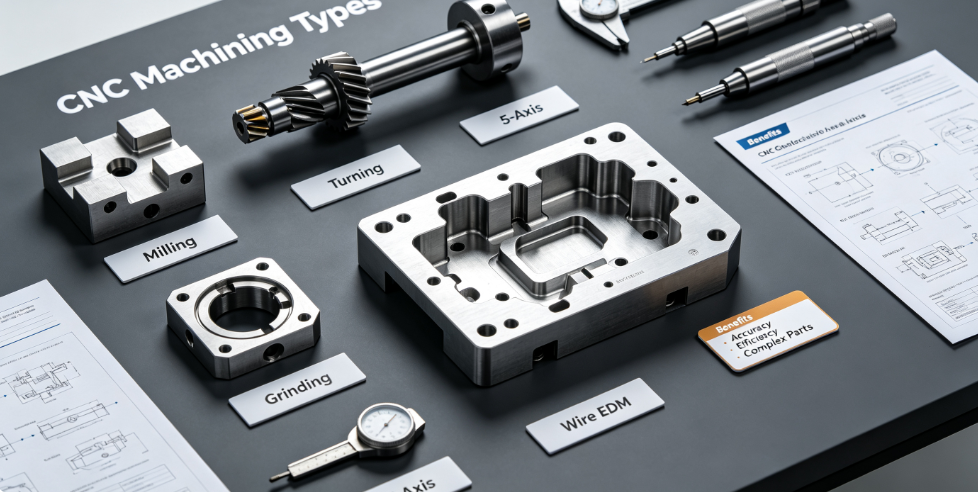
Not all CNC machines serve the same jobs. Below are the 6 most widely used industrial CNC equipment, sorted by function, use cases and visual references.
CNC Milling (Most Versatile Industrial CNC)
Milling uses spinning cutting tools; the workpiece stays fixed while tools move along linear/rotary axes to machine pockets, slots, contours and mounting faces.
- 3-Axis CNC Milling (X/Y/Z only) Best for simple prismatic parts: flat brackets, base plates, basic aluminum enclosures. Low programming cost but requires multiple re-clamping for angled or deep internal features, raising setup errors and lead time.
- 5-Axis CNC Milling (2 rotary axes + X/Y/Z) The mainstream high-precision workhorse of 2026. Spindle or part tilts/rotates, completing all complex surfaces in one single setup. Mandatory for semiconductor vacuum chambers, aerospace turbine blades, curved medical components. Eliminates alignment drift and guarantees uniform Ra finish on hard-to-reach walls.
CNC Turning (CNC Lathe)
The workpiece spins at high speed, while stationary cutting tools shape outer diameters, inner bores, threads and chamfers. Perfect for round symmetrical parts: vacuum flanges, shafts, threaded connectors, motor sleeves. Modern turn-mill combo lathes add milling functions to drill holes and machine flats on round components.
Wire EDM (Electrical Discharge Machining)
Thin conductive brass wire erodes hard metal via electrical sparks, no physical cutting force. Ideal for tiny sharp internal corners, narrow slots, hardened mold steel. It cannot machine plastics and solves geometry limits standard end mills cannot reach.
CNC Grinding
Abrasive grinding wheels remove tiny material allowances to hit ultra-tight tolerances (±0.001 mm range) and mirror-smooth surfaces. Used for bearing journals, mold shutoff edges, semiconductor sealing faces requiring Ra ≤0.2 μm.
CNC Laser / Waterjet Cutting
- Fiber laser: Fast precision cutting for thin aluminum, steel sheet metal, engraving
- Waterjet: Cold cutting with high-pressure water + abrasive grit; cuts metal, plastic, rubber without heat distortion for heat-sensitive materials
CNC Drilling
Dedicated to high-volume precise hole making, tapping and counterboring. Commonly integrated into milling centers instead of standalone machines for modern factories.
Top 7 Core Benefits of CNC Machining in 2026
Unmatched Repeatability & Consistency
Identical G-code delivers identical parts across prototypes and mass batches. Human operation variation is eliminated, critical for semiconductor wafer hardware and aerospace safety parts where even tiny dimension drift causes yield loss or failure. 2026 AI monitoring further stabilizes batch consistency by auto-adjusting cutting parameters in real time.
Broad Material Compatibility
CNC machines nearly all industrial engineering materials: Metals: 6061/7075 aluminum, 316L stainless, Ti6Al4V titanium, Inconel 718, H13 mold steel Plastics: PEEK, PVDF, PFA, LCP, high-purity PC (cleanroom/semiconductor grade)
No other mainstream manufacturing supports such a wide range of high-performance metals and rigid plastics.
Extreme Precision & Controllable Surface Finish
Tolerances down to ±0.001 mm are achievable with precision CNC + grinding. Surface roughness can be customized from rough Ra 6.3 μm to ultra-smooth Ra 0.2 μm for vacuum sealing. Designers fully control smoothness for particle control, sealing and plasma resistance needs.
Flexible Batch Scaling
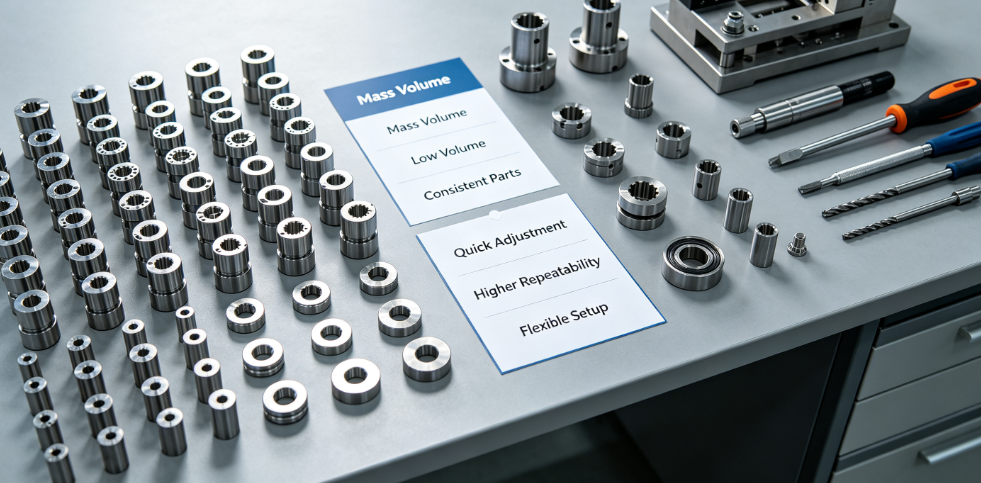
Works seamlessly for 1-off prototypes, low-volume custom runs (10–500 units) and medium mass production (up to 5,000 pieces). Tooling cost is minimal compared to injection molding or die casting, supporting fast design iteration favored by 2026 fast-cycle hardware development.
Labor Reduction & Lights-Out Feasibility
2026 CNC facilities widely deploy cobot loading, automated pallet changers and unattended lights-out production. Machines run overnight with minimal human oversight, cutting labor costs and expanding total daily output capacity.
Full Design Freedom for Complex Geometry
5-axis CNC unlocks curved contours, deep undercuts, angled ports and compound angles previously hard to manufacture. Combined with hybrid AM-CNC workflows, companies build conformal cooling channels and monolithic consolidated parts impossible for traditional manufacturing.
Full Traceability & Quality Compliance
Modern CNC connects with MES/ERP systems. Every cut, tool change and inspection log is recorded digitally, meeting strict audit rules for medical FDA, aerospace AS9100 and semiconductor cleanroom compliance.
Major Industrial Applications (2026 High-Demand Sectors + Matching Images)
Semiconductor & Wafer Fabrication
Key CNC parts: Aluminum vacuum chamber bodies, gas distribution manifolds, wafer handling grippers, PEEK/PVDF insulating fixtures, stainless UHV flanges Critical requirements: Low particle generation, Ra 0.2 μm sealing surfaces, low outgassing, burr-free machining, cleanroom compatibility. 5-axis CNC is standard for complex chamber internal channels in 2026.
Aerospace & Aviation
Typical components: Ti6Al4V structural brackets, Inconel turbine components, landing gear fittings, hydraulic manifolds Needs: High strength-to-weight ratio, heat resistance, strict GD&T tolerances, zero batch defects. Multi-axis CNC dominates aerospace production, paired with high-pressure coolant to extend expensive carbide tool life.
Medical Devices & Orthopedic Implants
Machined parts: Titanium bone implants, stainless surgical instruments, PEEK medical housings Standards: Biocompatible materials, burr-free edges, repeatable sterilization performance, ultra-clean surfaces. Precision CNC meets strict medical surface and tolerance regulations worldwide.
Injection Mold & Die Manufacturing
CNC builds mold cavities, cores, conformal cooling inserts from H13/P20 steel. Smooth mold surfaces directly control molded plastic quality. Many mold shops adopt hybrid SLM+CNC in 2026 to add intricate cooling channels then CNC-finish critical sealing surfaces.
Electric Vehicle (EV) & Automotive
EV motor housings, battery cooling plates, suspension brackets, transmission gears rely on high-speed CNC. Mass production balances tight tolerances and cost efficiency, with automated CNC cells cutting automotive component lead times year over year.
Caption: CNC milling of automotive transmission gear for dimensional accuracy and wear resistance
Industrial Automation & Robotics
Robotic end effectors, aluminum machine frames, custom fixture blocks, actuator housings all use CNC machining for customized fit and rigid mechanical performance.
Key CNC Machining Trends Reshaping 2026 Production
- 5-Axis CNC becomes baseline standard Complex geometry from semiconductor and EV designs pushes most precision manufacturers to phase out heavy 3-axis re-fixturing. Single-setup 5-axis lowers scrap, cuts cycle time and delivers more consistent surface quality across industries.
- AI-powered adaptive CNC control mainstream 40% of global CNC shops run AI monitoring in 2026. AI auto optimizes spindle speed/feed rates based on real-time vibration and temperature data, slashing tool wear by 20%–40% and reducing unplanned downtime via predictive tool failure alerts.
- Digital twin process simulation standard practice Engineers simulate full CNC cutting paths virtually before physical machining, eliminating tool collision risks and shortening setup time. Digital twins tie machine data, CAD and quality reports together for full production traceability.
- Hybrid additive + subtractive manufacturing fast growth AM prints complex internal lattices/channels; CNC machines critical mating/sealing surfaces to tight tolerances. This hybrid workflow cuts high-alloy material waste while retaining CNC precision, widely adopted for molds, aerospace and semiconductor custom parts.
- Cleanroom CNC expansion for microelectronics Temperature-controlled, filtered CNC cells rise in demand to produce low-particle semiconductor and medical components, pairing strict environmental rules with precision cutting.
FAQ
What is the difference between 3-axis and 5-axis CNC? How do I choose in 2026?
3-axis only moves X/Y/Z linear axes; cheap for simple flat parts but requires multiple re-clamping for angled features. 5-axis tilts/rotates the spindle/workpiece to machine all complex surfaces in one setup. Choose 5-axis for semiconductor chambers, turbine parts, curved medical components or any geometry with undercuts/angled holes. Simple brackets and flat plates can use cost-effective 3-axis.
Can CNC hit ultra-smooth Ra 0.2 μm surfaces for vacuum components?
Yes. Precision finishing passes with high-pressure coolant deliver Ra 0.2 μm on aluminum and stainless steel. For higher consistency, add light grinding or electropolishing post-CNC. Regular rough milling only reaches Ra 1.6 μm ~ Ra 3.2 μm without dedicated finishing.
Is CNC suitable for mass high-volume production above 10,000 units?
CNC works for medium batches. For 10,000+ identical plastic parts, injection molding delivers lower unit cost. For metal mass production, forging/stamping blank + secondary CNC finishing balances speed and precision better than full CNC machining. CNC remains ideal for low-to-medium custom batches regardless of industry.
How does AI improve CNC performance in 2026?
AI serves three core roles: auto-generates optimized CAM toolpaths to cut cycle time, predicts tool wear days in advance to avoid unexpected crashes, and adjusts cutting parameters live to stabilize surface finish and tolerances amid material variation.
What materials cannot be CNC machined?
Soft foams, fragile glass ceramics, and ultra-soft gels are not practical for standard CNC. Nearly all solid metals and rigid engineering plastics (PEEK, PVDF, LCP) machine reliably.
Does CNC produce burrs? How to guarantee burr-free parts for semiconductor use?
Minor burrs naturally form during cutting. Request CNC edge breaking, ultrasonic DI/IPA cleaning or vibratory deburring on drawings for cleanroom hardware. Proper finishing tool selection also minimizes burr generation during the machining phase.
What are the biggest advantages of hybrid CNC+additive manufacturing in 2026?
Additive creates impossible internal structures like conformal cooling; CNC locks tight tolerances and smooth surface roughness on functional surfaces. It reduces expensive titanium/Inconel waste and enables designs pure CNC or pure AM cannot manufacture alone.
Final Conclusion
In 2026, CNC machining remains the most versatile precision manufacturing solution for custom industrial hardware. Its core value lies in reliable precision, broad material compatibility, flexible batch support and continuous upgrade via AI, automation and multi-axis technology.
3-axis CNC covers basic simple geometry at low cost, while 5-axis has become the go-to standard for complex aerospace, semiconductor and medical components. When paired with modern post-treatment, digital traceability and hybrid workflows, CNC balances manufacturability, cost control and end-product performance.
For designers and procurement teams, matching machine type, tolerance rules and material choices to component functional needs eliminates unnecessary manufacturing costs while ensuring consistent, high-quality finished parts.