Published:Zorapid.Ltd
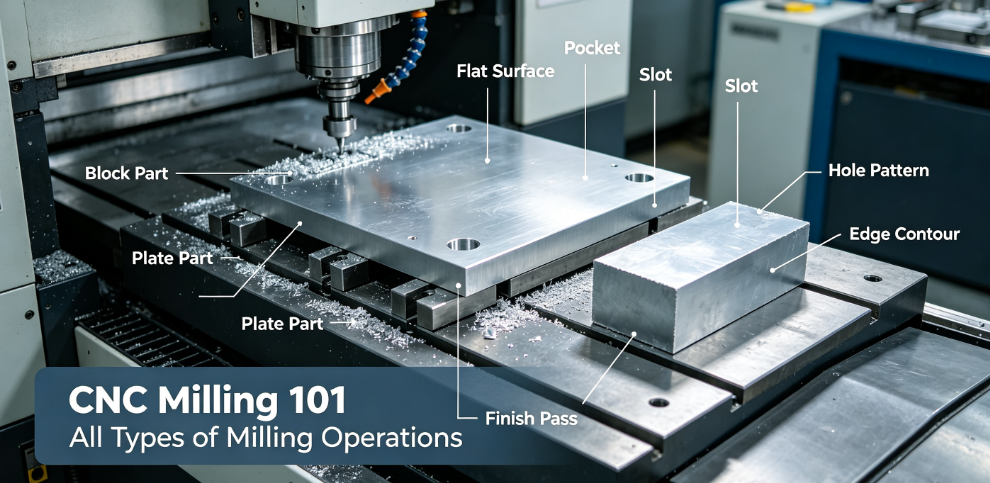
Solid metal blocks and flat plates make up most CNC machined industrial components: semiconductor chamber plates, fixture bases, mold plates, automation mounting blocks, aerospace spacer blanks, and custom equipment frames. All these parts rely on standardized CNC milling cutting modes.
New machinists and design engineers often mix up milling operation types, leading to wrong tool choices, poor surface finish, long cycle times, unnecessary tool wear, and out-of-spec dimensions. This beginner-friendly guide defines every common CNC milling operation exclusively for block and plate workpieces. We explain use cases, tool choices, key tips for aluminum/steel, match each process with HD watermark-free reference images, and share a quick decision table to pick the right cut every time.
All content focuses on prismatic block and flat plate geometry; curved complex profiling for freeform parts is covered separately.
Basic Background: Two Broad Milling Categories
All milling splits into two major families based on cutting direction, the foundation for block/plate processing:
- Peripheral Milling (End Milling) Cutting edges sit on the side of the tool cylinder. Tool side walls remove material. Ideal for slots, pockets, side walls, steps, contours on block edges. End mills are the primary tool.
- Face Milling Cutting inserts sit on the tool’s flat bottom face. The tool cuts across the top surface of plates/blocks to create flat, wide planes. Face mills dominate squaring raw blanks and surfacing large flat areas.
Full List of Standard CNC Milling Operations for Blocks & Plates
Face Milling (Surface Milling)
What it is
A large-diameter face mill flies across the top surface of a block or plate. It machines wide flat planes, removes saw marks, levels warped raw stock, and brings all plate surfaces to consistent thickness.
Common applications
- Squaring six sides of raw aluminum/steel blocks to precise length, width, thickness
- Finishing mold base plates, fixture mounting plates, semiconductor chamber flat flanges
- Removing rough casting/forging scale from thick metal blanks
Tool selection
Indexable insert face mills (50 mm ~ 160 mm diameter). Use round inserts for general finishing, square inserts for heavy roughing.
Pro tips for blocks/plates
- Clamp plates fully supported on the machine table to avoid flex during heavy face cutting
- Take multiple shallow passes instead of one deep cut to stop plate bending
- Finish pass removes only 0.05–0.1 mm stock for flatness and smooth Ra 1.6 μm or better
Peripheral End Milling (Side Milling)
What it is
Solid carbide end mills cut with vertical side flutes. Tools machine vertical outer walls of blocks, trim plate edges to final length, and create straight vertical sides.
Common applications
Trimming oversized block edges, machining square outer profiles, creating tall vertical side walls on fixture blocks, squaring rectangular plate perimeters.
Up Milling vs Climb Milling (Critical for Plates)
- Climb Milling (Preferred for CNC):Tool rotates in the same direction as table feed. Less tool wear, better surface finish, minimal workpiece vibration. Mandatory for thin plates prone to chatter.
- Conventional/Up Milling:Only used for hard crusty raw stock with surface scale; risk of plate lifting from the vise.
Pro tips
Long plates need slow feed rates to prevent side deflection of thin workpiece edges.
Pocket Milling
What it is
Removing material entirely inside a closed boundary to create recessed cavities inside solid blocks. Pockets are the most common feature on mold plates, semiconductor gas distribution blocks, fixture jigs.
Types of pockets for block work
- Open pockets: Open to one side of the block
- Closed pockets: Fully enclosed within block walls, with internal bottom floor
Tool rules
End mills must have radius matching internal corner radii of pockets. All CNC pockets have inner radii; sharp 90° internal corners require Wire EDM, not milling.
Workflow
Rough out bulk pocket material → semi-finish all walls and bottom → finish pass for dimensional accuracy and smooth floor finish. High-pressure through-tool coolant recommended for deep steel pockets.
Slot Milling (Slotting)
What it is
Cutting narrow linear grooves fully through or partially into blocks and plates. Slots have two parallel vertical walls and a flat bottom.
Two slot styles
- Through slot: Cuts all the way through a plate
- Blind slot: Ends inside the block with a solid floor
Tool choice
- Standard end mill: Slot width matches tool diameter
- Keyseat cutter: Specialized for narrow precision key slots on shaft blocks
Typical uses
Hardware mounting slots for positional adjustment, O-ring grooves on vacuum plates, wiring routing grooves on electrical enclosures, mold cooling shallow slots.
Key rule
Full slot cutting engages the entire tool width. Reduce feed speed by 30% to lower cutting load and tool breakage risk.
Step Milling / Step Profiling
What it is
Machining offset stepped levels on block sides or plate faces, creating multiple flat horizontal surfaces at different heights. Steps form shoulders, ledges, mating lands for assembly.
Applications
Mating steps between stacked chamber plates, spacer ledges, mounting shoulders on fixture blocks, mold alignment steps.
Machining method
Side peripheral milling cuts vertical step walls; light face milling cleans horizontal step tops. All steps controlled with Z-axis depth coordinates.
Chamfer Milling & Edge Breaking
What it is
Cuts angled bevels along sharp block/plate edges. Removes sharp 90° corners for safety, prevents burr lifting, adds assembly lead-in for bolts.
Common chamfer angles: 30°, 45°, 60°
Tools
Chamfer end mills, countersink tools, small ball nose end mills.
Critical for semiconductor hardware
45° micro chamfers eliminate sharp edges that shed micro particles; manual deburring can be reduced or eliminated with programmed CNC chamfering.
Counterboring & Countersinking
Countersink
Angled conical cut on plate hole entrances to recess flat-head screw heads flush with the plate surface. Widely used on aluminum equipment plates, stainless mounting blocks.
Counterbore
Cylindrical recess around a hole to recess socket cap bolt heads below the part surface. Standard for thick mold plates and heavy industrial blocks. Both operations rely on spot drill + drill + countersink/counterbore sequence on CNC mills.
Drilling (Hole Milling on Mills)
Drilling is a standard mill operation for all block/plate hole features: clearance holes, tapped holes, pin holes, cooling holes. Full workflow: spot drill → drill → tap / ream.
- Reaming: Finishes drilled holes to tight tolerance (+/-0.005 mm) on precision fixture plates and chamber port blocks
- Tapping: Thread generation for fastener assembly
Groove Milling (O-Ring Grooving)
Specialized slot milling for rounded or rectangular sealing grooves on vacuum plates and fluid manifold blocks. Ball end mills or special grooving tools machine precise O-ring channels to standardized width/depth dimensions. Improves UHV sealing performance for semiconductor hardware.
Contour Milling (2D Profile Milling)
Follows an arbitrary closed 2D outline on the block top plane to cut custom outer shapes (non-square blocks, irregular plate outlines). Common for custom automation fixture plates. Uses climb peripheral milling for clean edges.
Ball Nose Profiling (Curved Surfaces on Blocks)
Ball nose end mills machine curved radiused surfaces on block tops or edges. Used for rounded mold plate corners, soft contoured fixture surfaces. Not full 3D freeform; limited to simple curves on prismatic block geometry.
Thread Milling
CNC mills cut internal/external threads with thread mills instead of taps. Ideal for large holes, hard stainless steel blocks, deep blind holes where taps easily break. Thread milling delivers more thread accuracy on thick heavy plates.
Quick Selection Cheat Sheet: Which Milling Operation for Your Block/Plate Feature
| Feature on Block / Plate | Correct CNC Milling Operation | Preferred Tool |
|---|---|---|
| Large flat top surface needing leveling | Face Milling | Indexable face mill |
| Outer vertical edges of rectangular block | Peripheral End Milling | Solid carbide square end mill |
| Recessed closed cavity inside block | Pocket Milling | Square end mill (radius matched to corners) |
| Narrow linear groove through plate | Slot Milling | Slotting end mill |
| Stepped shoulder mating surfaces | Step Milling | Square end mill |
| 45° beveled sharp edges | Chamfer Milling | Chamfer tool |
| Recess for flat head screws | Countersink | Countersink drill |
| Recess for socket head bolts | Counterboring | Counterbore cutter |
| O-ring sealing channel | Groove Milling | Special grooving tool / ball mill |
| Custom irregular outer plate shape | 2D Contour Milling | Square end mill |
| Threads in thick stainless block holes | Thread Milling | Thread mill |
Critical General Rules for Milling Blocks & Flat Plates
- Climb milling is default for CNC: Only use conventional milling when machining scale-covered hot-rolled steel plates.
- Thin plates need full support: Use vacuum tables or fixture backup bars to stop bending and chatter. Never clamp thin plates only at edges.
- Always separate roughing and finishing: Rough removes bulk material with large depth of cut; finishing uses light cuts for precision and surface finish.
- Internal corners always match tool radius: Design drawings must call out minimum corner radius equal to end mill diameter.
- High-pressure through-tool coolant for steel blocks: Reduces flank wear, prevents built-up edge, keeps plate surfaces free of heat discoloration.
- Prevent plate warpage: Remove material evenly from both sides of thick aluminum plates to balance internal stress.
Common Beginner Mistakes on Block/Plate Milling
- Using face mills for narrow slots: Face mills cannot reach narrow recesses; waste time and damage tools.
- Ignoring plate vibration: Clamping too loose leads to rippled surfaces and dimensional errors on long thin plates.
- Attempting sharp 90° closed pocket corners with standard end mills: Causes tool collision and broken cutters; add radii or plan EDM.
- Running deep full-width slot cuts at high feed: Extreme cutting load snaps small end mills.
- Skipping spindle warm-up: Thermal drift causes uneven thickness across large aluminum plates.
FAQ
What is the difference between face milling and end milling for plate manufacturing?
Face milling cuts wide horizontal top surfaces to flatten plates and control thickness. End milling cuts vertical side walls, slots, pockets and edges. Most block jobs require both operations to finish all features.
Can all slots be machined with standard square end mills?
Straight rectangular slots work with matching-diameter end mills. Very narrow slots, keyways, and O-ring grooves need specialized grooving/keyseat cutters for better surface finish and tool life.
Why is climb milling recommended for thin aluminum plates?
Climb milling pulls the workpiece firmly against the fixture table instead of lifting it upward. Thin aluminum easily lifts with conventional milling, creating uneven thickness and chatter marks.
Do I need 5-axis milling for standard square blocks and flat plates?
No. Simple prismatic blocks and flat plates are fully completed on 3-axis CNC at lower cost. 5-axis is only required if blocks have angled holes, tilted pockets or compound curved features. Standard orthogonal geometry stays most cost-effective on 3-axis mills.
How to stop burrs along plate edges after peripheral milling?
Program small CNC chamfers on all edges, use sharp new end mills with climb milling, apply adequate coolant. Final ultrasonic cleaning removes leftover micro burrs for cleanroom semiconductor plates.
What milling operation do I use for multiple stacked plates machined in one setup?
Face mill all plates together for uniform thickness, use peripheral milling to trim shared outer edges. Drilling, counterboring and slotting run through all stacked layers at once to guarantee hole alignment across plates.
Closing Wrap-Up
All block and flat plate CNC milling breaks down into 12 core operations, grouped into face milling and peripheral end milling as two foundational categories. Every feature—flat surfaces, walls, pockets, slots, holes, grooves, steps—maps to one defined cutting process with matching tooling and parameters.
For designers and machinists, matching the right milling operation to each geometry eliminates avoidable tool breakage, chatter, dimensional drift and poor surface roughness. For high-volume aluminum fixture plates, stainless vacuum blocks and mold plates, standardized operation sequencing also cuts cycle time and stabilizes batch consistency.