Published by: Zorapid.Ltd
304 and 316 stainless steel is the worst springback offender in any sheet metal shop.
You program a clean 90° bend, lift the ram, and the flange pops open to 93°, 94°, even 95°.
You tweak ram depth again and again, but batch angles still drift wildly. The root cause is simple: stainless steel has high yield strength plus severe work hardening during cold forming. It stores massive elastic stress and bounces back the second pressure is removed.
At Zorapid, we bend thousands of stainless brackets, enclosures and structural parts every month. We know air bending alone can never fully kill rebound.
We have locked in a full set of process rules: grain control, tooling tuning, overbending compensation, bottom bending, and coining for zero-springback precision runs.
This practical guide walks you step by step through every actionable fix. We share calibrated overbend values for 304/316, explain how to cut elastic recovery, and break down when to switch from air bending all the way to full coining for tight ±0.5° angular tolerance.
If you keep fighting inconsistent bend angles on stainless steel batches, these shop-proven methods will cut scrap and hold stable repeatability part after part.
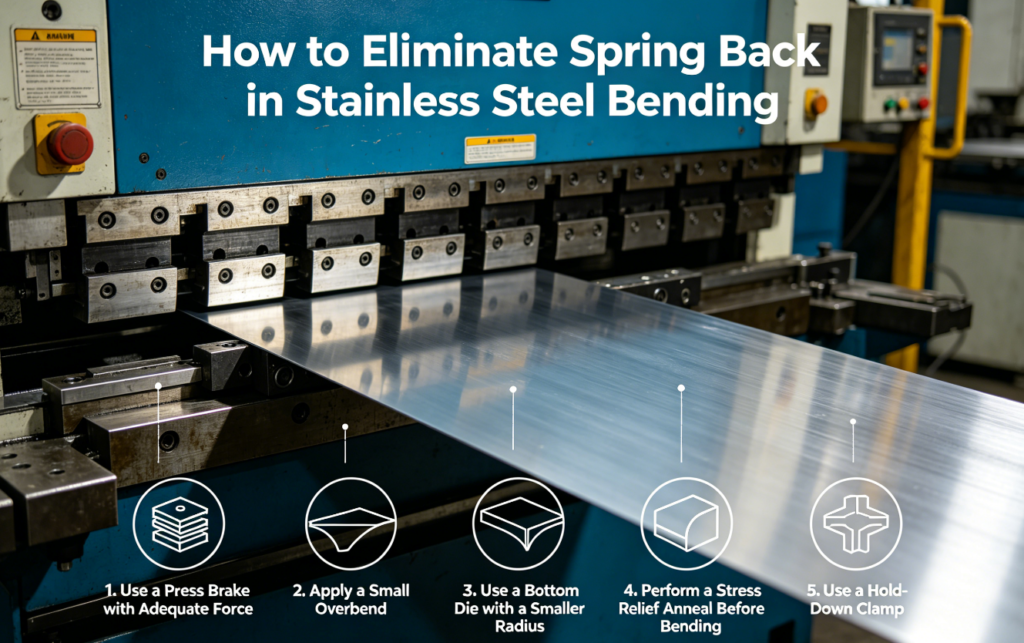
Why Stainless Steel Has Extreme Springback
Mild carbon steel rebounds only 1.5°~2.5°. 304 stainless regularly springs back 3°~5°, and 316 runs up to 6°. Three material properties create this problem:
- High yield strength (205–310 MPa) More elastic energy gets trapped inside the bend zone. When pressure lifts, the metal “snaps back” to release stored stress.
- Cold work hardening during bending The outer bend surface stretches and instantly hardens. This makes the material stiffer and increases rebound even more after each forming pass.
- Anisotropic grain structure Rolled sheet has long grain fibers. Bending parallel to the grain creates far bigger springback than bending across the grain.
Air bending only creates partial plastic deformation. An elastic core always remains inside the material. That core is exactly what causes the bend to open up.
To eliminate springback completely, you need to crush out that elastic core.
Calibrated Overbending (Best for Low-Cost Air Bending Runs)
Overbending is the first compensation step for every stainless steel job.
The principle is straightforward: Bend the part past your target angle, let it spring back, and land exactly on 90°.
Zorapid Standard Overbend Values (Shop Tested for 90° Bends)
| Material | Thickness | Starting Overbend Angle |
|---|---|---|
| 304 Stainless | 0.8–2.5 mm | +3.5° ~ +4.5° |
| 304 Stainless | 3.0–6.0 mm | +4.0° ~ +5.0° |
| 316 Stainless Steel | All gauges | +5.0° ~ +6.0° |
Strict Operating Rules
- Always run a test piece from the same sheet stock first. Yield strength varies between mill heats, so you need fine-tuning in 0.1° increments.
- Add 0.5~2 seconds dwell time at the bottom dead center. Holding pressure reduces immediate elastic rebound.
- Use a CNC press brake with Delem controller, input overbend offset directly into the Y-axis depth.
Limitation: Overbending only reduces springback; it cannot fully eliminate rebound. It works fine for tolerance above ±1°. For precision ±0.5° or tighter, you must upgrade to bottom bending or coining.
Bottom Bending to Cut Springback by 70%
Air bending leaves the sheet floating inside the V-die. Bottom bending forces the material fully against the die bottom, closing the gap and locking geometry tighter.
How It Suppresses Rebound
The entire cross-section goes through full plastic deformation. The elastic core shrinks sharply, so springback drops from 4° down to only 1°~1.5°.
Tooling & Setup Rules for Stainless Steel
- Select V-die opening = 6× material thickness (standard SS setup, wider than mild steel).
- Use matched punch and die with 88° tool angle instead of 90°. This reserves extra travel for overbending at the bottom of the stroke.
- Increase machine tonnage by 50% compared to air bending. Stainless needs extra pressure to seat fully against the die surface.
- Keep polished chrome tooling to avoid surface scratching while applying heavy pressure.
Bottom bending delivers excellent consistency for most industrial brackets. It balances accuracy and tool wear perfectly for medium-tolerance batch production.
Coining: The Only Way to Achieve Zero Springback
If your drawing requires ±0.25° angle tolerance with zero part-to-part variation, coining is your final solution. This process crushes the bend line with extreme pressure and erases nearly all elastic memory in the material.
Coining Working Principle
The punch penetrates slightly past the material’s neutral axis. The bend zone gets physically thinned (3%~8% thickness reduction). Every fiber becomes fully plastically deformed, leaving zero elastic stress to trigger springback.
After ram retraction, the bend angle stays locked with almost no opening.
Critical Coining Parameters for Stainless Steel
- Tonnage requirement: 5~8 times higher than air bending. Only run this on heavy-duty rigid press brakes to avoid machine frame deflection.
- V-die opening = 5× material thickness for tight material confinement.
- Limit coining strictly to the bend line only. Do not coin the entire flange to prevent material over-thinning.
- Use fully hardened D2 tooling. High pressure will quickly wear standard soft punch tips.
Best use case: Precision medical hardware, semiconductor brackets, and aerospace sheet metal where springback cannot cause assembly misalignment.
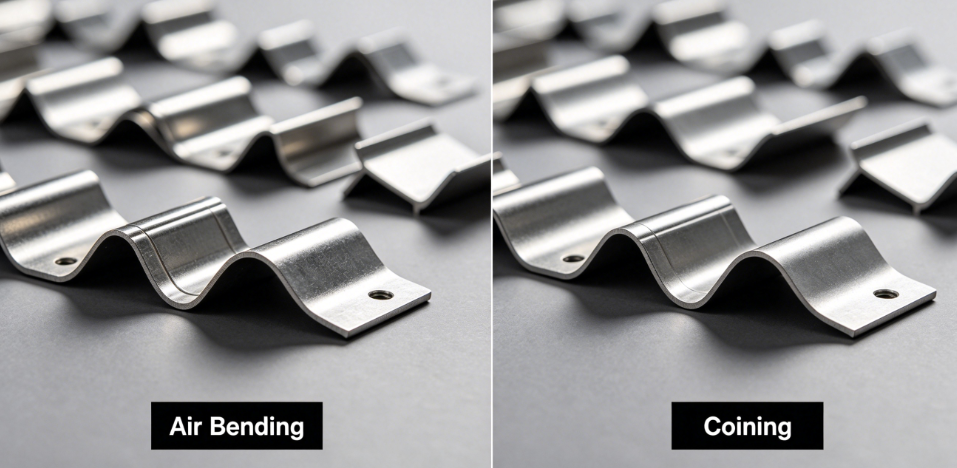
5 Material & Setup Tweaks That Reduce Springback Naturally
These small adjustments cut rebound before you even touch ram depth or pressure.
Tweak 1: Control Grain Direction (Non-Negotiable for Stainless)
Rolled stainless sheet has a visible rolling grain.
Never bend parallel to grain fibers — springback jumps 2° higher, plus cracking risk spikes sharply.
Always set bend lines perpendicular to the rolling grain. This alone cuts rebound by 30% on the same program.
Tweak 2: Use a Smaller Inside Bend Radius
A smaller R/t ratio increases plastic deformation.
Keep inside bend radius R ≤ 1.5× material thickness for 304, R ≤ 2.0× t for 316.
Larger loose radii leave thick elastic cores and worsen springback significantly.
Tweak 3: Avoid Multiple Re-Bending Passes
Re-bending the same fold triggers extra work hardening. The bend becomes stiffer, and springback grows larger on the second hit.
Lock your bend geometry in one single forming stroke whenever possible.
Tweak 4: Activate CNC Crowning Compensation
Press brake ram deflection creates uneven pressure across long flanges. The middle bends spring back more than the two ends.
Turn on motorized crowning to balance tonnage along the full bend length. This eliminates inconsistent angle drift across long stainless workpieces.
Tweak 5: Cold Stress Relief Before Bending
For extra-hard full-hard stainless sheet: Run low-temperature stress relief before forming. This lowers yield strength slightly and reduces stored elastic energy that causes rebound.
Tooling Selection Mistakes That Make Springback Worse
We see these four errors causing inconsistent bend angles every week:
Mistake 1: Using standard 90° punch + die for overbending
The tool hits bottom before you can overbend the material. You cannot compress the part past 90°, so springback remains uncontrolled.
Fix: Use 86°~88° under-angle punch to reserve extra stroke travel.
Mistake 2: Too wide V-die opening
Oversized dies let the sheet bend freely with minimal plastic compression. Elastic recovery becomes much larger.
Fix: Lock V-opening strictly to 5~6× sheet thickness for stainless steel runs.
Mistake 3: Worn dull punch tips
Blunt tooling creates uneven pressure along the bend line. Some sections spring back more than others, creating twisted flanges.
Fix: Keep punch tips sharp and polished exclusively for stainless jobs.
Mistake 4: Mixing grain direction in nested blanks
If your nesting rotates parts to save sheet material, some bends run with grain, others cross grain. The same program produces 2~3° angle difference within one batch.
Fix: Lock all bend lines perpendicular to rolling grain on the whole blank nest.
Zorapid Real Case Study – Eliminate Springback on 304 Precision Enclosure
Project Info
2.0mm 304 stainless steel equipment enclosure, 6 consecutive 90° bends, required angular tolerance ±0.3°.
Initial Air Bending Problems
- Average springback hit 4.2° per bend
- Flange angles varied 1.5° from left to right due to ram deflection
- 27% scrap from inconsistent bend geometry; parts failed assembly fit.
Our Zero-Springback Process Upgrade
- Revised blank layout: All bend lines perpendicular to rolling grain to cut work hardening rebound
- Switched from air bending to bottom bending with 88° punch + 6×t V-die
- Programmed +4° overbend with 1.5s dwell time at bottom dead center
- Enabled CNC crowning to balance pressure across the full 350mm bend length
- Locked inside bend radius at 1.5× material thickness to minimize elastic core
Final Result
Total springback reduced down to less than 0.3°. Bend angles stayed consistent within ±0.2° across the whole 300-piece batch. Scrap rate dropped below 0.5% with zero rework.
For follow-up ultra-precision orders, we upgraded to localized coining on critical fold lines and achieved near-zero rebound entirely.
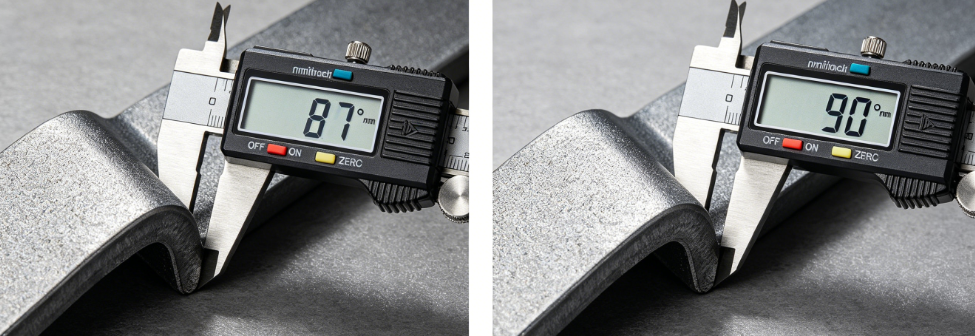
Clear Process Selection Chart (Pick The Right Method By Tolerance)
| Tolerance Requirement | Recommended Process | Remaining Springback | Best For Stainless Steel |
|---|---|---|---|
| ±1.0° and looser | Air bending + calibrated overbending | 1°~1.5° | Low-volume non-critical brackets |
| ±0.4° ~ ±0.8° | Bottom bending + overbend + dwell time | 0.3°~0.8° | Standard industrial sheet metal batches |
| ±0.25° ultra-precision | Local coining on bend lines | <0.2° | Precision fixture and medical hardware |
Decision rule:
Start with overbending air bending to control cost.
Switch to bottom bending for consistent mass production.
Run coining only when you need to fully eliminate springback with zero angular drift.
Quick Stainless Steel Bend Checklist To Kill Springback
Bend line runs perpendicular to sheet rolling grain
Inside bend radius R ≤1.5t (304) / R ≤2.0t (316)
Program calibrated overbend (3.5°~6° based on material grade)
Add 0.5~2 seconds dwell time at bottom dead center
Use 86°~88° punch instead of 90° to reserve overbend travel
V-die opening set to 5~6× sheet thickness
Turn on press brake crowning for long flanges
Avoid repeated re-bending to prevent extra work hardening
Switch to bottom bending or coining for tight angular tolerances
Run this checklist before every stainless setup, and inconsistent springback will no longer ruin your batches.
How Zorapid Guarantees Stable Stainless Steel Bend Accuracy
With 20+ years of sheet metal fabrication, we standardize stainless steel bending workflows to eliminate springback-related scrap:
- Pre-job grain direction check on every sheet blank during nesting
- Material-specific overbend libraries saved in CNC press brake controllers for 304 / 316 / duplex stainless
- Three-tier process routing: air bending, bottom bending, and localized coining matched strictly to your GD&T tolerance
- First article angle measurement with digital protractors before full batch run
- Ram crowning and tonnage adjustment to eliminate long-flange angle variation
We hold tight bend repeatability without endless trial-and-error setup.
Conclusion
Stainless steel springback comes from trapped elastic stress plus cold work hardening. You cannot fix it just by twisting ram depth.
Three core rules to eliminate rebound:
- Start with grain control and proper bend radius to cut springback at the material level.
- Use calibrated overbending and bottom bending to suppress elastic recovery for most production runs.
- Run targeted coining on critical fold lines when you need near-zero springback for precision assembly parts.
Match your forming method strictly to your angular tolerance, and inconsistent bend angles will become a problem of the past.
Send your stainless steel bracket drawings to Zorapid today. Our bending team will lock in the optimized process and hold stable bend accuracy for your full batch.
FAQ
Can springback be completely eliminated on 304 stainless steel?
Yes. Local coining crushes the elastic core along the bend line. After coining, angular rebound drops below 0.2°, which counts as zero springback for most engineering applications.
How much extra tonnage does coining require?
Coining needs 5 to 8 times the tonnage of regular air bending. You must use a heavy rigid press brake to avoid machine deflection and tool damage.
Why does bending parallel to grain make springback worse?
Rolled grain creates anisotropic stiffness. Bending along the fiber direction leaves higher residual elastic energy, increasing rebound by nearly 40% plus cracking risk.
Is bottom bending enough for ±0.5° tolerance on stainless steel?
Yes, when paired with 3.5°~5° overbend and dwell pressure. Bottom bending limits springback below 0.8°, which can be fine-tuned into ±0.5° repeatability.
Does material thickness affect springback value?
Thinner stainless sheet has higher R/t ratio and bigger rebound. Always run a test bend using the exact same sheet stock before locking the CNC offset value.