Publisher: Zorapid.Ltd
If you run precision mold jobs for automotive, medical or consumer plastic parts, you know this headache well.
You finish CNC machining on a mold plate. The dimensions look perfect right off the machine.
You wait overnight, then run CMM check the next morning. The plate warps, twists, and goes out of tolerance.
Scrapped steel, lost lead time, angry clients, and unexpected cost blowouts.
Mold deformation does not happen by accident. Every bend and warping has a clear root cause.
At Zorapid, we fix mold distortion for hundreds of EU and North American OEMs every month. Today we break down every common cause, plus step-by-step improvements you can apply directly on your shop floor.
No vague theory. All tactics come from our 20+ years of precision mold manufacturing.
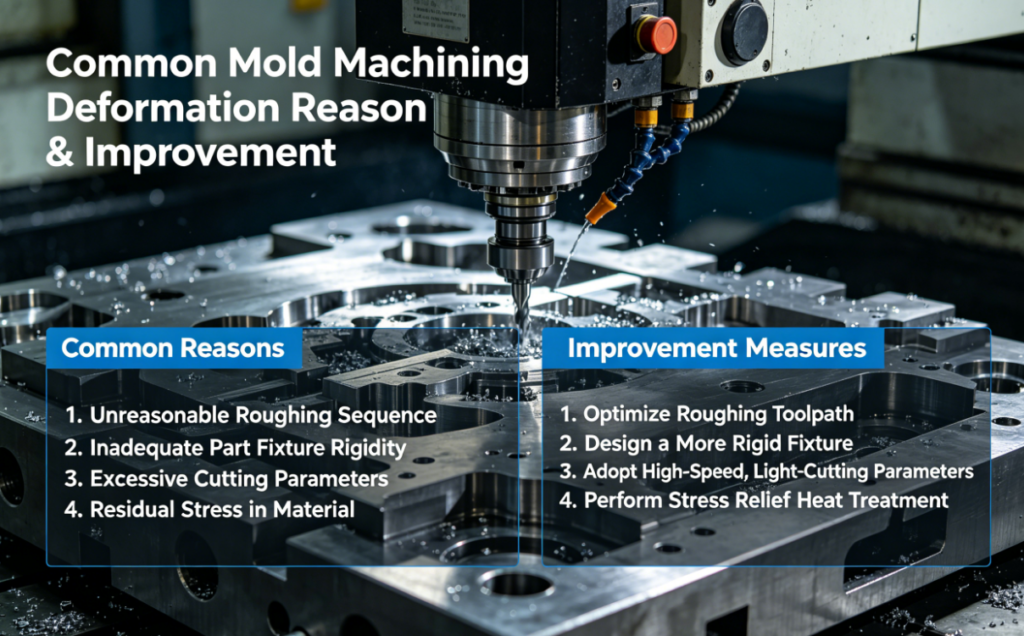
Raw Material Internal Residual Stress
Why it happens
Mold steel such as S136, NAK80, 718H, H13 carries locked stress from forging, rolling and heat treatment.
Steel forms uneven grain structures during smelting. When you cut away material with CNC mills, you remove part of the steel’s support structure.
Trapped stress suddenly releases. The mold plate bends, arches or twists slowly hours or days after machining.
Thick large mold bases and thin-walled cavity inserts suffer this issue the worst.
Real bad practice
Buying low-cost pre-hardened steel without forging normalization. Skipping stress relief before rough machining.
Zorapid’s Practical Improvement
- Choose steel with uniform grain segregation. We strictly pick vacuum-refined mold steel with low internal stress for all precision jobs.
- Add pre-machining stress relief annealing. Heat the steel to 550–600°C, hold temperature for 2–4 hours, then slow cool. This cuts locked residual stress by more than 75%.
- For large mold plates thicker than 40mm, add a second aging process right after rough cutting. Do not jump straight into finish milling.
Improper Fixturing & Clamping
Why it happens
Most machinists over-tighten vices or side clamps to hold the mold firmly.
Excessive clamping force squeezes the steel and creates artificial bending stress.
The mold stays flat while clamped. Once you release the vice after cutting, the plate springs back and deforms immediately.
Uneven support on hollow mold cores also creates sagging during heavy cutting.
Common mistakes
- 3-point rigid clamping on large flat mold plates
- Tight clamps right above thin ribs and weak sections
- No back-up support under hollow cavity areas
Fixes We Use Every Day at Zorapid
- Use distributed soft jaw clamping with moderate torque. Avoid concentrated pressure on narrow edges.
- Add full support blocks under the entire mold base to eliminate sagging during rough cutting.
- Machine thin ribs and weak features in multiple light cuts, not one heavy pass. Reduce one-time cutting force.
- Loosen clamps halfway through semi-finishing, let the part bounce free, then re-clamp lightly for final finishing. This eliminates clamping pre-stress completely.
Excessive Cutting Force & Poor CNC Machining Sequence
Why deformation kicks in
Rough machining removes most material in heavy passes. Deep cuts, fast feed rates push huge mechanical stress into the mold steel.
If you finish machine right after roughing without stress release, all cutting stress stays trapped inside the part.
Warpage becomes unavoidable once the part cools down.
The wrong machining order also makes distortion worse: machining thin ribs first, then heavy bulk material shifts the whole structure.
Typical wrong workflow
Full-depth rough → direct finish machining → no intermediate stress relief.
Optimized Process Route (Zorapid Standard NPI Mold Flow)
- Stick strictly to this order: rough machining → stress relief aging → semi-finish → second stress release → fine finishing.
- Split deep material removal into multiple shallow cuts. Keep cutting depth small to lower radial force on the mold cavity.
- Machine thick solid sections first. Process thin ribs and slim cores last. Keep the mold rigid during most of the cutting cycle.
- Use sharp solid carbide end mills to reduce friction. Dull tools create extra side pressure and push the mold out of shape.
Thermal Deformation from Uncontrolled Cutting Heat
This is the second biggest cause of out-of-tolerance molds.
Root cause
Heavy milling generates massive heat. Local zones on the mold expand quickly under high temperature.
If cooling cannot catch up, the heated area stretches. When the mold cools down after machining, uneven contraction creates bending and dimensional shrinkage error.
Large mold plates develop temperature gradients: one side hot, one side cool. The whole plate curves like a bow.
EDM wire cutting adds extra recast layer thermal stress, which slowly distorts small precision inserts weeks later.
Quick Improvements with Zero Extra Cost
- Stop flood cooling only. We run high-pressure through-tool coolant or MQL minimum quantity lubrication to carry away heat instantly. No hot spots left on the cavity surface.
- Let the mold fully cool down between roughing and finishing. Do not run rough + finish in one continuous hot cycle.
- Control workshop ambient temperature within ±2°C for high-precision mold jobs. Sudden air-conditioning swings cause slow thermal drift.
- Remove EDM recast layer with light surface grinding after wire cutting, to prevent delayed thermal stress release.
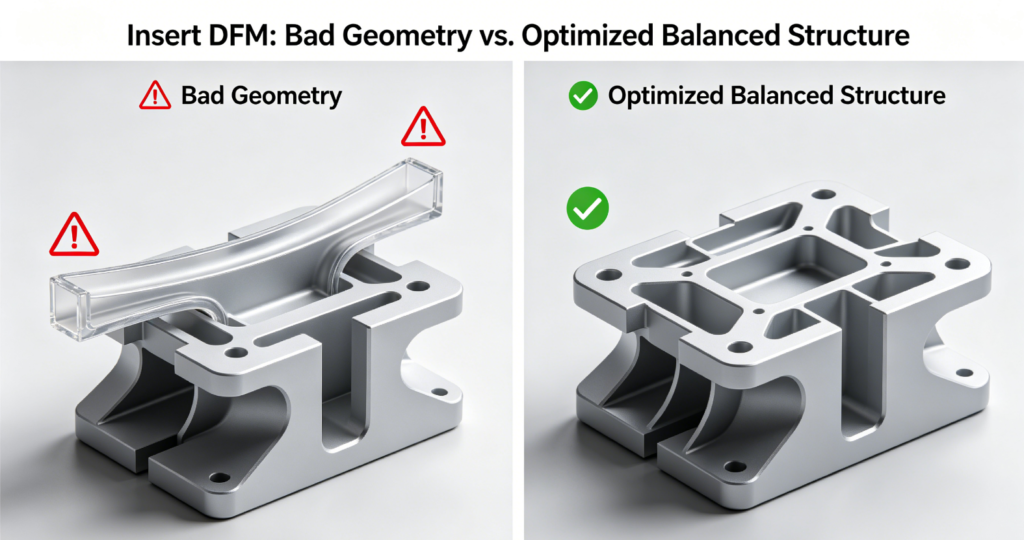
Mold Structural Design Defects
Many deformation issues start long before the first CNC cut.
Poor mold geometry locks stress inside the steel forever.
Common bad designs that trigger warping
- Sharp 90-degree internal corners without radii → severe stress concentration
- Extreme uneven wall thickness: thick bulk next to ultra-thin ribs
- Deep slim cores with zero draft angle, no reinforcing ribs
- Unbalanced cavity layout, heavy material only on one half of the mold plate.
Zorapid DFM Pre-Machining Check (We Run This Before Every Mold Program)
- Add R3–R5 fillets on all inner sharp corners to spread stress evenly.
- Balance wall thickness difference below 2:1. Avoid massive thick sections next to thin cavity walls.
- Add small reinforcing ribs on long thin mold cores to boost rigidity against cutting force.
- Run Moldflow warpage simulation in advance. We predict material shrinkage and structural bending, then adjust mold geometry before steel cutting starts. Simulation eliminates 60% of post-machining deformation problems upfront.
Heat Treatment Distortion After Quenching & Tempering
Pre-hardened and quenched mold steel still shifts shape after vacuum heat treatment.
Uneven quenching speed makes one side contract faster than the other. The mold plate warps after hardening.
Our Heat Treatment Control Rules
- Use vacuum quenching instead of open-air quenching for S136, STAVAX and corrosion-resistant mold steel. Uniform cooling reduces bending drastically.
- Apply triple low-temperature tempering after quenching, not just one temper. This stabilizes steel microstructure and locks down dimensions long-term.
- Straighten mild warping right after tempering while the steel still has slight temperature. Cold straightening creates new residual stress, so we avoid it entirely.
Full Step-by-Step Anti-Deformation Workflow (Zorapid Standard SOP)
Copy this workflow directly into your mold production to cut warpage by over 90%:
- Raw mold steel → Forging normalization + first stress relief annealing
- CNC rough machining (shallow light cuts only)
- Secondary aging treatment to release cutting stress
- Semi-finish milling + light EDM work
- Third low-stress tempering for hardened cavities
- Low-feed fine finish machining with sharp tools + MQL cooling
- Loosen all fixtures, let the part stabilize at room temperature for 12–24 hours
- Final CMM dimension inspection before delivery
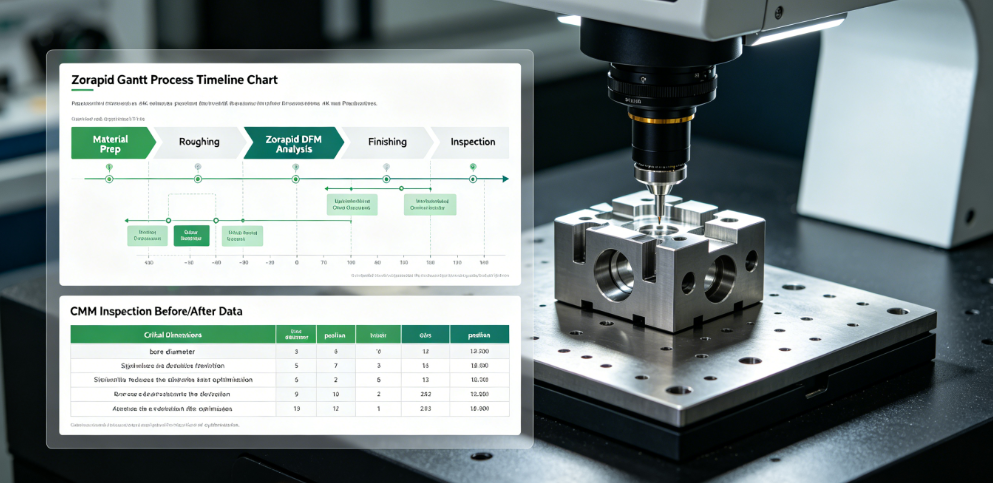
- Original deformation: 0.042mm
- After full process optimization: ≤ 0.007mm flatness error
Real Zorapid Client Case (EU Medical Injection Mold)
A German medical OEM sent us an S136 multi-cavity mold insert job.
Their previous supplier kept getting 0.03–0.05mm warpage after machining, causing flash on injection molded PEEK parts.
We applied our full stress control process: pre-aging steel, split cutting passes, intermediate stress relief, plus balanced DFM structural revision.
Final flatness held within 0.006mm. Zero deformation after 72-hour stabilization. The mold ran 1.2 million injection shots without shape shift.
Quick Troubleshooting Checklist
Deformation appears right after clamping release → fix over-tight fixture pressure
Warping shows up hours after machining → residual material stress; add aging heat treatment
Only thin ribs bend badly → split cuts and add structural stiffeners in DFM
One side of the mold plate curves → uneven heat; upgrade high-pressure cooling & stable workshop temperature
Distortion happens after heat treatment → switch to vacuum quenching + triple tempering
Wrap Up
Mold machining deformation is never random. It always comes from one or more of these 5 factors: raw material stress, clamping force, cutting heat, poor process order and weak structural design.
You do not need expensive new machines to fix most warping issues. Just rearrange your process, add 1–2 stress relief steps, and run DFM checks before cutting steel.
At Zorapid, we handle complex automotive, medical and semiconductor molds with strict anti-deformation control, holding tolerance down to ±0.005mm consistently for clients across Europe and North America.
If you keep fighting mold warping and tolerance drift, send us your 3D files. Our engineers will run a free DFM anti-deformation analysis for your next mold project.
FAQ
Can I skip stress relief for small mold inserts?
Small thin inserts still hold cutting stress. Even 50mm small cavity plates will slowly warp if you skip aging. We recommend low-temperature short-cycle stress relief for all precision mold steel.
QIs flood cooling enough to stop thermal deformation?
No. Flood cooling only washes surface heat away. Local high cutting temperature remains inside the steel. MQL or through-spindle high-pressure coolant works far better to eliminate hot spots.
How much extra lead time does stress relief add?
Only 6–12 hours of low-temperature heating. The time saved from rework and scrap easily makes up for this short waiting period.
Does Moldflow simulation prevent mold machining deformation?
Moldflow mainly predicts injection part warping, but paired with DFM structural analysis, it fixes unbalanced mold geometry that causes CNC machining distortion. We combine both simulations for best results.