Published:Zorapid.Ltd
If you design orthopedic implants—spinal cages, femoral stems, custom bone plates, patient-specific joint components—you already know the struggle.
Human bone anatomy is organic, curved, full of undercuts, tapered lattices and compound contoured surfaces. Standard 3-axis CNC shops can’t hit those complex shapes without 3–6 separate fixturing setups, stacking alignment errors, ruining critical bone-contact surfaces, and blowing your R&D timeline.
Titanium amplifies every machining headache: it’s abrasive, heat-sensitive, and demands ultra-smooth, contamination-free finishes to meet biocompatibility rules. Mess up the contour precision or surface roughness, and your implant fails osseointegration testing, FDA audits, or clinical trials.
That’s why Zorapid built dedicated simultaneous 5-axis CNC lines exclusively for contoured titanium orthopedic implants. This guide cuts through dense manufacturing jargon, breaks down real-world benefits for medical device startups and established OEMs, and explains exactly why 5-axis is non-negotiable for modern implant design.
The Big Pain Point: Why 3-Axis Fails Custom Titanium Implants
Let’s keep it honest, no corporate fluff. Traditional 3-axis machining creates 3 costly, risky problems for contoured titanium implants:
- Stacked dimensional errors: Every time you re-clamp the part for new angles, alignment shifts add up. Complex implants can hit 0.1mm total drift—way over medical tolerance limits of ±0.005mm.
- Damaged contoured surfaces: To reach undercuts or curved bone-mating geometry, operators manually flip the part, scratching delicate titanium surfaces that need Ra ≤0.8μm for safe implantation.
- Massive lead time waste: Multiple setups, extra tooling, and repeated inspection double or triple your production cycle, delaying prototype validation and clinical batches
For patient-specific custom implants (the fastest-growing orthopedic segment), 3-axis simply isn’t viable. You’ll scrap too many parts, miss testing deadlines, and risk regulatory non-compliance.
What Makes Contoured Orthopedic Implants So Hard to Machine
Modern orthopedic implants aren’t simple flat metal plates. Their engineered contours serve life-critical clinical functions:
- Curved femoral stems that mirror natural femur bone taper
- Lordotic spinal cages with angled porous lattice cutouts for bone ingrowth
- Patient-matched joint cups with spherical articulating surfaces
- Locking bone plates with multi-angle threaded holes along organic curved edges
Titanium Ti-6Al-4V ELI adds extra layers of difficulty:
- High thermal conductivity traps heat during cutting, causing microcracks that weaken implant fatigue life
- Abrasive alloy wears standard cutters fast, ruining consistent surface finish across contours
- Medical regulations ban residual coolant, burrs, or metal swarf on all bone-contact zones
Only simultaneous 5-axis CNC can machine all these contoured features in one locked setup without compromising material integrity.
5-Axis CNC: The Only Reliable Fix for Complex Titanium Implant Geometry
Let’s simplify how 5-axis works for medical manufacturing:
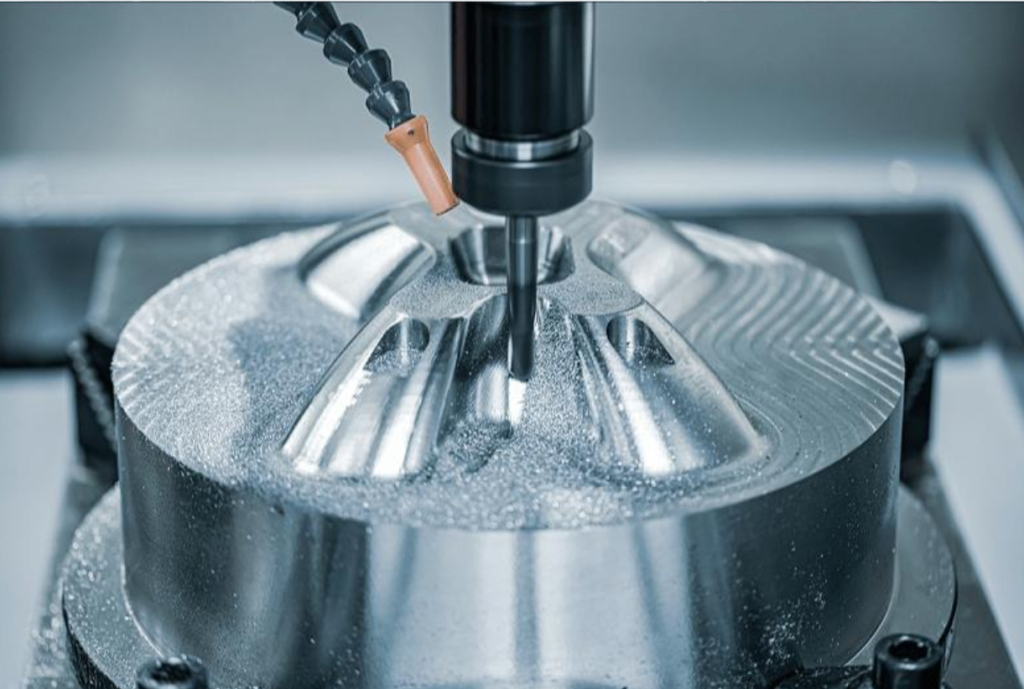
3-axis machines only move X/Y/Z linear directions. 5-axis adds two rotational axes, so the cutting tool tilts and spins around the titanium part continuously, hitting every curved surface, undercut and tapered feature from the perfect angle—single setup, zero re-fixturing.
Core 5-Axis Advantages for Contoured Titanium Implants
60% fewer dimensional errors vs multi-setup 3-axis machining
Single clamping eliminates alignment drift, holding consistent ±0.001mm micron tolerances across all contoured surfaces.
Superior, uniform surface finish on curved geometry
Tool maintains constant optimal contact angle while milling contours; surface roughness easily hits Ra 0.02–0.8μm required for orthopedic biocompatibilit.
Shorter production cycles, less scrap
Cut total machining time by 30–50% and eliminate parts ruined by repeated handling and flipping
Flawless biomimetic lattice & porous contour machining
Machines fine trabecular-style porous cutouts on spinal fusion implants without breaking delicate thin-walled titanium structures.
Full articulating spherical contour precision
Holds sphericity ≤10μm for hip/knee joint femoral heads, matching strict ISO 7206 medical standards.
Bottom line: If your implant design relies on custom curved anatomical contours, 5-axis CNC isn’t an upgrade—it’s a manufacturing requirement.
Zorapid’s Medical-Grade 5-Axis Titanium Machining Workflow
We built our implant production line from the ground up for medical compliance, not general metal parts. Every step eliminates contamination risk and locks in contour precision:
- Upload STEP/IGS implant CAD files + 2D medical drawings via our secure RFQ portal; we offer full mutual NDAs for all confidential implant IP
- Our medical engineering team completes free DFM review within 24 hours, flagging contour machining risks, material specs, and surface finish requirements
- Confirm batch size (1-off prototypes to mid-volume clinical runs), Ti-6Al-4V ELI grade, and biocompatible finishing specs
- Simultaneous 5-axis CNC machining in dedicated low-particulate production zones, using medical-grade non-toxic coolant only
- In-house medical finishing line: vibratory deburring, electropolishing, passivation, bead blasting, mirror polishing
- Full CMM coordinate measuring inspection for every contoured feature; complete FAI (First Article Inspection) reports included
- Bioburden cleaning, traceable lot labeling, sealed dust-free packaging, air shipping to US/EU medical facilities in 4–8 business days
Exclusive Zorapid medical perks implant OEMs won’t find at generic CNC shops:
- Zero minimum order quantity for custom contoured implant prototypes
- In-house cleanroom-level finishing compliant with ISO 14644
- Full device history records (DHR) for FDA 21 CFR Part 820 audits
- Dedicated medical account engineer for orthopedic project iteration support
Material Breakdown: Ti-6Al-4V ELI (Grade 23) for Orthopedics
Not all titanium works for implantable devices—we only machine ASTM F136 certified Ti-6Al-4V ELI (Extra Low Interstitial) for orthopedic contours.
| Material Grade | Key Orthopedic Benefits | Implant Use Cases |
|---|---|---|
| Ti-6Al-4V ELI Grade 23 | Low oxygen/iron content, superior fatigue resistance, full biocompatibility, natural osseointegration, MRI safe | Spinal cages, femoral stems, custom patient joint implants, locking bone plates |
| Commercially Pure Titanium Grade 1/2 | Ultra-corrosion resistant, softer for thin delicate contours | Minor trauma fixation plates, small bone screws |
We never substitute standard aerospace Grade 5 titanium for implant orders—it fails medical biocompatibility testing and regulatory documentation requirements. All raw titanium stock arrives with full material test certificates (MTCs) for audit traceability.
Real Client Case: Custom Contoured Titanium Spinal Cage Prototype
A US orthopedic medical startup reached out to Zorapid stuck with a critical design roadblock:
Their new lordotic spinal cage featured complex curved exterior contours and internal porous lattice cutouts for bone growth. Local US CNC vendors quoted 3-axis production requiring 5 separate setups, with 40% expected scrap rate and 14-day lead times. Their prototype batch of 12 custom contoured cages would cost over $14,000, plus delayed clinical testing timelines.
They switched to Zorapid’s 5-axis titanium machining service:
- Single simultaneous 5-axis setup for all curved contour and lattice features
- Ti-6Al-4V ELI material with medical electropolish finish (Ra 0.4μm)
- Zero scrap, all parts passed full CMM contour tolerance inspection
- Total lead time: 6 business days door-to-door Texas delivery
- Total project cost cut by 58% vs their original supplier quote
After bench testing, they revised the cage’s rear contour angle and ordered a second small prototype batch—no extra fixture setup fees, fast design iteration support. They locked their final implant geometry 3 weeks ahead of schedule and successfully submitted their 510(k) premarket notification shortly after.
This isn’t a one-off win. Every month, Zorapid partners with orthopedic OEMs and medical startups to streamline contoured titanium implant prototyping and clinical batch production.
Critical Surface Finishes for Biocompatible Implants
Contour machining quality only matters if paired with medical-grade finishing. We handle all implant surface treatments in-house to avoid cross-contamination risks:
- Electropolishing (Ra 0.02–0.2μm) Mirror-smooth articulating surfaces for hip/knee femoral heads; cuts friction and eliminates metal wear debris inside the patient’s body.
- Medical Passivation (ASTM A967) Forms a protective inert oxide layer on titanium to prevent in-vivo corrosion, mandatory for all permanent implants
- Controlled Bead Blasting (Ra 0.6–0.8μm) Textured bone-contact contours to boost osseointegration for spinal cages and trauma plates
- Vibratory Deburring Removes micro-sharp edges from contoured screw holes without scratching critical curved mating surfaces
All finishing processes use medical-certified chemistry, no harsh industrial coatings that risk biocompatibility failure.
Compliance We Cover: ISO 13485, FDA & EU MDR Standards
Orthopedic implant manufacturing lives or dies by regulatory documentation. Zorapid maintains full medical quality systems aligned with global requirements:
- ISO 13485:2016 certified medical device quality management
- Full traceability for every titanium batch, machining log, and inspection record (FDA 21 CFR Part 820 compliant)
- Documentation ready for EU MDR notified body audits
- Bioburden control and low-contamination machining zones for implant-grade parts
- Complete FAI, CMM dimensional, and surface roughness reports shipped with every order
We eliminate the massive headache of chasing incomplete manufacturing records ahead of clinical trials or regulatory audits.
FAQ
What tolerances can your 5-axis machines hold on contoured titanium implant surfaces?
We consistently hit ±0.001mm for critical curved mating and articulating contours, with sphericity under 10μm for joint prostheses, fully meeting ISO 7206 orthopedic standards.
Do you machine one-off patient-specific contoured titanium implants?
Yes, zero MOQ. We regularly produce single custom patient-matched implant prototypes for surgeon R&D and clinical pilot trials with no surcharge for low volumes.
Can you sign NDAs to protect proprietary implant contour designs?
Absolutely. We provide standard mutual NDAs for all medical clients, and all implant CAD files are stored on encrypted secure servers with restricted internal access only.
How long does a contoured titanium implant prototype batch take?
Standard 5-axis machining lead time is 3–5 business days. Rush expedited 48-hour production is available for time-sensitive clinical testing batches. Air freight to US/EU adds 3–5 days door delivery.
Is 5-axis machining required for every titanium orthopedic implant?
Flat, simple bone plates can run on 3-axis. Any implant with curved anatomical contours, undercuts, porous lattices, spherical articulating surfaces, or multi-angle threaded holes demands 5-axis for consistent precision and low scrap rates.
Do you supply full audit-ready documentation for FDA/MDR submissions?
Every order ships with complete MTC material certificates, CMM inspection reports, FAI documentation, surface roughness test logs, and full device history records required for regulatory audits.
Get Your Confidential Implant CNC Quote Today
Don’t let outdated 3-axis machining ruin your contoured titanium implant R&D timeline or blow your medical device budget.
Zorapid’s dedicated simultaneous 5-axis CNC lines are built exclusively for orthopedic implant engineers, startups, and OEMs needing precision-machined, biocompatible titanium anatomical contours. Upload your secure CAD files now to receive a no-obligation transparent quote with free DFM design feedback within 24 hours.
Whether you need a single patient-specific prototype or mid-volume clinical implant batches, we deliver regulatory-compliant, flawlessly contoured titanium parts fast, with full traceability and zero hidden setup fees.