Published:Zorapid.Ltd
Let’s talk about something that doesn’t get enough attention: what happens to your aluminum parts after they leave the factory.
And then you stick it outside.
Rain. Salt. Humidity. UV radiation. Temperature swings. A year later, it’s corroded, pitted, and looks like it spent a decade at the bottom of the ocean.
The good news? This doesn’t have to happen. The right anti-corrosion coating can keep your aluminum parts looking and performing like new for years — even in the harshest outdoor environments.
In this guide, we’re breaking down everything you need to know: the main coating types, how they compare, which one is right for your application, and the mistakes that can ruin even the best coating.
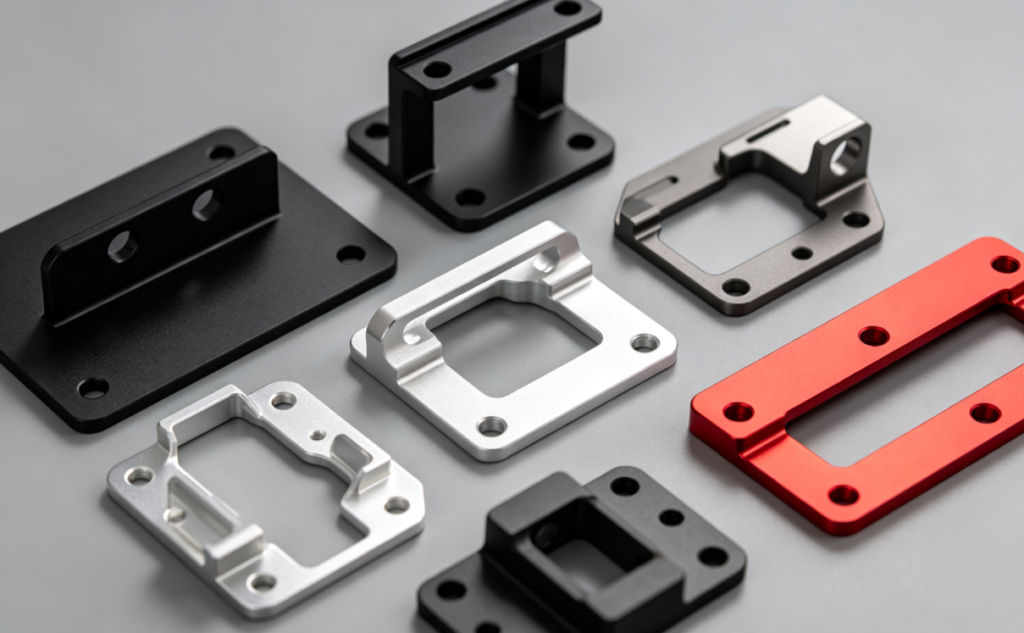
Wait — Doesn’t Aluminum Resist Corrosion Already?
Great question. And the answer is: sort of.
Aluminum does form a natural oxide layer when exposed to air. That’s why it doesn’t rust like steel. That thin oxide layer protects the metal underneath.
But protects is doing a lot of work here.
The Problem with Natural Oxide
- It’s thin — like, really thin (nanometers thick)
- It’s soft — scratches easily, exposing fresh aluminum
- It’s porous — moisture and chemicals can get through
- It’s uneven — some areas corrode faster than others
- It doesn’t look great — chalky, dull, uneven appearance
For indoor parts? The natural oxide layer is usually fine. For outdoor parts? Not even close.
Throw in salt spray (coastal areas), road salt (winter climates), acid rain, or high humidity, and that natural oxide layer doesn’t stand a chance.
You need something better. You need a real coating.
The 4 Main Coating Types (And When to Use Each)
There are dozens of coating options, but these four cover 95% of outdoor aluminum applications.
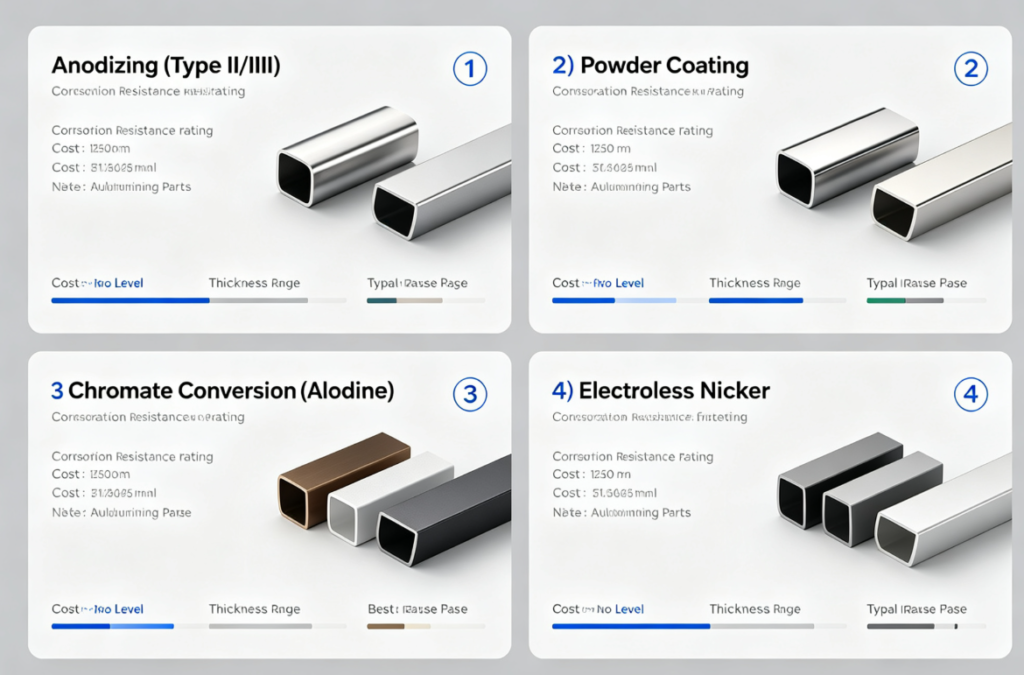
1. Anodizing — The Most Popular Choice
Anodizing is the go-to for outdoor aluminum parts. And for good reason.
How it works: It’s an electrochemical process that grows the oxide layer from the aluminum itself. Unlike paint or plating, it’s part of the metal — it can’t chip or peel.
The good:
- Excellent corrosion resistance — lasts 10-20+ years outdoors
- Hard surface — much more scratch-resistant than natural oxide
- Wide color options — black, clear, silver, red, blue, gold, and more
- Good wear resistance — stands up to handling and abrasion
- Cost-effective — not the cheapest, but great value for the performance
- Consistent appearance — parts look uniform and professional
The not-so-good:
- Adds thickness — Type II adds ~0.005-0.025mm per side, Type III adds more
- Can affect tolerances — tight fits need to account for coating thickness
- Limited color matching — colors are consistent within a batch, but batch-to-batch can vary
- Not a perfect electrical insulator — good, but not as good as powder coating
Best for: Outdoor enclosures, brackets, handles, marine parts, architectural components — basically anything that needs good corrosion resistance and a clean, professional look.
Types of anodizing:
- Type II (sulfuric acid) — standard, most common, 5-25μm thick
- Type III (hard coat) — thicker, harder, more wear-resistant, 25-100μm thick
- Type I (chromic acid) — thinner, used for aerospace, less common
2. Powder Coating — The Tough, Colorful Option
Powder coating is basically dry paint applied electrostatically and then baked on. It’s thick, tough, and comes in every color imaginable.
How it works: Fine powder particles are sprayed onto the part (they stick because of static electricity), then the part goes into an oven where the powder melts and cures into a hard, durable finish.
The good:
- Thick, durable coating — 50-150μm, much thicker than anodizing
- Excellent corrosion resistance — especially with proper pretreatment
- Unlimited color options — any color, any finish (gloss, matte, textured)
- Good electrical insulation — if you need isolation
- Hides surface imperfections — minor machining marks disappear
- Great value — especially for larger parts
The not-so-good:
- Can chip or scratch — unlike anodizing, it’s a coating on top of the metal
- Affects tolerances more — thicker coating means more dimensional change
- Not as wear-resistant — high-abrasion areas can wear through
- Masking is tricky — if you need bare areas (for electrical contact, for example), it adds cost
Best for: Outdoor enclosures, equipment housings, furniture, automotive parts — anything that needs great corrosion resistance and a specific color or finish.
3. Chromate Conversion (Alodine / Chem Film) — The Thin, Functional Option
Chromate conversion coating (often called Alodine or chem film) is a thin chemical coating that’s great for corrosion protection and paint adhesion.
How it works: The part is dipped in a chemical solution (usually containing chromates or similar compounds), which reacts with the aluminum surface to form a thin, protective layer.
The good:
- Very thin — 0.5-5μm, barely affects dimensions
- Good corrosion resistance — not as good as anodizing, but better than bare aluminum
- Excellent paint base — paint adheres way better to chromate than bare aluminum
- Maintains electrical conductivity — if you need grounding or electrical contact
- Fast and cheap — one of the least expensive coating options
- Conforms to complex shapes — gets everywhere, no coverage issues
The not-so-good:
- Not as durable — scratches and wears more easily than anodizing
- Limited appearance — usually clear, iridescent yellow, or olive drab
- Environmental concerns — hexavalent chromium is toxic (trivalent is better but still regulated)
- Not as long-lasting — good for 1-5 years outdoors, depending on environment
Best for: Parts that need a corrosion base for painting, electrical components that need conductivity, aerospace parts, or as a primer under powder coating.
4. Electroless Nickel — The Hard, Wear-Resistant Option
Electroless nickel plating deposits a uniform layer of nickel-phosphorus alloy onto the aluminum surface. It’s hard, wear-resistant, and provides good corrosion protection.
How it works: Unlike electroplating, which uses electricity, electroless plating uses a chemical reaction. The part is dipped in a nickel solution, and the nickel deposits evenly over the entire surface — including holes, cavities, and complex geometries.
The good:
- Uniform coverage — gets everywhere, even in deep holes and threads
- Hard, wear-resistant surface — much harder than anodizing
- Good corrosion resistance — especially with a mid-phosphorus or high-phosphorus formulation
- Solderable — if you need to solder to the part
- Magnetic options — low-phosphorus is magnetic, high-phosphorus is non-magnetic
- Consistent thickness — very predictable coating thickness
The not-so-good:
- More expensive — usually costs more than anodizing or powder coating
- Can delaminate — if pretreatment isn’t perfect, it can peel
- Limited color options — basically just nickel color (silver-gray)
- Environmental considerations — nickel is a regulated material
- Requires good adhesion prep — zincate pretreatment is critical for aluminum
Best for: Parts that need both corrosion resistance and wear resistance, complex geometries with deep holes, valve components, or parts that need soldering.
How to Pick the Right Coating
With all these options, how do you choose? Ask yourself these questions:
1: How harsh is the environment?
- Mild (indoor/sheltered): Natural oxide or chromate conversion
- Moderate (typical outdoor): Type II anodizing or powder coating
- Harsh (coastal/industrial/winter salt): Hard anodizing, powder coating with proper prep, or electroless nickel
2: Does it need to look good?
- Yes, appearance matters: Anodizing (clean, metallic look) or powder coating (any color/finish)
- No, function only: Chromate conversion or electroless nickel
3: What about tolerances?
- Tight tolerances (<0.05mm): Chromate conversion (thinnest) or anodizing with controlled thickness
- Moderate tolerances: Anodizing works fine
- Loose tolerances: Powder coating is okay, just account for the thickness
4: Does it need to conduct electricity?
- Yes, needs conductivity: Chromate conversion (best) or bare aluminum
- Some conductivity is okay: Anodizing is semi-conductive (thinner = more conductive)
- No, needs insulation: Powder coating or hard anodizing
5: What’s your budget?
- Lowest cost: Chromate conversion
- Best value: Type II anodizing
- Premium performance: Hard anodizing, powder coating, or electroless nickel
The #1 Mistake That Ruins Coatings (And Everyone Does It)
You can pay for the best coating in the world, but if the pretreatment is bad, it won’t last.
Pretreatment is everything. And most people skip it or cheap out.
What Proper Pretreatment Includes:
- Cleaning — remove all oil, grease, and machining debris
- Etching — remove the natural oxide layer and create a uniform surface
- Deoxidizing / desmutting — remove smut and prepare the surface
- Conversion coating (optional but recommended) — primer layer for better adhesion
Skip any of these steps, and your coating will fail. It might look fine when it leaves the shop, but six months later? Bubbling, peeling, corrosion under the coating.
We’ve seen it a hundred times. A customer pays for powder coating, but the shop skips proper pretreatment to save money. Result: the coating fails, and the customer blames the coating type. But it’s not the coating — it’s the prep.
Pro tip: Always ask your coating shop about their pretreatment process. If they can’t tell you exactly what they do, find another shop.
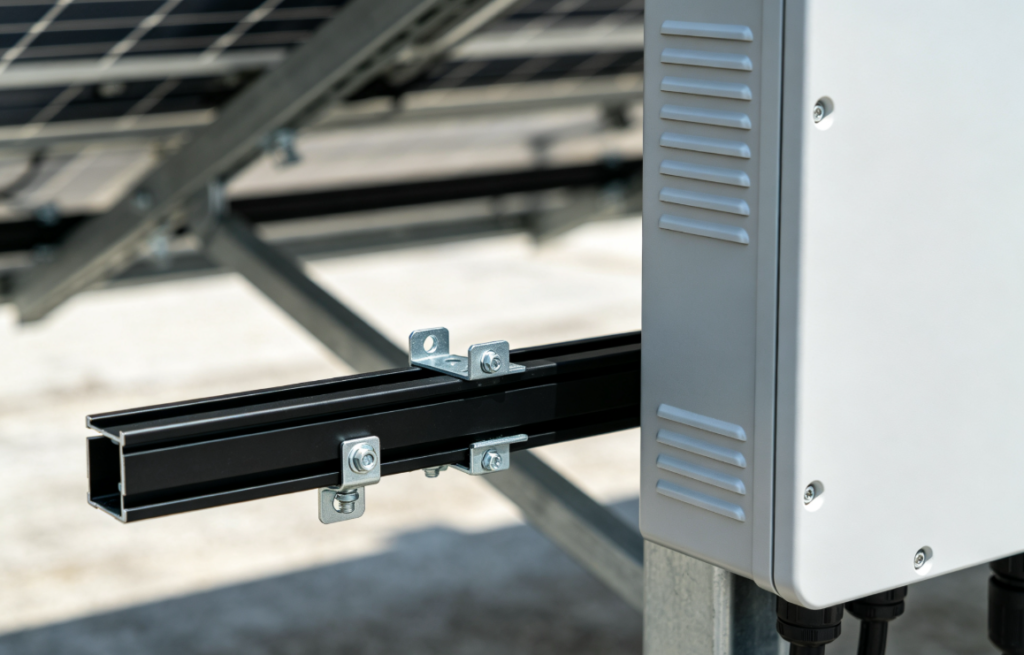
Real-World Example: Solar Panel Mounting Brackets
A solar equipment company came to us with a problem. Their aluminum mounting brackets were corroding after just 18 months in coastal Florida. They were using a cheap clear anodize, and it wasn’t holding up.
Their situation:
- Material: 6061-T6 aluminum brackets
- Environment: Coastal Florida (salt air, high humidity, UV)
- Current coating: Clear Type II anodizing (cheap, thin)
- Failure rate: 30% showing corrosion after 18 months
- Warranty claims were killing their profit margin
Our recommendation:
- Switch to Type II black anodizing with proper seal
- Add a chromate conversion pretreatment step
- Specify MIL-A-8625 Type II, Class 2 for quality assurance
The results:
- 5-year salt spray testing passed with zero red rust (vs. failing at 500 hours before)
- Field performance: After 3 years, zero corrosion on test brackets
- Warranty claims dropped 95%
- Cost increase: Only 15% more per part
- Net savings: $120,000 per year in warranty and replacement costs
They paid a little more upfront, but saved a fortune on the back end. That’s the power of specifying the right coating from the start.
The Zorapid Coating Advantage
Lots of machine shops outsource coating and cross their fingers. We’re different.
We Manage the Whole Process
From machining to coating to final inspection, we handle everything. You don’t have to coordinate with multiple vendors. One PO, one point of contact, one quality guarantee.
We Know How Coatings Affect Dimensions
We understand coating thickness and how it affects tolerances. machine parts so that after coating, they’re right in spec. No surprises, no rework.
We Do Final Inspection After Coating
We don’t just ship parts after machining.Inspect them again after coating to make sure everything is still within tolerance and the coating quality is up to standard.
Full Material & Process Traceability
- ISO 9001:2015 certified
- Full material traceability
- Coating process documentation
- Salt spray test data available
- RoHS and REACH compliant options
FAQ
Which coating is best for outdoor aluminum parts?
It depends on the environment and requirements, but for most outdoor applications, Type II anodizing is the best balance of cost, performance, and appearance. For harsh coastal or industrial environments, go with hard anodizing (Type III) or powder coating with proper pretreatment. For parts that need electrical conductivity, chromate conversion is the way to go.
How long does anodizing last outdoors?
Good quality Type II anodizing with proper sealing typically lasts 10-20 years in moderate outdoor environments. Hard anodizing (Type III) can last even longer — 20+ years. Actual lifespan depends on the environment: coastal salt air and industrial pollution will shorten life, while dry, mild climates will extend it.
Does anodizing add thickness? Do I need to adjust my tolerances?
Yes, anodizing adds thickness. Type II anodizing typically adds 5-25μm (0.005-0.025mm) per side. Hard anodizing (Type III) adds 25-100μm per side. For most general tolerances (±0.1mm or looser), this doesn’t matter. For tight tolerances or press fits, you need to account for coating thickness — we can help you calculate the right machining dimensions.
Can I coat only certain areas of a part?
Yes, with masking. We can mask off areas that need to stay bare — for example, electrical contact surfaces, threaded holes, or precision mating features. Masking adds some cost, but it’s standard practice. Just tell us which areas need to stay uncoated, and we’ll handle it.
What’s the difference between anodizing and powder coating?
Anodizing is a chemical process that grows an oxide layer from the aluminum itself — it’s part of the metal, so it can’t chip or peel. It’s thinner (5-100μm) and has a metallic appearance. Powder coating is a paint-like coating applied to the surface — it’s thicker (50-150μm), comes in any color, and can chip if scratched. Anodizing is more durable for wear, powder coating offers better corrosion resistance when properly applied.
Is chromate conversion coating RoHS compliant?
It depends on the type. Hexavalent chromium (Cr VI) coatings are NOT RoHS compliant and are restricted in many applications. Trivalent chromium (Cr III) coatings are RoHS compliant and are the standard now. We always specify trivalent chromate conversion unless you specifically ask for hexavalent (and have a valid exemption).
Can you match a specific color for anodizing or powder coating?
For powder coating: yes, basically any color is possible — Pantone, RAL, custom matches. For anodizing: it’s trickier. Anodizing colors are more limited and can vary batch to batch. Black, clear, and silver are very consistent. Colors like red, blue, and gold are possible but may have slight variations. If exact color matching is critical, powder coating is usually the better choice.
What pretreatment is required for good coating adhesion?
For anodizing: cleaning, etching, deoxidizing, then the anodizing process itself, followed by sealing. For powder coating: cleaning, conversion coating (chromate or phosphate), then powder application and curing.Electroless nickel: cleaning, acid activation, zincate strike (critical for aluminum), then plating. Skipping any of these steps will cause adhesion problems and premature failure.
Can I thread holes after coating?
It’s better to mask threads before coating, but sometimes you need to tap after coating (for example, if the coating thickness would affect thread fit). We can do either — just let us know your preference. If you’re tapping after coating, make sure to seal the exposed threads to prevent corrosion.
What salt spray rating should I look for?
It depends on your application. For mild indoor use: 24-100 hours might be enough.typical outdoor use: 500-1000 hours. For harsh coastal/industrial: 1000-3000+ hours. Good Type II anodizing typically passes 500-1000 hours. Hard anodizing or powder coating with proper prep can pass 2000+ hours. We can provide salt spray test data for any coating type.
How much do coatings add to the cost?
Rough guide (relative to machining cost):
- Chromate conversion: 5-15%
- Type II anodizing: 10-25%
- Hard anodizing (Type III): 25-50%
- Powder coating: 15-35%
- Electroless nickel: 30-60%
Actual cost depends on part size, complexity, masking requirements, and quantity. Small parts with lots of masking can be more expensive relative to the machining cost.
How do I get started with coated aluminum parts?
Send us your drawings and tell us about your application — where will the parts be used, what environment, any appearance requirements, and quantity. We’ll recommend the best coating option, give you a complete quote (machining + coating), and tell you the lead time. We handle everything — you get finished, coated parts ready to use.
Ready to Get Coating Right the First Time?
If you’re tired of:
- Aluminum parts that corrode after a year outdoors
- Coating shops that skip pretreatment
- Surprises with coating thickness and tolerances
- Coordinating with multiple vendors
Then let’s talk.
We don’t just machine aluminum parts. deliver complete, coated parts that will last in the real world. We help you pick the right coating, machine parts to account for coating thickness, and manage the whole process from start to finish.
Send us your drawings and tell us about your application. We’ll recommend the best coating option, give you a complete quote, and tell you exactly what to expect.
No fluff. No coating failures. Just parts that last.
Zorapid — Precision Machined Parts, Coated Right
3000㎡ Smart Manufacturing Center | Zhongshan, Guangdong