Published: Zorapid.Ltd
If you run an aerospace machine shop, you already know this truth: Inconel 625 builds the most critical jet engine, exhaust, and pressure boundary parts. This nickel-based superalloy holds full tensile strength at extreme heat, resists chloride corrosion, and passes every NADCAP and AS9100 audit thrown its way.
But here’s the catch. The exact material properties that make Inconel 625 irreplaceable for aerospace also turn it into one of the hardest metals to machine reliably.
Most small-to-mid CNC shops burn through inserts in minutes, fight endless chatter, scrap high-value forgings, and blow tight ±0.005mm tolerances before the first batch ships. One tiny mistake creates work-hardened skin on the part, ruins surface finish, and adds weeks of rework on aerospace orders with zero room for error.
At Zorapid, we machine hundreds of Inconel 625 aerospace parts monthly on five-axis mills and turn-mill centers. We’ve fought every machining headache this alloy throws at manufacturers. Today we break down every core challenge of machining Inconel 625 for aerospace hardware, plus the practical fixes we use to cut scrap, extend tool life, and hit aerospace-grade surface specs consistently.
What Makes Inconel 625 So Hard to Machine?
First, let’s skip generic material descriptions. Inconel 625 is a solid-solution strengthened UNS N06625 alloy loaded with nickel, chromium, molybdenum and niobium. No precipitation hardening phase, so it stays tough and ductile even in annealed stock. Four physical traits create the full list of machining pain points:
- Ultra-low thermal conductivity (only 1/3 of carbon steel)
- Severe instant work hardening under cutting pressure
- High chemical affinity that sticks material directly to cutting edges
- Extreme hot strength that keeps cutting forces high even at 1000°C+ cutting zone temperatures
Every single machining issue you face traces back to these four material traits. Let’s walk through each challenge one by one, specifically for aerospace component production.
Explosive Work Hardening
This is the biggest pain point for anyone running Inconel 625 parts.
Even light rubbing contact from a slow feed or dull tool hardens the workpiece surface 2–3 times harder than the base material in an instant. Once that hardened layer forms, your next cutting pass grinds into hardened metal instead of cleanly shearing fresh stock.
What Goes Wrong On Aerospace Jobs
- Light finishing passes rub instead of cutting, creating a hard skin
- Tool dwells inside deep seal grooves and bores (common on engine housings)
- Slow spindle speeds paired with low feed rates worsen surface hardening The result? Subsurface tearing, smearing, inconsistent dimensional drift, and premature edge chipping. For aerospace parts with strict fatigue life requirements, work-hardened surface layers turn a conforming part into scrap immediately. Aerospace OEMs reject parts with deformed surface microstructure every single day.
Zorapid Field Fix (Shop-Proven)
We strictly follow the cut, don’t rub rule:
- Keep feed rates high enough to slice fully beneath the hardened layer from the previous pass
- Never let the cutting edge pause inside deep cavities or sharp internal radii
- Complete 95% of stock removal while the alloy remains in the soft annealed state before heat treatment
Trapped Cutting Heat & Catastrophic Tool Wear
625 does not conduct heat away from the cut. Almost all cutting heat locks into the tool tip instead of flowing into the chip or workpiece. Temperatures at the rake face regularly hit 1100–1200°C during milling and turning.
Common Aerospace Machining Failures
- Carbide inserts suffer rapid crater wear and edge deformation after just 15–30 minutes of runtime
- Thermal stress cracks tool corners mid-finish pass
- Heat penetrates the part and creates thermal expansion, breaking tight linear and circular tolerances on complex aerospace geometries For high-mix low-volume aerospace production, frequent tool swaps blow up cycle times and drive up per-part costs drastically. Many job shops see 3–5x higher tooling costs running Inconel 625 compared to 316L stainless steel.
Our High-Pressure Coolant Solution
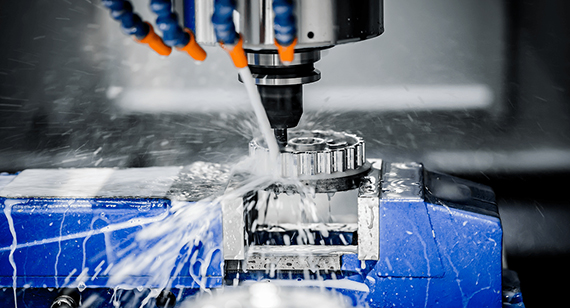
MQL mist will not cut it for critical aerospace components. We run 70+ bar high-pressure through-tool coolant aimed directly at the tool-chip interface to flush trapped heat away fast. Flood cooling alone cannot reach the cutting zone on deep 3D contoured aerospace parts made from Inconel 625. Without targeted coolant, no coating will extend insert life long enough for consistent production runs.
Built-Up Edge (BUE) & Poor Aerospace Surface Finish
Inconel 625 is chemically sticky. Hot nickel alloy welds itself to the carbide cutting edge and forms built-up edge (BUE) within minutes of starting a cut.
The Damage For Aerospace Hardware
- BUE tears material instead of shearing it clean, leaving smearing, torn grain, and uneven surface roughness
- Ra values jump far above the 0.2μm–0.4μm finish required for aerospace sealing surfaces
- Chunks of BUE break off randomly, leaving unexpected dimensional gouges on turbine and pressure components Stringy, unbroken long chips make this problem even worse. Continuous chips wrap around end mills, jam tool holders, and scratch finished surfaces on complex five-axis aerospace geometries. Many lights-out CNC runs crash entirely due to tangled Inconel 625 chips.
Practical Countermeasures We Deploy
- Only use sharp positive-rake PVD AlTiN coated carbide inserts; avoid negative rake tooling for finishing
- Use chip-breaker geometries designed for gummy superalloys to break long stringy chips into small segmented pieces
- Maintain constant chip load. Variable feed speeds worsen adhesion and BUE buildup dramatically on contoured aerospace parts.
Chatter, Vibration & Dimensional Instability
625 demands extremely high cutting forces. Weak fixturing, light machine rigidity, long tool overhangs, and thin-wall aerospace geometries create violent chatter vibration.
Aerospace Inconel 625 parts often feature thin-wall structures, deep bores, and slender shaft features. These thin sections flex under heavy cutting loads.
Key Problems Seen In Job Shops
- Visible chatter waves across finished sealing faces
- Wall deflection creates inconsistent wall thickness outside GD&T tolerance windows
- Vibration accelerates micro-chipping on tool edges Even small amplitude vibration ruins the fatigue performance of flight-critical components. No amount of post-grinding can fix chatter-induced surface damage on aerospace superalloy parts.
Rigidity Rules We Enforce On All Inconel 625 Runs
- Shorten tool overhang as much as possible; use solid carbide reinforced end mills for deep cavity work
- Build custom vacuum or fixture clamping to eliminate part movement on thin-wall aerospace blanks
- Tune spindle harmonics to avoid resonant chatter on five-axis 3D milling toolpaths
- Use climb milling exclusively for all roughing and finishing cycles to reduce cutting deflection
Tight Aerospace Tolerances & Residual Stress Risk
Aerospace OEMs hold Inconel 625 machined parts to ±0.003mm to ±0.005mm positional tolerances, plus strict control over surface residual stress.
Heat and mechanical cutting force lock tensile stress into the part surface. If left unmanaged, residual stress causes slow warping long after machining finishes—ruining fit during engine assembly. Most generic CNC programs create uneven stress distribution across complex contoured parts.
What Makes This Extra Tricky
- Thermal expansion shifts part size mid-batch if cutting heat is not stabilized
- Uneven stock removal pulls complex aerospace geometries out of true after unclamping
- Post-machining stress relief adds extra lead time to already tight aerospace delivery schedules
Zorapid Process Control
We split stock removal into multiple light finishing passes instead of heavy single cuts. We let the workpiece fully cool between machining operations, then run controlled stress relief before final CMM inspection. This keeps warpage below OEM allowable limits without sacrificing delivery timelines.
All Inconel 625 Machining Challenges In One List
- Instant work hardening from edge rubbing → surface tearing & tool chipping
- Trapped cutting heat → rapid tool failure & thermal dimensional shift
- Built-up nickel adhesion (BUE) → poor Ra finish & surface smearing
- High cutting force + thin-wall geometry → chatter, vibration & wall deflection
- Residual tensile stress → post-machining warpage & tolerance drift
- Stringy unbroken chips → tool jams, surface scratches & lights-out production crashes
Every one of these issues gets amplified when machining complex contoured aerospace components with deep cavities, thin walls and tight sealing features.
How Zorapid Beats These Inconel 625 Machining Hurdles For Aerospace Clients
We specialize exclusively in five-axis CNC and hybrid manufacturing for AS9100-certified aerospace superalloy parts, including Inconel 625 turbine housings, pressure fittings, exhaust components and engine seal hardware.
Here is our proven process stack:
Tooling: AlTiN PVD solid carbide with dedicated superalloy chip breakers; scheduled insert rotation to avoid gradual edge degradation
Cutting parameters: Low SFM + consistent high feed rate to stay below work-hardened layers; strictly controlled constant chip load across all 3D five-axis toolpaths
Cooling: Through-tool high-pressure 75bar coolant focused directly on the shear zone to trap heat and stop BUE Fixturing: Custom rigid workholding engineered for thin-wall Inconel 625 aerospace forgings to eliminate chatter
Process sequencing: Rough machine soft annealed stock → stress relief → light finishing passes → CMM dimensional inspection + surface roughness testing
DFM review upfront: We adjust internal radii, eliminate sharp corners and optimize stock allowance before the first cut to reduce tool wear and scrap risk
We regularly hold Ra ≤ 0.4μm surface finish and hold GD&T tolerances within ±0.005mm consistently for small-batch aerospace Inconel 625 orders without extended lead times.
Final Wrap-Up
Inconel 625 will remain the go-to superalloy for high-temperature, corrosion-resistant aerospace components for decades to come. Its unmatched mechanical performance comes with unavoidable machining challenges: work hardening, trapped heat, BUE adhesion, chatter vibration, and residual stress warping.
You cannot beat these problems by simply slowing down spindle speed. Reliable Inconel 625 aerospace production requires a fully optimized system: rigid machine setup, superalloy-specific tooling, targeted high-pressure cooling, carefully balanced feeds/speeds, and structured process sequencing to protect surface integrity and tight tolerances.
If your shop struggles with high tool costs, frequent scrap, or inconsistent finish on Inconel 625 aerospace parts, Zorapid can deliver stable, AS9100-compliant CNC machining for your flight-critical hardware.
Get in touch with our engineering team for a free DFM review and optimized Inconel 625 machining quote for your next aerospace project.
FAQ
Why does Inconel 625 harden immediately after even light contact with cutting tools?
Inconel 625 has extremely high hot tensile strength. Any rubbing action, slow spindle speed or dwell time creates cold work on the surface. The top layer can become 2–3 times harder than the base metal in a split second. This hardened skin destroys cutting edges and ruins the fatigue integrity required for aerospace flight parts. Always keep a steady chip load and avoid letting the tool drag across the workpiece.
Is flood coolant enough for machining Inconel 625 engine components?
No. Flood cooling only hits the outside of the cut. Most heat gets trapped between the tool tip and chip. For aerospace-grade results, you need through-tool high-pressure coolant (70–80 bar) shooting directly into the shear zone. MQL mist works only for light finishing, and it cannot prevent rapid crater wear on carbide inserts during heavy stock removal.
What is the biggest cause of built-up edge (BUE) when cutting Inconel 625?
Strong chemical affinity between nickel alloy and carbide. Hot workpiece material welds itself to the cutting edge. Low feed rates and dull tooling make this problem far worse. At Zorapid, we use sharp positive-rake AlTiN-coated carbide with superalloy chip breakers to break long chips and stop BUE from forming on sealing surfaces.
How can I stop thin-wall Inconel 625 aerospace parts from chattering and vibrating?
Chatter comes from high cutting force plus weak rigidity. Shorten tool overhang as much as possible, use reinforced solid carbide end mills, and build custom rigid fixtures to clamp thin forgings tightly. We only run climb milling on thin-wall Inconel 625 components to reduce part deflection and eliminate chatter marks on finished surfaces.
Will post-machining warpage always happen on complex Inconel 625 components?
Not if you control residual stress properly. Heavy single passes lock massive tensile stress inside the part. We split roughing and finishing into separate operations, let the blank fully cool between cuts, and add stress relief treatment before final dimension checking. This keeps GD&T tolerances stable long after parts come off the machine.
What cutting speed (SFM) works best for milling Inconel 625 aerospace hardware?
Keep SFM low for nickel superalloys. For solid carbide end mills, we stick to 25–45 SFM with consistent high feed per tooth. Higher spindle speeds spike cutting temperature, speed up tool failure and accelerate work hardening. Slow speed + steady feed is the golden rule for Inconel 625 five-axis milling.
Can we machine Inconel 625 to Ra 0.2μm aerospace surface requirements consistently?
Yes, with the right setup. Sharp coated inserts, high-pressure targeted coolant, light finishing depth of cut and stable fixturing let us reliably hit Ra 0.2–0.4μm on sealing faces. Surface smearing and tearing only happen when BUE or work-hardened layers are not kept under control.
How do you reduce scrap rate on high-value Inconel 625 aerospace forgings?
We start with a DFM analysis before the first cut. We optimize internal radii, remove zero-draft sharp corners, set reasonable stock allowances and split machining sequences properly. Preemptive process tuning eliminates most surface damage and tolerance drift, so expensive raw material rarely goes to scrap.
Can lights-out CNC production run stably on Inconel 625 parts?
It’s possible only if you control chip formation. Long, stringy nickel chips wrap around tools and holders and trigger machine crashes. Chip-breaker tool geometry plus uninterrupted coolant flow breaks chips into small segments. Without proper chip control, unattended runs will fail constantly on Inconel 625 workpieces.
Does Zorapid hold AS9100 certification for Inconel 625 aerospace component manufacturing?
Absolutely. Our five-axis machining and hybrid manufacturing workshop is fully AS9100 certified. We complete full CMM inspection, surface roughness testing and material lot traceability for every batch of Inconel 625 engine, pressure and structural aerospace parts we deliver worldwide.