Published:Zorapid.Ltd
Most first-time buyers get shocked by metal 3D printing quotes.
You submit a simple STEP file, and the price comes in far higher than regular CNC machining.
Nearly every service bureau keeps pricing vague, and hidden charges pop up one after another.
If you work on aerospace brackets, medical implants, or custom tooling, you need full transparency.
At Zorapid, we run industrial SLM metal printing 24/7 for EU and North American OEMs. We split every line item openly, no hidden fees.
Today we break down the full cost structure of custom metal 3D printing.
You will learn exactly where your money goes, which factors push the price up, and how to cut 30% of costs without sacrificing part quality.
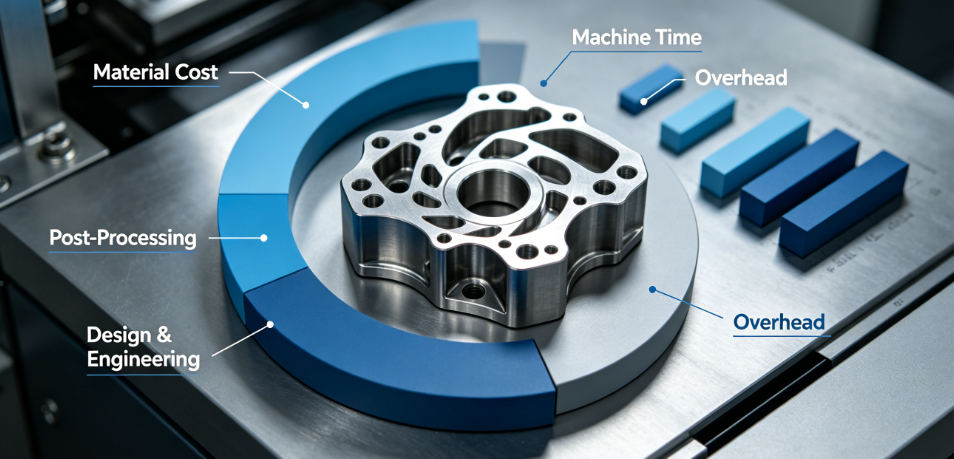
Core Cost Structure
Every custom metal 3D printed part follows the same cost formula.
We use industry-standard LPBF (SLM) pricing for 316L, Ti-6Al-4V, Inconel 718, AlSi10Mg and 17-4PH.
Total Job Cost =
Material Powder + Machine Build Time + Post-Processing + Labor & QC + Overhead & Certification
Typical cost percentage for a single prototype part:
| Cost Item | Percentage of Total Price | Key Variables |
|---|---|---|
| SLM Machine Runtime | 32% – 40% | Build height, layer count, part nesting |
| Metal Powder Material | 20% – 38% | Alloy grade, support volume, powder refresh ratio |
| Post-Processing Operations | 25% – 45% | Support removal, heat treatment, CNC finish, surface finishing |
| Labor, CMM Inspection & Certification | 8% – 15% | ISO test reports, porosity testing, dimensional checks |
| Overhead (argon gas, power, facility) | 5% – 10% | Cleanroom environment, inert gas consumption |
The biggest surprise for most clients: post-processing often costs more than the actual printing itself.
Tall parts, heavy supports, and tight surface specs will blow your budget fast.
Metal Powder Cost
Regular bulk metal bar stock is cheap.
Gas-atomized spherical powder for SLM is not.
Key Facts
- Powder price varies wildly by alloy (2026 global market rates)
- AlSi10Mg: $60 – $110 / KG
- 316L Stainless Steel: $70 – $130 / KG
- 17-4PH Precipitation Hardening Steel: $120 – $190 / KG
- Ti-6Al-4V Grade 5: $320 – $550 / KG
- Inconel 718 Superalloy: $450 – $700 / KG
- You pay for both the part AND the support structures. Supports waste powder and cannot be fully recycled. We add a 15% to 40% material multiplier based on overhang geometry.
- Powder degrades after repeated reuse. For aerospace and medical jobs, we must mix 15% – 30% fresh powder into recycled stock to avoid porosity. This raises material cost for high-spec projects.
Simple Calculation
Material Cost = Part Volume × Density × Powder Price × Support Waste Factor
Machine Runtime
Machine time is the single largest expense on most SLM projects.
Industrial SLM equipment costs $500,000 to $1.5 million, amortized over 5–7 years. This sets the hourly build rate.
Hourly Shop Rate Reference
- Zorapid industrial single-laser SLM: $55 – $70 per machine hour
- European & US service bureaus: $90 – $200 per hour
What Makes Build Time Skyrocket
- Z-axis build height Total printing layers directly depend on part height. A 100 mm tall part takes nearly twice as long as a 50 mm flat part with identical volume.
- Solid infill vs lattice structures Fully solid thick sections add massive laser scanning time. Lattice internal structures cut build time dramatically.
- Multiple contour passes Tight dimensional tolerances require extra laser finishing passes on all outer surfaces.
One critical rule:
Volume does not equal cost. A tall thin part costs far more than a short block with the same weight.
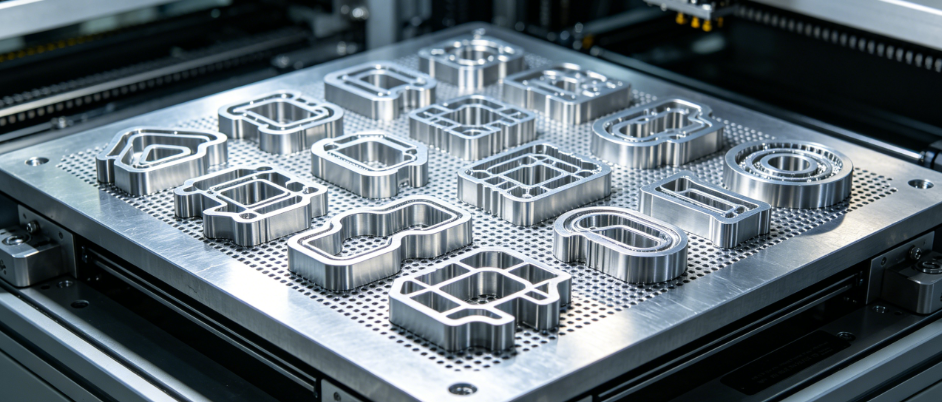
Post-Processing
No part comes out of the SLM chamber ready for end use.
This stage frequently makes up 40% of your total invoice. We break down every standard operation with clear pricing logic.
1. Support Removal
- Aluminum & stainless steel: Band saw cutting, low cost
- Titanium & Inconel: Wire EDM cutting, slow and expensive Every small overhang adds more supports and more labor hours.
2. Stress Relief Heat Treatment (Mandatory for All Metals)
3D printed parts hold heavy internal residual stress.
Without oven tempering, parts warp after machining. Standard batch heat treatment carries a fixed batch fee regardless of part count.
3. Secondary CNC Machining
As-printed surface roughness sits around Ra 6 – 15 μm.
If you need sealing faces, threaded holes or tight ±0.005 mm tolerances, you must mill the critical surfaces. This adds extra 5-axis CNC time.
4. Optional Premium Processes (These add big costs)
- HIP Hot Isostatic Pressing: Closes internal porosity, $300 – $800 per batch (required for aerospace load-bearing parts)
- Bead blasting & passivation
- Mirror polishing
- Ultrasonic deep cleaning for medical biocompatible components
Real Example
A small Ti-6Al-4V implant may only take 6 hours to print.
Support removal + heat treatment + finish machining can add another 8 working hours of labor.
QC, Testing & Certification
Prototype jobs only need basic visual inspection.
Aerospace, medical and semiconductor parts demand full documentation, and this adds measurable cost:
- Dimensional CMM inspection with full inspection reports
- CT scanning to check internal porosity
- Material mill test certificates (MTR) for powder batches
- ISO 13485 / AS9100 compliant process records
If you skip third-party testing, you cut 8% – 15% off your total cost.
Zorapid separates standard visual QC and premium metrology testing on every quote, so you only pay for what you actually need.
Overhead & Hidden Miscellaneous Fees
Most shops roll these costs into machine rates without listing them separately:
- Argon or nitrogen inert gas consumption inside the build chamber
- Continuous power for laser and thermal control
- Cleanroom environmental control for reactive titanium powder
- Powder sieving, filtering and contamination control
- Packaging and international DHL / FedEx air shipping
- Custom wooden crates for fragile complex lattice parts
These small add-ons usually make up 5% – 10% of the final bill.
Real-World Zorapid Quoting Case Study
Project: One Ti-6Al-4V aerospace lightweight bracket (single prototype)
Part volume: 22 cm³ | Alloy: Ti-6Al-4V Grade 5 | Requirement: Stress relief + wire EDM support removal + basic CMM check
- Ti powder material (including 35% support waste): $198
- SLM machine build time (7.5 hours @ $62/hr): $465
- Post-processing (EDM + heat treatment + bead blast): $320
- CMM dimensional inspection + material certs: $115
- Gas, power & packaging overhead: $72
Subtotal: $1,170
If you nest 4 identical brackets into one build plate:
Machine time and heat treatment batch cost get shared across all 4 pieces.
Per-unit cost drops down to $745 each — a 36% cost reduction per part.
This is why batch nesting is our top cost-saving tip for clients with multiple custom parts.
6 Practical Ways to Cut Custom Metal 3D Printing Cost
- Minimize Z-height during part orientation Flat lay the part on the build plate to cut layer count and laser time. This alone can slash build cost by 25%.
- Eliminate unnecessary supports with DFM design Keep all overhang angles above 45 degrees. Support-free geometry removes both powder waste and EDM labor cost.
- Use lattice structures inside solid bulk sections Topology optimization reduces material weight, powder usage and total print time.
- Nest multiple parts into a single build Amortize setup, heat treatment and overhead across multiple components.
- Only machine critical mating surfaces Leave non-critical outer surfaces in as-printed condition instead of full CNC finishing.
- Choose alloy wisely Use AlSi10Mg or 316L for prototypes. Reserve expensive titanium and Inconel only for high-temperature end-use parts.
Zorapid provides free DFM analysis before we lock your build file. We adjust orientation and reduce supports to bring down your final quote automatically.
When Metal 3D Printing Beats CNC on Total Cost
For simple block-shaped parts, CNC machining will always be cheaper.
But for organic lattices, internal conformal cooling channels, thin-wall complex manifolds and impossible undercuts, 3D printing eliminates expensive custom fixtures and multi-setup 5-axis work.
On low-volume complex geometries, additive manufacturing often delivers lower total lead time and lower total project cost.
We regularly combine SLM printing + 5-axis finish machining as a hybrid manufacturing workflow to balance price and precision.
If you send us your STEP file, we will send you a fully itemized, line-by-line quote with zero hidden charges. We list powder cost, machine hours and post-processing separately for full transparency.
FAQ
Why is post-processing often more expensive than the SLM printing process itself?
Printing only takes machine runtime. Removing solid metal supports needs wire EDM, every batch requires heat treatment to stop warpage, and precision finishing adds multiple manual and CNC steps. For most small prototypes, post-finishing accounts for 35%–45% of the full cost.
Does the service bureau charge for unused leftover powder?
No. You only pay for material fused into the part plus support structures. We recycle clean powder, but we factor in the 15%–30% fresh powder refresh rate required to keep porosity low for industrial-grade components.
Is HIP treatment always required for metal 3D printed parts?
Not for prototypes. HIP is only mandatory for load-bearing aerospace parts where zero internal porosity is required. We leave HIP as an optional line item on every quote to avoid overcharging basic projects.
How much cheaper is batch nesting compared to printing one single part?
When you fill one build plate with multiple components, fixed costs like oven batch fees, build setup and argon gas get shared evenly. Most clients cut per-unit cost by 30%–40% with proper nesting.
Why do US/EU AM bureaus have much higher hourly machine rates than Zorapid?
Local labor, facility rent and machine depreciation push Western shop rates up to $90–200/hour. Our industrial SLM workshop keeps stable machine-hour pricing while maintaining AS-certified powder control and consistent part density.
Can you separate printing and post-processing into two separate line items on the quotation?
Yes. All Zorapid formal quotes split powder cost, machine hours, support removal, heat treatment and CNC finishing into individual items. There are no bundled hidden charges.
Does part height affect pricing more than total material volume?
Absolutely. Printing time is based on layer count, which directly follows Z-height. A tall slender part with low material volume can cost far more than a short, dense block with the same total weight.