Published:Zorapid.Ltd
If you’ve ever requested CNC quotes for 10 pieces and then 1,000 pieces of the same part, you’ve seen the price gap firsthand.
The per-unit cost can drop by 60% or more — even with identical material, tolerance and surface finish requirements.
Most buyers never fully understand where this price difference comes from.
Suppliers rarely break down fixed costs vs variable costs, so you end up overpaying for small runs or overstocking inventory just to hit a bulk price.
At Zorapid, we run low-volume prototype batches and lights-out mass CNC production for aerospace, medical and automotive OEMs worldwide.
Today we lay out every cost gap between small batch and mass CNC production, share real quotation data, and show you how to balance price, lead time and inventory risk.
Core Principle: Fixed Cost Amortization Makes All The Difference
Let’s start with the most basic CNC costing rule.
Total CNC cost = Fixed one-time expenses + Variable per-part expenses
Fixed Costs (Same for 1 piece or 10,000 pieces)
- CAM programming & post-processing debugging
- Machine setup, tool loading and coordinate calibration
- Custom fixture building & first article inspection (FAI)
- CMM first-article testing, material certification and process paperwork
These costs do not change no matter how many parts you cut after setup.
Variable Costs (Rise directly with part quantity)
- Raw material blocks or bar stock
- Cycle time for cutting each individual part
- Tool wear, coolant and labor for repeat runs
- 100% full inspection for small runs vs sampling SPC inspection for mass orders
The gap happens because:
Small batches spread fixed overhead across very few units.
Mass production spreads the same fixed overhead across thousands of pieces, making setup costs nearly disappear from per-unit pricing.
Full Line-Item Cost Comparison
We use a real aluminum 6061-T6 aerospace bracket as the test part, with ±0.005 mm tolerance and Ra 0.8 μm finish.
Small batch: 25 pieces
Mass production: 2,000 pieces
| Cost Category | Small Batch (25 pcs) | Mass Production (2,000 pcs) | Main Cause of Price Gap |
|---|---|---|---|
| Programming + Machine Setup (Fixed NRE) | $680 total = $27.2 per unit | $680 total = $0.34 per unit | Fixed overhead spread across far more parts |
| Fixturing Cost | Standard vise, no custom tooling | Dedicated multi-part jigs + pallet fixtures | Mass production invests in repeatability to cut cycle time |
| Raw Material Cost | Small stock cuts, no bulk discount | Full bar bulk purchasing, 22% material discount | Small orders hit minimum stock charges |
| Machining Cycle Time Per Piece | Manual operation, frequent pause & check | Lights-out auto feed, continuous running | Mass runs eliminate idle machine time |
| Quality Inspection | 100% dimension check on every part | SPC sampling, only critical dimensions logged | Full inspection labor vanishes in high volume |
| Post-Processing Deburr & Finish | Manual hand finishing | Batch tumbling & automated deburr | Manual labor cost drops drastically |
| Overhead & Documentation | Full ISO test reports for every piece | Batch-level certification only | Less paperwork per finished unit |
Final per-unit price result:
- Small batch 25 pcs: $48.60 each
- Mass production 2,000 pcs: $16.30 each Total per-unit cost reduction: 66%
This is the typical gap you will see on aluminum, stainless steel and titanium CNC parts across most precision machine shops.
5 Major Hidden Cost Differences Most Buyers Overlook
1. Fixture Investment Strategy
Small batch work uses standard vises, soft jaws and quick-clamp setups.
No custom tooling, no extra jig cost. The tradeoff: longer per-part cycle time.
For mass production, we build dedicated multi-cavity fixtures that hold 6–8 parts in one clamping.
One machine run finishes multiple parts at once. Cycle time per piece drops by 40–60%.
The fixture cost is high upfront, but it pays for itself after a few hundred units.
2. Raw Material Bulk Pricing
When you order 25 aluminum blocks, you pay cut charges and small-quantity stock premiums.
When ordering thousands of pieces, we buy full-length bar stock directly from mills.
Material cost alone falls by 15–30% for 6061, 7075, 316L and Ti-6Al-4V bar stock.
3. Machine Operation Mode: Manual VS Lights-Out Automation
Small batch runs require constant operator supervision.
Machines stop frequently for measuring, adjusting tools and re-clamping parts. Labor cost stays high.
Mass production runs use bar feeders, pallet changers and automatic tool changers.
Machines run overnight without operators. Unattended production slashes hourly labor expense significantly.
4. Quality Control Labor Gap
Small batch orders require 100% CMM inspection on every component to avoid scrap on low-quantity runs.
For mass orders, we switch to statistical sampling (SPC). We only test a small percentage of parts instead of every single unit.
Inspection labor becomes a tiny fraction of total cost.
5. Rework & Scrap Risk
With only 20–30 pieces in a batch, even 2 rejected parts create massive percentage scrap loss.
Shops build extra buffer time and charge a risk premium.
In high-volume runs, small scrap percentages barely affect total cost, so we can lower the risk surcharge entirely.
How Batch Size Changes The Main Cost Driver
- 1–50 units (Prototype small batch) Fixed setup cost = 70%–85% of the total invoice. Programming, fixturing and first-article testing dominate your price. Material and cutting time are minor costs.
- 50–300 units (Medium low volume) Fixed overhead gets mostly amortized. Now per-piece cycle time and raw material become the main cost drivers.
- 1,000+ units (Mass CNC production) Fixed NRE becomes less than 5% of unit cost. Material price, cycle time and tool wear set the final price tag. At this stage, CNC may even compete with casting or molding for medium-complex metal parts.
Zorapid Real-World Case Study
Project: Stainless steel 17-4PH valve component
Tolerance: ±0.006 mm | Finish: Ra 0.4 μm
Order A: Small batch — 30 pieces
- Programming + setup + FAI inspection: $750
- Standard vise clamping, manual operation
- 100% CMM inspection on all 30 parts
- Small-quantity bar stock with cutting fees
Unit price: $52.80
Order B: Mass run — 1,500 pieces of the exact same CAD file
- Same one-time setup cost of $750 (spread thin across all parts)
- Build 4-part dedicated fixture, install automatic bar feeder
- Switch to SPC sampling inspection
- Bulk mill bar stock with 24% material discount
Unit price: $17.95
Key Result
Consolidating multiple small orders into one large batch cut per-unit cost by 66%.
If you split 1,500 pieces into 5 separate small orders of 300 each, you pay the setup fee 5 times, and the unit cost jumps back up to $39+ per piece.
Critical tip: Avoid splitting identical parts into multiple small purchase orders if you can schedule production in one single run. You avoid repeated setup charges entirely.
Tradeoffs Between Small Batch & Mass CNC
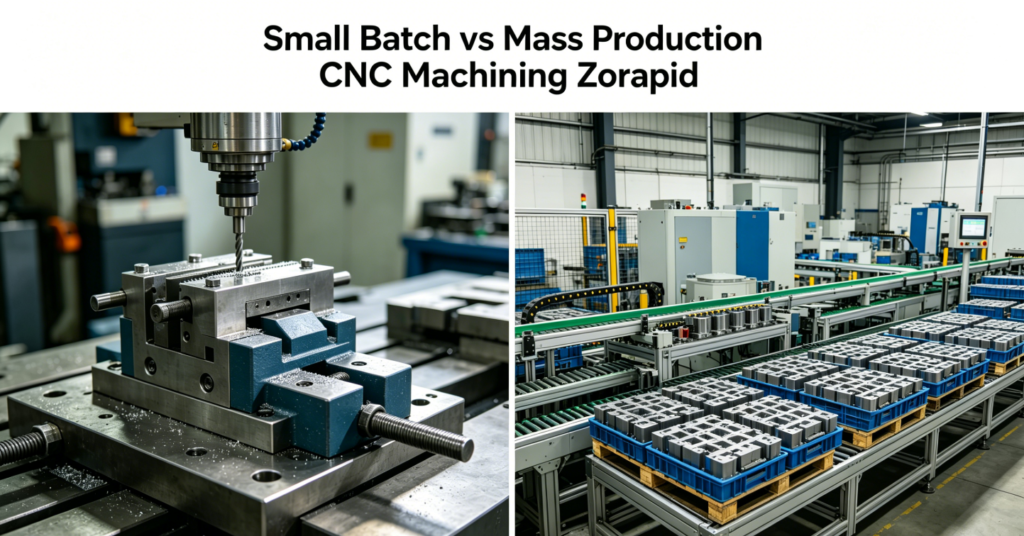
Small Batch CNC (1–200 pcs)
No custom fixture investment
Quick design revision without high tooling loss
Short lead time (5–12 working days)
Zero excess inventory waste
High per-unit cost
Limited automation options
Best for: R&D prototypes, medical pre-production validation, low-volume aerospace spare parts.
Mass CNC Production (1,000+ pcs)
Lowest possible per-unit cost
Lights-out continuous production
Stable repeatability with SPC quality control
Bulk material discounts
Higher upfront fixture cost
Longer lead time (25–40 days)
Risk of overstocking finished inventory
Best for: EV structural parts, consumer hardware, high-volume industrial fittings.
Hybrid Solution We Recommend
Run 50–100 small-batch CNC parts for design verification.
Lock the CAD drawing, then jump directly into automated mass CNC runs.
This balances low prototype cost and high-volume low pricing, with zero wasted tooling investment.
6 Practical Ways To Cut Small-Batch CNC Costs Without Moving To Mass Production
- Combine multiple similar parts into one build Program once, set up once. Amortize fixed setup fees across multiple components.
- Keep all non-critical dimensions looser Only hold tight micron tolerances on mating surfaces. Relax other features to shorten cycle time.
- Use standard vises instead of custom jigs Skip expensive dedicated fixtures for low-quantity runs.
- Consolidate quarterly orders into a single production run Pay the setup fee once instead of 3–4 times per year.
- Leave secondary finishing as batch tumbling instead of manual deburring Cut labor cost on surface finishing.
- Choose bar stock instead of cut plate material Less prep work means shorter machine setup time.
Zorapid offers transparent itemized quotes for both low-volume prototypes and high-volume automated CNC runs.
We separate setup charges, cycle time, material and QC line items so you see exactly where your money goes.
Send your STEP file, and we will generate two quotations: one for small batch and one for mass production for direct cost comparison.
FAQ
Why is the same CAD part 3x more expensive in small batches?
Programming, machine setup and first-article inspection are one-time fixed costs. With only 20–30 parts to absorb these expenses, each unit carries heavy overhead. Bulk orders spread this same fixed cost across thousands of pieces, drastically cutting per-unit overhead.
Does CNC mass production always require custom dedicated fixtures?
Not strictly mandatory, but dedicated multi-part jigs drastically reduce cycle time. Without custom fixturing, even high-volume runs will still keep higher per-unit cycle cost.
Will splitting one big order into multiple small batches raise total cost?
Yes. Every new order triggers a new setup, programming and FAI fee. 5 separate batches mean you pay the fixed NRE 5 times, pushing unit prices sharply upward.
Is 100% full inspection required for all small-batch CNC parts?
Most precision shops require full dimensional checks on low-volume runs. With very few finished parts, even one rejected piece creates high percentage scrap loss, so 100% CMM testing is standard practice.
At what quantity does the CNC unit price stop dropping sharply?
The steep price decline ends after roughly 200–300 pieces. Above 1,000 units, the cost curve flattens, and further quantity increases only bring small incremental savings.
Can Zorapid offer a hybrid quotation for prototype + follow-up mass production?
Absolutely. We lock in the CAD process after small-batch validation, reuse the CAM program and setup parameters, and remove repeated engineering charges on the follow-up mass run to keep total project cost low.
Do material bulk discounts apply to stainless steel and titanium as well as aluminum?
Yes. Bar stock for 316L, 17-4PH and Ti-6Al-4V gets significant price reductions when ordered in full mill-length bulk, cutting raw material cost by 18–30% for high-volume orders.