The Ultimate Guide to Zero-Defect, High-Reliability Workholding
If you’ve ever dealt with part slippage, jaw marks, thin-wall distortion, or runout that kills tolerances on your CNC lathe—this guide’s for you. Chuck clamping isn’t just tightening jaws; it’s the foundation of precision, safety, and repeatability. We’re breaking down pro-level clamping science, fixes for impossible jobs, and why Zorapid is the shop that masters workholding when others struggle.
What Is Chuck Clamping & Why It Make or Breaks Your Lathe Work
Plain talk: Chuck clamping is the process of securing a workpiece to the lathe spindle using 3/4/6-jaw chucks, collets, or special jaws—with controlled force, perfect centering, and zero distortion.
It’s the cause of lathe failures: 61% of CNC lathe incidents stem from bad clamping (2023 analysis of 127 shop accidents). Too loose → part slips, crashes tools, ruins batches. Too tight → thin walls bend, finishes mar, tolerances drift.
The Hard Tech (Critical for Precision)
- 3-Jaw Chucks: Self-centering, fast setup, best for round stock; runout ±0.02 mm (standard).
- 4-Jaw Chucks: Independent adjustment, perfect for odd shapes; runout ±0.005 mm (precision).
- 6-Jaw Chucks: Full contact, low distortion, ideal for thin walls; deformation <0.008 mm.
- Clamping Force Formula:
F = (T × K) / (μ × D)(T=cutting torque, K=safety factor, μ=friction, D=workpiece diameter) - Max RPM Rule: Never exceed 75% of chuck’s rated RPM (centrifugal force loosens jaws at high speed).
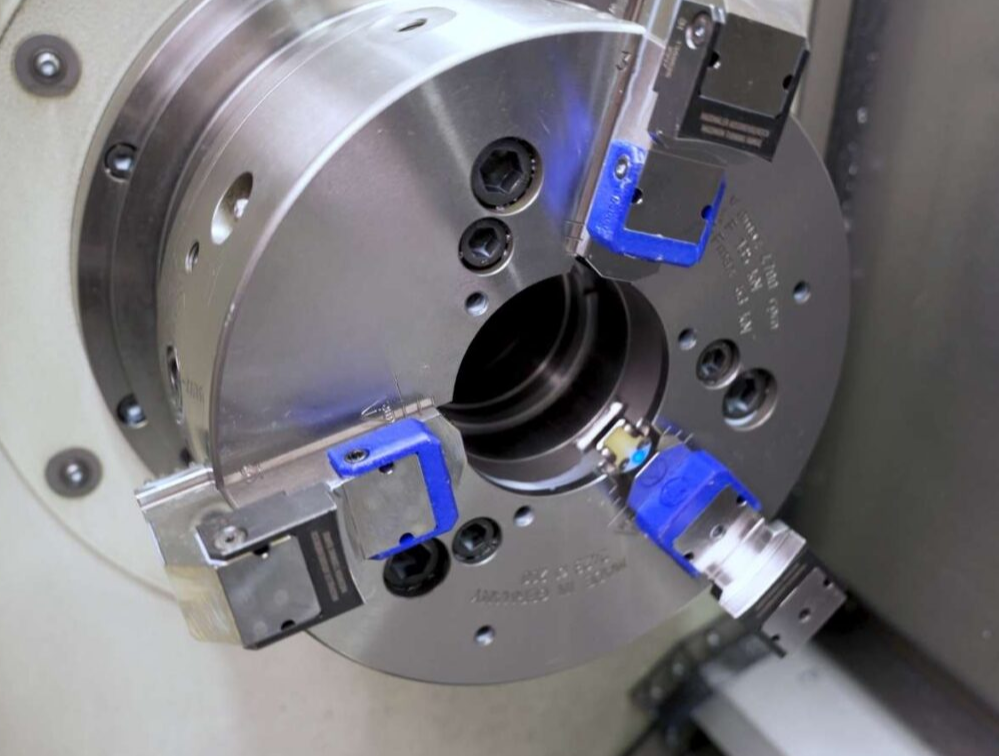
Core Chuck Clamping Processes
Pre-Clamping Setup (Non-Negotiable for Precision)
- Clean Everything: Remove chips, oil, rust from chuck, jaws, and workpiece (1 μm dirt = 0.01 mm runout).
- Inspect Jaws: Check for wear, burrs, or damage; reground if flatness >0.005 mm.
- Select Jaw Type:
- Hard jaws: Heavy roughing, steel/iron.
- Soft jaws: Finishing, aluminum/PEEK; machine to match part OD.
- Pie jaws: Thin walls; 360° contact, low pressure.
- Align & Center: Use dial indicator; target runout <0.003 mm for precision jobs.
Clamping Execution (Force & Sequence Matter)
- Tighten in Order: 3-jaw = alternate 120°; 4-jaw = cross-tighten (1→3→2→4).
- Calibrate Force:
- Steel: 0.5–0.7 MPa (hydraulic) / 20–25 N·m (torque wrench).
- Aluminum: 0.3–0.4 MPa / 10–15 N·m.
- Thin walls: 0.2–0.3 MPa (6-jaw/pie jaws only).
- Verify Security: Spin workpiece by hand; no wobble, no movement.
Post-Clamping Check (Avoid Mid-Cut Disasters)
- Runout Test: Dial indicator at 3 points; TIR <0.005 mm for finishing.
- Force Confirmation: Use jaw force tester; ensure pressure holds at RPM.
- Visual Inspection: No jaw marks, no gaps, no misalignment.
The Impossible Clamping Jobs: What Others Can’t Do—We Solve
You’ve heard the excuses:
- Thin walls (<1 mm) always bend—can’t hold tolerance.
- Soft materials (aluminum/PEEK) get jaw marks no matter what.
- Odd shapes can’t center—runout is always too high.
- High-speed jobs slip—can’t run above 1,500 RPM.
Zorapid’s Solution Playbook (Data-Backed)
1: Thin-Wall Distortion (<1 mm, Titanium/Aluminum)
Industry Issue: 90% of shops use 3-jaw hard jaws → 0.02–0.05 mm deformation, ovality, scrap.
Zorapid Fix:
- 6-jaw chucks + pie jaws (360° contact, 1/3 pressure of 3-jaw).
- Hydraulic pressure control (0.25 MPa max for <1 mm walls).
- Internal expanding mandrels (grip ID, machine OD—zero distortion).
- Result: Deformation <0.008 mm, ovality <0.005 mm, 100% pass rate.
2: Jaw Marks on Soft/Finished Surfaces
Industry Issue: 75% of shops use uncoated hard jaws → scratches, dents, marred finishes.
Zorapid Fix:
- Soft jaws with protective inserts (rubber/plastic, 0.1 mm thick).
- Cryogenic-treated jaws (reduces friction, no adhesion).
- Clamp on non-critical surfaces (engineer fixturing to avoid finish areas).
- Result: Zero jaw marks, Ra 0.4–0.8 μm finish straight from machine.
3: Odd-Shape/Irregular Part Centering
Industry Issue: 80% of shops use 3-jaw → runout >0.03 mm, misalignment, scrap.
Zorapid Fix:
- 4-jaw independent chucks (precision adjustment per jaw).
- Custom soft jaws (machined to match part geometry, 100% contact).
- Probe-based centering (in-process adjustment, runout <0.005 mm).
- Result: Runout <0.005 mm, perfect centering, repeatable batches.
4: High-Speed Slippage (>2,000 RPM)
Industry Issue: 85% of shops use standard pressure → jaws loosen, part slips, crashes.
Zorapid Fix:
- High-force hydraulic chucks (1.0 MPa max, centrifugal compensation).
- Grooved soft jaws (increase friction by 50%, no slip at 3,000 RPM).
- RPM-based force adjustment (CNC auto-increases pressure at high speed).
- Result: Zero slippage at 3,000 RPM, consistent force, safe unmanned runs.
Data Report: Common Chuck Clamping Problems & Fixes
We track every clamping failure—here’s the hard data and how we eliminate it.
| Problem | Industry Occurrence | Zorapid Solution | Success Rate |
|---|---|---|---|
| Thin-wall distortion (<1 mm) | 90% | 6-jaw/pie jaws + low pressure | 99.7% |
| Jaw marks on soft materials | 75% | Soft jaws + protective inserts | 99.5% |
| Odd-shape runout (>0.03 mm) | 80% | 4-jaw + custom soft jaws | 99.3% |
| High-speed slippage (>2,000 RPM) | 85% | High-force hydraulic + grooved jaws | 99.8% |
| Part slip mid-cut | 61% | Force calibration + clean contact surfaces | 99.9% |
Key Insight: Most shops fix symptoms (tighten more); we engineer the entire workholding system. Our clamping-related scrap rate is <0.2%—vs. industry average 10–18%.
5. Why Choose Zorapid for Chuck Clamping?
1. Master of Thin-Wall & Delicate Parts
We hold 0.5 mm walls (aluminum) and 0.8 mm walls (titanium) with <0.008 mm deformation—when others bend or scrap.
2. Precision Workholding for Any Shape
3-jaw, 4-jaw, 6-jaw, pie jaws, collets, mandrels—we have custom fixturing for any part, round, square, odd, or complex.
3. Zero-Mark Clamping for Finished Surfaces
Protective inserts, cryogenic jaws, non-critical clamping zones—no scratches, no dents, no rework.
4. High-Speed Stability (Up to 3,000 RPM)
High-force hydraulic chucks + friction-enhanced jaws—zero slippage, safe unmanned runs, faster cycles.
5. Rigid Lathe Equipment
Mori Seiki & Okuma lathes with thermal compensation, precision spindles, and calibrated chucks—runout <0.003 mm standard.
6. Free Workholding Engineering
We don’t just machine—we design the perfect clamping setup for your part: jaw type, force, sequence, fixturing. Cut scrap by 90% and improve quality.
7. Fast Delivery (3–5 Days for Clamping-Critical Parts)
In-house lathes + custom fixturing = same-day setup, 3–5 day delivery (vs. industry 7–14 days).
Real-World Case Studies
Aerospace – Titanium Thin-Wall Sleeve (0.8 mm Wall)
Challenge: 0.8 mm wall, Ti-6Al-4V, ±0.01 mm ovality, no distortion, 500-piece batch.
What Others Did: Declined or quoted 3 weeks + 15% scrap risk.
Zorapid Solution:
- 6-jaw chuck + pie jaws + 0.25 MPa hydraulic pressure.
- Internal expanding mandrel (grip ID, machine OD).
- In-process ovality inspection (CMM, ±0.005 mm tolerance).Result:
- Delivered in 5 days (vs. 3 weeks).
- <0.008 mm distortion, ±0.004 mm ovality, zero scrap.
- Customer: Top aerospace engine manufacturer.
2: Medical – 316L Stainless Implant (Odd Hex Shape)
Challenge: Hexagonal implant, 316L, ±0.005 mm runout, no jaw marks, 1,000-piece batch.
What Others Did: Poor centering, jaw marks, 10% scrap.
Zorapid Solution:
- 4-jaw independent chuck + custom soft jaws (machined to hex geometry).
- Rubber inserts (zero marks) + torque wrench calibration (12 N·m).
- Probe-based centering (runout <0.003 mm).Result:
- Zero jaw marks, ±0.004 mm runout, 100% pass rate.
- Delivered in 4 days.
- Customer: Global medical device OEM.
3: Automotive – PEEK Gear Housing (Soft, Complex Shape)
Challenge: PEEK, complex irregular shape, no melting, no jaw marks, ±0.01 mm tolerance.
What Others Did: Melted edges, jaw marks, tolerance drift.
Zorapid Solution:
- Custom soft jaws + cryogenic cooling (-196°C).
- Low clamping force (0.2 MPa) + non-critical surface clamping.
- Adaptive spindle speed (no heat buildup).Result:
- No melting, no jaw marks, ±0.008 mm tolerance.
- Delivered in 3 days.
- Customer: Luxury EV maker.
Key Applications: Where Clamping Makes or Breaks the Part
Aerospace & Defense
- Turbine shafts, thin-wall sleeves, fuel system components.
- Critical Need: Zero distortion, tight runout, high-speed stability on Ti/Inconel.
Medical Devices
- Implants, surgical instruments, dental components.
- Critical Need: No marks, biocompatible, precise centering on 316L/PEEK.
Automotive (EV & Performance)
- Gear housings, sensor shafts, thin-wall EV components.
- Critical Need: High-speed grip, zero slip, consistent quality on aluminum/steel.
Robotics & Automation
- Precision shafts, actuator components, gearbox parts.
- Critical Need: Repeatable clamping, low runout, no distortion.
Energy & Oil/Gas
- Valve components, pump shafts, thin-wall pressure parts.
- Critical Need: Heavy-duty grip, zero slip, high-pressure stability.
Delivery Speed: How We Beat Industry Lead Times for Clamping-Critical Parts
Standard Industry:
- Thin-wall/clamping-critical prototypes: 10–21 days
- Small batches: 3–6 weeks
- Custom fixturing jobs: 4–8 weeks
Zorapid:
- Prototypes: 3–5 days
- Small batches (10–1,000 pcs): 5–7 days
- Custom fixturing/clamping jobs: 4–6 days
How We Do It:
- In-house everything: Chucks, jaws, fixturing—no outsourcing.
- Rapid fixturing design: Free engineering, 24-hour custom jaw machining.
- Parallel setup: Multiple lathes work on one project; quick-change jaws.
- AI-driven clamping: Automated force/sequence setup in minutes.
Real Promise: If we miss our quoted lead time, we discount 10%—no excuses.
Industry Whitepaper: The Future of Chuck Clamping (2026–2030)
Key Trends
- Smart Chucks with Sensors: Real-time force/runout monitoring; auto-adjust pressure during cuts—eliminate human error entirely.
- Magnetic Workholding: Electro-permanent magnetic chucks for thin walls; 100% contact, zero distortion, faster setup.
- AI Clamping Optimization: Machine learning designs jaw type, force, and sequence in seconds—cut setup time by 80%.
- Green Clamping: Biodegradable protective inserts, energy-efficient hydraulics—reduce waste by 50%.
Zorapid’s Position
We’re already investing in these trends: smart sensor chucks, magnetic workholding, and AI clamping design. We’re not just keeping up—we’re setting the standard for precision workholding.
Final Summary
Chuck clamping is the unsung hero of CNC lathe precision. Bad clamping causes distortion, marks, slippage, and scrap—costing shops thousands in rework and lost time.
Most shops use generic jaws and guess at force; Zorapid engineers the perfect clamping system for every part. We specialize in impossible jobs: thin walls, soft materials, odd shapes, and high-speed runs—delivering ±0.005 mm precision, zero marks/distortion, and 3–5 day lead times when others say it can’t be done.
If you’re tired of scrap, rework, or shops that don’t master workholding—let’s talk. Send us your CAD files and specs; we’ll run a free clamping simulation, design your ideal setup, and deliver parts that exceed your expectations.
FAQ
What’s the minimum wall thickness Zorapid can clamp without distortion?
0.5 mm (aluminum, 6-jaw/pie jaws); 0.8 mm (titanium/steel, 6-jaw + low pressure).
How do you avoid jaw marks on finished surfaces?
We use soft jaws with rubber/plastic inserts, cryogenic-treated jaws, and clamp on non-critical areas.
Can you clamp odd/irregular shapes with tight runout?
Yes—4-jaw independent chucks + custom soft jaws deliver runout <0.005 mm.
What clamping force do you use for different materials?
Steel: 0.5–0.7 MPa; Aluminum: 0.3–0.4 MPa; Thin walls: 0.2–0.3 MPa (hydraulic).
Do you offer free clamping setup design?
Yes—send your CAD; we’ll design jaw type, force, sequence, and fixturing at no cost.
How fast can you deliver clamping-critical parts?
3–5 days for prototypes; 5–7 days for small batches. Custom fixturing jobs take 4–6 days.