Published:Zorapid.Ltd
Tight-deadline engineering scenarios are common: prototype validation for product iteration, failed production equipment emergency spare parts, semiconductor fab downtime repair, aerospace trial component testing, urgent medical fixture batches. Standard 7–15 day CNC lead times fail urgent project timelines. Many manufacturers only speed up cutting speed blindly, triggering tool breakage, dimensional scrap and costly rework, ultimately delaying delivery further.
Effective lead time compression does not mean reckless high-speed cutting. It systematically trims waiting time at every link: design for rapid machining, streamlined CAM programming, optimized machine setup, parallel workshop workflows, condensed quality inspection, streamlined post-processing and fast shipping. This guide breaks down implementable time-saving strategies sorted by engineering phase, includes material selection tradeoffs, batch splitting rules and risk control for rushed jobs, and provides a side-by-side timeline contrast between regular and expedited CNC flow. All reference visuals are high-definition with no watermarks for independent site publication.
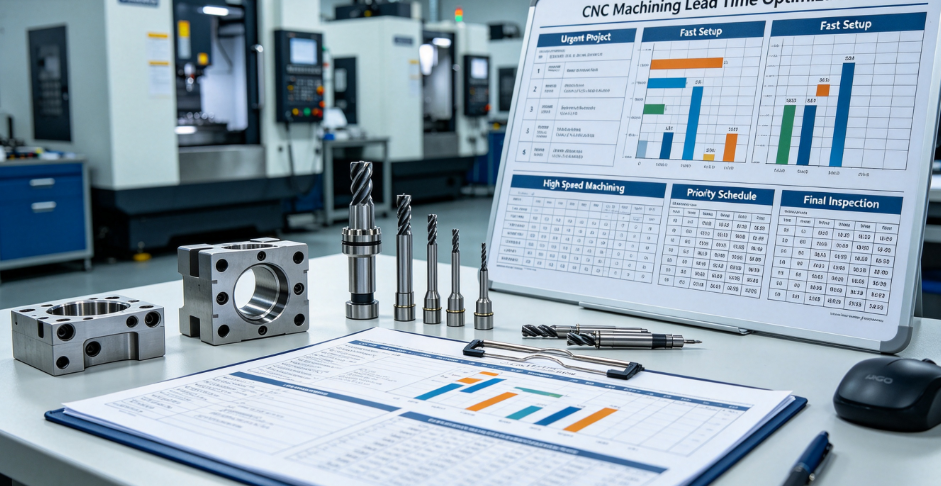
Full CNC Production Timeline Breakdown (Standard vs Expedited)
Total CNC lead time covers 8 non-negotiable stages. Most delays come from waiting, not actual cutting time.
- Drawing review & DFM confirmation
- Raw material procurement / stock preparation
- CAM programming + simulation
- Fixture design, fixture setup & workpiece clamping
- CNC roughing + finishing cutting
- Deburring, surface finishing, heat treatment
- QC inspection and documentation
- Packaging & shipping
Regular total cycle: 7–14 business days Expedited optimized cycle: 1–4 business days for most simple/medium complex parts
Front-End Design & DFM Optimization (Biggest Lead Time Cut at Zero Extra Machining Cost)
Design adjustments eliminate rework, simplify machining and cut programming/setup hours. All tweaks suit urgent revisions without hurting part functionality.
Simplify Geometry for Faster Machining
- Remove non-mandatory complex curved freeforms; replace simultaneous 5-axis features with 3+2 positional 5-axis or orthogonal features if function allows
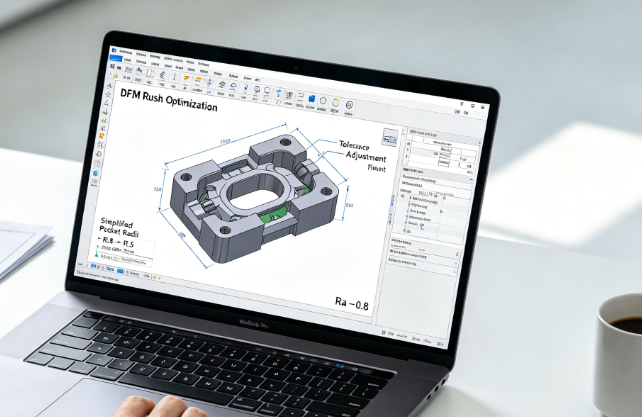
- Enlarge internal pocket corner radii to match standard common end mill sizes (6 mm, 8 mm, 10 mm). Cancel sharp 90° inner corners to skip slow Wire EDM. EDM is the top time killer for rush orders.
- Merge multiple tiny pockets/slots into unified large cavities to reduce tool change frequency
- Eliminate ultra-deep narrow ribs that demand long fragile tools and slow low-feed cutting
Material Selection for Emergency Lead Time
Pick readily stocked materials instead of custom special alloys to cut material lead time by 2–5 days.
| Urgent Priority Material Choices | Materials to Avoid for Rush Jobs 6061-T6 aluminum (universal stocked metal worldwide) | Custom tempered 7075, special aerospace aluminum grades with long mill lead times | | 304 stainless steel (standard workshop inventory) | Hastelloy, Inconel, custom nickel alloys (hard to source + slow machining) | | Standard PEEK solid rod, PVC, ABS plastic | Custom filled specialty polymers requiring special ordering | | Pre-hardened standard mold steel P20, 4140 prehard | H13, S136 needing post-CNC heat treatment (heat treatment adds 2–4 days minimum)
Rule for urgent molds: Use pre-hardened mold steel for emergency trial molds; skip vacuum quenching until formal mass production molds.
Tolerance Rationalization
Relax tolerance on non-critical surfaces. Tight GD&T calls force slow conservative cutting and full CMM inspection.
- Keep critical assembly sealing/position features at required tight tolerance
- Widen tolerance to ±0.1 mm for non-mating cosmetic surfaces
- Cancel unnecessary ultra-low Ra requirements (Ra 0.2 μm) on hidden internal surfaces; use Ra 1.6 μm standard finish
CAM & Programming Acceleration (Cut Programming & Machine Runtime)
Programming and inefficient tool paths waste 15%–30% total turnaround time on rush orders. Standardize CAM workflows for emergency jobs.
- Reuse proven existing CAM templates Store parameter libraries (RPM, feed rate, depth of cut) for aluminum, stainless, common tool sizes. No repeated manual parameter calculation; load saved cutting recipes directly.
- Minimize tool changes Consolidate features to use as few tool sizes as possible. Machine all features for one tool consecutively before swapping cutters. Reduce tool swap idle time.
- Adaptive high-speed roughing Adaptive clearing removes bulk material fast with consistent radial engagement; faster than conventional step-down roughing while lowering tool shock. Great for aluminum block stock removal.
- Simplify simulation workflow Complete critical collision simulation only; skip redundant fine path simulation for simple 3-axis plates. Reserve full detailed simulation exclusively for complex 5-axis rush parts.
- Standardize climb milling paths pre-set in templates No repeated path adjustment; lock climb milling as default to guarantee stable finish without trial cutting.
Workshop Floor Setup & Machining Workflow Compression
Most waiting hours happen during fixture setup, clamping and machine idle gaps. Adopt parallel operation for urgent orders.
Parallel Setup (Multi-station Offline Fixturing)
- Prepare vises, custom fixtures, soft jaws and workpieces on auxiliary tables while the CNC machine runs another part. No machine downtime for clamping.
- Use zero-point quick-change fixtures for repeat parts. Fixture location repeatability within 0.002 mm; setup time drops from 30–60 mins down to 5–10 mins.
- Batch similar urgent parts in one clamping run; machine multiple components in a single program cycle.
Machine Resource Priority Allocation
Urgent jobs get dedicated machine scheduling rules:
- Assign rush parts to idle 3-axis machines first; reserve 5-axis only if geometry cannot be completed on 3-axis. Avoid tying high-cost 5-axis up on simple plates.
- Arrange night shift unmanned machining for roughing cycles. Run bulk stock removal overnight; daytime shifts focus on precision finishing, inspection and finishing operations.
- Block machine time exclusively for emergency orders; pause low-priority non-urgent batches temporarily with customer notification.
Optimize Cutting Cycles Without Sacrificing Quality
- For aluminum: Increase feed per tooth moderately with high-pressure coolant; aluminum allows aggressive cutting with minimal tool risk.
- For hard stainless/titanium: Do not blindly speed up RPM/feed (causes tool breakage downtime). Shorten tool overhang via 3+2 5-axis tilt to enable faster stable cutting.
- Limit total roughing passes; set fixed stock allowance (0.1 mm uniform finish stock) to reduce redundant semi-finish cycles.
Parallel Post-Processing to Eliminate Sequential Waiting
Deburr, surface finishing, cleaning and heat treatment are major bottlenecks. Run these steps in parallel with CNC cutting.
- Split parts into groups: While CNC machines new blanks, previous finished components go to independent deburr/clean stations simultaneously. No serial waiting.
- Cancel time-consuming manual polishing for non-critical areas. Use CNC programmed chamfers to remove burrs automatically; skip hand deburring entirely.
- Heat treatment avoidance is the top emergency rule. If heat treatment is mandatory, source local heat-treatment vendors with same-day expedited service; ship parts to heat treat while CNC finishes remaining features.
- Bulk ultrasonic cleaning in batches; batch multiple urgent parts together to cut per-unit cleaning time.
QC Inspection Streamlining for Rush Parts
Full 100% CMM inspection drags lead times heavily. Build tiered fast inspection rules for urgent jobs while retaining compliance.
- Split critical vs non-critical features
- Critical mating holes, sealing surfaces, assembly dimensions: Mandatory measurement with micrometer/CMM
- Non-critical outer geometry: Sample inspection + visual verification only
- Shift partial inspection upstream Machinists perform in-process handheld gauge checks (calipers, micrometers, pin gauges) during cutting pauses. Catch offset errors early to prevent full batch scrap, eliminating post-machining rework delay.
- Simplify paperwork for emergency batches Create standardized rush inspection report templates with auto-filled fields; cut manual documentation time. Full formal inspection reports can be sent digitally after parts ship for customer records.
- Batch multiple urgent parts in one CMM run instead of separate individual scans to save machine queue time.
Logistics & Shipping Acceleration
Even perfectly finished parts get stuck due to slow delivery. Standard expedited shipping protocols:
- Local domestic express air courier (same-day / next-day air) replaces standard ground freight. For cross-border urgent parts, use international express door-to-door services.
- Combine multiple urgent components into one consolidated shipment to avoid multiple delivery fees and transit days.
- Arrange weekend courier pickup; regular shipping companies close weekends, while premium couriers support Saturday/Sunday collection.
- Pre-label shipping documents, commercial invoices in advance before part finishing to cut handover waiting time.
Risk Control to Prevent Rush Rework & Schedule Disasters
Speed cannot override basic process controls; scrap from reckless rushing causes far longer delays. Enforce these non-negotiable rules for fast-track jobs:
- Mandatory first piece inspection (FPI) Run one full part completely, verify all critical dimensions before machining full batch. One-time upfront QC avoids scrapping an entire batch of rushed parts.
- Retain conservative finishing parameters Never maximize cutting speed for final finishing passes. Roughing can be accelerated; finishing uses proven stable feeds to avoid surface defects and dimensional drift.
- Use fresh sharp tools for finishing Worn tools cause inconsistent sizing. Pre-load new coated end mills for urgent finish work; tool failure mid-run leads to hours of downtime.
- Lock stable workshop temperature for precision urgent parts Thermal variation creates dimensional errors. Temperature fluctuation correction avoids rework delays on tight-tolerance aluminum plates.
Lead Time Compression Reference Table (Regular vs Expedited)
| Process Stage | Standard Timeline | Optimized Urgent Timeline | Key Saving Measures |
|---|---|---|---|
| Drawing review + DFM | 1 day | 2–4 hours | Pre-simplify CAD, use stocked materials |
| Raw material preparation | 1–3 days | Same-day | Use in-house stocked blanks |
| CAM programming | 4–8 hours | 1–2 hours | Reuse saved cutting templates |
| Fixture setup & clamping | 1–2 hours | 15–30 mins | Offline setup + zero-point fixtures |
| CNC cutting cycle | 8–24 hours | 6–18 hours | Adaptive roughing, fewer tool changes |
| Deburr + cleaning + finishing | 4–12 hours | 2–6 hours | CNC automatic deburr, parallel processing |
| QC testing & paperwork | 6–12 hours | 2–4 hours | Tiered critical feature inspection |
| Shipping transit | 2–5 days | 1–2 days | Express air courier |
| Total overall | 7–14 days | 1–4 days | All above cross-phase parallel workflows |
Industry-Specific Rush Optimization Tips
Automation Fixture Emergency Parts
Maintain inventory of standard aluminum blank sizes in-house. All fixture plates use 3-axis only; cancel complex curved designs. Maximize vise clamping for fastest setup.
Semiconductor Urgent Vacuum Components
Keep certified aluminum/stainless blanks stocked. Avoid EDM if possible. Surface roughness checked via fast profilometer spot test; full particle testing can follow after delivery with digital documentation sent upfront.
Emergency Mold Spare Inserts
Choose pre-hardened steel to skip heat treatment. Simplify rib geometry to run on 5-axis instead of slow sinker EDM. Prioritize functional cavity surfaces over cosmetic polish.
Aerospace Trial Prototypes
Use 3+2 5-axis instead of continuous 5-axis wherever possible to speed programming. Offline fixture setup is mandatory to cut machine idle time. Critical GD&T gets targeted CMM inspection only.
FAQ
What single change cuts CNC lead time the most for urgent orders?
Using readily available in-stock raw materials and eliminating EDM machining by redesigning internal radii. Material procurement and EDM are the two longest bottlenecks; removing either saves multiple days reliably.
Can heat treatment ever be expedited for rush hardened steel parts?
Local heat treatment vendors provide 24-hour emergency quenching/tempering services for an expedite fee. If even this timeline fails, switch to pre-hardened steel with no post-machining heat treatment needed.
Is unmanned overnight CNC machining safe for rushed precision parts?
Safe for roughing passes. Final finishing must run during daytime with operator monitoring to catch tool wear or abnormal vibration early. Avoid unattended finishing to prevent scrapped parts and schedule delays.
How do multiple urgent parts get prioritized when CNC machines are fully occupied?
Prioritize parts with production line downtime impact first. Split jobs: run long roughing cycles overnight on all available machines; daytime shift completes finishing for all highest-priority components in rotation. Offline setup ensures machines never sit idle.
Why is Wire EDM strongly discouraged for ultra-fast turnaround?
Wire EDM material removal speed is far slower than milling, often adding 1–3 full days. Reshape CAD internal corners with radii to use standard milling unless sharp corners are functionally required.
Can inspection be fully skipped to save time?
No. Critical dimension spot checks with handheld tools are mandatory to avoid rework. Non-critical features can skip formal inspection, but full blind QC elimination risks scrapping finished parts and causes longer delays. Formal full reports can be delivered digitally after shipment.
What works best for small batch rush prototypes (1–5 pieces)?
Combine DFM simplification, stocked aluminum blanks, zero-point quick fixtures, CAM template reuse, offline setup and express air shipping. Most small aluminum prototypes can ship within 24 hours with this full set of tactics.
Final Conclusion
Urgent CNC lead time reduction relies on optimizing waiting time rather than speeding cutting speeds recklessly. The highest-impact improvements happen at the design phase: material inventory selection, geometry simplification, tolerance rationalization and EDM avoidance. On the production floor, parallel offline setup, split day/night machining schedules, tiered fast QC and parallel post-processing eliminate sequential bottlenecks. Logistics expedited delivery closes the final timeline gap.
All speed adjustments include clear risk guardrails: mandatory first-piece inspection, stable finishing cutting parameters and fresh cutting tools prevent scrap and costly schedule reversals. For any urgent engineering project, align design choices with workshop inventory and fast-capable CNC processes to hit tight deadlines while retaining required part quality. All supporting images are high-resolution without watermarks, ready for independent site embedding.