Published:Zorapid.Ltd
Custom machined components range from simple aluminum fixture plates and standard bolts to complex freeform aerospace brackets, micro medical implants and precision mold cavities. Many buyers and design engineers pick CNC processes blindly, leading to excessive cost, long lead times, failed tolerances, poor surface finish or unnecessary manufacturing limitations.
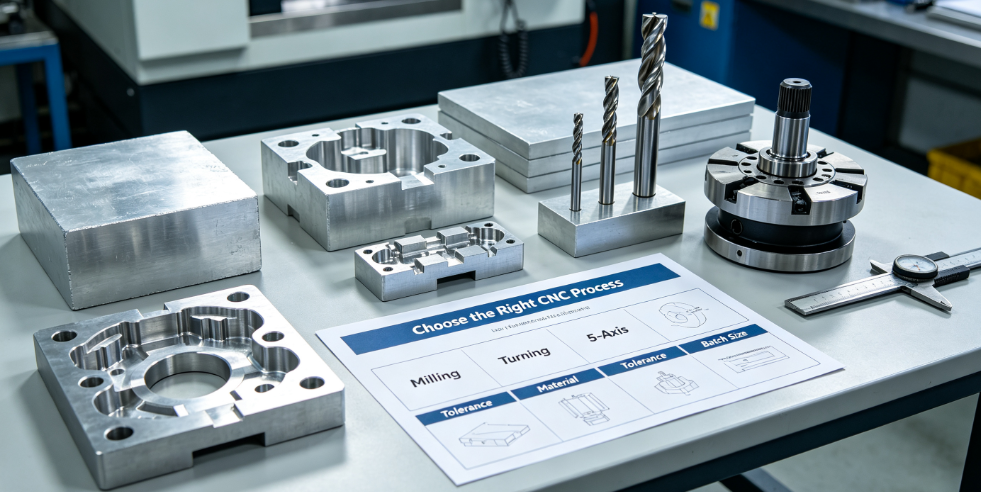
The ideal CNC process is decided by five decisive factors: part geometry complexity, tolerance requirements, surface roughness target, production batch size, workpiece material properties. This guide sorts mainstream CNC machining technologies, breaks down applicable scenarios one by one, provides direct selection rules for common industries (aerospace, medical, semiconductor, mold, automation hardware), and includes a simplified decision table. All matched reference pictures are high-definition with no watermarks, logos or text overlays for independent station display.
Core Judging Criteria to Narrow Down CNC Options
Confirm these five specs first before locking any process:
- Geometry shape: Prismatic blocks/plates, rotary round parts, curved freeform surfaces, deep narrow ribs, tiny sharp internal corners
- Tolerance level: General ±0.1 mm; precision ±0.01~±0.05 mm; ultra-precision ±0.001~±0.005 mm
- Surface finish: Regular Ra ≥1.6 μm; precision Ra 0.2–1.6 μm; optical/mirror Ra ≤0.2 μm
- Batch quantity: Prototypes (1–10 pcs), small batch (10–500 pcs), mass production (500+ pcs)
- Material hardness: Regular aluminum/copper; stainless steel; hardened mold steel HRC 48+; titanium, Inconel, fragile ceramics
Full Breakdown of All Common CNC Processes & Suitable Scenarios
3-Axis CNC Milling
Working Principle
The workpiece moves along X/Y/Z three linear axes; the spindle stays vertically fixed. All cutting relies on vertical tool movement and horizontal table travel.
Best fits
- Orthogonal block, flat plate, simple pocket, straight slot, standard hole features with no tilted angles or complex curves
- Automation fixtures, mounting bases, regular mold plates, semiconductor rectangular chambers
- Tolerance range: ±0.02 mm ~ ±0.1 mm
- Batch adaptability: Prototypes, small batches, medium mass production with simple geometry
Key advantages
Low machine cost, widely available workshops, fast programming, short setup time, low machining expense.
Hard limitations
Cannot machine angled holes, tilted pockets, full curved freeforms; repeated re-clamping causes position errors; poor accessibility for deep angled cavities.
Unsuitable cases
Freeform optical parts, bladed turbine components, parts with multiple angled surfaces requiring tight position tolerance.
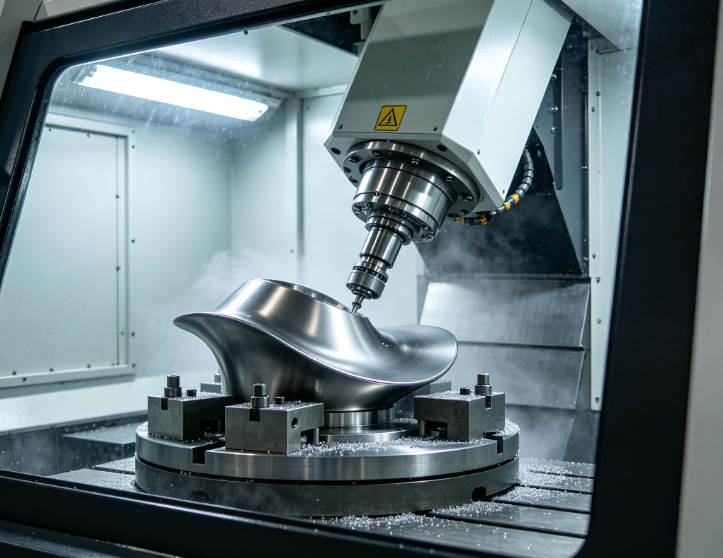
5-Axis CNC Milling
Working Principle
Two additional rotary axes (A/B or A/C) tilt the spindle or workpiece. Tools keep normal to curved surfaces throughout cutting with only one clamping setup. Split into 3+2 positional 5-axis and continuous simultaneous 5-axis.
Best fits
- Freeform curved surfaces, complex contoured parts, multiple angled holes/tapped holes on multiple faces
- Aerospace turbine brackets, medical bone implants, optical lens molds, semiconductor complex curved housings
- Precision tolerance ±0.005~±0.03 mm; Ra down to 0.02 μm after optimized finishing
- Prototypes and low-to-medium batches with high precision demands
Advantages
Single-clamp machining eliminates re-fixturing errors; stable surface roughness on curves; reaches deep narrow angled cavities; cuts manual polishing workload.
Drawbacks
Higher machine hourly rate; longer CAM programming time; needs temperature-controlled workshop for full precision.
Usage Tips
Choose positional 3+2 5-axis for parts with fixed angled planes to save cost; continuous 5-axis only for smooth freeform curved profiles.
CNC Turning (Lathe)
Working Principle
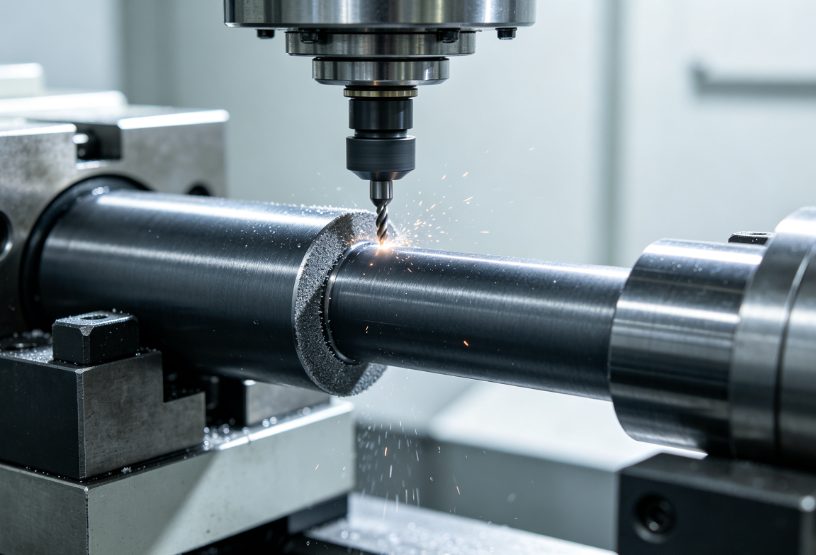
Workpiece spins at high speed; fixed cutting tools machine outer circles, inner bores, threads, face planes. Optimized for rotary symmetrical geometry.
Best fits
Round shafts, pins, bushings, threaded studs, annular sleeves, cylindrical manifold connectors Materials: all machinable metals and engineering plastics Tolerance: stable ±0.002~±0.05 mm for circular dimensions Ideal for all batch sizes of rotational parts, especially high-volume round hardware
Advantages
Fast cycle time for round parts; excellent concentricity; low unit cost for mass rotary production.
Limitations
Only efficient for rotary shapes; complex non-round side features cannot be completed on basic lathes.
Turn-Milling (Lathe + Milling Composite)
Working Principle
Lathe spindle rotates workpieces while milling spindles cut flat facets, slots, cross holes and irregular profiles on round blanks. Combines turning and milling in one clamping.
Best fits
Non-standard rotary parts with cross holes, flat sides, keyways; medical titanium bone screws, hydraulic valve spools, automotive shaft fittings
Core value
Avoid secondary clamping between lathe and mill; guarantee position tolerance between round surfaces and side features.
Wire EDM (Wire Electrical Discharge Machining)
Working Principle
Thin brass wire cuts conductive metal via electrical spark erosion; no physical cutting force.
Best fits
Sharp internal 90° corners impossible for milling, ultra-thin ribs (0.1 mm thin walls), hard steel precision punches, complex 2D contours Perfect for hardened HRC60 mold steel, tungsten, conductive carbide; tolerance up to ±0.001 mm
Advantages
Zero cutting force with no workpiece deformation; achieves true sharp inner corners; works for ultra-hard metals difficult to mill.
Limitations
Only for conductive materials; slow material removal; cannot machine large 3D curved surfaces efficiently.
Sinker EDM (Ram EDM)
Working Principle
Custom graphite electrode burns cavities into conductive material via spark discharge.
Best fits
Deep narrow mold ribs, tiny blind cavities, hard steel mold inserts, intricate micro features inaccessible to milling tools Common for plastic mold deep thin ribs, micro semiconductor cavities
Pros: Processes deep, narrow closed cavities where end mills cannot reach; compatible with fully hardened steel.
Cons: Long machining cycle; extra cost for graphite electrode manufacturing.
CNC Precision Grinding
Working Principle
Abrasive grinding wheels remove tiny material allowances to achieve ultra-high precision and mirror surface finish. Includes surface grinding, cylindrical grinding, jig grinding.
Best fits
Parts requiring ultra-tight tolerance (±0.001 mm) and mirror Ra ≤0.01 μm; mold core pins, precision gauge blocks, optical mold surfaces, precision bearing seats Mostly used as post-finishing after milling/EDM, not bulk material removal.
One-Click Selection Table by Part Characteristics
| Part Feature Category | Recommended Primary CNC Process | Backup Alternative |
|---|---|---|
| Simple square block, flat plate, straight slots/holes | 3-axis milling | Low-cost 5-axis if multiple angled holes exist |
| All round symmetrical shafts, sleeves, bolts | CNC turning | Turn-milling if side cross holes are required |
| Round parts with flats, keyways, transverse holes | Turn-milling composite | Separate lathe + 3-axis milling (low cost for large batches) |
| Freeform curved surfaces, multi-angle holes on 3+ faces | Continuous 5-axis milling | 3-axis with multiple re-clamps only if tolerance loose |
| Hardened steel sharp internal corners, thin ribs | Wire EDM + sinker EDM | 5-axis milling with large radii redesign if EDM budget limited |
| Ultra-precision tolerance ±0.001 mm, mirror finish | CNC grinding (jig/surface grind) | 5-axis ultra-fine finishing for non-mirror requirements |
| Deep narrow blind hard steel cavities | Sinker EDM | 5-axis with tiny long tools (higher chatter risk) |
| Small prototype batches with mixed complex geometry | 5-axis | Split 3-axis + turning + EDM to cut cost |
| High-volume standard prismatic components | 3-axis milling with fixture optimization | Mass-production dedicated mold if quantity exceeds 10,000 |
Process Matching by Material
| Material Grade | Preferred CNC Processes | Processes to Avoid |
|---|---|---|
| 6061/7075 Aluminum | 3-axis, 5-axis, turning, turn-milling | Slow EDM unless sharp corners are mandatory |
| 316L/304 Stainless Steel | All milling/turning; wire EDM for sharp corners | Long small tools on regular milling (severe tool wear) |
| Ti6Al4V Titanium | 5-axis short-tool milling, turning, turn-milling | Deep long-tool 3-axis milling (heavy chatter and BUE) |
| H13/S136 Hardened Mold Steel (HRC≥48) | 5-axis finish milling, sinker/wire EDM, jig grinding | Heavy rough milling with standard carbide tools |
| Inconel High-Temp Alloy | 5-axis high-pressure coolant milling, turn-milling | High-feed high-speed cutting; rapid tool failure |
| PEEK, PVDF Non-Conductive Plastics | 3-axis/5-axis milling, turning | Any EDM (plastic non-conductive, sparks cannot erode material) |
Process Matching by Industry Typical Parts
1. Automation & General Hardware
Mostly simple aluminum plates, brackets, spacer blocks. Default pick: 3-axis milling. Use turn-milling for shaft connectors. No need for 5-axis unless angled hole arrays exist. Controls overall machining cost effectively.
2. Plastic & Die Cast Molds
Mold bases: 3-axis milling Hardened mold cores/cavities: 5-axis semi-finish + sinker EDM for ribs + jig grinding for mirror finish Sharp internal corners always use wire EDM; avoid forced milling with big radii.
3. Semiconductor Vacuum Components
Aluminum/stainless chamber plates: 3-axis milling with strict surface finishing Curved laser housings, multi-angle port blocks: 5-axis single-setup machining Critical sealing surfaces add profilometer-qualified grinding finishing; micro particle burr features supported by EDM deburring.
4. Aerospace Structural Parts
Titanium/aluminum curved brackets, turbine components: Continuous 5-axis milling Round aerospace fasteners: CNC turning Strict GD&T profiles require 5-axis + CMM full inspection; re-clamping 3-axis is highly discouraged.
5. Medical Precision Components
Titanium implants with organic curved contours: simultaneous 5-axis Titanium bone screws: turn-milling Hard stainless surgical tools: 5-axis + wire EDM for tiny sharp features Most medical parts ban multiple re-clamping to keep consistent precision and cleanliness.
Batch Size Cost Optimization Rules
- Prototypes (1–10 pieces): Prioritize flexible 5-axis or split simple 3-axis/turning. Custom EDM electrodes cost too much for single pieces; redesign corners to radii to skip EDM.
- Small Batch (10–500): Balance 3-axis and 5-axis based on geometry. Optimize fixtures to reduce setup time; EDM only for non-negotiable sharp corners.
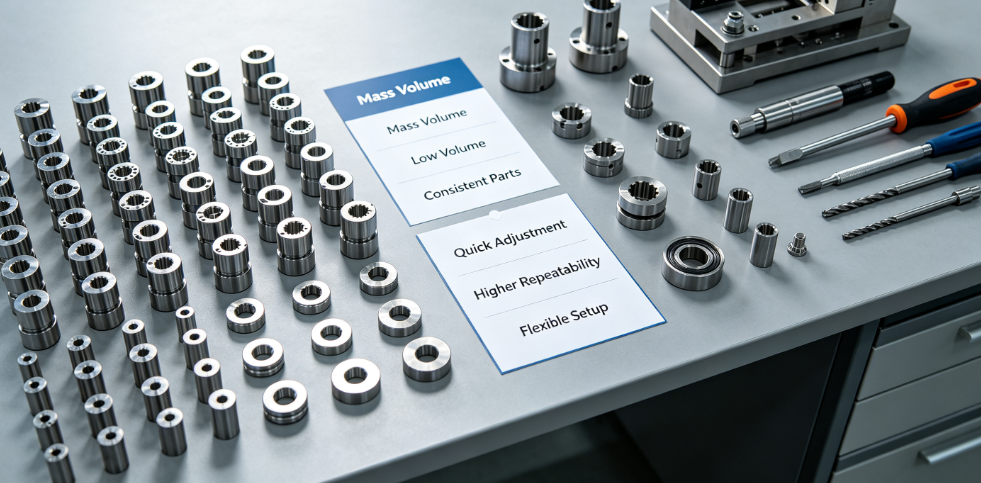
- Mass Batch (500+): Maximize low-cost processes. Use dedicated fixtures for 3-axis milling; turning with bar feeders for round parts. If volumes hit tens of thousands, evaluate casting/injection molding instead of full CNC.
Common Wrong Process Selections & Consequences
- Use 3-axis for multi-angle curved aerospace parts Result: Multiple re-clamping causes position errors; high reject rate, long total lead time.
- Try milling sharp 90° internal corners on hardened steel Result: Must use oversized tool radii, parts fail assembly; broken tools, low yield. Correct fix: switch to wire EDM.
- Machine precision mirror optical molds with regular milling only Result: Visible tool lines, uneven Ra; poor light performance. Add CNC grinding or EDM + polishing.
- Machine long thin titanium walls with 3-axis long tools Result: Severe chatter, dimensional distortion. Switch to 5-axis to shorten tool overhang.
- Choose EDM for aluminum mass production without sharp corners Result: Extremely slow cycle time, unnecessarily high manufacturing cost.
FAQ
How to decide between 3+2 positional 5-axis and full simultaneous 5-axis?
Use positional 3+2 5-axis for parts with fixed angled planes, drilled angled holes and stepped curved surfaces; cheaper programming and machining. Continuous simultaneous 5-axis is only required for smooth freeform organic curves that need constant tool angle adjustment, such as lens molds and turbine blades.
If a part has both round shafts and milled flats, is turning plus secondary milling better than turn-milling?
Small batches: turn-milling finishes everything in one setup for better tolerance consistency. Large mass batches: separate lathe and 3-axis milling is more cost-efficient, as dedicated machines run faster with lower hourly cost.
Can EDM replace milling entirely for hardened steel parts?
No. EDM removes material slowly and costs more for large stock removal. Standard workflow: CNC rough/semi-finish remove most material, use EDM only for unreachable sharp corners and deep narrow ribs.
Do all precision parts require 5-axis machining?
Definitely not. Flat rectangular plates, regular holes and straight slots achieve tight tolerances stably on 3-axis at much lower cost. 5-axis is a solution for complex geometry, not a universal upgrade for all precision parts.
Non-conductive materials like PEEK cannot use EDM. What processes work?
All standard milling and turning are fully applicable. Use high-speed low-heat CNC cutting with sharp tools to avoid plastic melting; rely on CNC programmed chamfers to replace EDM sharp corner solutions.
How to balance cost and precision when designing custom machined parts?
Match process to drawing tolerances: loosen non-critical corner radii to skip EDM; simplify tilted features to fit 3-axis machining where possible; reserve high-cost 5-axis/grinding only for critical functional surfaces.
For thin fragile CNC parts prone to deformation, which process is safest?
Wire EDM has zero cutting force and minimum deformation. If milling is required, use 5-axis with shortest tools, low cutting force and vacuum fixture support to reduce workpiece stress.
Final Summary
Selecting the proper CNC process relies on five core factors: geometry complexity, tolerance, surface finish, material hardness and production quantity.
- Simple orthogonal prismatic parts: 3-axis milling is the most cost-effective choice.
- Rotary symmetrical components: CNC turning dominates efficiency.
- Multi-angle freeform curved workpieces: 5-axis becomes necessary for accuracy and stable surface quality.
- Hard steel sharp corners, ultra-thin walls: Wire/sinker EDM is irreplaceable.
- Ultra-mirror ultra-precision dimensions: CNC grinding serves as final finishing operation.
Designers and buyers can avoid expensive rework and unreasonable pricing by aligning geometry design with process capabilities. Reasonable process selection shortens lead times, lowers unit cost and guarantees consistent quality across prototypes and mass batches. All three matched reference images are high-resolution with zero watermarks, ready for website embedding.