Published:Zorapid.Ltd
If you manufacture aircraft engine parts, satellite brackets or UAV structural components, you’ve hit these identical roadblocks.
You machine superalloys from solid bar stock. Buy-to-fly ratios hit 30:1, wasting thousands of dollars on expensive IN718 or titanium scrap.
Topology-optimized lightweight lattice designs can’t be cut with standard 5-axis CNC tools.
As-printed metal 3D parts hit tight tolerance walls or sealing faces out of spec, with rough layer lines killing surface finish.
Pure CNC lacks design freedom. Pure additive can’t hit aerospace’s strict ±0.01 mm tolerance and Ra 0.8 µm sealing requirements.
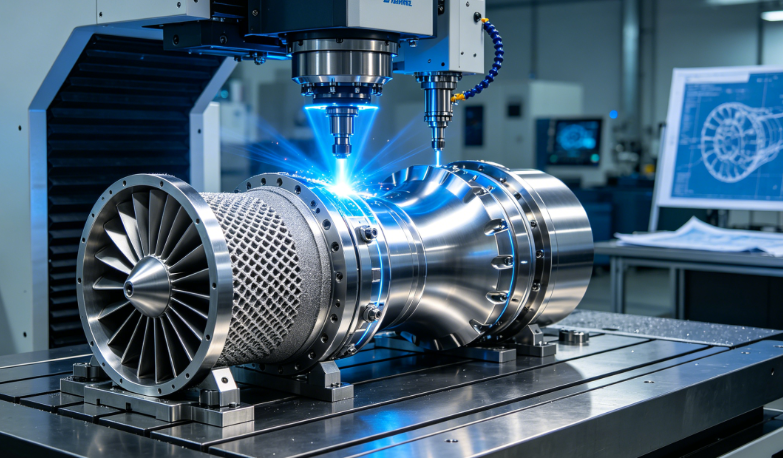
Hybrid additive + CNC manufacturing solves both limitations in one unified production line — exactly what aerospace production demands.
At Zorapid, we run integrated SLM metal printing paired with 5-axis precision CNC milling for commercial aerospace, defense UAV and satellite clients across EU and North America.
Our hybrid workflow slashes material waste by 75%, cuts part weight up to 42%, and delivers fully certified aerospace-ready components in half the lead time of traditional machining.
Today we break down everything you need to know to switch your complex aerospace parts to hybrid manufacturing, with real production data and client results.
The Pain Points Traditional Aerospace Machining Can’t Fix
Let’s cover the costly bottlenecks every aerospace manufacturer fights daily:
- Sky-high buy-to-fly ratios: Solid superalloy stock removes 90%+ material during milling; IN718 and Ti-6Al-4V powder/bar stock carries extreme raw material cost
- Impossible lightweight geometries: Internal conformal cooling channels, load-bearing lattice cores, consolidated multi-part assemblies cannot be machined from solid billet
- Long multi-setup machining: Complex blisks, fuel injectors and actuator housings require 4–6 separate CNC fixturing steps, expanding lead times 4–8 weeks
- MRO repair limitations: Worn turbine blades and high-value engine components cannot be restored without full re-forging or new blank production
- Tradeoff between weight and precision: Light 3D printed parts fail dimensional inspection; heavy solid machined parts add unnecessary aircraft fuel load
None of these headaches exist with a properly optimized hybrid additive + CNC workflow.
What Is Hybrid Additive + CNC Manufacturing
Hybrid manufacturing merges two complementary processes into one controlled production pipeline for aerospace:
- Additive Stage (SLM Metal 3D Printing) We print near-net-shape blanks layer-by-layer using selective laser melting. This builds all complex internal features, lattice lightweight structures and consolidated single-piece assemblies impossible for subtractive machining. We leave a tiny uniform finishing stock (0.1–0.3 mm) only on tolerance-critical surfaces — mating faces, threaded holes, sealing lands and airfoil profiles.
- 5-Axis CNC Subtractive Finishing Stage Post heat-treatment, we run high-speed 5-axis milling exclusively on the reserved stock. CNC eliminates printed layer scallops, locks dimensional tolerances down to ±0.008 mm, and delivers aerospace-grade smooth Ra finishes (0.4–1.6 µm) on all functional surfaces.
Key difference from separate print-then-machine shops: Zorapid controls every stage under one roof, aligning CAM printing data with CNC toolpaths to minimize residual stress, distortion and rework.
6 Game-Changing Benefits for Aerospace OEMs & MRO Teams
Every advantage below comes from our batch production data for aerospace clients:
Benefit 1: Cut Buy-to-Fly Ratio From 30:1 Down to 2–3:1
Traditional solid bar machining wastes massive volumes of expensive aerospace superalloys.
Hybrid additive only deposits material where the final part exists. Material utilization jumps from 10% up to 95%, slashing raw alloy spend by 60–70% per component.
Benefit 2: Reduce Component Weight Up To 42% Without Sacrificing Strength
Additive unlocks topology optimization and internal lattice infill.
Aerospace brackets, engine support frames and satellite housings shed bulk material while maintaining equal tensile and fatigue performance.
Lower part weight directly cuts aircraft fuel consumption and increases UAV flight range — a core aerospace design priority.
Benefit 3: Consolidate 5–12 Separate Machined Parts Into One Single Printed Assembly
Traditional aerospace assemblies rely on dozens of bolted, welded individual components.
Hybrid additive prints the full integrated geometry in one blank. Fewer joints eliminate leak risks, reduce assembly labor and cut overall part count drastically.
Benefit 4: Eliminate Multiple CNC Setups, Slash Lead Times by 40–55%
Solid complex aerospace parts require repeated re-fixturing on 3/5-axis mills.
Hybrid near-net blanks only need one CNC finishing setup for all critical features.
Our average hybrid aerospace part lead time drops from 6–8 weeks down to 2–3 weeks for prototype and low-volume production runs.
Benefit 5: Restore High-Value Aerospace Components for MRO Repair
For turbine blades, nozzle segments and landing gear wear zones:
- CNC machine away damaged material
- SLM laser deposit fresh matching alloy onto worn areas
- 5-axis finish restore original drawing dimensions and surface finish Repair costs hit just 25–30% of producing a brand-new blank, drastically extending expensive engine component service life.
Benefit 6: Meet Strict Aerospace QA Standards With Repeatable Precision
Pure SLM printing cannot reliably hit ±0.01 mm tolerances or smooth sealing Ra values.
Our 5-axis CNC finishing removes all printed surface defects: layer lines, uneven scallops and minor build distortion.
Every hybrid part ships with full CMM dimensional reports, Ra roughness inspection logs and material test certificates aligned with ASTM aerospace standards.
Top Aerospace Components Built With Hybrid Workflows
These are our highest-volume hybrid aerospace parts for global aviation and space clients:
- Blisks & Turbine Airfoil Segments (IN718) Internal conformal cooling channels + precision machined blade profiles for jet engine hot sections
- Lightweight Structural Brackets (Ti-6Al-4V / AlSi10Mg) UAV, satellite and commercial aircraft load-bearing frames with lattice internal structures
- Fuel Injector & Hydraulic Valve Housings Twisted internal flow passages printed additively; CNC-finished sealing lands at Ra 0.8 µm for zero leakage
- Rocket Oxidizer Pump & Nozzle Components High-temperature nickel alloy parts with integrated thermal management channels
- Actuator & Landing Gear Sub-Assemblies (15-5PH Stainless) Consolidated single-piece housings with precision threaded holes and bearing seats
- Aerospace Interior PEEK-CF Structural Supports Carbon-filled polymer printed blanks with CNC machined mounting counterbores and snap-fit features
Aerospace Grade Alloys We Process For Hybrid Manufacturing
Each material carries tailored SLM printing parameters + specialized CNC finishing tooling to avoid tool wear, surface tearing and residual stress cracks:
IN718 Nickel Superalloy
Core engine hot-section material; hybrid workflow balances print density control and low-feed CNC finishing to prevent work hardening. Delivers high-temperature creep resistance critical for turbine components.
Ti-6Al-4V Titanium Alloy
Primary lightweight structural aerospace material. We use high-pressure through-tool coolant during CNC finish to eliminate surface burning and hold consistent Ra 1.6 µm cosmetic surfaces.
15-5PH Precipitation Hardened Stainless Steel
Actuator and hydraulic component grade; hybrid process avoids post-machining distortion after age hardening heat treatment.
AlSi10Mg Aluminum Alloy
Satellite, UAV and aircraft interior brackets; fast SLM deposition paired with high-SFM aluminum finishing for low-cost lightweight parts.
Carbon-Filled PEEK (PEEK-CF)
Interior non-load structural components; air-cooled low-speed CNC finishing prevents polymer melting and smeared surfaces.
Zorapid Standard End-to-End Hybrid Manufacturing Workflow
We follow this certified aerospace-grade process for every hybrid order, zero skipped quality control steps:
- DFM for Hybrid Design Review (24hr Turnaround) Our aerospace engineers audit CAD files to optimize lattice structures, add uniform 0.1–0.3 mm finishing stock, eliminate print support interference with CNC toolpaths, and flag residual stress risks early. We share marked revision feedback with your design team before printing starts.
- SLM Metal Additive Near-Net Printing Print blanks under controlled heated chamber atmosphere to limit oxidation; monitor layer density in real time via in-situ laser inspection to avoid porosity defects.
- Stress Relief Heat Treatment (Aerospace Spec Compliant) Controlled furnace cycle eliminates printing residual stress — the top cause of post-machining warpage and dimensional drift for superalloy aerospace parts.
- 5-Axis CNC Precision Finishing Specialized coated carbide cutters run dedicated finishing parameters for each alloy; single-setup milling for all tolerance-critical mating, sealing and threaded surfaces.
- Full Aerospace Quality Inspection Suite
- CMM 3D dimensional scanning for critical feature tolerance validation
- Mitutoyo profilometer Ra surface roughness testing
- CT non-destructive scan to verify internal channel integrity
- Material certificate, heat treat log and process report packaged with each shipment
- Optional Secondary Processes Vacuum brazing, passivation, anodizing, precision grinding for ultra-tight sealing surfaces, NDT crack detection for flight-critical components.
Real Zorapid Case Study: Aerospace Engine Bracket Cost & Weight Breakthrough
Client Background
EU commercial aerospace Tier 1 supplier, needed replacement engine support brackets originally machined solid Ti-6Al-4V billet.
Original traditional production issues:
- Solid blank weight: 2.1 kg per bracket
- Buy-to-fly ratio: 28:1, massive titanium scrap waste
- Lead time: 7 weeks, 4 separate CNC fixturing setups
- 11 individual bolted sub-parts in full assembly
Our Hybrid Optimization Actions
- Redesigned bracket with topology optimized lattice core via DFM
- SLM printed Ti-6Al-4V near-net blank with 0.2 mm uniform finishing allowance
- Single 5-axis CNC setup to machine mounting pads, threaded holes and bearing faces
- Consolidated all 11 discrete components into one single printed hybrid part
Final Measurable Results
- Finished bracket weight reduced to 1.22 kg (41.9% weight cut)
- Buy-to-fly ratio dropped to 2.7:1, titanium raw material cost down 68%
- Total lead time compressed from 7 weeks to 2.5 weeks
- Assembly labor eliminated 9 bolted joints, cutting assembly time by 70%
- CMM inspection confirmed all critical dimensions held ±0.01 mm tolerance, Ra 1.6 µm mating surfaces fully compliant with aerospace drawing specs
- Total per-unit production cost reduced by 36%
Drawing & Spec Best Practices for Hybrid Aerospace Parts
We regularly see client drawings with misaligned specs that inflate cost or risk inspection failure. Follow these aerospace hybrid design rules:
- Separate surface callouts clearly: As-printed non-critical internal lattice can carry Ra 6.3 µm; all mating/sealing faces require CNC-finished Ra 0.4–1.6 µm
- Reserve 0.1–0.3 mm uniform finishing stock on every tolerance-controlled feature — avoid uneven stock that causes CNC tool deflection
- Avoid extreme thin printed walls (<0.8 mm) on load-bearing zones; hybrid workflow balances print stability and lightweight design during DFM review
- Clearly label material standard (ASTM F3055 for IN718, ASTM F2924 for Ti-6Al-4V SLM powder) to match aerospace audit traceability rules
- Mark separate tolerance zones: Loose ±0.1 mm tolerance for non-contact printed geometry; tight ±0.008–±0.015 mm for CNC machined assembly features
Zorapid’s DFM team automatically flags over-specified tolerances or unoptimized print geometry to lower your project cost without sacrificing flight safety standards.
FAQ
What aerospace part volumes suit hybrid additive + CNC manufacturing?
Hybrid manufacturing delivers the strongest ROI for 1–500 unit low-to-medium production runs, prototypes and MRO repair components. For mass high-volume simple geometry parts, pure CNC solid machining remains more cost-effective.
Can hybrid parts meet commercial aerospace flight certification standards?
Yes. Zorapid’s full traceable workflow, heat treat control, NDT CT scanning and complete material test reports satisfy EU and US aerospace OEM audit requirements for flight-critical engine and structural components.
What’s the maximum tolerance hybrid manufacturing can hold?
Our 5-axis CNC finishing stage consistently locks critical dimensions to ±0.008 mm, with sealing surface roughness down to Ra 0.4 µm — matching or exceeding standard aerospace drawing requirements.
Is hybrid manufacturing more expensive than traditional solid CNC machining?
For complex, multi-feature, lightweight aerospace parts: No. Raw superalloy scrap savings, reduced setup labor and consolidated part count drive total per-unit cost 30–40% lower than solid billet machining. Simple block geometry will still cost less with pure CNC.
Can hybrid manufacturing repair worn turbine blades and engine hardware?
Absolutely. Our MRO hybrid workflow machines away damaged zones, laser deposits matching alloy, then CNC restores original drawing dimensions — a fraction of the cost of new replacement components.
Closing Paragraph
Traditional solid CNC machining hits hard limits on weight, geometry and material waste for modern aerospace design. Pure metal additive manufacturing cannot deliver the tight tolerances and smooth sealing surfaces flight hardware demands.
Hybrid additive paired with precision 5-axis CNC milling combines the best of both technologies: full design freedom from 3D printing, uncompromising precision from subtractive machining, and massive cost, weight and lead time savings for aerospace components.
If you are developing lightweight engine brackets, blisks, fuel housings or satellite structural parts and want to slash material waste and production timelines, send your STEP CAD files to Zorapid today. Our aerospace engineering team will deliver a full hybrid DFM optimization report with clear weight and cost projections, free of charge for quotation projects.
Zorapid | Integrated Hybrid Additive & 5-Axis CNC Manufacturing for Aerospace Grade Components