Publisher: Zorapid.Ltd
If you’re a mold maker or product engineer picking steel for your next tool, this is the comparison you’ve been waiting for.
Two of the most common mold steel options sit on opposite ends of the machining spectrum: pre-hardened mold steel (P20, 718H as standard grades) and H13 hot work tool steel.
Most buyers only compare price and hardness. Few break down how each material behaves during CNC roughing, finishing, EDM, polishing, lead time, tool wear and total project cost.
At Zorapid, we machine thousands of mold blocks monthly for automotive, medical, consumer goods and die-cast clients across North America and Europe. We’re breaking down every machining difference with real shop floor data, no generic sales fluff.
By the end of this post, you’ll know exactly which steel to pick based on your production volume, resin type, delivery deadline and CNC shop capacity.
Quick Basics – What Pre-Hardened Steel & H13 Actually Are
Pre-Hardened Mold Steel (P20 / 718H)
Pre-hardened steel arrives fully heat-treated from the mill. No extra furnace work needed after you machine the cavity.
Standard hardness lands at HRC 28–35, balanced for easy cutting and moderate mold wear resistance.
Alloy makeup stays low-chromium, built for plastic injection molds with non-abrasive, low-temperature resins like PP, ABS and PE.
H13 Hot Work Mold Steel
H13 ships soft (annealed HRC 18–24) as raw blank. You machine the mold first, then send the full block out for quenching + double tempering to hit final HRC 48–52 working hardness.
High chromium, molybdenum and vanadium alloying delivers extreme thermal shock, heat and abrasion resistance. It’s built for die casting, glass-filled high-temperature plastics and million-shot production runs.
Core Machining Head-to-Head Comparison
We split this into every step your CNC team will touch: rough milling, finishing, tool life, cutting parameters, EDM work, polishing, distortion risk and scrap rate.
1. Machinability & CNC Cutting Speed
Pre-Hardened Steel (P20) Machining Performance
This steel is machinist-friendly by design.
- Smooth, low cutting force during roughing; minimal spindle load fluctuation
- Standard coated carbide end mills work without specialized hard-cut tooling
- Industry baseline SFM: 70–100 m/min for roughing, 120–160 m/min finishing
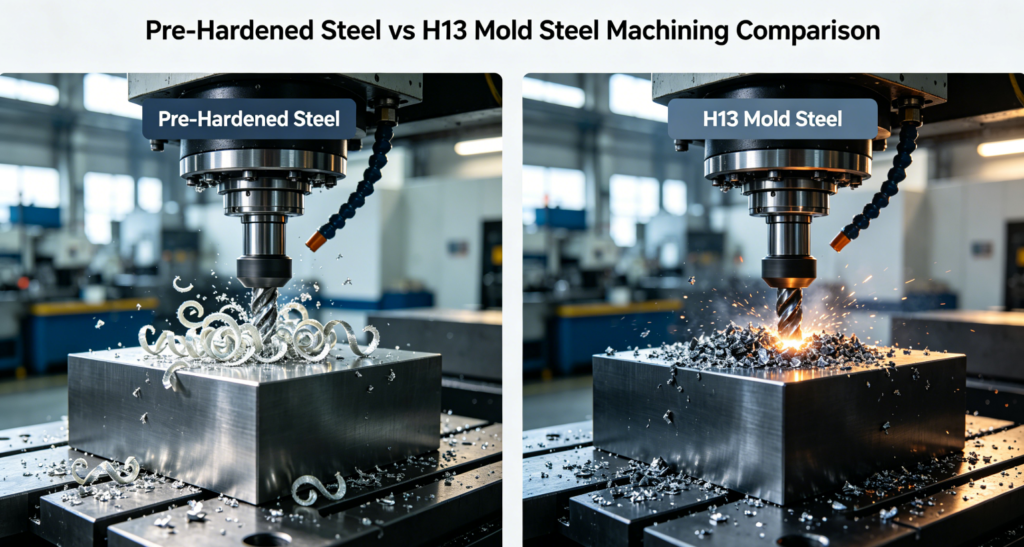
- Short, curled silver chips that flush away cleanly with standard coolant
- No chatter risk even with moderate tool overhang
Our internal data: P20 roughing removes material 18–22% faster than soft-state H13. Hardened H13 cuts take 2x longer total runtime.
H13 Steel Machining Performance (Two Stages)
- Annealed soft blank machining (pre-heat treat): Moderately easy, but higher alloy abrasion wears inserts faster than P20
- Post-heat treat hard milling (HRC 48–52): Very challenging
- Must use high-helix variable-pitch AlTiN/AlCrN carbide tools
- Cut SFM drops to 30–50 m/min; shallow depth per pass to avoid edge chipping
- High cutting heat concentrates at the tool tip; requires 70+ bar high-pressure coolant
- Long, sharp abrasive chips that scratch mold surfaces if not fully cleared
2. Tool Wear & Consumable Cost Breakdown
Tool replacement costs add massive hidden expense most engineers ignore.
- Pre-hardened P20: End mill life averages 110–140 minutes continuous cut. Insert change frequency is low, cutting tool spend minimal.
- H13 Soft State: Tool life drops 35% vs P20 for identical cutting paths.
- H13 Hardened State: Tool wear spikes 120% higher. Shops regularly burn through end mills in under 50 minutes of finishing work.
Real Zorapid client example: A 4-cavity consumer mold machined in P20 used $185 total in cutting tools. The identical mold design in post-heat treated H13 hit $420 in tooling alone.
3. Standard CNC Machining Parameter Cheat Sheet
| Machining Metric | Pre-Hardened P20 (HRC30) | H13 Annealed Blank (HRC22) | H13 Hardened (HRC50) |
|---|---|---|---|
| Roughing SFM | 85 m/min | 60 m/min | 38 m/min |
| Feed Per Tooth | 0.20 mm/z | 0.14 mm/z | 0.08 mm/z |
| Max Axial DOC | 3.0 mm | 2.0 mm | 0.6 mm |
| Recommended Tool Coating | Standard TiN | AlTiN Heavy Duty | AlCrN Hard Cut |
| Coolant Requirement | Standard flood coolant | Mid-pressure 40 bar | High-pressure 80 bar |
4. Distortion Risk & Post-Machining Rework
This is one of the biggest gaps between the two steels.
Pre-Hardened Steel Zero Heat-Treat Distortion Risk
All thermal processing finishes at the mill before delivery. Once your CNC finishes the mold, dimensions stay locked.
No furnace trips, no warping, no post-heat treat re-milling or grinding corrections. Tolerances ±0.005 mm hold straight off the machine.
H13 Severe Distortion After Heat Treatment
After quenching and tempering, H13 blocks warp 0.1–0.3 mm per meter on average.
Large deep-cavity molds can shift even more.
Your shop has two costly fixes:
- Machine oversized cavities pre-heat treat, then grind/mill back to final size post-hardening (adds full secondary machining cycle)
- Leave extra stock allowance everywhere, extending initial CNC runtime by 30%+
We regularly see 1–3 full days of rework added to H13 projects to fix heat treat distortion. Pre-hardened steel eliminates this step entirely.
5. EDM & Wire EDM Machining Differences
- P20 Pre-hardened: Fast EDM burn rates, uniform material removal, minimal electrode wear. Great for tight thin ribs and tiny mold details.
- H13 Hardened: Slow EDM cutting speeds, higher electrode consumption. Hard recast layers form on cavity walls that require extra polishing time to remove.
6. Polishing & Surface Finish Potential
- Pre-hardened P20: Polishes smoothly to SPI B1/B2 cosmetic finish, ideal for unfilled plastic consumer parts. Mirror SPI A-grade polish is possible but takes extra hours vs H13.
- H13 Steel: After heat treatment, the uniform alloy grain delivers premium SPI A1/A2 mirror polish. Perfect for high-gloss automotive and medical cosmetic molds, even with glass-filled resins.
Lead Time & Total Project Machining Timeline Comparison
Lead time is make-or-break for prototype and fast-turn tooling projects.
Pre-Hardened P20 Full Mold Timeline
- Receive pre-hardened blank (ready to cut day 1)
- CNC rough + finish machining in single setup
- Polish / texture / inspection
- Ship finished mold Total typical turnaround: 7–12 business days for standard molds
H13 Full Mold Timeline
- Receive soft annealed H13 blank
- First CNC roughing pass (oversized stock for distortion allowance)
- Ship block to external heat treat vendor (3–6 day furnace queue + processing)
- Return warped block for secondary finish milling / grinding
- EDM, polishing, final inspection Total typical turnaround: 18–30 business days
For rush prototype orders under 300,000 shots, pre-hardened steel slashes delivery windows by half.
Upfront vs Long-Run Cost Math
Scenario 1: Short Run / Prototype Mold (≤300,000 shots, unfilled PP/ABS plastic)
- Pre-hardened P20: Lower blank cost, no heat treat fees, faster CNC runtime, zero rework labor
- Total all-in cost (material + machining + labor): ~32% cheaper than H13 Best for: Consumer prototypes, small batch bridge tooling, low-temperature injection molding
Scenario 2: High Volume / Die Cast / Glass-Filled Resin (500,000+ shots, aluminum/zinc die casting)
- Pre-hardened P20 wears fast under abrasion and heat; you’ll replace the mold early
- H13 higher upfront machining cost pays off: 3–5x longer mold service life, no frequent cavity repair or re-polishing Best for: Automotive die casting, glass-filled PA/PPS medical molds, continuous mass production
Pre-Hardened Steel Machining Pros & Cons
Pros
- Direct-to-cut stock – skip all post-machining heat treatment steps
- 15–25% faster total CNC machining cycles
- Minimal cutting tool wear, lower consumable overhead
- Zero furnace distortion, tight tolerances on first pass
- Short lead times for urgent prototype tooling
- Easier to machine for small CNC shops without hard-cut equipment
Cons
- Lower max hardness (HRC35 cap) limits wear resistance
- Poor thermal stability – fails under die casting or high heat injection
- Not compatible with abrasive glass/mineral filled resins for long runs
- Mirror polishing takes longer than properly tempered H13
H13 Mold Steel Machining Pros & Cons
Pros
- Industry-leading heat and thermal fatigue resistance for die casting
- High post-temper hardness (HRC 48–52) fights abrasion from filled plastics
- Superior mirror polish capability for premium cosmetic parts
- 3–5x longer mold lifespan for mass production
- Resists heat checking, cracking and cavity deformation under high cycle heat load
Cons
- Two-stage machining process with mandatory off-site heat treatment
- 2x longer CNC machining runtime overall
- Sharply higher cutting tool consumption and hard-cut tooling investment
- Heat treat distortion adds costly secondary grinding/milling rework
- Significantly longer lead times for fast-turn projects
- Higher total machining labor cost upfront
How To Pick The Right Steel For Your Mold
Ask yourself these 4 quick questions to lock in your material:
- What’s my total expected production shot count?
- Under 300,000 shots → Pre-hardened P20
- Over 500,000 shots / die casting → H13
- Am I running glass-filled, mineral-filled or high-temperature resins?
- Yes → H13 only
- No (pure PP/ABS/PE) → Pre-hardened steel works perfectly
- Do I need my mold delivered in under two weeks?
- Yes → Pre-hardened steel eliminates heat treat waiting time
- Do I require A-grade ultra-mirror surface finish for luxury cosmetic parts?
- Short run mirror finish: Pre-hardened acceptable
- High volume mirror finish: H13 delivers better polish efficiency & longevity
Zorapid’s Machining Best Practices For Both Steels
Top Tips For Machining Pre-Hardened P20
- Run feed rates at the higher end of the recommended window to avoid built-up edge (BUE)
- Standard flood coolant works – no need for expensive high-pressure systems
- Leave 0.08–0.12 mm polishing stock on all cosmetic surfaces for fast hand finishing
- Use 4-flute general purpose carbide end mills for balanced speed and surface quality
Top Tips For Machining H13 To Cut Costs & Boost Tool Life
- Machine all roughing while H13 remains soft pre-heat treat; leave 0.3–0.5 mm stock allowance to absorb distortion
- After tempering, only perform light finishing passes to reduce hard-cut runtime
- Invest in variable pitch 5-flute AlCrN coated end mills for hardened H13 cuts
- Maintain 70+ bar high-pressure coolant to flush abrasive chips and lower tip temperature
- Double temper per ISO hot work steel standards to minimize long-term mold thermal fatigue
Final Wrap-Up – Machining Takeaways For Mold Buyers
At the machining level, the core divide could not be clearer:
Pre-hardened steel is built for speed, simplicity and low upfront machining cost. It’s the go-to choice for every short-run plastic mold project where fast delivery and budget control are top priorities.
H13 trades longer machining cycles, higher tool costs and extended lead time for unmatched heat, wear and cycle durability. It’s the only viable option for die casting and million-shot abrasive plastic production.
If you’re still unsure which material fits your mold project’s machining, volume and deadline goals, send your CAD file to Zorapid’s engineering team. We’ll complete a free DFM analysis with steel material recommendation and exact CNC machining timeline breakdown tailored to your product.
FAQ
Can I skip heat treatment if I pick H13 steel for injection molds?
No. H13 only arrives soft annealed at HRC 18–24 straight from the mill. Without quenching and double tempering, it lacks abrasion and heat resistance. The mold will scratch, deform, and fail after just tens of thousands of shots. Pre-hardened steel is the only mold steel that ships fully heat-treated with zero post-machining furnace steps.
How much faster is pre-hardened steel machining compared to hardened H13?
Overall CNC runtime for identical mold geometry runs 40%–60% quicker on pre-hardened grades like P20 or 718H. Hardened H13 demands slow cutting speeds, shallow passes and high-pressure coolant, plus extra secondary grinding to fix heat treat distortion that adds days of extra machining labor.
Will pre-hardened steel work for glass-filled plastic molds?
Not for long-run mass production. Pre-hardened steel maxes out at HRC 35, so glass fiber particles rapidly scratch cavity surfaces and wear out mold inserts. If you run glass-filled PA, PPS or PC for over 300,000 shots, H13 hardened to HRC 48–52 is the only cost-effective pick.
Why does H13 cause more cutting tool wear during CNC machining?
H13 holds high chromium, molybdenum and vanadium alloy content. These hard alloy carbides act like tiny abrasives when cutting. Annealed H13 already wears tools 35% faster than P20; fully hardened H13 spikes tool consumption over 100% compared to pre-hardened steel. Shops need premium AlCrN coated end mills just to machine hardened H13 efficiently.
Does pre-hardened steel warp after machining?
Almost zero distortion risk. All thermal stress relief and hardening finishes at the steel mill before delivery. Once CNC work wraps up, dimensions stay consistent, and you can hit tight ±0.005 mm tolerances without secondary rework. H13 always warps post heat treatment and requires stock allowance + post-hardening finishing passes.
Which steel is better for mirror SPI A-grade polishing?
Tempered H13 delivers smoother, faster mirror polishing for high-volume cosmetic molds. Pre-hardened steel can reach SPI A finish too, but it needs significantly more manual buffing hours and scratches more easily during long production cycles. For short-run prototype glossy parts, pre-hardened steel is still acceptable to save cost.
What’s the typical lead time difference between P20 pre-hardened and H13 molds?
Standard pre-hardened mold turnaround sits at 7–12 working days. H13 molds take 18–30 days total because you have to account for heat treat queue time, distortion correction re-machining and slow hard-milling finishing steps. If you have a tight prototype deadline under two weeks, always choose pre-hardened steel.
Can H13 be used for plastic injection molds, or is it only for die casting?
H13 works great for both aluminum/zinc die casting AND high-stress plastic injection molds. It’s ideal for high-temperature resins, abrasive filled materials, and molds expecting 500,000+ production shots. Pre-hardened steel only suits low-heat, unfilled plastic short-run tooling.
Is pre-hardened steel cheaper than H13 when counting all machining costs?
For low-volume projects (≤300k shots), pre-hardened steel cuts total all-in cost by roughly 30%. You skip heat treat fees, reduce tool replacement expenses, and eliminate rework labor to fix distortion. For million-shot mass production, H13’s longer mold lifespan balances out its higher upfront machining expense over time.
Do I need special CNC equipment to machine pre-hardened steel?
Standard 3-axis or 5-axis CNC machines with regular coated carbide tools and flood coolant work perfectly for pre-hardened steel. Machining hardened H13 requires high-pressure coolant systems, hard-cut specific tooling, and rigid machine spindles to avoid chatter and premature tool failure. Small job shops without hard milling setups almost always stick to pre-hardened steel.
How does EDM wire cutting differ between pre-hardened steel and H13?
EDM burns far faster on pre-hardened steel with less electrode wear and thin, clean recast layers. Hardened H13 runs slower during sinker/wire EDM, creates thick recast layers on cavity walls, and forces extra polishing to remove surface defects left after burning.
Can Zorapid help me pick between pre-hardened steel and H13 for my mold?
Absolutely. Send over your CAD drawing, expected shot count, resin material and delivery timeline, and our engineering team will deliver a free DFM analysis with a clear steel recommendation, full machining parameter breakdown and accurate lead time & cost estimate tailored to your project.