Published:Zorapid.Ltd
If you design or source minimally invasive endoscopy instruments for hospitals, surgical device brands across Europe, the US and Canada—you know how brutal micro shaft production can get.
Tiny endoscopic shafts sit at the heart of every laparoscope, bronchoscope, cystoscope and disposable endoscope probe. One tiny dimensional error, uneven surface finish or burr can ruin surgical performance, trigger FDA/EU MDR non-compliance, or force costly full batch scrap.
Most generic machine shops can hit standard ±0.02mm tolerances, but endoscopic micro shafts demand far tighter control: wall thickness down to 0.06mm, OD tolerances ±0.003mm, burr-free micro bores, mirror smooth biocompatible surfaces, and consistent straightness over ultra-slender lengths. Regular 3-axis CNC can’t handle this delicate micro work without chatter, deformation or surface smearing.
Why Tiny Endoscopy Shafts Demand Micro Ultra-Precision CNC
Let’s cut straight to the critical gaps standard CNC can’t solve for endoscopic micro shafts:
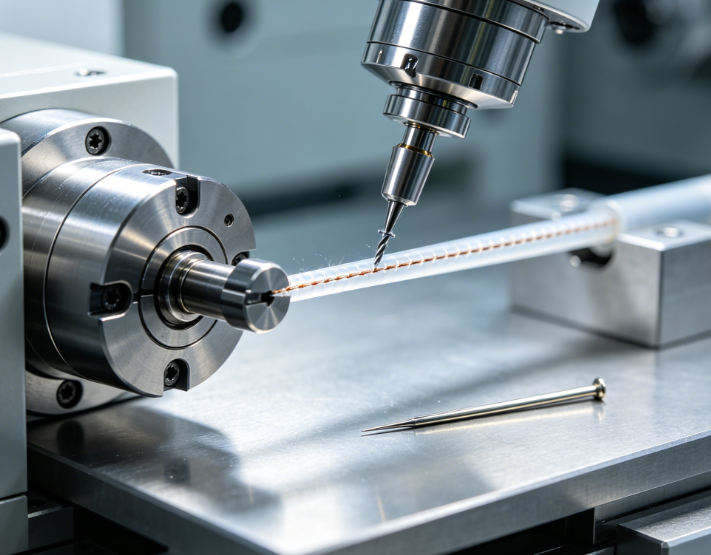
- Extreme slender length-to-diameter ratios Many endoscope shafts run 50–300mm long with outer diameters only 1.0mm–4.0mm. Regular lathes create vibration chatter, bending and uneven wall thickness during cutting. Our micro Swiss CNC uses guide bush steady rest support to hold rigidity through full machining.
- Micron-level tolerance requirements Fluid channels, guide wire lumens, connector mating shoulders and sealing grooves require repeatability down to ±0.002–±0.005mm. Even 0.01mm drift causes fluid leakage, wire jamming or assembly failure during surgery.
- Zero micro burr & seamless internal bore finish Any tiny burr inside the shaft lumen risks scratching delicate guide wires, tissue damage inside patient cavities, or contamination traps that fail medical biocompatibility testing.
- Biocompatible thin-wall geometry Disposable endoscopic shafts use ultra-thin walls (0.06–0.15mm) to maximize inner channel space. Standard machining pressure warps thin tube walls irreparably. Micro low-feed, high-RPM cutting parameters eliminate deformation.
- Strict surface roughness specs for medical use Internal and external surfaces must hit Ra ≤0.05μm for easy sterilization, no biofilm buildup. Conventional turning leaves visible tool marks that don’t pass Class II medical device inspection.
At Zorapid, our micro ultra-precision CNC cells are purpose-built for these surgical micro shaft challenges—no retrofitted general machinery, no compromises on medical quality standards.
Zorapid Micro Ultra-Precision CNC Full Workflow for Endoscopy Shaft Components
Every tiny endoscopic shaft follows a standardized, fully documented production pipeline visible to your US/EU engineering team via weekly progress updates:
Medical DFM Micro Analysis (Critical Pre-Machining Stage)
Before touching any micro bar stock, our medical machining engineers run a dedicated micro DFM report tailored to endoscopic shafts:
- Slender rod rigidity simulation to predict bending during micro cutting
- Thin wall thickness validation to avoid collapse under micro tool pressure
- Micro groove, lumen and undercut feature manufacturability check
- Shrinkage & thermal expansion compensation for titanium, stainless steel, PEEK
- Draft, edge radius and deburring requirement mapping
- Tolerance conflict review for mating endoscope handle connectors
We share annotated CAD screenshots and risk notes in plain English; we only start machining once your team signs off all DFM adjustments. This eliminates 95% of costly post-production micro part rework.
Biocompatible Material Stock Selection for Micro Endoscopy Shafts
We machine three primary medical-grade materials for tiny endoscopic shafts, each matched to your disposable/reusable device roadmap:
- Medical Grade 316L Stainless Steel (1.4435) Best for reusable rigid endoscope shafts, high tensile strength, corrosion resistant for repeated autoclave sterilization. Micro CNC capable of 0.08mm minimum wall thickness.
- Ti-6Al-4V ELI Titanium Alloy Ultra-lightweight, MRI-safe, ideal for long minimally invasive surgical probes. Low thermal conductivity requires specialized micro carbide tooling to avoid surface discoloration.
- Medical Implant PEEK Radiolucent, flexible disposable endoscopic micro shafts, no metal artifacts in imaging. Low cutting force micro parameters prevent plastic melting and edge smearing.
All raw material batches ship with full material test certificates (MTC) traceable for EU MDR and FDA device audits.
Swiss-Type Micro Ultra-Precision CNC Machining Core Process
Our production line uses high-precision Swiss sliding head micro CNC machines built for sub-4mm diameter micro shafts:
- High-speed spindle up to 15,000 RPM for ultra-fine micro cuts
- Oil mist minimal quantity lubrication (MQL) medical-grade coolant, no chemical residue retention
- Built-in guide bush steady rest to stabilize slender micro bars, eliminate chatter lines
- Multi-axis simultaneous cutting to machine outer OD, internal lumens, sealing grooves and locating shoulders in one single setup
- Micro carbide boring tools down to 0.3mm diameter for tiny internal fluid channels
One-setup machining drastically reduces part handling errors—every tiny endoscopic shaft maintains consistent micron tolerance across full length.
Zero-Burr Micro Deburring & Cleanroom Finishing
Micro burrs are the top failure point for endoscopy OEMs, so we run two dedicated deburring stages post-CNC:
- Ultrasonic micro deburring for internal lumens, removes micro metal slivers without scratching thin walls
- Electropolishing for stainless steel & titanium shafts to hit Ra ≤0.05μm mirror finish All finishing takes place inside a Class 1000 semi-cleanroom to prevent micro dust contamination on surgical components. PEEK shafts receive solvent medical-grade ultrasonic wash to eliminate fine plastic particles.
In-Line Micro Metrology & 100% Dimensional Inspection
Every single micro endoscopy shaft undergoes full automated measurement before packaging:
- Optical micrometer scanning for OD/ID micron tolerance verification
- CMM contact probe inspection for shoulder step heights, groove depths and total shaft straightness
- Surface roughness tester to validate Ra medical finish requirements
- Visual high-magnification microscope audit for micro burrs, scratches or surface defects
We attach full inspection data, measurement charts and golden sample photos to your FAIR (First Article Inspection Report) for regulatory submission.
Medical Sterile Packaging & Export Shipment
Qualified micro shafts are cleaned, dried, sealed in medical-grade PE packaging with batch traceability labels. We ship directly to US/EU medical device factories with full compliance documentation bundles.
Key Technical Advantages of Zorapid Micro Ultra-Precision CNC for Endoscopy Shafts
- Consistent micron tolerance range ±0.002mm to ±0.005mm, far tighter than standard medical machine shops
- Machining capability for ultra-slender shafts: L/D ratio up to 120:1 without bending or chatter
- Minimum wall thickness 0.06mm for disposable micro endoscopic tubing
- Burr-free internal lumens down to 0.3mm micro bore diameter
- In-house cleanroom electropolishing and medical ultrasonic washing
- Full ISO 13485 medical manufacturing traceability for every production batch
- English-speaking medical engineering team familiar with FDA, EU MDR, UKCA audit requirements
- Rapid micro prototyping lead time 7–12 working days; mass micro component production available
- Zero hidden inspection, finishing or compliance documentation fees in all quotes
Most Common Micro Endoscopy Shaft Machining Defects & How We Eliminate Them
We’ve solved every frequent micro shaft issue Western medical OEMs face with generic suppliers:
- Chatter lines on outer shaft surface Root cause: Unstable bar support on standard lathes Zorapid fix: Swiss sliding head guide bush steady rest + low-vibration micro cutting parameters
- Uneven thin wall thickness along shaft length Root cause: Multiple re-fixturing during multi-step machining Zorapid fix: Single-setup multi-axis micro CNC complete machining
- Micro burrs trapped inside internal lumens Root cause: Manual deburring unable to reach tiny deep channels Zorapid fix: Automated ultrasonic lumen deburring + post-polish microscope inspection
- Shaft bending after machining Root cause: High cutting heat and heavy clamping force Zorapid fix: Low-pressure micro clamping, MQL cooling, stress relief post-processing
- Tool marks failing medical surface specs Root cause: Low-quality standard cutting tools Zorapid fix: Diamond-coated micro carbide tooling with ultra-fine feed rates
Industry Compliance Standards We Follow for Surgical Micro Shaft Components
All micro ultra-precision CNC production for endoscopy shafts adheres to global medical regulatory rules:
- ISO 13485 Medical Device Quality Management System
- ASME Y14.5 GD&T Micro Tolerance Drawing Standards
- EU MDR 2017/745 for Class IIa/IIb endoscopic surgical devices
- FDA 21 CFR Part 820 US medical manufacturing requirements
- Biocompatibility material standards ISO 10993 for skin & tissue contact components
FAQ
What’s the smallest outer diameter endoscopy shaft Zorapid can machine?
Our Swiss micro CNC lines reliably machine micro shafts with OD starting at 0.8mm, with internal lumens as small as 0.3mm. We regularly produce 1.0mm–4.0mm diameter shafts for bronchoscopes, cystoscope probes and disposable laparoscopic instruments.
What micron tolerance can you guarantee on endoscopic micro shafts?
Standard production tolerance ±0.005mm for OD/ID dimensions. For high-end surgical imaging equipment, we deliver controlled precision down to ±0.002mm with 100% CMM optical inspection for every batch.
Can you machine ultra-thin wall disposable PEEK endoscopy shafts?
Yes. We specialize in medical PEEK micro thin-wall components with minimum wall thickness 0.06mm. Our low-heat micro cutting parameters prevent melting, warping and edge smearing common with plastic micro machining.
Is electropolishing included in your micro shaft machining quote?
All-in pricing covers standard medical electropolishing for 316L and Ti-6Al-4V shafts to Ra ≤0.05μm. We add a clear breakdown for specialized surface treatments in every formal quotation, no surprise extra charges post-production.
How long is lead time for micro endoscopy shaft prototypes and mass runs?
Micro prototype small batches (10–50 pcs): 7–12 working days. Mass production micro component orders: 18–30 working days, depending on shaft length, lumen complexity and compliance documentation requirements. Our lead times are consistently shorter than EU domestic micro machining suppliers.
Do you provide full FAIR and traceability documents for FDA/EU MDR audits?
Absolutely. Every order ships with full MTC material certificates, batch production records, complete CMM inspection data, surface roughness test reports and first article FAIR documentation fully aligned with US and European medical audit standards. Our engineering team can assist you to fill in device technical files if needed.
What’s the maximum length of micro endoscopic shaft you can produce without bending?
Our Swiss micro CNC setup stabilizes slender shafts up to 300mm total length with L/D ratio as high as 120:1. Longer custom probe lengths are available with segmented precision assembly secondary operations.
Can you avoid micro burrs inside tiny shaft lumens?
Our dual-stage automated deburring workflow eliminates internal micro burrs entirely. Ultrasonic agitation targets deep narrow lumens, followed by high-magnification microscope inspection to confirm zero residual metal slivers before cleanroom finishing. Manual hand deburring is never used for endoscopic fluid channel components.
Do you support low-volume custom micro shaft R&D batches for medical startups?
Yes. We accept small R&D prototype orders from EU/US medical startups with no minimum order quantity lock-in. Our micro CNC cells are flexible for low-run iterative design changes, with transparent per-unit pricing for small batch testing.
What information do I need to submit to get an accurate micro CNC quote & DFM review?
- STEP/IGS 3D CAD files + 2D GD&T engineering drawings with full micro tolerance specs
- Target material (316L, Ti-6Al-4V ELI, medical PEEK)
- Required surface roughness Ra value and finishing type (electropolish / ultrasonic wash)
- Annual production volume (R&D prototype vs mass manufacturing)
- Regulatory compliance requirements (FDA, EU MDR, UKCA)
- Shaft length, OD, ID and thin wall thickness limits
- Required lead time target
We deliver a free micro DFM risk analysis and formal all-in quotation within 24 working hours after receiving your technical files.
What after-sales support do you offer for micro endoscopic shaft components?
All Zorapid micro machined medical parts carry dimensional consistency warranty. Our English medical engineering team provides free remote technical troubleshooting via video call for your assembly or sterilization teams. We also support design iteration tweaks and secondary precision assembly for complete endoscope probe subassemblies.
Closing Takeaway
Tiny endoscopy shaft components sit at the core of safe, high-performance minimally invasive surgery—cutting corners on micro CNC precision creates massive regulatory, clinical and financial risks for medical OEM brands across Europe and North America.
Standard general-purpose machining cannot replicate the micron-level stability, zero-burr finishing and medical compliance built into Zorapid’s Micro Ultra-Precision Swiss CNC workflow. Every process step, from initial micro DFM analysis through cleanroom inspection, is engineered specifically for slender, thin-walled endoscopic micro shafts.
If you’re sourcing prototype or mass production micro endoscopy shafts for your surgical device line, send over your CAD drawings and project requirements via our website contact form. Our medical micro machining team will deliver a free DFM evaluation and transparent fixed-price quote within one business day, tailored to US/EU medical regulatory standards.