Published by: Zorapid.Ltd
Every product team hits the same roadblock in NPI development.
You finish 3D printed samples for fit checks, and you’re ready to run functional tests, beta customer trials, or limited small-batch launches.
The hard choice pops up immediately:
Do you drop $15,000+ on a hardened steel production mold with a 8–12 week lead time? Or find a flexible tooling solution to produce 500–10,000 production-grade plastic parts fast?
At Zorapid, we build hundreds of rapid prototype molds for small-batch plastic runs every year. We see the same costly mistake repeated over and over: locking in expensive hard tooling before the part design is fully validated.
Rapid prototype molds (also called soft tooling or bridge tooling) fill this gap perfectly. Built mostly from high-grade aluminum, these tools cut lead time in half, slash upfront mold cost by 40–65%, and produce real injection-molded parts with your final resin — no more unreliable 3D printed test pieces.
This complete guide breaks down everything you need to know about rapid prototype molds for small-batch plastic manufacturing. We cover mold material selection, cost & lead time data, common design pitfalls, iteration flexibility, and a real case where aluminum prototype tooling cut total project spending by 48% while delivering beta parts in 18 days.
If you need low-volume molded components without the risk of scrapping expensive steel molds after design tweaks, this practical playbook will streamline your small-batch workflow.
What Exactly Is a Rapid Prototype Mold?
Let’s clear up a common misunderstanding first.
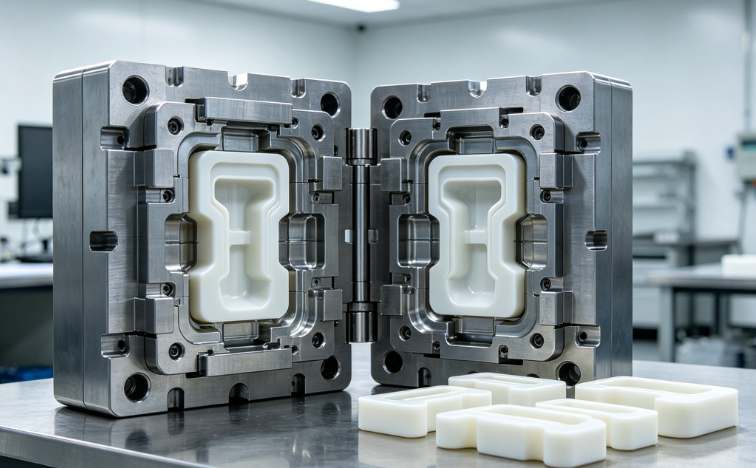
A rapid prototype mold is not a low-quality disposable tool. It is a precision injection mold built specifically for short-run production, designed to bridge the gap between one-off prototypes and full mass-production hard tooling.
Core Characteristics
- Material: High machinability aluminum alloy (6061-T6 or aerospace-grade 7075-T6) or pre-hardened soft P20 steel for longer small runs. No heat treatment is required after CNC machining, so we skip weeks of secondary processing.
- Structure: Mostly single-cavity design, paired with a standard universal mold base (MUD system). No complex hot runners or hardened ejector components to keep cost low.
- Output Capacity: Stable production of 500 up to 10,000 shots for aluminum versions; P20 steel bridge molds can extend up to 50,000 small-batch parts.
- Part Quality: Uses standard injection pressure and temperature. You can mold ABS, PC, PP, Nylon, POM, and even low-content glass-filled plastics with the same surface finish and material properties as mass-produced parts.
3D printing only proves geometry. A rapid prototype mold lets you run real molding cycles to catch sink marks, warpage, knit lines, and ejection damage before freezing your final CAD file.
Direct Comparison: Rapid Prototype Mold vs Steel Production Mold
This side-by-side table is our standard quotation reference for small-batch projects. All data comes from our in-house mold shop production records.
| Evaluation Item | Aluminum Rapid Prototype Mold (Small Batch) | Hardened H13/S136 Steel Production Mold |
|---|---|---|
| Primary Raw Material | Al 7075-T6 / 6061-T6 | Pre-hardened steel + vacuum heat treatment |
| Total Mold Lead Time | 12–25 working days (T1 sample fast track) | 60–90 days with heat treatment & EDM work |
| Upfront Tooling Cost | 35–55% lower than steel mold | High initial investment |
| Typical Shot Lifespan | 5,000–10,000 cycles | 500,000+ long-term mass production |
| Cooling Efficiency | 5× higher thermal conductivity; 20–30% shorter molding cycle | Slow heat dissipation, longer cooling hold time |
| Design Revision Cost | Low cost; easy CNC rework on aluminum cavities | Expensive rework; re-machining hardened steel costs heavily |
| Surface Finish Support | Polishing, light texture grain available | Full deep etching + high polish for cosmetic mass production |
| Best For | 500–10,000 pcs beta runs, iterative design validation | 100,000+ high-volume mass manufacturing |
Key takeaway:
If your batch size stays under 10k units and you still plan to tweak wall thickness, gating or draft angles, rapid aluminum prototype tooling is always the lower-risk choice.
Top 5 Advantages of Rapid Prototype Molds for Small Batch Plastic Runs
1: Slash Upfront Investment & Eliminate Sunk-Cost Risk
The biggest pain point in early-stage product development is wasted tooling budget.
A small custom steel mold easily costs $12,000–$30,000. If your small-batch testing reveals warpage or assembly interference, the whole tool becomes scrap.
Aluminum prototype molds cut mold expenditure nearly in half. You only pay for CNC cavity machining without heat treatment, complex EDM or hardened mold bases. Even if you revise the part 2–3 times after testing, reworking the aluminum cavity remains cheap and fast.
For startup and R&D teams working on tight budgets, this eliminates nearly all financial risk during small-batch validation.
2: Cut Total Lead Time to Launch Beta Batches
Hardened steel molds require rough machining → heat treatment → stress relief → finish CNC → EDM → polishing. Every step adds waiting time.
Aluminum machines 40–60% faster than tool steel. We skip thermal processing entirely.
Our standard timeline:
DFM review + CNC machining → T1 sample delivery in 12–18 days; full small-batch production ready within 3 weeks.
Many of our clients ship beta customer orders before competitors even finish steel mold processing. Speed wins early market testing and pre-order sales.
3: Faster Cooling Shrink Your Molding Cycle
Aluminum transfers heat five times faster than steel. Molten plastic solidifies much quicker inside the cavity.
Cycle time drops by 20–30% compared to identical parts run in steel molds.
Even on small runs of 1,000–3,000 pieces, the faster injection cycles speed up your whole batch delivery without sacrificing dimensional stability. Thin-wall parts have less residual stress and far less warpage thanks to uniform rapid cooling.
4: Iterate Freely Without Massive Rework Fees
Small-batch production is almost never one-and-done.
You will adjust gate location to eliminate knit lines, add draft angles to fix ejection scuffs, or thicken thin walls to reduce sink marks.
Modifying an aluminum cavity only requires re-milling local features. We can update the mold and run a revised batch within 3–5 working days.
Steel mold rework needs re-EDM and re-polishing, often costing thousands and adding weeks of delay.
We regularly run 3–4 design variants sequentially on the same aluminum mold base just by swapping revised inserts.
5: Produce Real Injection-Molded Parts (No More 3D Printing Limitations)
3D printed parts have layered grain, inconsistent shrinkage, and cannot replicate the behavior of molded ABS, PC or glass-filled nylon. Your environmental and durability test data will be unreliable.
Parts from rapid prototype molds go through full injection, packing, hold and cooling cycles. The material shrinkage, surface texture, warpage and cosmetic defects match exactly what you will get from future mass-production steel tooling.
You validate every molding defect early, so you lock in a perfect design before investing in hard tooling.
Mold Material Selection: 6061 vs 7075 Aluminum vs P20 Bridge Steel
Pick your prototype mold material strictly based on batch size and plastic resin. Zorapid’s shop standard rules:
- Aluminum 6061-T6 (Entry-level rapid tooling)
- Shot life: Up to 5,000 cycles
- Best for: Unfilled ABS, PP, PE small batches under 3,000 pcs
- Pros: Lowest cost, easy welding and rework
- Limitation: Poor wear resistance against glass-filled resins; not ideal for deep textured surfaces
- Aluminum 7075-T6 (Our most popular prototype mold grade)
- Shot life: 5,000–10,000 stable cycles
- Best for: PC, PC+ABS, Nylon, low-fill glass resin, cosmetic housings with light grain texture
- Pros: High tensile strength, better surface polish, less cavity wear, fast cooling
- Cons: Cannot be easily welded; design should be mostly frozen before machining
- P20 Pre-hardened Steel (Bridge Tooling for Medium Small Batches)
- Shot life: 50,000+ cycles
- Best for: 10k–50k small runs, glass-filled plastics, abrasive engineering resins
- Use case: When you need continuous short-run production while waiting for your final hardened mass-production mold to be built
General rule:
Under 10,000 shots with unfilled plastic → 7075 aluminum prototype mold.
Above 10,000 shots with filled resin → upgrade to P20 soft steel bridge tooling.
4 Common Prototype Mold Mistakes That Ruin Small-Batch Runs
We fix these four engineering oversights on most incoming part files before cutting aluminum cavities:
1: Zero draft angles on ribs and bosses
Aluminum molds cannot withstand heavy forced ejection. Zero draft creates severe scuffing and cavity wear after only a few hundred shots.
Fix: We add 0.5°–1.5° minimum draft during our free DFM check before CNC work starts.
2: Over-specifying deep heavy texture on aluminum cavities
Deep grain etch creates sharp ridges that catch plastic during ejection, tearing both part and cavity surface.
Fix: Limit rapid prototype molds to light SPI grain or high polish. Save deep texture for steel production tooling.
3: Placing gates right on thin-wall cosmetic surfaces
Improper gating causes knit lines, sink marks and trapped air bubbles that show up clearly on small-batch molded parts.
Fix: We optimize gate position and runner layout in MOLDFLOW simulation before machining the cavity.
4: Building multi-cavity prototype molds too early
Multi-cavity aluminum molds raise cost and slow cooling consistency. Variation between cavities ruins small-batch test data.
Fix: Stick with single-cavity design for all iterative small-batch validation jobs. Multi-cavity only makes sense for stable high-volume bridge production.
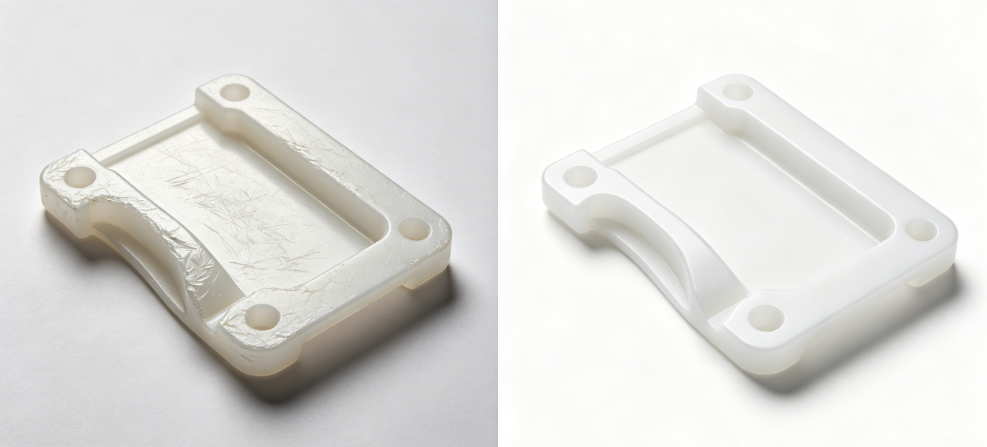
Zorapid Real Case Study – Small Batch Beta Production With Rapid Prototype Mold
Project Background
Consumer electronics plastic enclosure, material PC+ABS, required small batch of 2,200 beta test units for early customer sampling.
Original plan: Build hardened S136 steel mold right away.
Original Risk
Total mold cost would hit $18,500 with 9-week lead time. If environmental testing caused warpage, the whole steel tool would become scrap.
Our Rapid Prototype Mold Solution
- Built single-cavity mold from 7075-T6 aluminum alloy
- Completed DFM draft optimization + MOLDFLOW cooling analysis
- Finished CNC cavity machining and polishing in 16 working days
- Ran injection molding with balanced cooling to control thin-wall warpage
Final Results
- Total mold cost reduced by 48% compared to steel tooling
- Beta batch parts delivered 6 weeks ahead of the original timeline
- We found minor sink marks on the thick boss during small-batch molding, revised the CAD file and reworked the aluminum cavity in 4 days
- Zero scrap across the full 2,200-piece run; parts passed all cosmetic and assembly tests
After validation, the customer froze the design and ordered the hardened steel production mold with zero costly rework.
Ready-to-Use DFM Checklist For Rapid Prototype Mold Design
Run this checklist before releasing your part for aluminum mold machining:
All vertical walls have defined draft angles to avoid ejection damage
No deep heavy grain; only polish or light matte texture on aluminum cavities
Single-cavity layout for iterative small-batch testing
Gate and runner layout optimized to eliminate knit lines and air traps
Wall thickness kept uniform to reduce sink marks and warpage
Hole features placed no closer than 2.5× wall thickness to mold edges
Resin type matched to aluminum grade (7075 for engineering plastics)
Follow these rules, and your rapid prototype mold will produce consistent small-batch parts without premature cavity wear.
How Zorapid Delivers Reliable Rapid Prototype Molds For Small Batch Runs
With 20+ years of mold building and short-run injection molding, we support R&D teams across medical, automotive, consumer electronics and automation hardware.
Our end-to-end rapid tooling service includes:
- Free DFM mold review + MOLDFLOW cooling & warpage simulation
- High-speed 3/5-axis CNC milling on 7075 aluminum with fast-track T1 sample lead time
- Controlled mold polishing and light surface texturing for cosmetic small-batch parts
- In-house injection molding line to produce your 500–10,000 piece batch right after mold completion
- Low-cost local cavity revision if you need design tweaks after small-batch testing
We keep your tooling cost low, iteration fast, and avoid the high risk of premature hard steel mold investment.
Conclusion
Rapid prototype molds are not just temporary test tools. They are the most cost-effective bridge between 3D printed prototypes and mass-production steel tooling for small-batch plastic manufacturing.
Three core takeaways for your NPI workflow:
- Use 7075 aluminum rapid prototype molds for 500–10,000 piece beta runs. You cut mold cost by nearly half and slash lead time from months down to 2–3 weeks.
- These molds produce true injection-molded parts with production-grade resin, so you catch molding defects long before you lock in expensive hardened steel tooling.
- Keep single-cavity design and light surface finishes to extend aluminum mold life and minimize rework cost during design iterations.
Stop gambling your budget on steel molds before your design is validated. Validate first with rapid prototype soft tooling, then scale to mass production confidently.
Send your STEP part file to Zorapid today. Our mold engineers will finish the DFM analysis and quote your aluminum prototype mold + small-batch molding within 24 hours.
FAQ
How many shots can I get from a 7075 aluminum prototype mold?
5,000–10,000 stable cycles for unfilled ABS, PC, PP and Nylon. If you run glass-filled plastics, expect shorter lifespan; we add small P20 steel inserts on high-wear edges to extend mold life.
Can I do texture etching on aluminum prototype molds?
Light matte grain works perfectly. Deep heavy texture creates sharp undercuts that tear plastic during ejection and abrade the aluminum surface quickly. Reserve deep grain for hardened steel production molds.
What is the typical lead time for a single-cavity rapid prototype mold?
12–25 working days including CNC machining and polishing, without heat treatment delays. We offer fast-track T1 sampling for urgent small-batch orders.
Should I choose prototype tooling or jump straight to steel molds?
Always use aluminum rapid prototype molds if you still need to adjust wall thickness, gating or draft angles, or if your total batch stays below 10,000 units. Only build hardened steel molds once your design is fully frozen and production volume exceeds 50,000 parts.
Will parts molded from an aluminum prototype mold match mass-production quality?
Yes. We run identical injection pressure, temperature and packing parameters. Shrinkage, warpage and surface quality will be consistent with future steel-molded components, making small-batch test data fully reliable.