Published:Zorapid.Ltd
If your CNC machines spend more time sitting idle than cutting metal, you are throwing away profit every shift.
Traditional clamping takes 15 to 45 minutes to align, indicate and re-zero every new job.
For small-batch, high-mix orders, changeover downtime kills spindle utilization.
This is where a zero point fixture system completely rewrites your workflow.
It locks pallets into a fixed reference position in seconds, no repeated probing, no manual alignment.
At Zorapid, we rolled out zero point workholding across all our 5-axis cells. We boosted spindle uptime by 42% and cut setup scrap nearly to zero.
Today we break down how this quick-change system works, hard data on time savings, real shop use cases, and how it makes lights-out unmanned production possible.
What Is a Zero Point Fixture System, In Plain Shop Terms
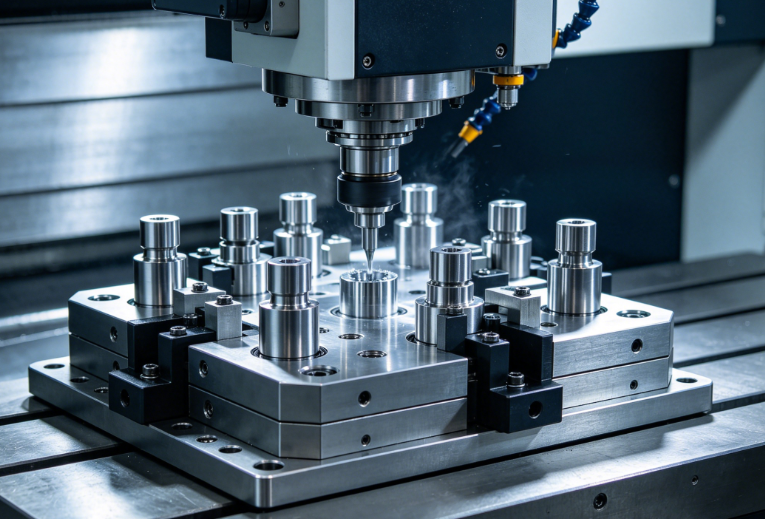
A zero point system builds a universal fixed origin on your machine table.
It has two core parts:
- Base modules: Bolted permanently onto the CNC table. These hold locking pull studs with pneumatic or hydraulic clamping power.
- Pallet plates: Mounted under your vise or custom fixture. Each pallet has precision locating pins that drop straight into the base modules.
How it works
You clamp and align workpieces on a bench outside the machine while the spindle keeps cutting.
When the machine finishes the current job, you unlock the old pallet, drop the new pre-fixtured pallet into position, and lock it in one motion.
No re-indicating, no re-setting workpiece zero. The coordinate origin stays identical every single time.
Repeatability stays within ±0.002 mm, even after thousands of pallet swaps.
This is the secret to eliminating human alignment error forever.
Zero Point VS Traditional Vise Clamping
Most shops underestimate how much time manual fixturing eats up.
We tested both workflows on our aluminum aerospace bracket jobs with frequent job switching.
| Operation | Traditional Clamping | Zero Point Pallet System | Time Saved |
|---|---|---|---|
| Remove old fixture & clean table | 12 min | 2 min | 10 min |
| Align, indicate & bolt down new plate | 22 min | 0 min (pre-set offline) | 22 min |
| Probe edges & reset workpiece zero | 16 min | 0 min (fixed datum) | 16 min |
| Run trial cut & adjust offset | 10 min | 0 min | 10 min |
| Total job changeover time | 60 minutes | Under 90 seconds | 58+ minutes per switch |
For a shop with 4 job changeovers per shift:
Traditional setup loses nearly 4 hours of spindle time every single day.
With zero point fixturing, that lost time vanishes entirely.
Key Outcome
Spindle-on cutting time jumps from 45% up to 75%–82%.
More cutting hours directly turn into higher monthly output without buying new machine tools.
5 Core Efficiency Gains From Zero Point Workholding
1. Shift Setup Work Offline (Biggest Productivity Win)
This is the game-changer.
Operators prepare new parts, clamp vises and set coordinates on a separate bench.
The CNC machine never stops running to wait for fixture prep.
Setup work no longer blocks machine runtime.
2. Zero Repeated Zeroing & Alignment Errors
Every time you re-clamp manually, you introduce small positional drift.
Tight ±0.005 mm tolerances often fail just from inconsistent indicating.
With a fixed zero datum, every pallet returns to the exact same coordinate position.
Scrap caused by setup error drops by over 70% on precision 5-axis parts.
3. One Fixture Base Works Across All Your Machines
All your 3-axis, 5-axis and EDM machines share the same zero point interface.
You can move a pallet with a partially machined part from milling to wire EDM without re-clamping.
No stacking tolerance from repeated re-fixturing on multi-operation jobs.
4. Cut Labor Dependency
Less time spent tightening bolts and dial indicators means fewer skilled operators tied to each machine.
One worker can tend 3–4 CNC cells instead of only 1 or 2. Labor cost per finished part falls sharply.
5. Unlock Lights-Out Unmanned Production
Zero point pallets are the foundation of unattended machining.
Robots can automatically swap pallets without human adjustment.
We run 12-hour overnight lights-out batches on our titanium and Inconel jobs purely thanks to standardized zero point fixturing.
Zorapid Real-World Case Study
Project: S136 medical mold inserts, frequent design revisions & small batch runs
Old workflow problems:
- Every new insert required 40+ minutes of re-fixturing and zero reset
- Multiple re-clamps created position shift on thin-wall cavity features
- Only 3 batches could run per machine per day
After installing pneumatic zero point base plates:
- All vises were pre-mounted on interchangeable pallets
- Part clamping was fully moved to offline bench preparation
- Pallet swap finished within 60 seconds, no coordinate rework
Measurable results:
- Daily production batches increased from 3 up to 7
- Setup-related scrap dropped from 9% down below 1.2%
- Total throughput rose by 55% without adding extra machines or staff
- All multi-op parts maintained consistent tolerance across milling and sinker EDM
Best Application Scenarios For Zero Point Fixtures
Zero point systems deliver maximum ROI on these job types:
- High-mix, small-batch CNC parts (aerospace, medical prototypes, custom tooling) Frequent job switching makes long changeovers extremely costly.
- 5-axis multi-sided complex components Eliminates repeated re-clamping for undercuts and full 5-sided machining.
- Multi-operation jobs (Milling + EDM + Grinding) Transfer pallets between machines without breaking the reference datum.
- Lights-out automated production cells Standardized pallets are mandatory for robotic pallet changing.
Less Ideal Scenario
If you run only one single part in 10,000-piece mass runs with zero job switching, the ROI will be slower. But nearly all modern precision job shops still benefit from standardized zero-point workholding long term.
Practical Tips To Roll Out Zero Point Fixtures Without Overspending
- Start small Fit zero point base plates on your busiest 5-axis machine first. Run a 30-day productivity test before rolling out to the whole shop.
- Standardize all pallets Make every fixture plate share the same pull stud layout. Avoid mixed interfaces that defeat quick-change benefits.
- Choose pneumatic locking for manual workshops Hydraulic locking works great for automation, but air-operated modules carry a much lower upfront cost for manual pallet swapping.
- Keep locating surfaces clean Debris on the zero point locating face ruins repeatability. Add regular air blowing between pallet changes to maintain micron-level accuracy.
- Match clamping force to your material High-feed aluminum milling needs firm clamping, while thin stainless parts need even pull-down force to avoid pallet bending.
At Zorapid, we standardized our entire workholding around zero point pallets. We cut lead times for low-volume custom parts while holding tight tolerances across every batch.
If you struggle with long setup downtime and inconsistent positioning on multi-axis jobs, we can share our pallet layout and fixture layout files for reference.
FAQ
How much time can a zero point fixture cut from CNC job changeovers?
In most mixed-batch workshops, changeover time drops from 30–60 minutes down to under 2 minutes. Setup time is reduced by more than 90%, and nearly all alignment probing work disappears entirely.
Will zero point pallets hold tight micron tolerance after repeated swaps?
Quality zero point modules deliver repeatability within ±0.002 mm. As long as locating surfaces stay clean, coordinate drift will not show up even after tens of thousands of pallet lock/unlock cycles.
Can I move zero point pallets between milling machines and EDM equipment?
Yes. If all machines use the identical zero point base layout, you can shift a partially finished part between CNC milling, wire EDM and sinker EDM without resetting the workpiece origin. This eliminates cumulative clamping errors on multi-step precision parts.
Is a zero point system only useful for 5-axis CNC machines?
No. 3-axis job shops with frequent part switching see almost the same productivity gain. The biggest benefit comes from offline fixturing, which works equally well on vertical machining centers.
What is the difference between pneumatic and hydraulic zero point locking?
Pneumatic air locking is low-cost and perfect for manual pallet swapping. Hydraulic systems deliver higher clamping force and connect easily with robot automation for lights-out production cells.
Can I keep my existing vises and jigs with zero point pallets?
Absolutely. You only need to bolt your current vises onto new zero point pallet plates. No need to discard your existing clamping tooling during the upgrade.
Will zero point fixturing help lower scrap on thin-wall CNC parts?
Yes. Manual re-clamping always creates slight positional shift. With a fixed zero datum, you avoid repeated offset adjustments that cause thin walls to go out of tolerance. Setup-related scrap usually falls dramatically after implementation.